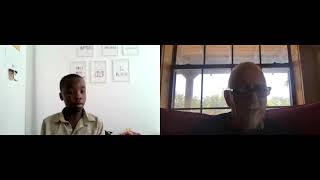
Sankara, a child, works through what science actually is with a facilitator's questions. She lands on the difference between studying something systematically and just experiencing it, and names space, atoms, dark matter, and anatomy as the weird, fascinating parts that hook her.
Chapters
Okay, okay, well, I thought we'd go ahead and start now since it looks like they can't join us this time. Um, so I want to go to a topic. I want to know, what is science? What do you think science is?
It's science that scientists use.
Okay, science is what scientists use. Um, and where does science come from?
Science is basically the understanding of stuff.
Okay, so if you understand a sentence in English, are you doing science?
Yes, because if you were like from Nigeria and you— I mean Um, if you're like from China and you're first learning it, it's kind of like science.
I see. Okay. Um, that actually makes some sense to me. Uh, how about if you, uh, understand how to bake a cake? Is that science?
Yes, because you have to work out how much baking soda and stuff, and people use baking soda a lot. I mean Yeah.
Okay, so, um, is basically everything science then?
No.
So what are some examples of things that are not science?
Actually, yeah, everything's science.
Everything's science. Um, so, uh, music, if you're listening to a song, that's science?
No.
Okay, um, so some things are science and some things are not.
It's just— I was thinking—
sorry, go ahead.
I was thinking about stuff like space because, yeah, everything in space is science.
Okay, everything in space is science. Does that mean if you're living on Mars and you're having lunch, that having lunch is science?
Um, except you living on Mars, I meant like everything in outer space once you're outside a planet.
So suppose you are, um, in a spaceship going through outer space and you're eating lunch. Is eating lunch science?
No. You have to actually be out there without a spacesuit to eat. I mean, we have to actually be outside in space.
I see.
Without anything surrounding you besides the spacesuit.
I see. How about the study of plants? Is the study of plants science?
Yeah.
Is eating plants science?
No.
So why, what makes the study of plant science but the eating of plants not science?
Because the study of plants is basically, um, looking at its genetic code and eating plants is just your everyday life, like you're eating a bag of cheese and onion crisps.
Okay. How about magic? Is magic science?
Depends.
When is magic science and when is it not science?
If they're like studying, um, the, um, Celtic, they had a belief that was— I'm thinking about archaeologists now. Um, is archaeologist taking archaeologists a scientist?
Well, that's a good question. Archaeologists typically study, like, ancient ruins and things like that. And so suppose you are discovering an ancient ruin, like an ancient pyramid or something like that. Do you think that should be considered science?
Mm. I didn't understand. Can you repeat it again?
So an archaeologist is typically someone who studies ancient, ancient ruins, for instance, like a pyramid. And so suppose you are discovering ancient pyramids and you're digging them up and things like that. Does that make you a scientist?
Yes.
Why?
Because you're an archaeology— archaeologist.
Archaeologist.
I mean, no, I'm trying to think. I've heard of the word before. Archaeology. Something archaeology, something scientist.
Okay, so let's jump, let's jump to memorizing. Do you ever memorize stuff for a test like at school?
Sometimes, yeah.
Would you say when you're memorizing things, is that science?
Depends.
Why? When is it science and when is it not science?
It's science when it's about science, and it's not science when it's not about— Actually, it is science because it's studying your brain and how you remember things.
I see. So if you pay attention to how you remember, then it's science, or if you're memorizing stuff about science, then it's science?
Both.
Okay. Um, and do you like science?
I love science.
Why do you love science?
Science.
Why?
Science is fun.
Is it? Is that the only reason you love it?
Science is very, is very weird.
Weird. Okay, so number one reason you like it is it's fun. Number two reason is it's weird. Any other reasons to like science?
Because space is science.
Space is science. So if all of a sudden space was not science, then you would not like it anymore?
I wouldn't like that. I wouldn't— right, yeah, I wouldn't like that kind of thing.
Okay. Um, do you like— if so, if we decide archaeology is science, then are you going to like archaeology?
No.
So it sounds like— do you like science, or do you only like certain kinds of science?
I like certain kinds of science.
Got it. Beyond space, what are some other kinds of science you like?
Atom science.
Atom science.
Matter science. Dark matter.
Give me some more examples.
Um, Paraphrasing science, I mean anatomy.
Anatomy, you're interested in anatomy?
Yeah.
Why?
Because it's the study of humans' body or body of a random animal.
Got it. Well, I think science is wonderful as well. I'm delighted that you like science so well. And exactly what science is is an interesting, complicated sort of topic. So we'll probably read things on that at some point in the future so we can get a really, really clear understanding of what science is. And I do encourage you to see if there's some videos on people who've swum the English Channel. I think you will be amazed what it takes to swim the English Channel. It's a pretty incredible thing. So I want to keep these short. So it's great to reconnect. It's been a little while. And I hope to see you next week. Sound good, Sankara?