Socratic educator Michael Strong with five year old Alana
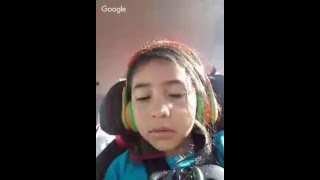
Michael Strong asks five-year-old Alana about space and planets. She thinks the Sun and Moon are the same size, confuses planets with plants, and believes spiders and humans are equally intelligent. He gently probes her ideas about telescopes, heat, and distances to reveal what she actually understands.
Chapters
Hello, Mr. Strong.
How are you?
Great, how are you?
I'm great. I hear you're going to the beach.
I am.
Is that fun? Will it be fun to go to the beach?
Yes.
Somehow I imagine that you really, really love going to the beach. Am I right?
Yes.
Okay, good. So your dad told me that you studied the solar system this week, is that right?
Yes.
So tell me what the solar system is. What does that mean?
So like, it's space but a bunch of planets in there.
And what is a planet?
A planet?
Yeah, is it like a plant?
Not a planet.
So what's the difference between a plant and a planet?
It's because plants are in Earth instead of space and in other planets.
So a planet is in space, and tell me what space is.
It's our solar system.
Okay, where can I find it? If I want to go look at it, where do I find it?
Up in the sky.
So I look up in the sky and I see— let's see, right now there are clouds.
And no, with a telescope.
Oh, okay. So if I look in the sky with a telescope, do I see our solar system then?
Yes.
How?
Because the telescope helps you You see better and closer up high.
So have you seen the solar system through a telescope?
No, not yet.
I see. And is the Sun part of our solar system?
Yes.
I imagine, you know, you're not supposed to look at the Sun, but you can see the Sun if you don't look directly at it, right?
Yeah.
And how about the Moon?
The moon. We see it at night.
So which do you think is bigger, the sun or the moon?
Sun.
How do you know?
Because the sun is the biggest planet in the— it's the biggest planet in the whole universe.
But sometimes the moon looks bigger to me. Am I just wrong, or does the moon show up different for me?
Well, Sometimes the moon looks bigger because the sun is so big.
That confuses me. The moon looks bigger because the sun is so big?
Or it's just because at night I think we only see the moon is, is bigger in space, but I guess the Moon and the Sun are the biggest planets.
So they're both— you think they might be about the same size? So what other planets are there beyond the Moon and the Sun?
Excuse me?
What other planets are there other than the Moon and the Sun?
Smaller?
Are there any other planets, or are those the only planets?
There are, like Jupiter.
And have you ever seen Jupiter? And have you seen Jupiter?
No.
How do you know it's there? Maybe, maybe it's not really there and people are just telling you stories.
Jupiter is there. It's one of the planets.
How do you know? How do you know?
Because I saw astronauts in space a lot, and I think I've seen Jupiter there.
I see, like on TV or something?
Yeah.
Okay. So how far away is the Moon? Is the Moon close or far away?
Far, far away.
Do you think airplanes can go there?
Nope, only rocket ships, but rocket ships are a type of airplane.
I see. And can human beings go in rocket ships to the Moon?
Excuse me?
Can a human being go in a rocket ship to the moon?
Yes.
Would you like to go to the moon?
Yeah, but when I grow up.
Okay. How about the sun? Could human beings go to the sun in a rocket ship?
Excuse me?
Could a human being go to the sun in a rocket ship?
No.
Why not?
The sun is too hot.
How do you know the sun is hot?
It'll maybe burn you. It'll maybe burn you down.
How do you know that the Sun is hot?
Because it's like hotter than the core of our planet.
Well, maybe so, but how can you— how do you know? We can't touch it, right? If we can't touch it, how do we—
cannot even touch it.
But how do we know if it's hot if we can't touch it?
Because it's hot. As the sun that's shining in my, in my island right now.
So you're thinking because it's very bright, because it's bright, therefore it's hot?
Yes.
Okay. How about the moon? Do you think the moon is very hot?
The moon is very hard—
hot. Do you think the moon is hot?
Repeat to me.
Do you think the Moon is hot like the Sun is hot? Are both of them hot?
So you mean the Sun, if it's facing the Moon, the Moon can get hotter?
Or maybe the Moon itself is hot. How do you know? What if— do you think that maybe you'd burn if you landed on the Moon? You said the Sun is hot. Maybe the Moon is hot too.
Maybe, but I guess the Sun can burn it.
So you think the sun maybe gets the moon warm?
Excuse me?
You think the sun makes the moon warm?
Yes, I think.
Okay, okay. Um, and do you think that a place like Jupiter is closer to Earth or farther away from Earth?
Farther away.
Why do you think that?
Because some of the planets are far away from Earth.
How do you know? Maybe, maybe there's a secret planet that's close. How do you know the planets are far away?
Because there are no secret Planets.
Okay, so why do you think that they have kids study the solar system? Why did they teach you about the solar system at school?
Excuse me?
Why did they teach you about the solar system at school?
So that we can— I can tell I teach everybody else what the solar system is, and even kids that are 3 or 4.
So the reason that they teach you is so that you can go out and teach other people?
Yes.
What would we do without all these educated 5-year-olds telling us about the solar system? People like me wouldn't understand it.
Excuse me?
What would we do without educated 5-year-olds telling us about the Solar System?
A 5-year-old?
Aren't you a 5-year-old?
Yeah.
And you said that they teach you about it so you can tell other people, right?
Yeah.
So that makes me think that you are supposed to tell everybody about the Solar System, because that's why they taught you, right?
Yes, that's right.
Okay, um, what else did you do this week that was interesting?
I went surfing, like I am right now.
Wow, you not only go to the beach, but you go surfing?
Yes.
Do you surf alone on a surfboard, or do you surf with your mom or dad?
I surf with my dad.
And you paddle out there, and you crawl on the board, and then both of you Come back on the board?
No. Well, I cannot go by myself right now.
Really? You paddle out there, get on a board, and then you ride a wave all by yourself?
No.
What do you do?
My dad comes with me.
Does he get on the board with you?
Well, he doesn't ride the wave with me.
He just sets you up? He helps you get set up on the board?
Yeah, and he pulls me in.
Oh, okay, but you can stand on the board and balance all by yourself? No. So how do you stand? Do you sit on the board?
I lay down on my belly on the board.
Oh, okay, that's probably safest and best. That makes sense. So surfing and the solar system. Anything else this week?
Well, and I'm going to school.
Tell me about school.
Okay, so I, I told you some of the things that I learned about spiders.
Yes. What else did you learn? No, maybe I don't know what we can talk about Well, yeah, we talked about spiders making webs and things like that. I think it's amazing that spiders can make those webs. Do you think spiders design the webs in advance? Do you think the spiders have the web all figured out before they make it?
They make it.
Do they know how to— how do spiders know how to make it? Did they go to web-making school?
No.
So who teaches a spider how to make a spider web?
No one. It's just, they just know how.
Doesn't that seem funny? I mean, I don't know how to make a web. Why do they get to know how to make a web and I don't know how to make a web?
I don't know.
Do you think it's funny that spiders know how to make such fancy webs?
Yes.
Okay. Well, I think the world is pretty interesting. I wonder about these things. Don't you wonder about how it is that spiders can figure out webs?
Yes.
What if you tried to make a web? Do you think that you could make a web that is as good as a spider web?
No.
But aren't they— are you think spiders are smarter than you, or are you smarter than spiders?
We're smarter than spiders.
Why is it that they can make webs and we— you can't?
Uh, we're both smart.
You think you're equally smart? Spiders are just as smart as you?
Yes.
Okay. I am— I think that you guys are well on your way to the beach. Is your dad right there? Yes. Okay.
He's in front of me.
Okay, so can he hear us? Or he probably can't hear you. He can't hear me because you're with the headphones on, right?
Yeah, I do.
I'm going to explain for him and for other people who may be watching that I am trying to connect your thoughts and your experience to how you understand the world. So I'm interested in how you, Alana, think about the sun and the moon and how you, Alana, think about spiders and intelligence, because I want to know how you understand the world. Does that make sense?
Yes.
So when you think— and I want— I like it when you think about how the world works, because according to Alana, the sun and the moon are about the same size, right?
Yes.
And spiders and people are about equally intelligent, is that right? Yes. And you might change your mind too. I think it's okay to change our minds, don't you think? What causes you to change your mind about things?
Sometimes you think things that you like, and sometimes you just change your mind.
About things you like? Yeah.
Or things you're doing.
Or things you're doing? How about, what would make you change your mind about whether the sun and the moon are the same size?
Whether the sun or the moon?
So suppose I said, what if the Sun is bigger but it's farther away?
The Sun is pretty close to Earth.
You think the Sun is just as close as the Moon is?
No.
Do you think the Sun is closer or the Moon is closer?
Sun is closer.
Okay. Okay, well, how can you tell what's closer? Is there a way to tell if the Sun or the Moon is closer?
No, but you can look through a telescope.
Well, you know never to look through a telescope at the Sun, you know that, right? Because it would burn your eyes. Yeah. So we have to over time figure out how we can use telescopes to figure out things about the solar system? Because it sounds like you know that somehow we can use telescopes to figure out things about the solar system. But right now, have you ever even looked at a telescope?
No.
Okay, so right now you don't have personal experience of a telescope, right?
Yeah.
Okay, well, at some point when you do get personal experience of a telescope, let's see if we can figure out how we can learn about the solar system once we have a telescope, okay? And then we'll have Alana's theory of the solar system.
Okay.
Sound good?
Yes.
Okay, in which case, I'm going to let you have a wonderful day surfing, and we'll see you next week, okay?
See you next week.
Okay, bye-bye.






