DAO structuring and quadratic voting (Jordan Topoleski, founder Arkive)
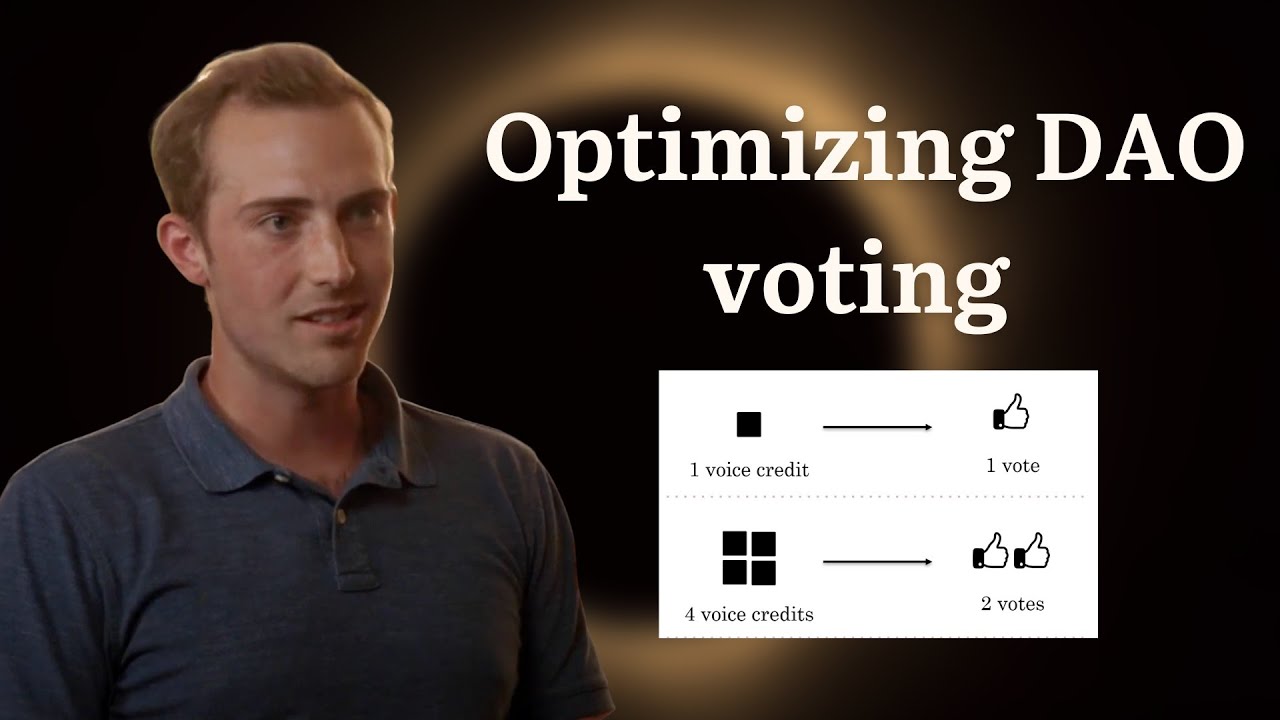
Jordan Topoleski describes how Archive, an art-focused DAO, moved beyond simple token voting to quadratic voting and specialized guilds so members could vote based on expertise rather than just financial stake. The goal is to keep the community aligned without early financialization destroying what they're building.
Chapters
Can we get away from the mean? So is there a way to engineer a crowd that can sort of break out from the, from the sort of averaging out, or if crowds are bound to end up with the average, can we engineer a way in which we do enable some specific aspects of the crowd's brains to arise?
Yeah. Yeah. Very good question. I think, you know, I think this is, maybe sometimes what we've seen with the downfall of direct democracy and the reason we've kind of gone to systems that have added more nuance. It's a little bit of a question in my mind that comes down to how you're allowing pathways to contribution. And maybe in a conversation, something that you've thought a lot more about than I have, you're probably more qualified to talk about it. If you're an expert in a certain field, you probably deserve to have a little bit more weight. I think a lot of the focus that we have at Archive is trying to think through this and say, hey, you know, when it's the contemporary art round, the person that's a contemporary artist or someone that's a contemporary art gallerist, you know, might have an opinion on it that's a lot stronger than other people. So when we even think about voting on works, we're kind of shifting to this system of delegation where you have a set amount of points, say 1,000 points, that you can choose to allocate over the entire season. So instead of just saying, oh, it's one vote, yes or no, you can choose to allocate, ah, like this one, Ah, 400 points, you know, and it's 40% of my vote for the whole season. But I really care about participation in this one because I'm either very knowledgeable about it or because this work means a lot to me and I want to be center stage in telling the story of this work.
So that system sort of embeds the depth of connection that you have. And really, you know, you really believe in something specifically. And so you need to allocate all of your— do the votes get more expensive the more I allocate on one candidate? In the sense that I know there is a system in which every single vote, if you vote for every single candidate, you have just enough number of votes. But then if you allocate all of them, they become slightly less powerful. And so do you have any sort of linear—
Yeah, like even quadratic voting where it's like first vote is 1, second vote is 2, third vote is 4. No, but I think we're really open to being experimental with our community and trying to think about what is the way that we can get to the best decision being made. And we're at this super primitive stage in all these organizations right now where, you know, with a lot of DAOs and a lot of Web3 organizations, it's one token is one vote. To the end of the day, what that means is the person—
So basic.
The person with the most amount of money is the person that— look at these votes, it's 5 to 10% participation, a lot of them. A lot of times it's 3 or 4 people that are the majority token holders, a VC that's delegating their— no shade, no shade— a VC that's delegating their token vote to maybe a blockchain organization, it's someone on the founding team, and it's a bag holder that's overly financially incentivized. For us, it's saying, how do we abstract away some of this financialization? In fact, this is the reason we actually chose to go out and raise venture money early on, because there's one way in running these organizations that's introducing this financialization directly away, saying, the first thing we're going to go out and do is sell a token, sell NFTs. A lot of projects have done that. You can bring in $5 million, $10 million, whatever it is.
Yeah.
Kind of a cash grab. And now you're in this system where everything is financially motivated because that's the first thing that you did. What we said is the reason we want to go out and raise money is because we really need to set the stage for what Archive is going to be. And Archive is an institution at the end of the day. For it to be able to have a lot of longevity, we need to really be able to set the tone, really be focused, really have a concerted effort around Setting the barriers, setting the tone of what wants to be done here and build it out in a correct way so that the core team itself can slowly move out and have those rails in place for the community to be able to carry this on for hundreds of years and beyond. And I think introducing financialization has been a really tough move, oftentimes in a negative way for projects early on because it kind of flywheels out of control. No, no, no.
Absolutely. It makes total sense. And I'm so interested to see the correlation that you're going to create between the type of curation and voting of the members and the art that actually comes out. So what art pieces are bound to what systems and why? I think that's going to be really interesting to see. I'm not sure if you're ever going to be able to draw any sort of connection, but I think so. I think we will.
I think we will. seen little interesting examples in the way we've been doing it early on is very 1.0. For our first few acquisition rounds, we just went out and these works were presented and community members could say, I vote for option A, I vote for option B, I vote for option C. And it's 3 options, you have 1 vote and it's done.
Very basic.
As we start to expand, see people say, oh, I think it was our second week, a member reached out and said, hey, these 3 works are great, but I want to abstain. I feel like I'm not the right person to be commenting on this. Like, huh, super interesting. They still wanted to say, hey, I'm an active member, I'm still super participating. But I'm abstaining. But on this round, I don't want to vote. I very much engaged with the materials, I read everything, I tuned into the calls of the community, I thought about this deeply. At the end of the day, I said, you know, I actually don't feel like that. Or it's even different. Some members say, hey, of these 3 works, I don't feel like we should acquire any of the 3. I feel like this is one where I want to not just abstain, I just don't want to vote for any of them. I want to pass on this round. And as we continue to grow, we have to build out a system that allows all these variables to come into play. And that's kind of what makes us so crazy in this Web3 world is once it's out there, it's out there and it's a running system.
And you are going to build all of these different systems one way or another in the sense that you think Archive itself is going to fork all these sort of different curated communities that have different rules for selecting the art pieces. And anybody can subscribe to whatever they subscribe to in the sense that I think that the art pieces that we select should be decided by highly experienced people that have done specific things in their life. And so you're gonna curate the curators themselves through that. And then other, someone else wants actually pure democracies, like everybody's got one vote, which doesn't necessarily end up being the best outcome always, but maybe the most interesting one. For instance, I think there is a funny event that happened. I have a very blurred memory, but I know they— What was it? They kind of needed to decide the name of a boat. I think it was like the Royal Boaty McBoatface.
There you go.
And so if you let everybody come up with names, and then which one is the winning name, the absurd one that everybody's like, ah, it's gotta be that one.
It's funny you bring that up. I think we sometimes joke in our community archive that we've messed up if we end up acquiring Boaty McBoatface into the community, partially as a joke. But I think, you know, I think, I think there's maybe actually a little bit different of a way we look at it, which is it's our goal to find and experiment to the systems that work best. So it's, you know, obviously we still want to have the system at the end of the day. And if we could jump to the final stage where we have the voting system that we feel like as a community is working in the very best way, we want to get there. You know, we don't need to mess around with systems that we feel like aren't accurately representing what our membership wants. What we do do, however, though, is I think graduate to this model where we start to form guilds. I think what guilds look like is something that's a specific way for you to be involved with Archive. So right now you're a member of Archive. There's different themes that come about. You know, one was music television, one was focused on, you know, INIAC patent and historical documents, one was focused on video works, one on design and architecture, for example. Right now you're voting in all of these. In the future, you might say, hey, I'm going to join Archive and I'm going to join Archive in the Watches Guild.
Ah.
I love watches. You know, the rest of the stuff, I love being around. I love seeing the conversation, but I just want to be a voting member of Archive. for the Watch Guild and specifically involved with that one. So we start to allow all these pathways of introduction for people that might have these specific interests, still want to be exposed to everything else, both in terms of the people that are around and in terms of a collection building strategy, but their contribution is going to be a little bit more focused on where they feel their expertise is. I think starting to allow these little modal pieces to build out starts to build this honestly complex organism itself that's kind of exploring all these different directions.
Love it.
Can we have the VC archive? No, I'm joking. It's the last thing you should do.
But quick one. No, it's actually not a quick one. I think it could be a hard one. But tell me.
Uh-oh.
What I'm thinking is you're saying that you're going to be experimenting with different types of voting systems so that you can figure out which one the best way is, right? And the question is, how do you know when you've found it? How do you measure the outcome of a selection process?
Very good question. I think the answer is simple. The answer is when the community collectively feels like it's the best pathway for choosing the right items. And I think I say this to people a lot. I say everything we do at Archive right now is an experiment. The whole project is an experiment. And what we need to do is make sure that as a community, we're supporting the community itself, that the members are feeling like this is an accurate process for representing the collective interests, which why, again, to go back to this original point we were talking about, potentially forking off at some point is very important because people that are in the Watch Guild, for example, and people that are in the Contemporary Art Guild might have very different opinions of what should be brought into the collection. We have to make sure these different models all at the same time— by we, I mean the community. This is eventually an organization where it's just a group of people all doing this together, and it's me as someone who's on the core team right now, participating just alongside— Hopefully someone like you who ends up becoming a member and participating member of the community.
So I love how opinionated you are in the sense that you totally accept the fact that Archive may be a success for the members, but may also be seen as a massive failure for non-members. It's like, oh, they select absolute shitty artworks. And you're like, yes, but in our definition, these are a fantastic phenomenon, and that would define a success.
Interesting. So I think it's our job at Archive to make sure that our membership continues to be representative of the best group of people that are there to tell these stories, acquire works from the collection, et cetera.
Mm-hmm.
So a lot of the job and a lot of the system that the community and the core team is really focused on right now is how do we make sure we have a system with longevity that makes sure we can both add new members in that have phenomenal perspectives in making these decisions, and also how do you prune the membership sometimes. So if someone is saying, hey, I no longer am able to be an active member, or hey, I'm not participating in a way that's productive to the community, there's also ways for people to roll out. And I think that's actually something that's super interesting in Web3 right now. It's allowing people to now have this exit to the market almost in a way.
Totally. Which is something that we haven't thought about. Everybody's engineering system.
Yeah, onboard, onboard.
What about offboard? What about someone's contribution to a DAO is done?
Say like this, say you're a member of a country club right now and You're 9 months in, you're like, I don't get a lot of value out of the country club.
It's like—
You're not getting your money back. It's like, hey, man, we enjoyed having you here, Michelangelo, but we'll see you later. That's this really interesting thing. You're actually voting in a way your confidence in the project as a member. So if you say all of a sudden, hey, I no longer am getting a lot of value to this organization, you now go out to the market and you sell your membership for whatever the market price is for it. You're literally voting with your membership by actively choosing to stay there. And you always have exit liquidity to be able to sell this to someone else if you don't feel like this is a place you belong. So this is a really interesting metric that I think talking to other operators in the DAO and the Web3 space are really thinking about is this metric of how many people are flipping, quote unquote, the membership or how many are listed for sale. For example, you can go look at it on OpenSea. It becomes this interesting metric of thinking about how tightly aligned and people are tied to the community.
Interesting.
10,000 memberships and only one is listed for sale or one is sold in the past month, you must say, wow, there's this very interesting mechanism where people feel like despite there being offers out there for maybe tens of thousands of dollars for their membership to have access to this community, to have access to voting power, I still feel like staying there. Probably a pretty good success metric for engagement.
Yeah, but at the same time, the more you grow, the more Archive is going to evolve. And so you're not always going to be able to accommodate everyone. So you should actually hope for some members to—
We need that.
Because otherwise it's just stagnating.
No. I agree. I agree. There needs to be an out system. And that's why it's so interesting. No one's forced to be here, and there's not always such a high level of sunken cost of being there. If you want out, you feel like this is no longer a community for you, it means we as a community need to make sure that's not happening for bad reasons. But that naturally happens.
Right.
I think you have to think every year there's probably a certain percentage of people that say, hey, I no longer have the time for this. Hey, my interests have changed, and I feel like I no longer want to be actively participating in these votes. There naturally needs to be a level for kind of circling the community. And we as a team and as an organization really need to think about creating those pathways out just as strongly as we create the pathways in and allowing there to be that continual rotation. So the best of the best are basically always there and have the infrastructure to attract them and have them be contributing members long-term.
And then offboarding them as well when the time is ready because, yeah, you don't want them to stay there when they want to offboard and just out of complexity, they're not onboarding, or maybe because the price is high and they want to wait until they speculate. And they're like, I don't— which is why engineering, like, adding the financial layer is like, it's quite tricky. You gotta think it well because you create incentives whether you like it or not. Uh, and if your incentives are not aligned with the community members' incentives, all of a sudden you create a system.
Yeah. So there's this big discussion right now of like utility in, in Web3 communities, and I think it's interesting because There's 2 ways you can look at someone choosing to hold their membership. One way is saying, I'm holding this membership because I think it's going to appreciate in value. It's not because you're seeing utility, it's because you see financial returns of holding this as an investment asset. I think we really are trying to find ways that we can avoid that at Archive and make sure if people want to sell or want to hold for speculative reasons, we can actually think about enforcing mechanisms for trying to make that not happen. On the other hand, what you do want is people continuing to hold because they say, wow, even though on the market someone's offering me $5,000 to buy my membership in, I perceive more than $5,000 of value because every year I have access to events, to cultural conversations, to voting and selecting and allocating millions of dollars to be able to actually acquire works into the collection. And that's the metric we're competing against, is saying, Are people holding membership in Archive because they really feel like they're getting that value out of it and they say, oh, of course, I'd never sell it for $5,000. This is really valuable to me. And I think the whole Web3 space is just kind of trying to come to ground and saying, when financial incentives are introduced like this, it's really hard to tell the root cause of why someone is selling something. Is it speculators? Is it flippers? Or is it people that are maybe exiting the community in a more graceful way because they feel like, oh, if someone's like, hey, I literally started a new job, I don't have as much time to do this anymore. Perfectly valid reason. And it's how do we create the right collection, the right curation mechanisms in a way to say natural filtering out and bringing people in that are going to be there for the long term or mission aligned. And how do we too, as a community and organization, provide real utility?










