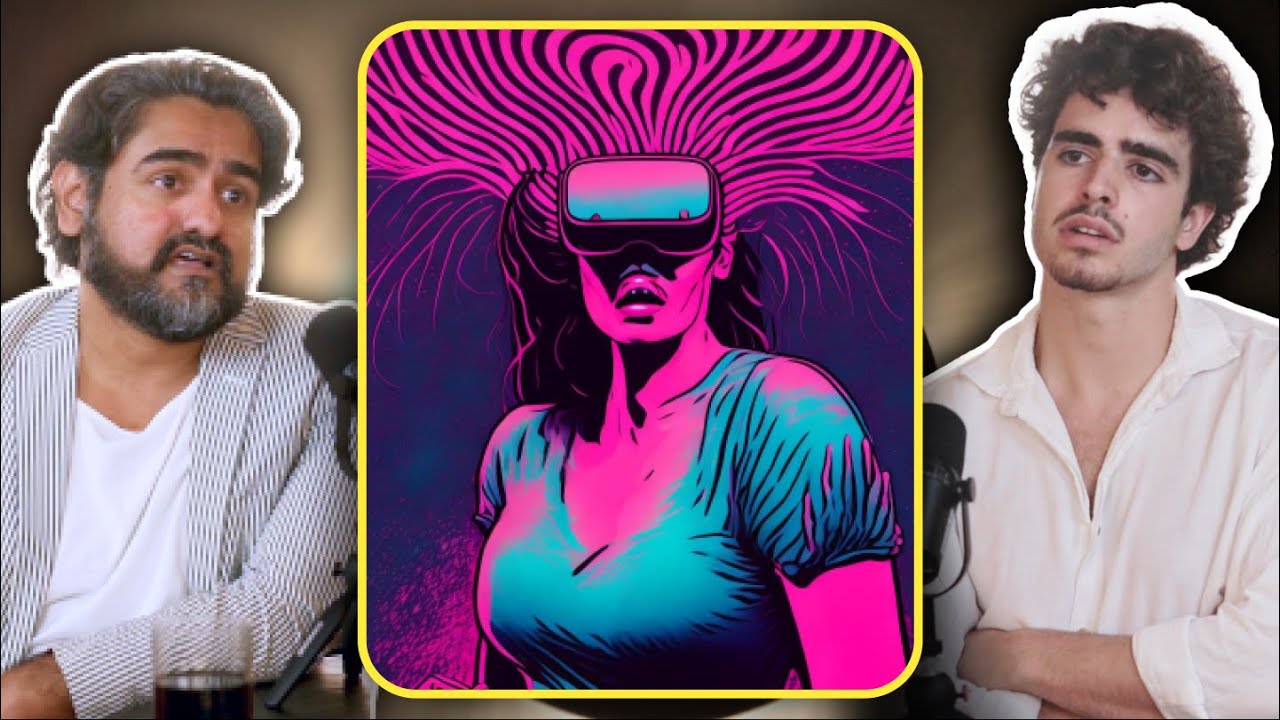
Two people debate whether the next internet will be 3D and spatial. One argues we're already seeing it with Roblox and Minecraft, where Gen Z spends time in immersive environments. The other questions why we'd copy today's social and economic structures into a virtual world, and whether 3D is actually the answer.
But why do we need to support these skilled experiences without the limits when it comes to— so what kind of social structure will we want to replicate in the virtual world? What kind of economical structure? Why do we need to transport it into the virtual world in the first place? Why do we have this need?
So, yeah, that's a great question. And I think you're kind of leading on a fairly controversial word today, like the metaverse. What does it mean? And everyone's talking about it. So there we're moving from games to not only games. I think games are an important part of this shift in what we call the metaverse. But let's talk about that for a second, right? So the metaverse is really about, we've come from a world where the web is 2-dimensional, right? But we've also come from a world where the web is very centralized. If we look at the first wave of the web, it was actually increasingly decentralized because people people were running servers all around the world. Web 1.0 was more decentralized, but it was less functional. And Web 2.0 was about ISPs, well, service providers, cloud providers, data center providers providing this capability. The next shift is about moving from flat web to moving to things that are much more intuitive because the web, we've learned how to live with it. Right? But it's not immediately intuitive. People had to learn, and they've done a good job. But what is intuitive to humans is the spatial experiences and the spatial connections. And we've already seen this with games today. Gen Z, they're a 3D-first generation, and they're growing up with these 3D spatial experiences as being the primary experience in games like Roblox and Minecraft.
Right.
And that's evolving into What do the future social networks look like? What does collaboration and coworking look like in the future, right? How do we actually make problem solving more intuitive? If I can visualize proteins and their interactions, maybe I can understand how they fold in an intuitive way that I won't today just by looking at equations and diagrams on a flat screen or page.
So the claim is that we've limited our ability to represent, I mean, we haven't really cracked way to represent our ways of interaction, the interface that we've utilized to interact with each other on the internet and with the internet itself has been very lacking. Sort of mouse, computer, a 2D screen, and then these social media that are text-based or image-based. They're not immersive. Would immersive be the keyword here, or is it something else?
I think immersion is a part of it. But that said, you don't always want to increase immersion. That's also a thing, right? Sometimes it's better to have— like, if If you look back at, say, the '70s, we thought that we'd be talking to everyone on our watches with a face on it. But that's actually not the best way to communicate with someone. You often just want to send a text message. But there are instances where you do want to immerse yourself. So certainly, immersion is a part of it. But the other side of things is, what's intuitive? The problem with flat interfaces is we've learned to work with them, but they're not intrinsically intuitive.