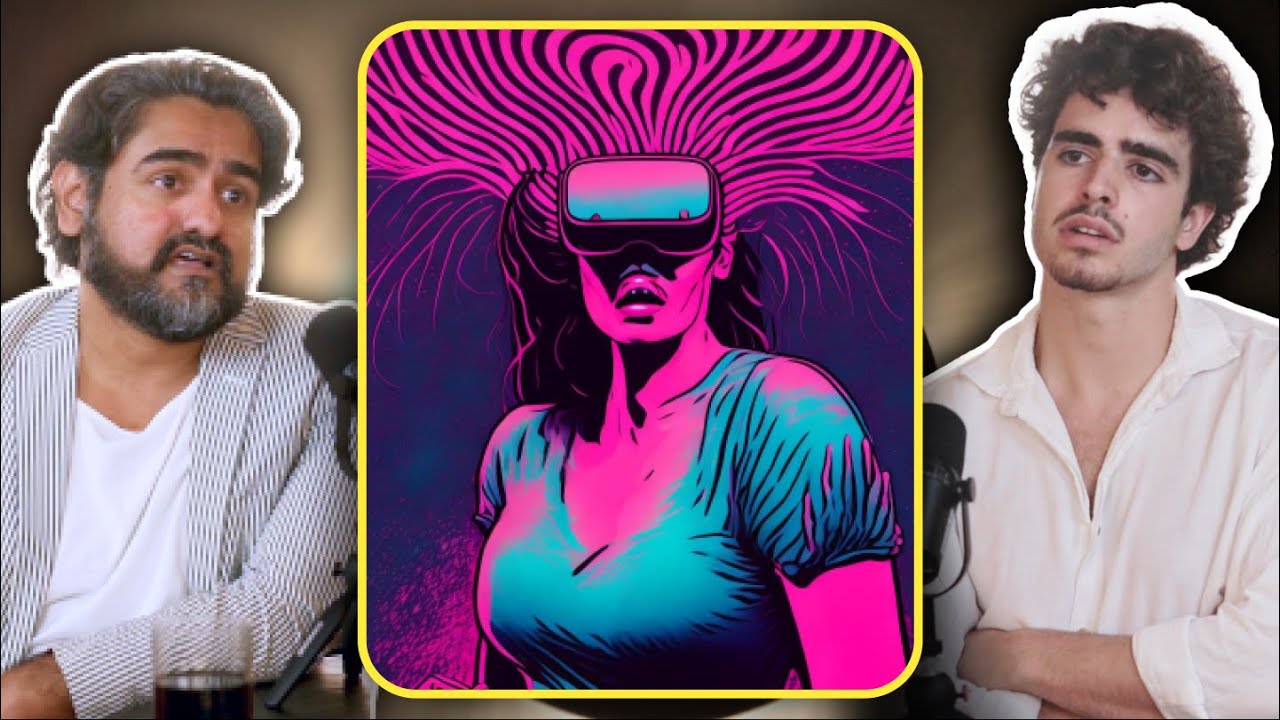
Rashid Mansoor argues that moving human activity into virtual worlds isn't escapism but a path to massive efficiency gains, potentially boosting civilization by orders of magnitude. He sees VR as humanity's most critical frontier, capable of solving problems the physical world cannot.
I think in, in a lot of the listeners' mind, probably a question is going through, and it's, is this sad or is it not sad? Because partially, like, is this idea that we find so meaning into virtual realities, is this idea something that should lead us to feel almost a bit awkward about the fact that we're escaping from our real life, or, or should it be enriching? Oh, look at the possibilities. How should we feel about this?
I'm definitely of the camp that thinks that this is an exciting new frontier and probably the most important frontier because there are many problems we will solve in this sphere that we can't in the physical world or won't in the timelines you're talking about. I actually think that this shift, and I gave a talk on this recently at the Royal Institution for Twin Global, there is a shift to the virtual sphere that's going to create for us an opportunity to improve the efficiency of our civilization by not 2x or 10x, 10x, but by much greater orders of magnitude, 100x, 1,000x, the upper bound being actually 100 quadrillion.
The efficiency. The efficiency. Why the efficiency?
And what I'm talking about here is today, our existence is very matter, costly in terms of matter. It's very matter intensive. And we are exploiting the environment, the planet, at a rate that is unchecked. There are no natural predators to humans. There are no natural checks and balances. And our base physical needs, that have been around for about 300,000 years as anatomically modern humans, those haven't really changed. But we've become so effective at taking ourselves outside of that equation that we can exploit matter and nature to serve our psychological needs to a very profound degree. That's not efficient at all. If we can shift those needs, because those needs don't necessarily need to be matter, if we can shift those needs to the digital realm, and that requires simulation scale, that requires these next-generation interfaces, That requires digital scarcity and decentralization to happen. But if you're able to do that, then we are moving from matter to pure energy as a means with which we satisfy the craving of mankind. And if we do that, the efficiency gain for pure energy is significantly greater than anything we can possibly achieve when we have to serve those needs with matter.