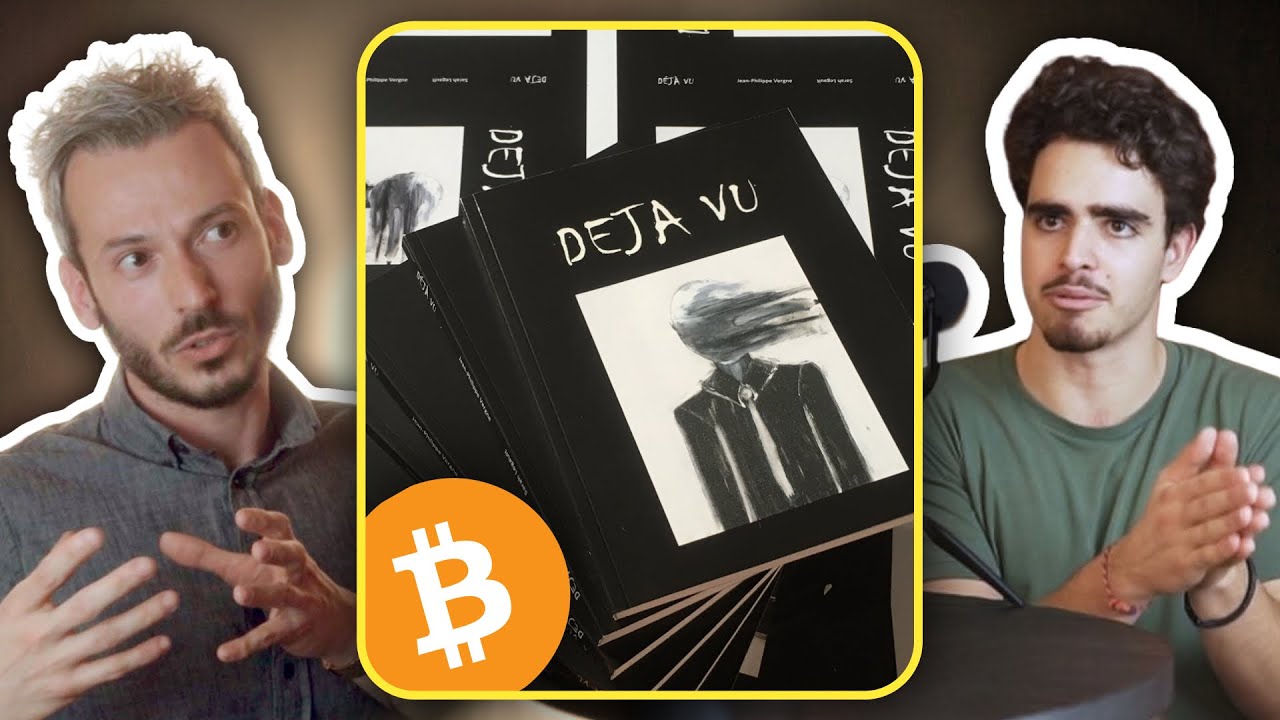
In this conversation, Michelangelo Valtancoli explains his experimental bilingual graphic novel, which tells the story of a corporation that develops a technology to edit people's memories. Two whistleblowing employees try to bring the corporation down. The printed book presents an edited narrative that differs between the French and English versions and ultimately tells a false ending. To create a provable "single source of truth," each chapter’s text was cryptographically hashed, and the hash was transformed into a Bitcoin public address. These addresses were then embedded in the Bitcoin blockchain via timestamped transactions in 2017, long before the term “NFT” was common. The blockchain records the original ordering and timing of the chapters, allowing anyone to verify the authentic content by checking the corresponding transaction. Because the addresses were derived from hashes, no private keys exist, making the tokens non‑transferable and permanently locked in the blockchain. The speakers discuss how this approach demonstrates immutable provenance, contrasts the unreliable printed narrative with the trustworthy blockchain record, and highlights the novel’s experimental use of Bitcoin as a source of truth.
Chapters
And so the book basically tells the— so it's written in French and also in English. And so you can read the story in 2 different languages and the story is told slightly differently depending on the language. But the story basically is about a corporation that comes up with a new technology that is a little bit scary because it enables the corporation to edit people's memories. And there are employees of the corporation who find this too scary and they're actually trying to take down the corporation. They're whistleblowers, if you wish. And so the, in a very experimental fashion, this graphic novel tells the story of these 2 people who are trying to take down that corporation. But the story itself has been edited, like the memory of the story itself has been edited. And the way the story happens, the way the chapters are ordered in the book, is telling one narrative, but there's another narrative that has been recorded in the Bitcoin blockchain by essentially creating a cryptographic hash of each chapter and recording that using the Bitcoin's timestamping capabilities in a different order. And so the book contains, we printed in the book the public addresses that were created for each of the book's chapter. And you can go to the Bitcoin blockchain and see Basically at what time exactly the events that are being described in each chapter actually happened. And if you can, you can put the pieces of the puzzle back together.
So the Bitcoin version is the original one, is the one that is supposed to be the source of truth.
Exactly. But that's not the one that's been printed in the book. So the book is basically a lie and the truth only lies in the Bitcoin blockchain. And there's a way to find that and to find it in a way that's provable because Each chapter is basically as its hash that's been converted to a public address.
And this story is like completely the opposite. Like, is it very different, I assume?
I don't wanna say too much. It's quite different. It's quite a different ending. But what we found interesting with this is basically playing with this idea of the single source of truth, as you suggested. Also playing with this idea of having this provable ordering of events, provable timing of things. where, you know, what you read cannot necessarily be trusted, but what's in the blockchain has kind of a different level of trust attached to it. But also, there's this idea of like creating a sort of weird NFT. I mean, the term was not really on our minds at the time. We did this in like 2017, but basically each Bitcoin address has a transaction that's been sent to it and the Bitcoin address itself. represents a hash of each chapter. So we can prove that, you know, the text that's in the PDF is actually the text that was written at a particular point in time, right?
Yeah.
But those addresses were, because they were created based on a hash, they don't have a private key to them. So each address basically contains a digital trace of each chapter in a way that's provable, but it's not transferable. Like, I cannot send anybody the Bitcoin transaction, like these unspent amounts, They're stuck there forever because I wanted to be able to choose exactly what public key I wanted to use so it matches the hash of the chapter. But of course, the downside of that is I cannot match the private key with it 'cause it hasn't been generated jointly. And so these are non-transferable tokens that are stuck in the blockchain forever, each representing one chapter in the book and the order in which the events happened.