3 Lead Generation Program | Geo-Frame | Digital Listening | Social Listening
In this webinar, a Spire North/American Spirit representative walks real‑estate professionals through three proprietary lead‑generation solutions designed for the COVID‑19 market. The first, Insight Real‑Time Geo New Home Shopper (geo‑framing), uses patented device‑level geolocation tied to MLS listings to identify in‑market home shoppers, enriches them with Experian‑derived income and demographic data, and serves targeted Facebook/Instagram ads offering a free home‑buying guide. The second, Digital Listening, captures users who type predefined real‑estate keywords into browsers (e.g., realtor.com, Zillow) and immediately emails them a series of custom HTML offers, with optional postal follow‑up. The third, Social Listening, leverages a proprietary Facebook algorithm to place ads before users whose on‑platform behavior indicates home‑search activity. For each program the presenter details data sources, targeting logic, ad delivery mechanics, pricing (monthly ad spend, per‑lead costs, partner cost‑share rates), and ROI case studies that demonstrate 19:1 returns for geo‑framing and substantial profit margins for digital listening. The session also outlines partnership models (individual agents, teams, branches, or whole companies) and provides contact information for follow‑up.
Okay, Ted, let's get started.
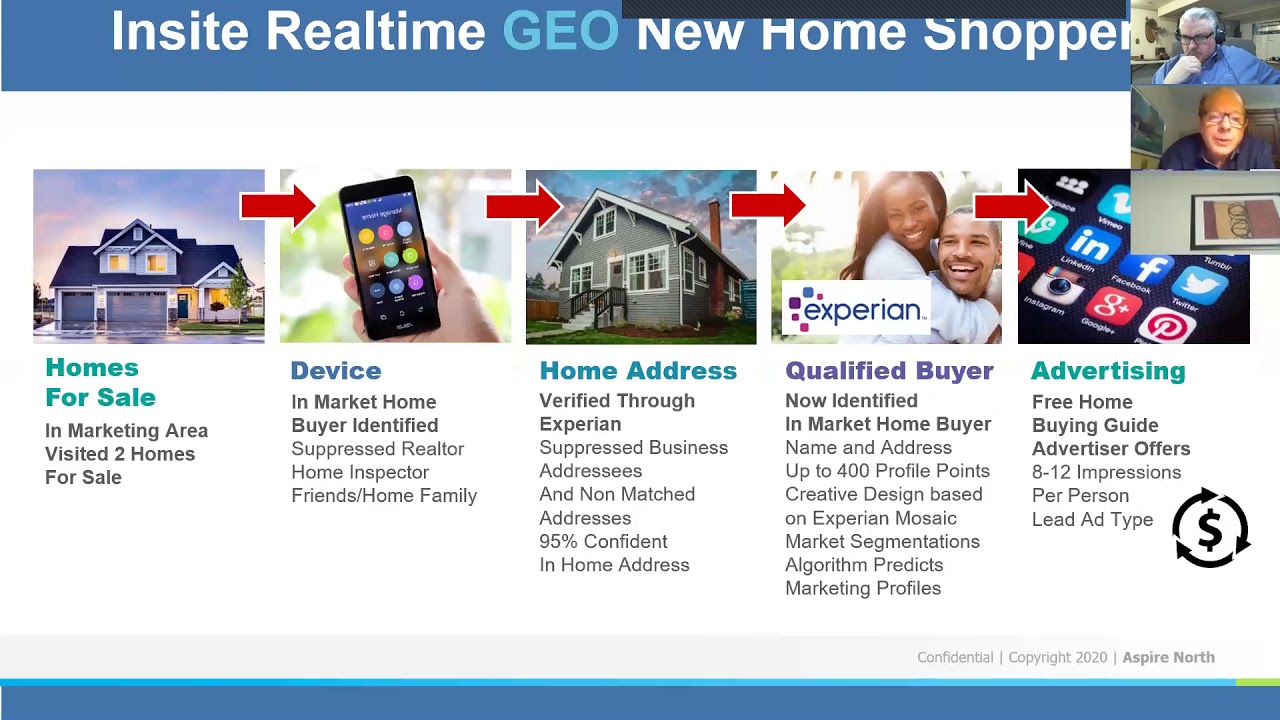
Good morning, everybody. Jay and Sue, thank you for taking the time. We'd like today to share, we think, our very promising and proven lead generation programs for people in the real estate business. We're, as you know, in a unique situation in our country with COVID-19. And just like buying a house, some people like traditional 2-stories, some people like ramblers, some people like beach homes. We've got 3 different solutions depending on what part of the country you're in and what you like to do. And one is called geo-framing, and another one is digital listening, and the third is social listening. So we're gonna go through each of these ideas and you'll probably have questions, which Mike will unmute periodically and we can answer those. And probably you wanna have a follow-up call afterwards. 'Cause these can be built around an individual realtor, a real estate team, a real estate branch, or the company overall. And if I could just get this thing to move. A little bit of— let me just get this out of the way. Spire North is a— we work with Mike Larkin, who's one of our channel partners, and we're a data technology analytics group based out of Eden Prairie, Minnesota. Our parent company is American Spirit. Our data team has at least 200+ years of experience. We have 350 employees, been in the printing business 40 years. So we're unique where we have print, data technology, analytics all under one roof. So certainly a really neat opportunity for marketing people like myself. We are considered a top 75 printer in the country. We house all of Experian's data and many other data sources within our company. It's not moving here today. There we go. I'm sorry. Our first idea is called Insight Real-Time Geo New Home Shopper. It's pretty neat technology. This is a patented program. And right now, certain parts of the country, you know, people are not going outside looking at open houses and so forth. Things hopefully will be opening up shortly. But there are parts of the country where open houses are being made. And our technology, it's assumed that your area, this could happen. As you probably worked open houses in the past or currently do it, and you meet people, consumers who don't, you know, are coming in, taking a peek. We call those people in-market. Now let's say, for example, in your area, there's— your marketing area, there's 100 zip codes. And we have all the MLS listings on Zillow, etc. Any home that's coming up for sale, we have in our system. It's automatically geo-framed. So what does geo-framing mean? Geofencing is off cell phone towers, so that's a very broad area. Here we have that particular home frame. We're able to identify The devices that are in that home. So we can tell the people who live there versus those who are coming in and visiting. It's pretty neat. Now, once we identify that device that it's in that home, we can match that back to the, to the device's home address. We have 95% of all devices in the United States. We know where they, where they live. Some people call that a little bit creepy, but it's pretty neat technology from a marketer standpoint. So when we see devices in that home, we differentiate those who live there versus visiting. We can eliminate maybe realtors coming in that house. We know the devices from home inspectors, and we all— we also know the devices of maybe friends visiting that home. And then we can distinguish the person who's coming in looking at that home because they've looked at at least 2 homes for sale. And that's who we're marketing to, is that individual. Now, why is that important to a realtor? You know, up to, I think it's, I don't know, up to 50% of the people looking at homes under $350,000 or more are not represented. So, if they're out there looking for a home, they're going to need somebody to help them find a home. That's why you do a lot of open houses, right? And you also know if they already own a home, They may need a realtor to help list them. So, there's 2 opportunities there for a realtor. And when you're looking at, you know, 14,000, you know, in a zip code of 100 people, there's statistically about 14,000 homes that'll be up for sale. And, or maybe, excuse me, about 5,000 to 7,000 homes up for sale. And we're able to identify 2 to 3 unique people per month coming into those individual homes. It's a pretty good— opportunity for a realtor to pick up a lot of buying and listing and customers. Now, just because we identify that device back to your home address, you know, we're 95% confident in that because we're doing this every day for, you know, hundreds of different applications, not just real estate. But we can also see the home values they're looking at. Maybe you want to look for buyers who are targeting $200,000 to $500,000 homes. Or $500,000 to $1 million or $1 million plus. We can— we see that also, and we will make sure that they're income qualified. And we know the incomes of people because we're an Experian partner, so we know a lot. We have actually 400 points of information about each individual consumer. So we can whittle those down. So if we're going to be advertising your business to these people, they're going to be hot. Highly qualified people. They're just not online doing some window shopping. They've taken the step to actually go in and visit 2 homes. Majority of the people don't have a realtor at this point. We also know that they're income qualified and we also know the home value range you want to target. Which online, places like Zillow, if you're buying leads on Zillow and Realtor.com and those sources, You can't get that tight and you don't know if they're really interested in looking at a home or not. It's a big difference from snooping around online because you can't really tell. Like, I'm online all the time looking at home values. I'm not in the market. So, this is a very highly qualified buyer. So, now that we have these people identified, what we're doing is we're going to put an ad in front of them on their Facebook, Instagram feed. And we've done this many times. And our offer is, you know, a free home buying guide. Is it, you know, buying a home? I'm not telling you as a realtor anything you already don't know. Consumers are not in the market that often to buy homes, so they're not experts. So if they can get a white paper on how to do this, they'll sign up for it. And let me show you how this works. Here's a case study. You know, besides, you know, this group today is about realtors. We run the same application for mortgage and people who are moving and a lot of other home services companies. So as you're thinking about this, you may have referral partners like a mortgage person, a personal insurance agent, a moving company. All these may want to be good partners for you in this program, or maybe you want to do it on yourself, on your own. But here's the ad we ran for Jersey Mortgage, and we're targeting people who are looking at new homes. And you see, this is an example of an ad through my Facebook feed on my desktop. And you see, you know, get a free home buying guide. And if I'm interested in that, I click on learn more, and that's going to go within my Facebook application. And there's a little form that pops up, and we've got some copy here, information, and this form is automatically filled out by Facebook. It pulls from my profile. Now, if something's incorrect there, I can change it, then I just hit submit. A pop-up page comes up, says thanks, you're all set, and we'll be in touch, whatever copy we want to build for you. Now, this lead automatically gets emailed to you. Now, if you have a CRM system, we can plug it into that, or it can come to you. Maybe there's a central person in the office or the company, etc. And this happens 24/7, 365. You're not waiting a week for this stuff, and we're not sharing these leads with any competitors. This is all— we're advertising, you know, your business. If you have a partner who's in the mortgage business, This lead can be passed on to them and they can cost share it. Same with their personal insurance or moving company and several others, because all these people would love to get in touch with these people who are planning on— they're out looking at homes because they may need services for their existing home and they may need services for their new home. You know, here's some examples of how it's worked. We have dozens of case studies. The impressions are the number of ads that people saw. The frequency is the number of times the average person saw the ad. The clicks are the number of people who clicked on the ad, and not everybody who clicks on the ad hits submit. This is the number of leads they received, and they're very, very pleased. That's why they kept on running this campaign. What's the investment? We have 2 parts to the cost. One is an advertising cost. It's basically a monthly advertising investment of $3,750. That covers that we designed that Facebook ad. There's 120,000 impressions. Again, an impression is the ad is seen by the person. And we're not teeing it all up so everybody sees the ad at 6 o'clock in the evening or whatever the time may be. The technology works so it knows when you're coming on your Facebook account, whether it's on whatever technology, and it puts the ad in front of you at that time. And we're targeting about 14,000 in-market home shoppers in the marketing area you want to go to. If you want to add partners, each additional partner, it's $250. Because we want to make sure that you're getting the leads and we automatically send the lead to the partner at the same time. Then the second part is, you know, this is a very low-cost advertising. Covers the advertising and the data. This is proprietary data. Nobody has this data available except for us. We're the only people in the United States who have every home in the United States framed and can And can advertise you to these people walking into that home. So you can think about this as sort of like a digital open house. We, we, we charge you per lead. 1 to 50 is $50, 51 to 250 is $40 each, and so forth. Now when you sign up, our first 30 days we only charge $20 per lead. So if you're, if you're doing this on your own, it's $20. If you bring in a mortgage person, you can split that so it's $10 apiece. If you have an insurance person and maybe a mover, divide that by 4 plus the mortgage, you're $5 apiece. It's a very, very low-cost way to be targeting your business to an in-market home shopper because you know they've taken the time They actually go into homes. So, they're further down the road in making a decision to buy. Now, if you're buying mailing lists right now, we do a lot of mailings for realtors. We don't know when we're mailing to the majority of those people if they're in market to look for a home or not. So, I call it spam mailing. So, we have taken this to the next generation. So, we're only putting you in front of people who visit and open up Could be an open house or a home at least twice. Again, we're putting your ad in front of somebody 10 to 15 times. The examples we've ran in earlier programs, the average frequency was around 1, 2 times, or 3 times they saw the ad. Here we're putting at least 10 to 15 ads in front of them. Now, this is a pretty heavy chart here. You know, how does this work, Ted? Does it make economic sense? You can read some of this data in here, direct mail, lead cost, all that stuff. You know it much better than I do. So, I'm just trying to get you— this is the best advertising program available because, you know, we're putting your name in front of people who have looked at 2 homes. And statistically, you know, 30-40% of these people are still not represented. The break-even is pretty— I'll go over and say, hey, let's say if 1% of the 14,000, you know, filled out that form, that's 140 leads. And, you know, my real estate friends tell me that, you know, if they get a lead, a personal lead from a friend, they close about 30% of those. So, I took 30 down to 10. So, I'm saying 10% of these leads, you know, they You can help them either buy a home or list a home that— or a combination. So the 140 leads, 14 became a customer. I took an average home of $300,000, and that commission is split where you're in the 3%, you don't get the full. And I know that varies in every situation. So that's $9,000 average commission. So, if you get 14 deals times $9,000, that's $126,000 in commission. Your advertising investment was $3,750. Your total lead cost would have been $2,800. That's based on the 140 times $20. So, you add up the $3,750 plus $2,800, you get to $6,550. That's your total. campaign cost. Your cost per sale, sold home, whether it's a listing or a buyer, is $467. Again, that's very inexpensive. You're earning $9,000 on average and investing $467 in marketing costs. That's a 19-to-1 ROI. And for my real estate friends we've shared this with, They generally raise their hand pretty fast because that's pretty conservative. Hey, it's like a worst-case scenario. Can you get— if you're marketing your business to 14,000 people, can you get one customer? I think that's a much higher probability of getting a customer on these 14,000 than doing any spam mailing, any ad in the newspaper, radio, or TV. Any other medium you've been using in the past, because these people are known to be in market. Much higher quality lead than any online real estate site too. Our second idea here is called digital listening. Some people may call this a little bit creepy. You know, we're not competing on page 1 of search. We're not doing SEO. Okay, you give us your marketing zip codes, and I'm gonna go off this PowerPoint real quick here, and you give us the keywords you want to target. And as soon as somebody puts that in their browser, I'm gonna be able to capture— say it's realtor.com, Zillow, you give me— this is an example of a nationwide over a 30-day period for our client here. We're able to capture— you put that realtor.com or zillow.com or homes.com, any of these keywords you give us, you put that in your browser, within 60 minutes I'm going to send that person an email from you with an offer, here's a free buying guide, etc. And so what we call this listening. I'm not gonna get too deep into how the technology works, but it's just like keywords for Google pay-per-click or SEO, except for bypassing that whole process. And you put that in your browser, I can— when you put that in your browser, I can attach that keyword to your email that you use most often. And within, you know, an hour, I'm going to send you an email on my real estate services because I know you're out there looking. And these are just examples nationwide for this client that we're, that we're doing. Now with an email, I can— about half the emails I can match back to a postal address. You could drop a mailing. We like to drop for sure through the email because we're going to a larger number and we can get you in front of them quicker, quicker. So I call this digital listening. Again, people are searching online for homes for sale. You determine the marketing area. The base program is up to 25,000 individual emails. That could be a week or two, or it could be over a couple months. Again, we sit down with you and discuss the keywords. We have a person in Florida that only wants to do beach homes, $1 million or more. Anybody searching the United States for those, those keywords, we grab them and we email marketing because this person wants to be able to be their listing agent. And we send them not just one email. But a series of 5. Now, statistically, when we send the first email, we have at least a 20% open rate. And the reason for that is we already determined that very high level of interest, but we want to drip them. So we create 5 different emails, and these are custom HTMLs, not some basic stuff you find in Mailchimp. You approve all the copy and everything. We generally want that free home buying guide guide offer. And so you're looking at about 125,000 emails and an average open rate across the whole thing uniques is 30%. Again, when we send the first one, we're getting an open rate of 20% unique. So when I talk about— then we're going to add 4 more emails to it. So this 30% is pretty conservative. of the whole database being open. Probably gonna be at least 50%, but I'd rather be conservative. Now, to do a program like this, this is something that, you know, probably if you're a real estate team or a branch or maybe an office, is we're gonna be getting a, you know, high volume here. And the investment's $16,000. But you're looking, you know, under 20 cents, you know, a name here. Very inexpensive marketing. Just think if you had to pay that for, you know, what you're paying on a per-click basis or an SEO investment. You get yourself in front of 25,000 people 5 times. Now we look at some numbers. Numbers are, you know, here's a database where we marketed to 25,000 people. It's not going to happen all in a week depending on how broad you're going, but Maybe it's over several months. And unique opens after the 5 communications, we estimate 30%, very conservative. So that'd be 7,500 unique people open the email. So what? That doesn't give me a lead. Well, that's why we have projecting here 1, 2, 3, 4, 5, 10% of the people open that email will complete a form. And, and they want to connect with you. So 1% of 7,500 is 75 people, and you close 10% of them, they become a buyer or listing customer, a combination. So that's 7 sales at $9,000 per sale, that's $63,000 in commission. The cost is $16,000. You netted out, you're up $47,000. That's a very good return. We think 1% is very, very conservative because if they're telling you they're interested in meeting with you, you know, we think your close rate at 10% will be much higher. We also think the, you know, you're probably at the 3% or 4% or 5% rate. This is why you could partner in with a couple realtors, a branch office, or maybe the whole company. And as you can see, this fixed cost is all the way down, and it's a very profitable opportunity. This is a new application for real estate. We're the first ones to bring it to the realtor market here. And the third one is, you know, just like different homes, people like, you know, the geo— now the geo-framing can only work in certain parts of the country. The digital listing can work anywhere right now. Some people want to go on the social side. And what we're doing here is using Facebook data on people looking. And so, again, people looking at homes using Facebook's data. Now, this is an algorithm we've built within the Facebook platform, so it's not available to the everyday Facebook advertiser who gets in there. This is our own proprietary secret sauce, and what we're doing is we're putting a Facebook ad in front of them with the offer. This investment is a little less, it's $4,800. The reason being our data is not quite as good as Google search, but it is good. We've run many programs. Here's a program we just Completed in Illinois. Here's the number of leads we got. This is for a moving company targeting the same audience, right, right in the heart of COVID And the lead cost is around $50 apiece. So these are just some examples. Again, Be creative. It could be all yourself. You could bring in other realtors, a branch, the company. You can bring in partners and cost share with a mortgage, personal insurance. You can be in what we call home goods or services business. Mike, I'm more than happy to take any questions from the group at this time.
I don't think we have any questions right now, Ted. Yep, we got it opened up. Um, we'll go ahead, uh, and send out a recording to everybody, but if you're, uh, looking to contact me, uh, you can get ahold of me at Mike Larkin. Uh, my phone number is 515-577-3750, and my email address is mlarkin@asb-ia.com. Thank you everybody for joining us. Uh, looking forward soon.
Bye-bye.