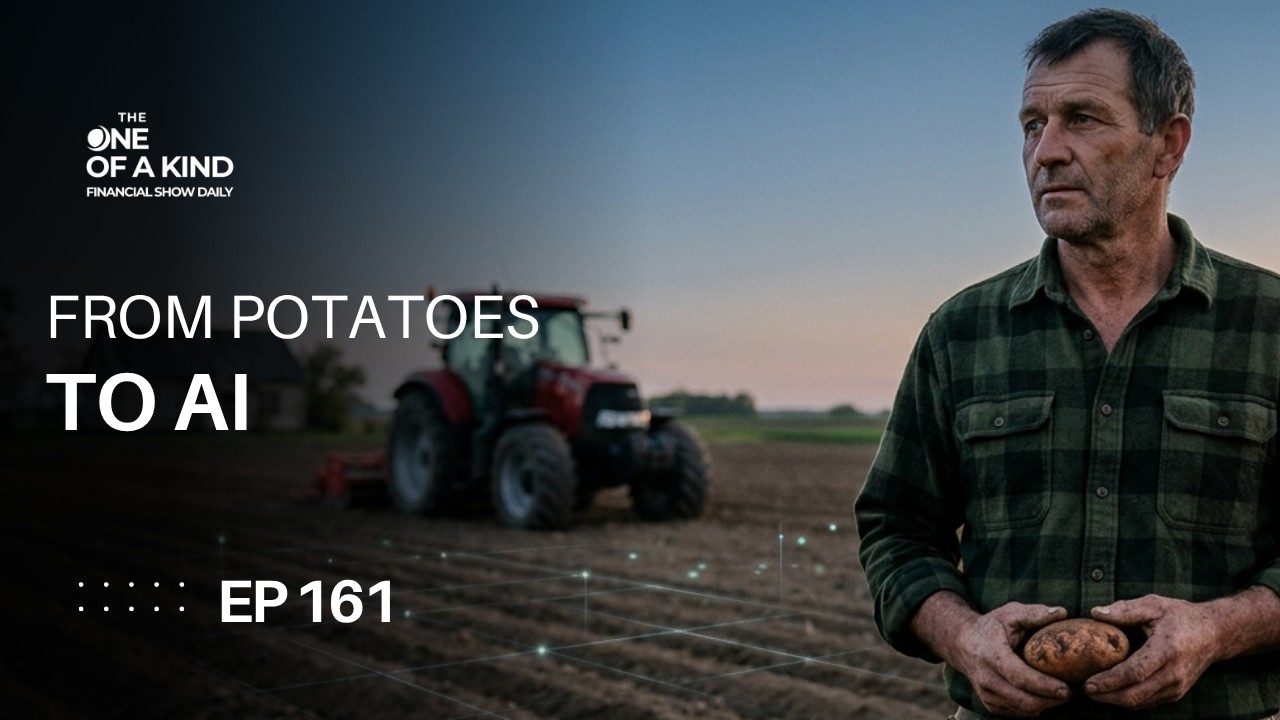
In this episode of the One of a Kind Financial Show Daily, host Mike Milligan (CFP, founder of One Oak Financial) weaves together a historical narrative and a market briefing. He tells the story of J.R. Simplot – a potato farmer‑turned‑billionaire who, in 1980, wrote a $1 million check for a 40 % stake in the fledgling Micron Technology, a memory‑chip startup that began in a Boise dentist’s basement. Simplot saw DRAM chips as a commodity similar to potatoes and backed the venture, ultimately turning a potato empire into a $200 billion memory‑chip giant that now supplies high‑bandwidth memory for Nvidia’s AI accelerators. Micron’s $50 billion, two‑plant expansion in Boise positions the city as a ground‑zero of the U.S. AI supply chain. Milligan then provides a concise market wrap‑up (Dow, S&P 500, Nasdaq, Russell 2000, Brent and WTI prices) and outlines the upcoming Q2 earnings calendar, highlighting big banks, ASML, Netflix and TSMC, and explains which data points (net interest income, loan‑loss provisions, AI‑capex signals, subscriber growth) will be most telling. He revisits three consumer‑stress metrics he reported the prior week – FHA delinquencies (11.88 %), commercial‑real‑estate CMBS delinquencies (7.35 % overall, 12.34 % office), and sub‑prime auto 60‑day delinquencies (6.9 %) – noting they are at multi‑decade highs. The host promotes his new “Reckless Abandonment: How AI Is Reshaping Everything” special‑report series, urges listeners to share local anecdotes about housing, auto repossessions, and mortgage stress, and closes with a financial‑planning lesson: diversification is not just about stocks and bonds but about recognizing commodity‑type opportunities and taking measured, documented risks, as Simplot did. Throughout, Milligan repeats the standard disclaimer that the content is educational, not investment advice.
Chapters
Good morning and welcome to the One of a Kind Financial Show Daily. I'm Mike Milligan, Certified Financial Planning Professional, founder of One Oak Financial. Today, a story about French fries, memory chips, and a small city in Idaho that quietly became one of the ground zeros of artificial intelligence. Plus, Friday's market close, the Q2 earnings season that kicks into gear this week, and where big banks and Netflix fit in your plan. This is educational, not advice. Educate, coach, plan. And never miss a moment. Before we get into today's show, one piece of housekeeping. Over the weekend, we launched our new special report series on this feed. It's called Reckless Abandonment: How AI Is Reshaping Everything. Episode 1 dropped Saturday. Episode 2 is going to drop next weekend. If you have not listened yet, please do scroll back in the YouTube feed. It's a limited series, and it's the framework for how we're going to talk about artificial intelligence on this show for the rest of 2026, because AI is not coming. It's here and it's already reshaping how you save, how you invest, how you retire, and honestly, how you work. Reckless Abandonment. Go listen after this show.
Be one of a kind with Mike's plan.
Now to today's main story, and I want to give credit up front. The story is of a man named J.R. Sipplott and a company named Micron Technology. And the reason little Boise, Idaho became one of the ground zeros of artificial intelligent economy. Here's how it happened. J.R. was born in 1908 in Dubuque, Iowa. His family moved to Southern Idaho when he was a baby. He dropped out of school at the age of 14. He raised hogs, he grew potatoes, and in the 1940s, when the US Army needed food that would not spoil in the field during World War II, Siplett Figured out how to dehydrate onions and potatoes at scale. He fed the army, and that made him his first million. Then in the 1960s, a young restaurant guy named Ray Kroc came to Cipollone with an idea. Kroc was running a hamburger chain called McDonald's. He wanted a consistent frozen French fry. Cipollone invented a new freezing process, and he supplied Ray Kroc with more than half of the French fries served by McDonald's. The deal made him a billionaire. His license plate in Boise read SPUD. Now, here is where it gets interesting for us. In 1978, twin brothers named Ward and Joe Parkinson set up a little company in the basement of a Boise dental office. They wanted to make computer memory chips, DRAM chips to be exact. Sedative gas from the dentist wafted through the floorboards. One of their executives literally used a hair dryer to help to keep the company logo from smearing off the chips. That was the beginning of Micron Technology. They needed money. A few local Boise businessmen put in $300,000. Then they went to Siplott's son, Scott. Scott went to his dad, and in 1980, J.R. Siplott wrote a check for $1 million For a 40% stake in Micron Technology. Now, Cipollone knew nothing about computers, but here's what he understood. He looked at memory chips and he said, this is just like potatoes. It's a commodity. Japanese competition has crushed margins. The only way to win is to be the lowest cost producer of the highest quality product. Same playbook, different chip. He handed over the check and he said, quote, boys, it's a gamble and we're going to take it. The gamble built the fab. That fab built Boise. It put Boise on the map. Cipollone's stake grew to nearly 20% of the company. By the mid-1990s, that stake was worth over $3 billion. J.R. Siplett went from potato chip billionaire to memory chip billionaire. He passed away in 2008 at the age of 99. Fast forward to right now. Micron Technology today has a market capitalization north of $200 billion. It's the only US-based manufacturer of memory chips at scale, and its high bandwidth memory, HBM, is the memory that sits next to Nvidia's AI chips in the data centers powering ChatGPT, Powering enterprise AI, powering everything we talked about this weekend in reckless abandonment. And Micron is investing $200 billion in the United States over the next 2 decades. $50 billion of that is in Boise. 2 fabrication plants going up right next to the original headquarters. The first production expected in 2027. Over 17,000 jobs projected for Idaho. The 2022 CHIPS and Science Act helped fund it, but the seed, the seed was one potato billionaire in 1980 writing a $1 million check to 2 brothers working out of a dentist's basement. Boise, Idaho, a ground zero of AI because a farmer diversified from one kind of chip to another. Here's the planning lesson. And it's educational only. Diversification is not just about stocks and bonds. It's about the courage to look at a completely different asset class, understand the fundamentals, and take a measured risk on something you believe in. J.R. Simplot did not stop being a potato farmer. He added memory chips. He did not chase the trend. He recognized a commodity market he understood. This is a one-of-a-kind financial thought pattern. We do not chase returns. We build a plan.
Be one of a kind with Mike's Plan.
Friday's close before we look forward. Friday, the Dow closed at 52,637, up 149 points for the week, or, or up for the day. Up 0.29%. The S&P closed at 7,575, up 32 points. That's up 0.41%, the strongest of the 3 majors on the day. And the NASDAQ Composite finished at 26,281, up 74 points or 0.29%. The Russell 2000 pulled back a little bit to 2,977, down about half a percent. Small caps were, were the tell all week. They lag and they're still telling us the consumer is uneven. Let me talk oil for a minute. It eased into the weekend. Brent crude finished at $76 on Friday, down 0.4%. WTI closed at $71.52, down 0.8%. This is the first real cooling in crude oil since the Iran escalation started midweek. Just take a look this morning and see what happened overnight through the weekend and see where we're heading, because the Iran story is not resolved and the Middle East does not take weekends off. Now, the week ahead. This is the week Q2 earnings season shifts into overdrive. On Tuesday, the big banks— JP Morgan reports before the bell. The Street's looking for $5.60 a share on $49.5 billion in revenue. Bank of America, Street's looking for $1.44 a share, roughly $30 $30.7 billion in revenue. Citigroup, the consensus is $2.68 a share or $20.9 billion in revenue. Wells Fargo consensus $1.71 or $21.1 billion. Goldman Sachs expects $13.91 a share. BlackRock is also reporting Tuesday expecting $11.20. Guys, what is, what is that consensus and what is that revenue target? How do analysts come up with that? They listen to calls, they trend forecast, and then on Tuesday when these companies announce, their stocks will move based on did they beat, meet, or disappoint on the per share and the total revenue. Look out for what they're saying about consumers. Look out what they're saying about inflation. It's going to move the market. On Wednesday, Morgan Stanley and ASML, the Dutch company that builds the machines that the chips that Micron competes with. Watch this one on the AI CapEx. Thursday, it's Netflix. They report after the bell. This is our first big tech read of the season. Also on the calendar this week, TSMC, the Taiwanese chip foundry that actually manufactures Nvidia and Apple Silicon. Their guidance is the single biggest tell of the AI CapEx cycle. Watch the tape. Here's what I'm listening for. These are not stock picks. They're just signals. From the banks, I'm looking for net interest income guidance, loan loss provision, credit card delinquency trends. That last one connects directly to the 3 consumer stress stories we ran last week: FHA, commercial real estate, and subprime auto. From Netflix, I'm looking at subscriber growth in a moderate— moderating consumer environment. If Pepsi's consumer is trading down, is Netflix consumer still adding a second streaming service? We're going to find out. And from ASML and TSMC, AI infrastructure demand— are the hyperscalers still building? Because if they are, Micron's Boise fab is going to matter for a very long time. That's educational only. It's not a recommendation to buy or sell any of these securities. Last week we were ran 3 stories that no one else on the financial media was talking about. FHA delinquencies at 11.88%, the highest since the Great Recession, per the MBA Q1 2026 National Delinquency Survey. Commercial real estate CMBS delinquencies at 7.35%, with office CMBS at a record 12.34%. And subprime auto 60+ day delinquencies at 6.9%, a 32-year high. Worse than the 2009 Great Recession peak, per Fitch. The response on those 3 stories was incredible. I got emails, I got, I got calls, I got people scheduling meetings with me. I had media reaching out. What surprised me most is how many of you said, Mike, this is happening to my neighbor, my cousin, my son, and my tenant. So here's my ask. This week. Comment on the episodes, on this Monday show, on last Tuesday, on last Wednesday. Tell me what you're seeing on the ground. Tell me, for those of you who live in Chicago and Houston and Midland and Albuquerque, New Mexico, Colorado Springs, Colorado, Kittery, Maine, Nashville, Tennessee, Birmingham, Alabama, Laurinburg, North Carolina. What is your zip code seeing? Are you a landlord watching rents soften? Are you an auto dealer seeing repossessions rise? Are you a mortgage professional seeing FHA files stretched thin? Your stories become our other listeners' education. This is how the show grew. Comment, read every one, tell people how you are feeling, and we may build an entire show around your anecdotes later this week. Educate, coach, plan. That's what we do here.
Be one of a kind with Mike's Plan.
Two chips, same family, two industries, one legacy. That is J.R. Sibblott's story. And the through line is not that he got lucky in memory chips. The through line is that he wrote things down. He had a plan. He had a family that could carry it forward. Your plan does not have to be $1 million into a semiconductor company. Your plan starts with one page, one document, one conversation with your family. That is the one-of-a-kind financial plan. We are 3 days away from the halfway point, uh, of the week. What is the one financial thing you have been putting off that we are going to accomplish this week? Write it down today. Reach out, comment, educate, coach, plan. Never miss a moment. This has been the One of a Kind Financial Show Daily. I'm Mike Milligan, Certified Financial Planning Professional and founder of One Oak Financial. This podcast is educational only. It's not investment advice, not a recommendation to buy or sell any specific security. Past performance is not indicative of future results. Consult your own licensed financial professional before making any investment decisions. I am an investment advisory representative with Advisory Alpha LLC. Ideas by Mike, doing business as One Oak Financial, One Oak Puerto Rico, doing business as One Oak Wealth Information, and Mike Milligan LLC, doing business as One Oak Collective, are unaffiliated entities of Advisory Alpha LLC. My funds are managed by Advisory Alpha LLC in mutual fund ETFs, I have multiple annuities, and I do not personally own any of the stocks mentioned on today's show. Have a blessed week.
Visibility, strategy, take that lead. Transformation's yours, fulfill the need. Mike's got the way to help you rise and stay. Leadership impact you'll find in your one-of-a-kind mind.