Episode 3 Pat Finley
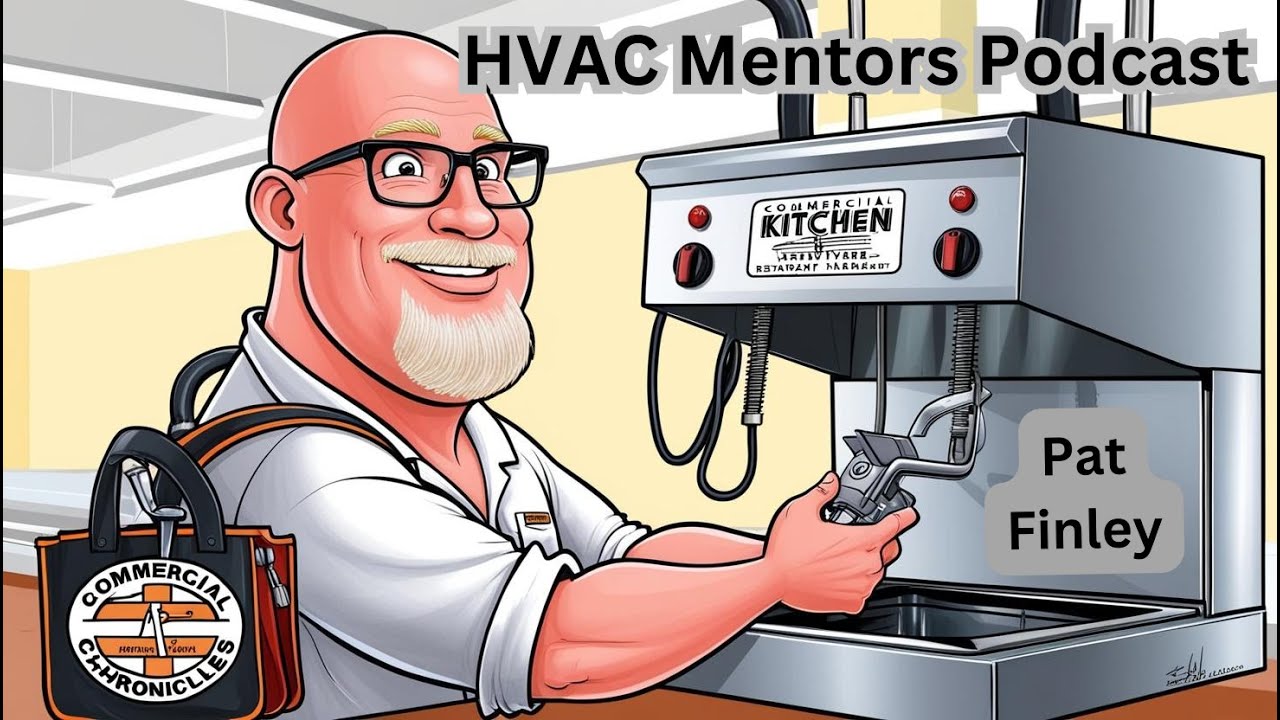
In this episode of the HVAC Mentors Podcast, host Mike (Speaker A) interviews Pat Finley, the founder and host of the Commercial Kitchen Chronicles. Pat recounts his path from a high‑school electrician to a commercial‑kitchen refrigeration technician and trainer, highlighting how his ADHD drove him to seek variety and avoid repetitive work. He describes the rapid technological evolution of commercial kitchen equipment—from simple controls to iPad‑enabled fryers—and how he built a hands‑on training curriculum covering thermodynamics, R‑290 refrigerant, brazing, pressing, and extensive lab work. Pat explains his teaching philosophy of starting at the lowest skill level to ensure no one is left behind. The conversation shifts to recruitment: Pat runs career‑day presentations, uses Instagram, TikTok, Facebook, and his podcast to showcase the niche trade, aiming to attract new talent away from traditional college routes. He outlines upcoming industry engagements, including AHR, the HVAC Tactical Awards, the HVAC School Symposium, and NAFEM, where he plans to record content and possibly exhibit. Pat also shares personal details—his family, three children, the support of his wife, and how he balances a 55‑60‑hour work week with content creation. Finally, he offers advice to aspiring trade educators and content creators: start by filming real‑world problem‑solving, leverage company or community‑college opportunities, and ignore online critics. The episode ends with contact information for Pat’s social channels.
Chapters
What's up everybody? Welcome to the HVAC Mentors Podcast. I am thrilled today to have with us Mr. Pat Finley, who is the host of Commercial Kitchen Chronicles. Uh, Pat is, um, along with many of our other guests that you'll see on this show, one of my first teachers and, and mentors in the trade, and, uh, one of the people who has just, uh, kind of resonated with me Uh, you know, again, just a regular guy, just like many of these, these, these people you're going to hear from on this show, but somebody with a heart for not only the, the job and the trade, but then a heart for, uh, teaching and, and helping to, uh, elevate those who, who are, uh, out there in the field today. So, so Pat, welcome. Um, you know, why don't you start out just telling us a little bit about yourself and, and how you got into Uh, both the trade as well as into, uh, into training.
Hey, thanks for having me on, man. I really appreciate it. I'm excited you're doing this and you're gonna, you know, highlight some people that have given back and shared their knowledge with the industry. And I'm really appreciative, you know, I'm really glad to be here. I really appreciate you having me on. So my name is Pat Finley. Um, I live in Central Indiana. Um, I've been in one form or another of skilled trades my entire life. Um, I did electrical in high school. I did a vocational program, came out and was an electrician for 7 years, and, um, kind of got stuck doing the same thing over and over. And if you know me, I have ADHD really bad, and doing the same thing is never a good thing for me. So, um, Oh man. Uh, a company my dad worked for, um, got bought out by a big mega conglomerate, and, um, he didn't want to work for that kind of place. He worked for family his whole life, and That's just what he wanted to do. So he got me on, and that's how I got involved in the kitchen world. I started off as a hot side tech for 3 years, and, um, I cut my teeth at McDonald's, nursing homes, and schools. That was like my main 3 accounts. And, um, I caught on really fast and I progressed really fast. I want to do refrigeration. Company I was at didn't want to, you know, train me, didn't want to invest in me, so I left. And I went to a company, said they would invest in me. And on day 1, I said, so when we're gonna start refrigeration training? And they told me, stuff's on the truck, figure it out. So yeah, so I bounced around for a couple years, had some health problems, and I've been where I'm at now for coming up on 14 years. So, um, I just love this industry. Um, it's kind of cool that we're, we're really lumped in with the HVACR guys. Um, we're not really HVACR people, techs, but we're in that sector just because we share a lot of the same common things. And I do do some HVAC work every once in a while. I'm not very often, but I get— I do get to do it. So. But yeah, 20, almost 20 years in this, this industry, and I love every minute of it, man.
That's awesome. Yeah, and I mean, the thing that I've always found interesting about that side is that, um, that side about the, uh, the kitchen equipment refrigeration side is, you know, an oven is basically a tiny furnace. Um, you know, a refrigerator operates under the exact same principles. As an air conditioning unit at home. And in fact, well, like a reach-in or, you know, maybe a portable fridge, those may be more difficult because I don't know about you, but, you know, I don't have toddler hands anymore. And, you know, some of those things— right?
Mm-hmm.
Some of those things can just be, you know, really difficult to get to, especially when you're, you're dealing with the little The little, uh, the metering device, the coil, a very small, uh, capillary tube or the capillary tubes. God, what is— my brain's not braining. I apologize, that may happen.
Right.
Um, yeah, when you're dealing with little capillary tubes, and I mean, it's just, it's really, uh, it's, it's very technical. Um, and I'm actually kind of proud that you guys are a part of HVACR. Um, and, and yeah, I think on your last episode you even said that It's like less than 10% of what you do is HVAC.
Oh yeah, it's, um, nothing, man.
Yeah, I mean, and, and I really enjoy the videos and stuff where you're occasionally showing like fryers and ovens and stuff, um, because, you know, also being an ADHD superhero, um, the, uh, the, the one thing that I enjoy is a variety of stuff. Early spring in residential is the bane of my existence because by the time you've done your 80th residential, you know, condensing unit, you know, hose it down, check the capacitor, check your contactor, check, you know, amp draw. I mean, you've done— you're like, okay, your brain is just like, I'm done with this. I've seen enough of these. Can I do something different?
Yeah, that's, uh, that's enough. Uh, I could see that, you know, just the same thing over and over and over. Like I said, you know, ADHD got the best of me. Um, I couldn't do it. I could probably do it maybe a week. After that, I'd be like, I can't do this, find me something else to do.
Yeah, exactly. And that, that's definitely not a problem from what, what commercial kitchen guys I've known. And just from seeing your stuff, it's like, you can't— if you're bored, you're the problem.
Yeah, I mean, this Our industry is evolving so fast. I've been doing this, you know, coming up on 19 years, almost 20 years. And when I first started, it was pretty simple stuff. You know, if you had a control that had some push buttons on it, it was pretty high tech. And now I've got fryers that got iPads on the front of them, and like you hit buttons and it tells you what to do, tells you what's wrong with it, it gives you an error code. I mean, I got a fryer, you push a button, it tells you how to filter and clean it. It walks you through the steps. I mean, these things are just getting more and more advanced. So That's where I'm thriving right now, is I love learning that new stuff. And as long as they keep advancing, I'll just keep advancing myself too.
Absolutely. And I think that's what really separates the, the real serious technician from the, uh, you know, the kind of, I don't know, average tech or mediocre tech. Um, but, uh, you know what, what, uh, I guess obviously you must love learning. You know, I mean, you know, because there's, there's a constant barrage of new stuff and new manuals, new, um, you know, new things. Um, so, you know, talking about then the other side of that, the, the teaching side, um, how did you first get into teaching? Like, what, you know, going from transitioning from tech to trainer?
So I've always picked up new guys. I had the new guys ride with me, you know, and I work them through our progress, you know, if they, if they're already technical I work them through our paperwork and that kind of stuff. I've always done that just because I'm very process-driven as far as paperwork goes. I want to be perfect because I'm the type of guy that my notes are so detailed that generally manufacturers and managers don't call me. Because I put it this way, if you can't remember what you did 3 months from now when the manufacturer has a question, you better have it, you know, you better have a memory where you can. And I can't do that. I used to be able to, but I can't anymore.
Yeah.
I put the notes in there so I don't have to worry about it. Um, and then it kind of transitioned. Um, one day, um, Gary Sherman, um, he's president of the company, he came up to me, he's like, hey, Safessa's looking for a refrigeration trainer. He's like, put your name in for it. I was like, I was like, I was like, am I ready for that? Do I want to do that? And there was always talkings of me being a trainer eventually. And, um, I went to Safessa and I worked for a couple guys, and next thing you know, I'm helping rewrite the curriculum. And I've been back 6, 7, 8 times maybe. I can't remember. It's been a bunch of times. So I go to— I go to the headquarters in South Carolina, um, once or twice a year, and I teach 12 to 16, um, beginning techs for refrigeration. They have to have their EPA, they have to have some electrical knowledge, they have to have, you know, be able to do basic hand tools. And they come in and we start with basic thermodynamics, and we go through refrigerant, we go through R290 pretty heavy because that's real prevalent in our in our industry. We cover brazing. Um, I introduced pressing, so I, um, RLS sends me out some fittings and we all press some fittings in there so they can see that's a viable option and how to properly do that. Um, and it's just, it's 5 days and it's, you know, when I first got the program it was like 85% slides and people were just falling asleep, falling out, people getting up, walking out. I've got down to about 50/50, and ideally I'd like to have about 25% computer work and 75% of the labs. We've got a really cool setup now where we have 4 boxes. They all have a small evaporator hung in there. They all have a small condensing unit. We have them pipe it, so we make them flare it so we can reuse it, so it's not constantly getting brazed onto because, you know, it'd burn up stuff eventually. So we have them flare everything. I make all the guys sign the flare nut where they flared, so that way if it does leak, they can go back and fix their leak and they can see why it leaked and, you know, try to use that. So. We wire it, you know, controls the pump-down system with a solenoid, a TXV. It's a really cool, really cool project we do with guys. And then I just kind of advanced from there. So I picked up some manufacturer training. So I, what they call a level 2 instructor for Frymaster, which means there's the way they classify training for some companies. They do 3 levels, like level 1 or level 3 is Online, like just some online stuff. And level 2 would be something I'd teach to like my fellow company employees. And then level 1 or level 3, depending on how they word it, would be at the factory or factory-level training. So I teach that intermediate class. It's a day and a half to 2 days, a lot of hands-on, a lot of tearing fryers apart. And then I do the same thing for Garland, which is a clam grill. If you've ever been to McDonald's, you see how they smash that burger. It's, you know, 2 clams and it comes down, it closes, it smashes it and cooks that quarter-pound burger in like 80 seconds. And 42 seconds for the frozen 10-to-1. So I fixed those and serviced those and set those up. So, um, but I teach that class as well. So, and there's more stuff coming in the pipe. Um, I'm— we're getting ready to start up a refrigeration program for our Training Unlimited program, which is an in-house thing we do where we bring green guys in and we get them ready for the field. The normal hot side of it is, I think, an 8 or 10-week program. And then we're trying to scale the refrigeration to either be, you know, do we want to do a week, 2 weeks, or what? So there's a lot more opportunities for me to train coming up.
I think that's really cool, especially given the fact that, you know, I mean, we're pretty close in age, I think. The, you know, growing up, the message was, you know, go to college, get a professional job, you know, don't get your hands dirty, you know, don't do hard work. But it seems like there's a big shift lately away from college and into, you know, vocational training, skill training, and trades that's starting to happen. And I'm personally excited about it. Do you see that, or how do you see the commercial kitchen area reaching out to young students and recruiting young people? Because I mean, a lot of people have heard of HVAC, but if HVAC is a little lesser known than say plumbing and electrical, commercial kitchen is probably virtually unheard of in comparison.
Yeah, so we're kind of the forgotten side of HVAC. People don't really know this job exists because they don't think about it, you know. How often does your, your stove at home break? Never. Yeah, maybe if it does, you just go buy a new one. Most people don't fix them. Um, and you can't do that in a restaurant. If I go to a restaurant, I've got ovens that are $80,000, $100,000 ovens. They're not, they're not replacing those when they break, you know.
They'll fix it. If not half a million, you know, like in the grocery stores.
Yeah, depending on the size of the oven, what they're cooking.
So yeah, yeah.
So we're not, you know, people are mind-blown when they find my page or I talk about it. Like, what, you do what? I'm like, yeah, it's really cool. So I've done some college, college and career days at high schools, my local high school. I went to my kids' high school actually and did one there. And I was only one of 2 or 3 careers there. And I was just— I had fun. I took some tools in there. I was making noise when the kids would walk by and try to get their attention, try to explain it. But we do some career days, we do some advertising, but I just don't— I think as an industry we don't do a good enough job putting it out there, period. It's just kind of like we just try to recruit guys we see, or, you know, you know, steal guys from HVAC or refrigeration guys, bring them over. Um, I, I'm, you know, that's kind of the reason why I started what I do is because I want to get it out there. So I started the Instagram, the podcast, and everything just to put it out there and show it off that it is a cool career, a viable career. Yeah, it can be dirty sometimes, but you can make a lot of money playing with grease, man.
Yeah, bring a change of clothes and keep them on the truck at all times and you'll be all right.
I definitely have a change of clothes, uh, sometimes 2.
Yeah, that would be frustrating if you get, you know, out from under a fryer, go change, clean up at a gas station or something, and then you go get filthy at a second job. I could— yeah, that, that would be 100% my luck.
Um, yeah, I try to, I try to look and see what my next job is before I get too ahead of myself, but sometimes you just gotta do what you gotta do.
Absolutely, absolutely. So yeah, I mean, could you imagine going to McDonald's and, yeah, sorry folks, no french fries McNuggets or chicken sandwiches because, you know, fryers are broken, you know, we got to get a new one. Uh, they're not gonna— they're not gonna— they're not gonna stand for that.
No. And luckily, like, most of your chain places like that, like McDonald's, have anywhere from 2 to 6 fryers depending on the size. So they're getting backups and redundancies. Um, so they got some play in it, you know, even if they lose an entire— they're in 2 banks, they have a front bank and a rear bank. Um, and if they lose one bank, they can still cook stuff on the other one. So they have some backups, but They're pretty demanding, man. It's, you know, you may have a grandma at home and it's too hot or too cold, but that grandma doesn't, you know, serve $5 million of McDonald's food in a year. So—
Right, right. I think—
good.
No, I was just gonna say, um, you know, one point of confusion too, I think, that people run into is you've got commercial, like grocery store rack refrigeration, and you've got commercial kitchen equipment which also generally includes their walk-ins, reach-ins, and their, you know, restaurants' HVAC. Um, do you— now, your, your company, or you don't do any of the rack stuff, correct?
No, I see it and I'm fascinated by it, but I'm too scared to start over somewhere else. So I'll—
That's 100% where I am. The, uh, it is, it is its own animal. And, and I think that, you know, for, for those people who have thought about going into commercial refrigeration, and we're talking racks, grocery stores, um, you know, I wonder if sometimes the, uh— it is a demanding branch of the field. I mean, you, you can't leave until it's done.
Yeah.
And, uh, you know, you might be there 20 hours, but, um, that is not— and I, I, I know that, uh, you guys in commercial kitchen do you know, it can be a demanding day and you can have some long days, but it's, it's really not that demanding typically. Would you say that's correct?
No, it's not stay there till it gets done. You know, if I lose a walk-in and we got to wait for approval or we gotta wait on equipment, uh, most of my stuff I can call in a refrigerated truck and it'll be there within a couple hours and they can transfer it over there and it'll be fine for a few days. You're not emptying out, um, you know, of all the refrigeration or refrigerated food out of a grocery store. It's just not going to happen. I mean, you got to get around it. That's why the systems are so big And a lot of them are oversized. They got redundancies built in, so if they lose compressor, they can still run. Um, so that's a whole nother world, man. I live vicariously through those guys. I love watching, you know, Kevin talking to Brett Wetzel and some of the other people I see doing racks all the time. I'm like, man, I guess really cool. I'd like to do it, but I don't want to start over.
Yeah, it's, it's kind of like, you know, owning and restoring a classic muscle car. Like, I want to do it, but when it comes to actually doing it, the expense and the work involved in it, it's like, man, I love watching other people do it too, though.
I've got enough hobbies, dude. I'd love to restore a car. I keep sharing cars I want.
Oh my God.
Like, one day I'll end up doing it, but I'm like, it'll just sit in the barn.
You know, unfortunately you're, you're way overpopulated on deer at your place, so, you know, you got to really take focus on that first.
Dude, I don't focus on that near enough. Uh, I went out quite a few times, but I missed the shot. Um, it just is what it is. I, um I try to take my son out with me, so to get him out there and experience things with him. So it is what it is. I have fun. It's just, uh, I need to make it more of a priority. Plus, it's not my property.
My brother—
oh, he'll kind of— like, I don't want to— and I don't want to impede on him, but like, he really doesn't care. He's like, I would rather you and, you know, Dalton shoot something than me shoot something. I'm like, okay. So—
Oh man, that's great. So the neighboring property or something, or a buddy nearby?
My brother's property. He's about He's about 10 minutes away. He's got a— lives along the river and he's got like a big— it's a real long narrow patch, but the deer just come through there every day like clockwork.
Nice. Now I do like your videos from the tree stand sometimes where it's just like, you know, I think he's just sitting out there, but nothing wrong with that either.
So yesterday I wanted to go because, you know, this snow we supposed to got this weekend was supposed to be here like— yeah, it didn't come till 6 at night. If it was going to come, I was— yesterday was the last day of season. I was just going to go out there and just take my bow and just sit in there and watch the snow. Um, I've had a rough couple weeks, patches of some— I had a death in the family, so much stuff going on. I was like, I just want to go out.
I'm sorry.
I appreciate that. I just want to go out there and sit and like not even look at my phone, just like chill until it gets dark and just walk out. What happens happens. And, uh, the snow didn't come, so I didn't go out. If I'm gonna be cold, I'd rather be cold in the snow, and it didn't snow, so Yeah, I hear that.
So, um, what, um, what led you then eventually to start Commercial Kitchen Chronicles? Like, what, what led to the podcast? What was the catalyst there?
So I drive a lot. Um, like, it's kind of weird. I may drive 500 miles a day and I may drive 50 miles a day. I never know where I'm gonna go. We don't have zones. Like, I cover, uh, Illinois to Ohio, and I cover like 150 to 200 miles north and south, like, like 100 miles north of Indy, 100 miles south of it. It just depends, like, where ramen demand I go. So I was always listening to podcasts, man. I was a huge fan of, um, Make Trades Great Again, HVACR School Podcast, uh, anything out there I could get absorbed, you know, HVAC Uncensored, Tool Pros. I was like, just—
Appetite for Construction.
Yep, yep, love all of those on repeat, non-stop, non-stop. And, um, You're driving, you know, so you can just play them and go. And, uh, I just was like, man, I was like, there's electricians out there, there's plumbers out there, there's HVAC guys, but there's no one talking about what I do. And I was like, one day— you follow me on Facebook, so you see how I work. I'm like, one day I was like, I'm gonna start a podcast, you know, based on what I do. And like a week went by, it was like I was on to something else. I mean, just, just how I work. And I was walking by Gary's office one day, he's like, hey Pat, I want to talk to you. I was like, oh man, I screwed up. What'd I do? He's like, no, it's good, man. I was like, oh, okay. He's like, it's about that podcast. I was like, oh, he's gonna tell me I can't do it. Next thing you know, he's like, no, we want you to do it. We're gonna support you. We're gonna help you. And I was like, oh, now I gotta do it.
Yeah, now you gotta.
And it just kind of blossomed from there. It started off pretty slow. Um, I was just trying to do it by myself without anybody and just quickly realized that you can talk to yourself for 4 hours and then edit it down to 20 minutes and it still doesn't make sense. So, uh, I, I got some guests on and then I picked up Dusty as a co-host. He comes and goes. He's this real busy young guy. Um, and then I picked up Jason and Rich and the rest is history, man. We just have fun. Um, if my co-hosts can make it on, they can. If they don't, they don't. Um, but we just, we started off interviewing people from our industry. Um, we want to highlight and show, show off the people. Um, but we also like, we'll bring on other tradespeople. We're not against any other trades. We want to showcase all the trades. Our main focus just has to be on what we do because that's what I'm trying to stick to, but I've had a fiber optics person on, I've had, um, plumbers, I've had HVAC guys, I had a rat guy on last week. Um, I'm not opposed to any skilled trade. I want to show off all the trades. So yeah, just to promote the trades and try to grow it.
That is actually also my goal with this show, is to branch out beyond HVAC. Um, because, you know, at the end of the day, we need, uh, we need commercial kitchen guys, we need HVAC guys, uh, but we also need plumbers and carpenters and Electricians, drywallers, painters. I mean, we need them all. You know, I can't— as much as I even— even I try to do everything myself around my own house, there are times when it's just like, yeah, I just— I don't have the time, or I just have 1,005 other things going on. Like, I've already been forbidden from— when we do— we keep hem-hawing over upgrading the kitchen cabinets, and I've already been forbidden from doing them myself. I'm not allowed.
So I'm right there with you. I did my office here. I did everything but the drywall, and I paid someone to do the drywall. I just don't have the patience, and I wanted to look halfway decent. So, but nope, I, I'm smart enough now to realize that I can't do it all. Um, I make a little more money than when I had to do it all, so now I just kind of embrace myself a little bit and pay somebody. There's professionals out there for a reason, right?
Exactly. And, you know, give them a little love. The, uh, so as far as the podcast goes, where do you see it going? I, I know, uh, One time I remember messaging you and asking you, so, so you mean you work full-time and you do the podcast? For some reason I had it in my mind like this is a full-time thing, but evidently, uh, we are all gluttons for punishment and this is a part-time thing. But what do you see the future of, of the podcast, uh, happening or, or being?
So I'm not sure. I'm just enjoying the process right now. Like I said, um, uh, I work 55, 60 hours a week, not by force but by choice, because I enjoy what I do. Um, guys, I'll leave at 5 in the morning. If I get to a job site by 6, I will, and I'll be home at 6 and I'll still have 12 hours in, that kind of deal. So I, you know, I work a lot, but I use my work to, you know, to show off what we do. Um, my goal for the podcast, just to keep growing and keep, uh, shining that light on these people in the industry. Um, get some more sponsors. Um, like I said, I'm not trying to make money or get rich off of it. Break even would be nice.
Not lose.
Um, uh, I just triggered some sponsors, and I've got some really great sponsors that work with me, and, you know, they're thrilled to back us in what we're doing. We're just trying to grow this industry, and if I, if I can get, you know, some more people involved, it'd be, you know, it'd be great. Um, my favorite part about this though is when I get a text message or an email or a message on social media from somebody who's like, hey, I heard your podcast, I was thinking about, you know, changing careers and ended up doing it, ended up loving this job. Um, and that's really what makes it, you know, worthwhile. Um, I have days where I don't want to do it anymore just because, like you said, this is a full-time job whether people believe it or not. It's— there's a lot of work that goes on behind the scenes. And, um, but yeah, when I get those messages, it proves that, you know, I am doing it for the right reasons and I am having fun.
So yeah. Yeah, it's, it's definitely more to it than just sitting and, you know, shooting it for an hour with your buddies online. It's— and recording it. It's, uh, you know, there's a lot of video editing, a lot of, uh You know, well, just time and scheduling people. And you know, I just realized I double scheduled someone for after AHR, so now I'm gonna have to go figure that out. And so I'm just like, you know, it's it's full bore into it. But you know, it's the the other cool side of it is, you know, if if I were to talk about HVAC and refrigeration stuff as much as I get to talk about it with other people to my wife. She would probably murder me.
I hear that. My wife doesn't like hearing me talk about my work. Um, luckily my wife supports what I do, so like, yeah, she goes with me. She has a lot of flexibility for work. She can work remote. Um, she works— okay, so like she can go and work from an Airbnb, or if the hotel's got good Wi-Fi, she can work from there. Um, but she'll go and she'll video for me, or if we go to an after-party, she'll come with me. So But she's really my biggest supporter. Like, she'll do some stuff for me, she'll make some stuff for me. Um, you know, she'll— she doesn't really edit anything, but she looks what I put up, she's like, hey, you messed up, you misspelled this, go fix this, go do this. And I'm like, okay. So, um, she is my biggest supporter, and you gotta have people behind you to support you. Yeah, be a pain in the butt. It's gonna be a— you don't want to come between you and your family. So—
No. And speaking of family, so you do have— so you're married. Uh, you mentioned you have, uh, is it just one son or do you have other kids?
So I actually have 3 children. My daughter is 24, she is a licensed massage therapist.
So cool.
And then I have a 22-year-old son that's worked with me for 2 and a half years, um, kicking butt. Uh, he's got a house, a brand new Bronco, he's engaged, he's making money. Yeah, so he's— he, he used to be my apprentice in all my videos. And now my youngest son, he's 19, just turned 19. Um, he's been working with me about 6 months, a little over 6 months, and He's, uh, catching on and starting to do some stuff.
So, um, yeah, passing on the family tradition.
Yeah, so my youngest always said he wanted to work with me. Um, like, I'd go to the shop and clean my van out when he was younger. I'd take him because he was small and he could run up and down inside my van. I'm like, hey, grab me that, grab me that, put this here, put that there. He's like, I want to work with you. I was like, cool, you know. Well, one day his brother was probably 19. He's like, hey, he's like, I'm gonna apply where you work at. You guys hiring? I was like, you're not applying here. And he goes, yeah, I am. I was like, no, you're not. You're not coming to work with me. Because this kid was your prototypical jock, never used any tools. Um, he has one of those you're not gonna beat me attitudes, luckily, and that's kind of worked out in his favor. But like, I seen him use tools one time, and I had him change the brakes on his truck, and I was getting ready to tell him, I was like, hey, he was pushing down the wrench. I said, I was gonna say, don't close your fist, leave your fist open, because if you slip, you're gonna punch the ground.
Yeah.
As soon as I started to say it, he punched the ground, and I was like, Tools aren't for this kid. But next thing you know, um, he's working with me 2 and a half years and he's a sponge. He's soaking up all kinds of knowledge. He's out there killing it and he's making me proud. And you know, Dalton's the same way. He's out there killing it, um, making me proud. He's learning differently. There's 2 different kids. Like I said, Corbin, my oldest one, he, uh, just had jock mentality where you're not gonna beat me, not gonna give up. So that's him. Dalton's more methodical, more of a thinker. So, you know, we'll see. We'll see how they go. It'll be interesting to see what they do in the next 5 years when they start, you know, going head-to-head and see what they can do.
Oh yeah, that— yeah, that emerging into adulthood and, and, uh, kind of taking your own direction, that, that whole stage, that is, that is cool to see, uh, kids do. It's, it's weird that I'm referring to people in their 20s as kids, but my daughter, my daughter's 24.
I call her friends kid. Hey kid, what's up?
Oh yeah, that's a good kid.
Like, uh, no, just look at me and smile and they're like, okay, whatever, whatever, guy. I'm like, I'm only 42, don't call me old.
Yeah, I, I've officially reached the, uh, grumpy old man. It's like, kids, dang kids, keep your ball out of my lawn. Absolutely. So AHR is coming up in about a month. Um, I actually just got my tickets booked, my airfare and stuff like that. So, um, so what are you looking forward to there? Are you, are you doing Are you doing any specials with Commercial Kitchen? I think I've asked you like 15 questions in one sentence.
So if this is your first AHR, you're gonna be blown away. You're gonna be like a kid in a candy store. I suggest you make an itinerary and go to the stuff you want to see. Anything you may want to see, you put on the back burner because it's going to be a lot of walking. So you better have good shoes and better be prepared to see a lot of cool stuff. But We are actually recording every day at the Podcast Pavilion at 10 AM. Um, Jason's gonna be there first day. We have RIDGID coming on.
Nice.
Um, Refrigeration Technology, so I'm sure we'll have Beth and Ash on again. Um, the Viper Vixens, as they dub themselves, on. And then, um, I've got Watts coming on to talk about some of their plumbing stuff that I use, so they're gonna be on one day too. So I've got 3 shows, all with 3 guests. I'm excited for that. I am working on a booth appearance. Um, they've tentatively agreed to it, so I'm gonna see if they follow through, and hopefully I'll have a booth appearance where they're gonna be having me come in the booth and showing off the product. So I'm really excited about that. Um, but there is just so much to see, so much to do. After parties here, after parties there. I will be at the HVAC Tactical Awards. Um, I'm never gonna miss that. Um, that is a night you— a night to remember. It's you know, you don't see these people dressed up in blue and suits, ties, tuxedos, dresses. Um, you get a chance to sit and mingle and talk to everybody. Um, drinks if that's your thing, food, and then the award show. Um, I won the actual Best Social Media Content 2 years ago. Um, I gave it away last year, so I'm looking forward to see what's gonna get— who's gonna win this year. There's a lot of new categories. I think it's gonna be a blast.
That is amazing. And yeah, so HVAC Tactical, is that during the same week with, uh, AHR, or is that the week after, or shortly after AHR ends?
So it's the Sunday night before. So it's always the same city, it follows AHR. Okay, right before. So, um, I'm going to be at the HVAC School Symposium Thursday, Friday, and then I'll be at Tactical Awards on Sunday night, and then I'll be at the show the next 3 days.
Are you teaching at the symposium, or are you attending?
I'm attending. I wanted to teach, but I was too nervous and too scared to actually commit to it. So I think next year I may try it. Um, all right, I want to go and see what it's all about first. Um, sure.
Yeah, I'm, I'm looking forward to Jennifer's, uh, 10 Commandments of, uh, of boilers. No, um, so that, that's going to be exciting. And I'm— so here in— and I don't know if it's the same in Indiana, but here it's all gas forced heat, the forced air heat. Everything residential is gas forced air heat. You do see some boilers and Very, very, very super rarely you see an oil burner, but but it's all natural gas. So I've never really had the need to learn about boilers. But boy, over the last few months, have they been just popping up left and right in front of me. So now I'm really excited that Jennifer, as it happens, is going to be teaching boilers. So actually, the Where I work, I'm actually having a boiler replaced, and so that's going to be exciting because get to actually get my hands dirty and help the contractor with that. It's a healthcare facility, so I can't just do it myself. It has to be a licensed, you know, somebody with mechanical license, which I do not have. But I get to get, you know, get in there and help out. So I'm looking forward to that. So lots to be proud of. Lots to man. Lots going on. You know, it seems like. Just seems like a bright future ahead, man. So 2025 is going to be amazing, I, I think, is my predict— my prediction.
Yep. I got a lot of things working on the podcast. Um, well, I guess, um, a lot of manufacturers I'm gonna get involved, try to get some manufacturers to show off some of their stuff too. Um, so I'm working with True ice machines, uh, to have them on. Uh, I'm working with AccuTemp, uh, griddles and steamers up in Fort Wayne. I'm gonna go up there and tour the facility. I've got some other stuff coming up too. So got a lot of stuff coming up. Got a lot of stuff I'm gonna record at. I'm going to NAFM, which is North American Food Equipment Manufacturers Association, I do believe. I probably butchered that, but it's a big show where they show off all the latest and greatest food equipment. So I'm going to that at the end of the month in Atlanta, and I'm gonna do a bunch of recording there, some interviewing in some booths and stuff, and showing off the latest and greatest in food service. So Um, just busy year, man. Just trying to promote the industry, man. It's what's really turned into is just showing off what I do, um, and what we do as, as a, as a little niche in the HVACR world. So.
Absolutely. So I've got 2 more questions for you. One is, um, what, uh— I just completely— it's gone. So the other question is, and hopefully I'll come back to it, so what, uh, One thing I like to ask, you know, our teachers is, uh, you know, what are you learning? Like, what, what is it? What is something that you're, you're trying to become more familiar with? Uh, is there a particular book you're reading or, or something you're trying to kind of, uh, familiarize yourself with right now?
Um, no, not really. Um, I haven't had any— started any books. Um, I've got a couple sent to me that I need to break into. Um, trying to refocus on slowing down and thinking about things before I say things. I've got a bad habit. I think it's really just ADHD where you just like, if it comes to your brain, you got to spit it out because if you blink 3 times, you forget it.
It's like you're describing my entire life.
Yeah, so I'm trying to slow down before I respond because I've gotten myself in trouble. And it's not that it was negative, but it's perceived negative. So yeah. Slow it down. That's what I'm trying to work on myself. Um, but when I teach, like, something I try to focus on is I try to teach to the lowest skill level. Like, that's the hardest thing.
Right.
When I teach, I'll have 12 to 16 techs in, and some may be pretty good. I've had some like 3rd or 4th year union apprentices in that I'm like, you want to teach this class because you sound like you know more than me. Like, and try to Make sure no one gets left behind. That's the hard thing to do when you teach. You gotta— you don't want to leave anybody behind, but you also don't want anybody to be bored where they're going to cause problems or not pay attention or zone out.
Right, exactly. And, uh, yeah, I think one of the hardest classes that I taught back when I was teaching at Midwest Tech was, um, I had a guy who was already EPA certified. He was— he had just never been to trade school, and his company offered to pay for it. Uh, there was another guy who had years in as an auto mechanic, so he knew how to like trace down low voltage shorts and like, you know, all the basic electrical, electrical theory and everything. And, and he was pretty good with vehicle air conditioning, so he understood the refrigerant loop. I had a few guys like that who were really smart. They already had a lot of experience, and I'm just like, okay, so, uh, you guys can teach. Um, but yeah, I think that's part of the reason too why my passion is, is the beginners. You know, those people who are just starting out and they really don't know much, um, you know, they're afraid to, you know, work with the low voltage circuit. They think they'll get electrocuted by 24 volts, um, you know. But, but yeah, the, the, the guys who know a lot are definitely most challenging. So I get what you're saying about kind of teaching to the, the lowest skill level. Uh, that's definitely a helpful piece of advice. And that was the other question I was going to ask is, you know, what do we It's either what do we do, or what do you say to maybe those who are on the fence about, you know, doing some teaching themselves? You know, maybe somebody kind of has a heart for content creation, or for— or, uh, maybe, you know, looking into transitioning into teaching. Maybe they're, they're having trouble getting off the fence. I mean, what do we say to those who, who, uh, want to teach and maybe they're not yet?
Um, if you want to just show what you're doing, I mean, that's going to help a lot of guys out. That's really how I got started with content creation, was just showing what I did. It's kind of morphing into more than that, but just start to show off what you're doing. Explain something. You see something that you think someone's going to benefit from, make a short video explaining what the symptoms is, how you checked it, how you fixed it, and go from there. And that'll give you a start, and then you'll just gain a little bit more knowledge, a little more trust in yourself, and it just keep growing from there. But if you work for a big company, there's always opportunities to teach inside those companies. So reach up to the higher management and see, you know, what they have to offer, what they want to do. You can always, you know, talk to community colleges and see— there's always colleges looking for, you know, instructors, people want to come in and talk about what they do. So that's something you can do as well. Other than that, just, just show off what you're doing and enjoy it.
You know, the thing that Yeah, absolutely. And that's kind of been the, uh, kind of call that I've been responding to lately too, is just, just flipping do it. Put stuff out there. And, you know, some of it's going to be a little shaky at first and unclean, and, and it's gonna, you know, sound a little silly, but so what? Do it.
You know, I'm gonna start somewhere, man. Like, I did that long format video last week, and it could have been a lot better, but I'm just starting on the long format stuff, and Yep, you got to start somewhere. There's, there's no perfect time to start. I think Tony said last week or this week, he's like, there's no perfect time, just do it.
Yeah, exactly, exactly. I think, uh, I think, you know, there's, there's a lot of, uh, I think that's part of just being a technician is, is, you know, we always want to be perfect. Everything has to work right. Nothing can be, you know, your wires need to be cleaned up and zip tied together, you know, you can't leave anything sloppy. And so if we're going to teach something, I think we want it to be perfect, but I think we need to understand that none of us are perfect, um, but we all have something to share.
Yeah, and I will say something: if you're going to show it online, be prepared for people to say something. But just realize that most of your biggest haters or critics online, they don't show anything they do.
Yep.
Don't take it personal. Most of these people that do that kind of stuff are miserable people, and they're just— they're miserable. They're not happy themselves, so there's lashing out at you to make themselves feel better. So don't take it personal. Um, yeah, I want to go back at them. I go look at their profile and I want to, you know, be one of those accounts where it goes back at them and talking crap, but I can't do that. I want to be professional. I can't get in trouble.
No, as much as— yeah, I, I think sometimes we all have that side of us that wants to be like, oh yeah, oh yeah, pal, you know, let me, let me tell you a thing or two. But yeah, at the end of the day, it's, it's important just to understand that Yeah, they're— they are speaking from a place of jealousy and, um, you know, really probably regret that. Why don't I have the skill or the courage to do what that person's doing? Um, yeah, I had somebody come back to me and like send me a private message like, yeah, I really don't like the sound of your voice. And I'm like, hey, you know what, I don't like the sound of my voice either. I mean, I didn't say that, but that was my first thought. It was like, yeah. I can't stand the sound of my own voice, so blah blah blah.
You can't please them all. Just enjoy what you're doing now.
Yeah, absolutely, man. Well, hey, um, you know, Pat Finley, I am so happy to have had a chance to sit and visit with you, um, and get a little better acquainted. I definitely look forward to seeing you in Orlando in a few weeks. I can't believe— every time I say that, I can't believe it's coming that quick. But, you know, the— it's been a real joy to have you. And hopefully, if those of you who are listening have any questions for Pat or anything, please feel free to put those in the comments. You can also find him on Commercial Kitchen Chronicles anywhere where you can find your podcasts, Apple Podcasts, Spotify, and all that. Also Facebook. And anywhere else? TikTok? Any other socials?
Instagram, Facebook, TikTok, LinkedIn. Search Commercial Kitchen Chronicles or Pat Finlay, and it'll come up everywhere.
Right. So, um, yeah, feel free to like and follow this podcast and comment, and definitely like and follow Pat's stuff. If you haven't watched his content, it's very helpful. It's really good stuff. And it's really, really interesting. So thank you, Pat, once again for being on with us, and we'll see you next time.
Thanks.
Okay.









