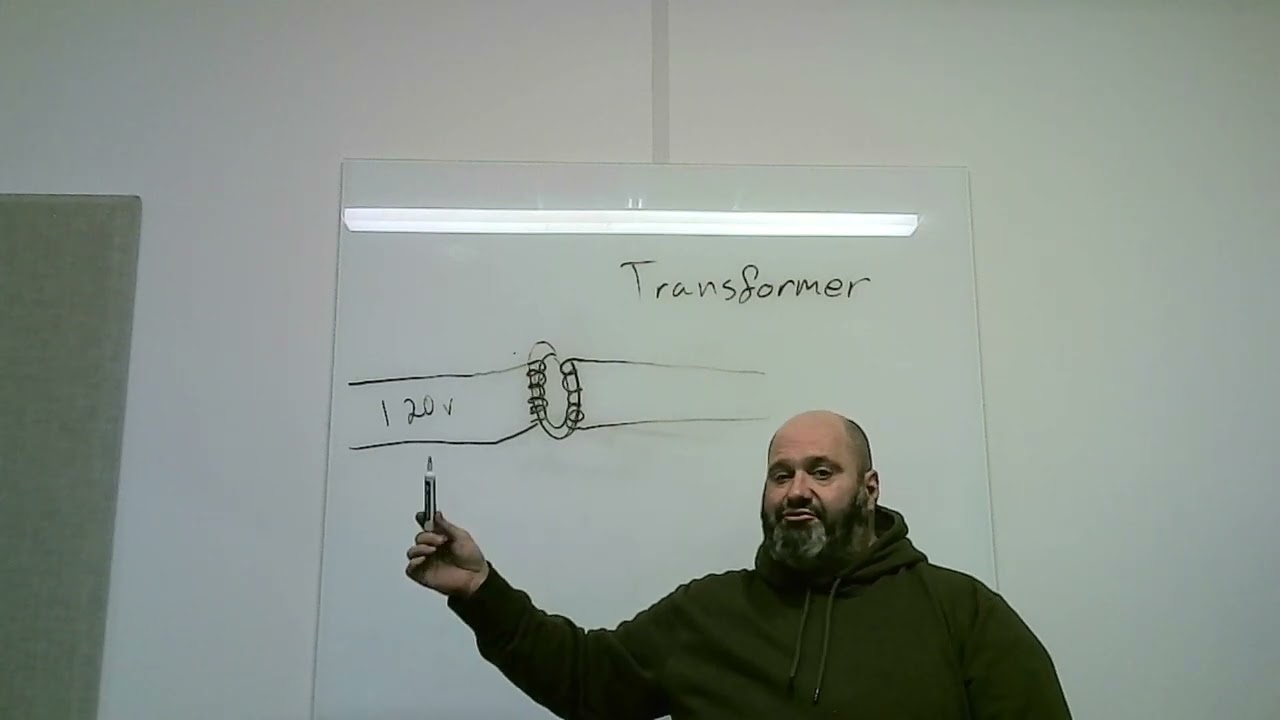
Mike Plezia explains how HVAC transformers step 120 V down to 24 V to power control circuits and thermostats. He covers construction, failure modes like shorted windings, and two testing methods: measuring secondary voltage or checking winding resistance with an ohmmeter. Always de-energize before testing.
Chapters
What is up everybody? It's Mike here to help you with your basic questions for the HVAC learners in our community. If you're new to the trade or if you know of somebody who's new to the trade, I hope this video helps you a lot. Please like and subscribe at the bottom of the page, and if you have suggestions for other videos, definitely don't hesitate to reach out and let me know. To begin, There is one part to an HVAC system that's absolutely fundamental, whether it's heating or cooling, and even some— and even in refrigeration and, and many other types of HVAC equipment, you're going to usually have 2 different voltages. One voltage is going to be for controls, and the other voltage is going to actually be running and driving the system. So that part that I'm talking about is the transformer. Transformers, more than just robots in disguise, and definitely more than meets the eyes, as the '80s cartoon might tell you, are an integral part of your HVAC system. But what do they do? So you'll have generally, especially in residential, You'll have 120 volts of current coming into your unit, right? So this much we know. Thanks, Mike, for stating the obvious. So 120 volts are coming into your system, into a coil. So that coil is actually wound around an iron core. That iron core is the heart of your transformer. When Another coil is wound around that iron core. You can actually step current up or down. There is a direct relationship between the amount of windings on the primary side. That's where the incoming current is, is on the primary, and it's called that because that's where current first flows. There is a direct relationship between the number of windings on the primary side and the number of windings on the secondary side. The secondary side having less windings will actually step current down, and if the secondary side has more windings, it will actually step the voltage up. So why is this important? Well, in order to power things like controls or to have a control signal sent through through a safety device, like say a limit switch, or, uh, for your control board to be able to detect that, let's say, your pressure switch has closed, indicating the inducer motor is on in a gas furnace, you need to have 24 volts, at least in most residential systems. Now, how do you get 24 volts? Because nothing in your breaker box is putting out 24 volts. Well, The voltage is produced through your transformer. It allows us to use a lower voltage current in things such as your thermostat and other controls and switches. Your electromagnetic coils inside of your contactor in your AC condenser, for instance, would not be able to work without the transformer. And the cool thing is that This is simply the current flowing through the primary side doesn't actually flow through the iron core. The really neat thing is that these coils concentrate the current flow and that resistance generates an electromagnetic field. That electromagnetic field then actually generates the current in the secondary side. Then that current flows through the induction coil in, say, your contactor Or a fan relay, and then will open or close that control based on what the transformer is sending and what other controls, switches are opened or closed. One thing that I've seen on especially older systems where maybe they're not as well protected is frequently you will have a transformer that's— that will blow the primary or Or really the secondary windings, if the winding shorts. So for, say for instance, on an outdoor condensing unit, um, maybe the— for whatever reason, a wire has— the insulation has rubbed off of a wire and it's shorted. That will actually cause the windings in here to short out and, and really to basically blow out. How do we test a transformer then? Simply put, one of two ways. So one is, if the primary side is energized, if we know the voltage that should be coming through the secondary side, if we are getting that voltage, then that secondary side is fine. And then obviously the primary is too, because it wouldn't be causing the secondary side to work. If not, then we know that we have a bad secondary winding. One of the simplest tests is a— is an ohm reading. Obviously, you want your, your power to be cut to the transformer, and really, ideally, you want it connected to nothing. You can get by without disconnecting it completely, but personally, I prefer to disconnect everything from it. That way, you are truly isolated. You should get a low measurable resistance reading off of A magnetic induction coil. If you are getting zero, or rather OL, which is infinity— infinite resistance, or OL, basically means that there is no path for current to flow. Okay. So if you're getting that, then that means you most certainly have a broken winding. Or a short winding. If you're getting high, high resistance, let's say 50 ohms, 60 ohms, 120 ohms, how, you know, however many, 500 ohms, uh, resistance, that means that you're— you've got a path for current to flow through, but the resistance is so high that it— the, the energy is never going to get to the actual final load or the control or safety, which is, uh, which is where your failure point is. The transformer then would be considered bad. You can't really repair a transformer, although I would presume technically anything is possible. So without the transformer, your system is dead. It cannot operate at all. So that's why it's important before we're disconnecting wires, before we're going through and diagnosing anything, And really, technically, even if we're like, you know, jumping out the thermostat or something like that, or bypassing the thermostat in order to, you know, make, you know, heating or cooling mode turn on at our whim for testing purposes, we really should de-energize the transformer before we do that. The reason is that it's very easy to accidentally short the transformer, and now Whatever component or part has brought you to this home that you are now checking their system, you now also have to replace the transformer. Been there, done that, guilty. Um, and no doubt pretty much everyone who sees this video will have done the same at one point or another in their career. But, um, but that's just a short explanation of the transformer. It's pretty integral to, again, the, uh, the The operation of an HVAC system. The other thing that it can do is, because it is— because the power is less susceptible to power fluctuations, a transformer can also be a 120 to 120, for instance, transformer. Because it's going to allow for less power fluctuation because there will be less load On the system or possibly no load after the transformer. So that's pretty much all I have for today, and I thank you all for visiting with me. If you have any questions or suggestions for future videos, please share those in the comments. Otherwise, as always, it's been a pleasure and I look forward to hanging with you guys next time. Bye for now. Bye.