Advancing Industry 4.0: Think Globally, Act Locally
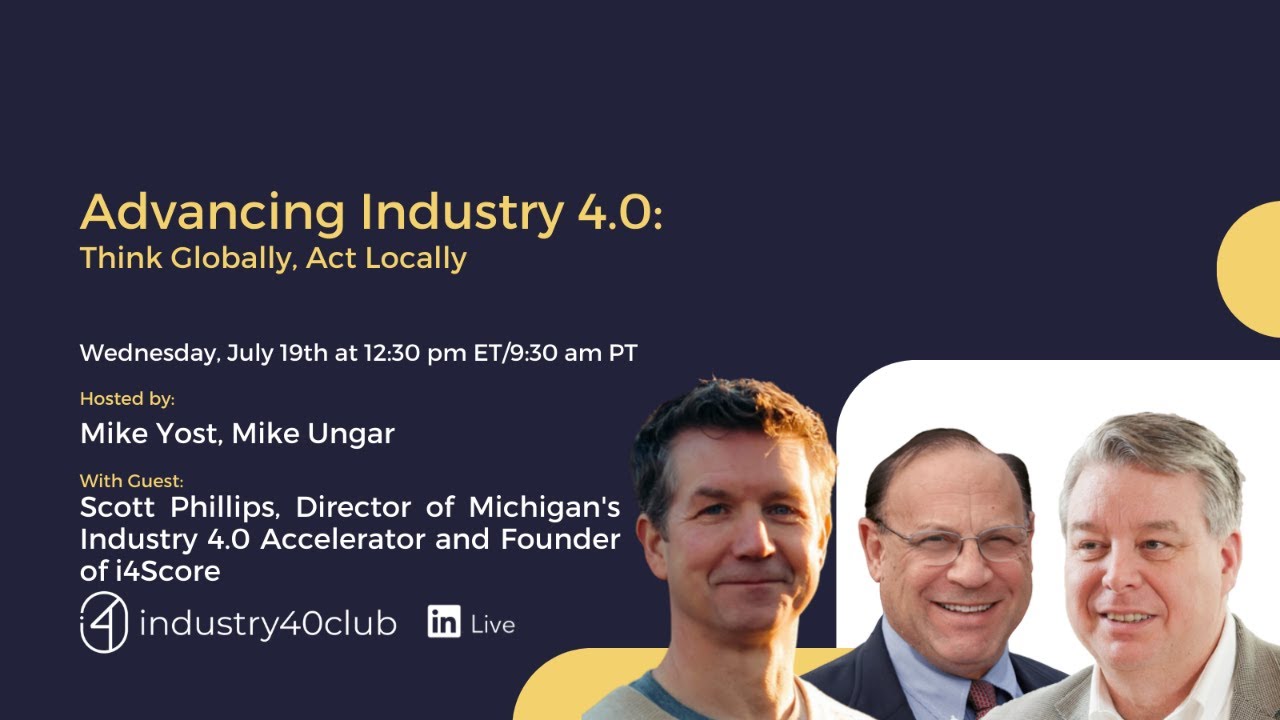
Scott Phillips leads Michigan's five-year Industry 4.0 initiative to help 6,500 of the state's 13,000 manufacturers adopt new technology. The program offers $25,000 matching grants for eight vetted technologies and connects small and medium-sized firms with vendors through regional roundtables, with no fees to manufacturers.
Chapters
Good afternoon and good morning, everybody. My name is Mike Ungar, and I am one of the co-founders and chairman of the Industry 4.0 Club. Glad you decided to join us. We're here today for our fireside chat. This afternoon, we're going to be speaking with Scott Phillips, and I'll be co-hosted with Mike, Mike Yost. Just a minute before we get into talking with them, just talk about the club for a second. The Industry 4.0 Club, we— our mission is to advance the deployment of Industry 4.0. We do that in several ways by hosting conversations like this, to enhance the knowledge of our followers. And we also are involved in live events. We had the opportunity recently to do the programming for IME East in New York and are getting ready for the IME West event in California in early 2024. Just a little bit about myself. I retired from Michelin North America 3 years ago. having spent 35 years working for them in a variety of roles, including continuous improvement, operations, finance, and HR. And today I'm a business coach and executive coach with Focal Point. Mike, would you introduce yourself, please?
Sure, thanks. My name is Mike Yost. I am one of the co-founders of the club and recently named as the CEO. So I am taking over leading the organization here with our, our mission to help drive diverse conversations and value for our constituents. My background is 35 years in industry, most of it in the industrial automation, industrial software side. And so look forward to hearing from Scott. I've known Scott for some time. I know that he has a lot to share with his work of how to help manufacturers, especially those that are not the largest of the manufacturers. Looking forward to the conversation, Scott.
Great, thank you.
Yeah, so we're joined today, we're really lucky to have Scott Phillips join us today. Scott, in addition to the millions of things he's been involved in, he led an organization called I4Score focusing on doing assessments for manufacturers in the Industry 4.0 area. Today he also leads the Michigan Industry 4.0 Accelerator. And we're really looking forward to talking with him more about how he got into all this and his experience there. So welcome, Scott.
Thank you. Thank you, guys. Glad to be here.
Scott, just to start us off, you know, how did you get into manufacturing? So maybe we can— let's take— go back a few days and, you know, how did you get into this manufacturing business altogether?
Yeah, it's a good story. I came out of college and I was in finance and accounting. I was doing banking in Detroit. Came out of Michigan State and found out that was pretty boring relatively quickly. Ended up out in suburban Detroit at a regional office for Burger King Corporation doing regional operations in the Upper Midwest. And then worked my way to Whirlpool Corporation over on the west side of Michigan. And eventually ended up down in Findlay, Ohio at our dishwasher plant. And that's where I got my first taste of manufacturing, doing cost accounting and materials, management and, you know, spent 16 years at Whirlpool and would have to say that those 2 or 3 years out at the plant was the happiest and most interesting by far. So stayed with Whirlpool for a while and then did about 7 or 8 years of consulting with small-medium manufacturers in Ohio, Indiana, and Michigan through a couple federal programs through the Department of Commerce. And then I ended up here at the Michigan Industry 4.0 Accelerator about a year and a half ago. And so I do other things, but right now this is my primary focus.
That's fantastic. So it's interesting how our, you know, how you start down one road and it takes you in different directions. That's really cool. So it sounds like you got a passion for manufacturing today, which is really wonderful. Can you talk more about the mission of the accelerator and just how it helps manufacturers?
Yeah, yeah. So, and if anybody's listening and wants to pull up the website, it's i40accelerator.com. But about 3 years ago, the state of Michigan started an initiative which they funded. It was a 5-year goal to educate and motivate manufacturers to learn about and adopt Industry 4.0 technology to be globally competitive. We're in about the 3rd year of the program. The goal is there's 13,000 manufacturers in Michigan. A lot of them are small and medium, and some are midsize, and a lot of big ones. But the goal is after 5 years that half of them, or 6,500, can respond to a survey that they feel more equipped to compete in an Industry 4.0 world than before. The programs had different elements like teaching and workshops. The current version of the program includes a grant where Michigan manufacturers can qualify for $25,000 in matching funds to adopt new Industry 4.0 technology.
And so that's an evolution.
Did it—
it started— what was it before it got to the point of implementation?
Yeah, they've, they've kind of transitioned every year so far. So the first year was a lot of education Where organizations like MMTC in Michigan, which is our MEP affiliate, Automation Alley, which is an organization that focuses on this, and the accelerator ourselves, really we were out in the field throughout Michigan putting on educational events. There were assessments. Year 2 kind of focused on assessments that were being done by different organizations to help manufacturers know where their biggest needs were. And then in year 3, Michigan decided to take a very prescriptive approach. So they offered this grant program, specifically up to $25,000 matching funds if you pick from a list of like 8 technologies to implement it. So they're trying to move more from just training and understanding into implementation.
Yeah, so this— go ahead, Mike. No, go ahead. Yeah, I was gonna say, it sounds like a recruiting speech for bringing businesses to Michigan, you know?
Yeah, yeah, it is. And, you know, the first— about the first year of the program was funded at about $3 million, and that $3 million was reserved within about 3 months. So the program director went back to the Strategic— Michigan Strategic Fund and asked for a second tranche. And they came back with a second $3 million, which is now almost exhausted. So we blew through $6 million pretty quickly within just about 12 to 14 months.
Wow. You said, you said, Scott, that the goal of the program is to educate and motivate, right? Talk a little bit about the motivate side of things. Are you— how are you finding manufacturers responding, especially the smaller manufacturers, when you talk to them that you have funds to do Industry 4.0? You know, what's the response and the motivation there?
You know, I would say overall it's been pretty good. The state's done a good job of creating a network of economic development and other people to make sure we can cover the entire state, including the UP. We do these regional roundtables where we generally get maybe 10 to 20 manufacturers to show up. And when they show up, they'll get an education about Industry 4.0, and then they'll get information about the grant. Of the 20 that may show up, I would say it could be only 2 to 3 that act on it, that follow through and apply for the funds. Almost, uh, almost 90% of any company that applies usually, usually qualifies and gets funded. The only obstacles— The only obstacles we've had is that Even though a $25,000 match seems like a small amount, for a small-medium, it can be hard to come by. And it's a reimbursement program, so they have to fund the entire investment, or let's say $50,000 first to get reimbursed $25,000. And that can be a struggle.
Yeah, we, we had a question, Mike. Let me just throw this up really quick.
I was going to ask you to throw that question up, Mike.
Yeah, just because of the question from Javier. You're speaking about the folks you serve there. Can you clarify a bit more?
Yeah.
A little bit more about their demographics?
Yeah. In Michigan, we have about 13,000 manufacturers. I'm going to be off a little bit, but the federal definition of small-mediums is 500 employees or less. That's the SBA definition. That's what we use in Michigan. Most states do as well. So you do have to be under 500 employees to qualify for the matching funds. In Michigan, I would say that probably— I'm going to say probably about 85% of our 13,000 manufacturers are below 500 people, maybe even 90%. And I would say probably 70% of them are 50 people and less. Because we're in the automotive and other supply chains, we have a lot of small tool and die shops. It's just kind of the nature of the Upper Midwest and Michigan.
Yeah, that's consistent, Scott. Just to share a little bit of context as well, just from a percentage perspective, I live in Northeast Ohio, and so not the entire state, but basically the northeastern quarter of the state has about 7,700 manufacturers, and 94% of those are 100 employees or smaller.
Yep.
So, but at the same time, that, that manufacturing base makes up 30% of our employment and 50% of our economic output. So they're critically important to us, which means we need people like you and programs like you're talking about to help those companies.
Yeah, yeah, no, very similar profile to Michigan for sure. A lot of, a lot of job shops, right? Small, small people doing, um, custom job shops and small production runs and things like that. So kind of the nature of automotive and durable goods, discrete manufacturing.
Yeah, for sure.
That's really, that's really neat. Well, and I'll just reinforce what you just said. Living here in South Carolina, the picture's the same. You know, 90% of the manufacturers are, you know, 20 employees and less. It's just amazing with that. And that's a significant part, obviously, of the employment of the state. in the manufacturing sector.
So the other issue that raises when you're that small at— and we see this, you know, sometimes you say 500 people or less and everybody throws them in that same bucket of SMMs. But there's a big difference from what we see in the upper end of that range to the lower end. If you're over a couple hundred employees, maybe 200 or 300, we often will find that they'll have some IT resources internally, some core competency and some controls and programming out on the shop floor. But when you're small, below 100, and you don't have that core capability, it's not just the finances and the capital that's tough, but the lack of skills gets tough to implement some of these technologies.
Well, and when we, when we talk about Industry 4.0 and your conversations, how you frame it up through the accelerator and, and through, um, the, the MEPs and such, how the state of Michigan programs you're talking about, how important are things like continuous improvement methodologies and a culture of being able to improve your processes if you have data to support them versus just the technology side as well.
Yeah, that's a great point, Mike. And we're one of 3 statewide service providers for this state program. So we partner closely with MMTC, who is our MEP affiliate, and Automation Alley. And I would say we're all lockstep, meaning that when we see small-medium companies, we think of it as people first, then process, then technology. And there's so many of them that they're missing some skills or some leadership or some incentive to change and move forward for whatever reason. Even if they have, they may have been lean at some point, but because of retirements or other reasons, they've lost their lean edge.
Yeah.
And so we certainly don't want to automate wasteful processes that they already have in place. So getting the people and the processes addressed first is really important. And then, you know, like I say, technology can be a challenge depending on what their— the adoption of it depending on their internal capability. You know, a lot of them have, for example, if they're that small, they've outsourced their IT to a managed service provider maybe 5 or 10 or 15 years ago. And so You know, a lot of Industry 4.0 involves IT/OT integration, and if they've lost that IT core competency, it gets a little hard.
It's tough too with the messaging out there nowadays, right, with so many, so many very capable technologies and solutions that just seem to be absolutely everywhere. And so I think one of the critical points for the small manufacturers, at least as I interact with them, here in our region is who do you trust? That's one of the things we're trying to drive at the club. That's a role that you play obviously from an accelerator perspective is they trust you to help them figure out what the landscape looks like.
Yeah, I think so. That's our goal is to play that role for sure.
We had a question just to follow that from one of our folks listening in. The question is, what's the receptiveness or receptivity and adoption level for Industry 4.0 among these small and mid-sized companies?
It's a pretty open-ended question and a good question. I would say it depends. What I mean by that is it can depend on the size and sophistication of the organization, to be sure. It can also depend on the leadership, You know, in other words, are they really motivated to try to change the organization? And then the last thing is it can depend if they're in a regulated business. So if they're in, you know, if they're in med device or automotive, they're almost required to be making moves in some of these areas of tracking and tracing technology and things like that. So I think the answer is it really depends on the size and sophistication of the company, the leadership, And the nature of the industry they're in.
I think it also ties in with how you define Industry 4.0, right? There are a lot of companies that are investing in automation or investing in robotics or investing in advanced process control solutions and things like that to make their processes better. If you look more holistically and talk about totally integrated systems and shop floor to top floor connectivity and understanding You know, information about your products and your suppliers and, you know, your safety levels and quality stuff like that. I mean, it's much, much, much lower. And I would dare to say that my reality here in Northeast Ohio is that it's very few companies that are really embarking and adopting, to answer the question there, an Industry 4.0 at this point. And I think one of the points that's important is the point that you just mentioned, Scott, when you talk people, process, and technology. I think more people are getting involved today and starting to drive an awareness and an understanding for themselves, right? And looking for people and investing into their people that understand the principles and the technology is sort of the third piece of the stool. So if people are getting up to speed and gaining an understanding, getting involved from an awareness perspective and an education perspective, then they're really starting down the journey and they are starting to adopt the philosophies of Industry 4.0, even though there isn't a specific project that they've done yet from a technology perspective, which I think is really good news for us that people are starting to do much more of that. And I think that probably shows— does that reflect What the evolution of the programs in Michigan, right? Because you talked about awareness and now you're doing implementations.
Yeah, I agree with you, Mike. And I would say this is not so much from my role here at the Accelerator, but from my personal experience consulting even before this. I think companies pass through 5 stages of adoption. And this is just my words, but I think first they have to get through inspiration. If they're not motivated to move forward for any reason, it's hard to move on. You just have to become inspired. The second is education. You have to know what it is. What is Industry 4.0? The third is you need a plan or a strategy. What is it you're trying to accomplish with your business objectives such that Industry 4.0 can help it? The fourth is usually systems integration. Usually your infrastructure and your plumbing is not set up right. So you need some systems engineering integration. And the 5th and last is solutions, actual point solutions of OT and IT technology. And I think so often most companies start in exactly the reverse, right? They attend a webinar or they have a trusted advisor or a vendor or somebody that said, have you looked at this new machine vision line inspection tool? It's great. Well, yes it is, but if you didn't pass through those first 4 phases, before you started picking solutions, I think you're gonna run into data silos and automation silos and kind of a fragmented approach. So I think people have to be inspired, then they have to be educated, and then they have to have a plan, then they have to have a system, and then they need solutions.
That's a great way to look at it. That's a nice way to think about it. And it helps, I think it helps a lot of folks think through where are they, In that journey, I think it's not sufficient. Oftentimes you'll find one engineer who's excited about it, but the company itself or the leaders aren't yet, and that's a big obstacle to overcome.
Yes. You mentioned i4Score. When I do assessments using my assessment tool and I'm testing for some of these things we're talking about right now, I always gather input and responses from multiple people through levels of an organization and functions and genders. and career experience. And almost always you see different responses from senior leaders than you do supervisors or single contributors about almost any of these questions that you would ask. And that's just based on the principle of wisdom of crowds. If you've ever read about that or read that book, I highly recommend it. But if you don't have input from a broad cross-section of your organization, it's gonna be hard to get momentum if you move forward with implementation.
Yeah, it's a good point. I wanted to kind of turn to a little, a slightly different element. You know, we— the title of this conversation is Think Globally, Act Locally, and your job obviously is to bring all the technology, if you will, to be a resource for the technology around that exists today for your local manufacturers. How do you stay abreast? How do you keep yourself up to speed with what's going on around the world in terms of innovation, you know, whether that's in the U.S. or in Michigan in the U.S. or abroad? How do you do that?
It's not easy. It's a big lift. So basically the role of the accelerator is to do matchmaking. It's to talk to manufacturers in Michigan of all different types and sizes and try to listen to their problem statements and what we call their areas of interest. Once we curate those and group those together, and we typically have— we have 7 or 8 right now that come up quite often in our conversations, then we go and recruit and vet new technologies from around the world. And we do that in a couple of ways. Our accelerator has a portal profile on a couple global portals, GUST, FSuccess. These are places that technology companies from around the world can apply to participate in our accelerator. So we screen them to see if they're solving problems that we're hearing on our phone calls with our manufacturers. That's one channel where we learn about technology. The other channel is the 30 manufacturers we're talking to bimonthly also suggest technologies to us that they're trying. And then probably the 4th channel is we have 5 experts in residence involved, and these 5 people are like me, kind of late in their career. been around in manufacturing in different ways, and we also just share technologies that we see. Every time we find a technology we want to onboard, we have an initial interview with them to learn more about their value proposition and who their target customer is. If that's a fit with what we're hearing on our phone calls, then we have a team review where everybody can understand their solution and know when to pitch it and how to present it.
I know, Scott, that nonprofits historically, at least through my experience, are always cautious in that line between being nonprofit and, you know, expose— even exposing their clientele or their members to anything commercial. So how do you manage that, or do you see issues when you're introducing somebody with something to sell, right? You're introducing a solution provider, recommending a list of vetted solutions. I'm wondering if there's learning here for everybody to say that you seem to be managing a tension point that I see others just completely avoiding because they don't want to be anywhere near recommending a solution provider.
Well, I think it's the way that we go through that that whole conversation. And I'll just give you an example. So typically, if I'm talking to Detroit Manufacturing Systems in Detroit on a bimonthly basis, we're listening to issues they're having on the floor. At the same— when we do that phone call, we're pulling up on our website the latest 3 or 4 companies that may be able to solve that. And we're going to give them a quick— just a quick video or demo of those companies. They will tell us if they want an introduction or do not want an introduction. If they want an introduction, we'll make an introduction and put the 2 together, and then our role is done. We don't do anything more with that. The other thing is we're at 4 pretty major events every year in Michigan. We're at Manufacturing in America through Siemens at the Ford in Detroit. We're at Automate. We're at Integrate, and then we're at our own show here at the Advanced Manufacturing Expo. At each of those shows, we have 15 to 20 of our companies exhibiting and pitching. And so any of our corporate partners that want to learn more on an informal way before engaging those companies, they've first of all heard us talk about them on the phone calls, they go to the websites and they can see them. And so by the time they're moving forward with them, I don't think they feel sold. They've been educated. And that's why a lot of our tech clients want to get into our portfolio. We offer no seed fund, no investment at all. They want to get into it because they're going to get exposure to manufacturers in many different ways.
Yeah, I think it's certainly appropriate for people to be cautious, and you certainly don't want to come to an accelerator or come to a nonprofit, come to an event like this, and be sold, right? You want to be heard, you want to be educated, you want to be presented with opportunities. But I do think that sometimes nonprofits flip to the extreme where they're just so standoffish in doing what you're doing that I think people can learn from that as a best practice.
Yeah, I think what's different for us is it's just purely in our charter. It's the only thing the state of Michigan wants us to do is to listen to problems, curate, find technologies, and get them to Michigan. Yeah, I mean, it's, it's just pretty straightforward.
Just 2 questions popped into my head as you were talking there about the program, the outreach you're doing, um, bimonthly, I think you said. Um, who are you typically talking to? Like, what roles are you talking to? And then are the clients— are they clients of yours? Are they paying you for that service, or is the state paying you to be available for So to answer the last thing first, the state pays for everything.
So for our program, there's no fee for a tech company to be a portfolio company, and there's no fee for any manufacturing partner to participate. We're currently at about 30 of each, but we don't have any limit.
Okay.
So, so there, yeah, there, there's no fee for them. And as far as the type of people, Mike, it's really, I say it tends to fall into about 3 buckets. Most often it's somebody in advanced manufacturing at a— if it's a big company, they're at a strategic role in R&D. If it's a small company, it's just whoever's in charge of manufacturing engineering or process engineering. The second biggest one is probably CVCs. If we're talking to the big companies like Lear, Magna, BorgWarner, some of those, probably half the time our point of contact is corporate venture capital. And they're interested in— they're more interested in us wanting to show them very early stage seed ground stuff more than later stage stuff to put out on the floor. Another bucket we get is IT. So sometimes we have somebody from IT who's trying to integrate OT and IT. We have a few of those. And other than that, I would say it's cats and dogs.
Yeah.
But it's mostly somebody in terms of advanced manufacturing, We typically have that more than we have plant operations.
Okay, okay, that's interesting.
Do you— does that sometimes frustrate you? I mean, isn't the real audience going to be the manufacturing folks, or how is that? How do you see that?
Yeah, and that can be one of the issues. So, you know, for us, we have to get to the right companies Who are the right size, and we have to get to the right people who are our point of contacts. We'll usually start out with one person, and we may transition because they aren't really the right person. They were just the first person we were introduced to. The other thing is there's some companies where we have 3 or 4 or 5 people on the phone call from different functions within it. But, but to be honest, even today, we don't always have the right person on the call. We have to hope that they get us to the other people. with the companies we're suggesting, or that they transition us to a different person.
And how— and I think this goes back to one of their questions early on— is it a message of Industry 4.0 that's getting people to pick up the phone and take your call, or is it something about change management or productivity or performance, or like, what is it that's getting people to pick up the phone from a messaging perspective?
I think the hardest thing is you gotta meet 'em wherever they are. And that sounds trivial, but understanding where they are is hard. We were talking earlier about lean and continuous improvement.
Yep.
If we're talking to a small-medium, that's where we wanna start with them. You know, if they're not on a journey that somehow has involved lean and continuous improvement, then they're gonna struggle to move forward. If they are on that journey, then the next step we move 'em to is data-driven. It's time to add, to become data-driven, to continue those journeys they're already on. And so the technologies we'll introduce to them have more to do with machine monitoring and just exposing basic data to them.
Okay.
If it's mid-market companies, they're our sweet spot because they have the IT and OT resources and they have a capital budget. Usually they have a very specific pain point. When we're talking to a mid-market manufacturer, they're currently experiencing a quality issue, a throughput issue, a safety issue, something very specific. And so if we don't have a technology to help them, we'll go find one. If we're talking to the bigs— so we call them the bigs, the mids, and the small-mediums is what we call them. The bigs are often shopping. They're using us as one of several tech scouting channels they may have to be scouting technology. What they want, what their biggest fear is that they don't know the current state of tech, state of the art.
Yeah, gotcha.
That's really neat. I was thinking about how many folks come to you, you know, you gave these 5 elements, inspiration, education, Plan, systems, and then solutions. How many folks come to you for the inspiration piece? Is that something that you also get involved in to help? You know, one— there's one messenger in the company and he says, I need some help to pass the message. Can you help me with that? Is that something you guys do as well?
And maybe I can— maybe I can piggyback on that because I was going to ask a similar question, like how much of it is inspiration versus desperation, right? Like there's a quality, but like I grew up in the automotive Tier 1 space up in your neck of the woods, Scott, And the systems we put in place were because there was a $12,000 a minute fine if you didn't deliver on time and in sequence, right? So no better motivator than that, right? So is it inspiration, people see the opportunity, or is it desperation that they have a problem they're trying to solve?
Yeah, I like that, Mike. I hadn't thought of it that way. Usually the inspiration is desperation. You know, I won't name the company, but An interesting example of what you just said is we recently did a really kind of thorough 2-day site assessment of a very large steel producer. And we were mostly walking around with their maintenance people, which included some control systems people. And at the end of the tour, we were talking about where they were with their internal you know, SCADA systems and data handling systems and things like that. And when we left the table in front of their management, the 2 or 3 programmers, control programmers, said, please don't leave us hanging. Please, please don't. Oh, they said, please don't abandon us. We wrote it in quotes. And they said in front of their management. And I think because they knew they could help, they knew we could help them.
Yeah.
We had the right people to help them.
Yeah.
But they also had been so used to the, you know, management not following up a meeting like that. So long story short, that's an extreme example of what you said, where people know we can help them, they just need help getting the message to the people with the purse strings.
Yeah, yeah. I think, you know, we've talked before, and I, you know, I think one of the, maybe the biggest challenge overall for our industry is that last-mile connection to the manufacturers themselves. And I think they'd be shocked to know how many resources are available to help, right? How many programs like this, how many people like yourself, how many clubs like this, how many things are going on with the express purpose to serve them. But it's really difficult for them, I guess, to get access to them and to have that position of trust to bring value, you know, those sorts of things. So I think that feeling of, hey, we finally got something that can help, and if you take it away, we're going to feel abandoned, I think is probably something a lot of people can relate to.
Yeah, and I think that gets these first 2 steps in the journey of inspiration and education. There's only so much you can do to suggest to somebody that they ought to look into, you know, if I'm in Northeast Ohio, I ought to look into Manufacturing Works or Magnet or Neo or all this, or the community colleges or all the things out. At some point, if you can't inspire them to follow through with that or go to some trade shows or get on some websites, then there's really not much more you can do. So, you know, for me, I just always have a bunch of resources like trade shows, magazines, my favorite videos, you know, Walker Reynolds, my favorite podcasters. You know, I'm always offering up Free resources to people. And I can kind of tell if they come back to me and they've gotten inspired or they haven't, you know, you just lost them. But I do my best to give people a lot of resources.
That's great. Yeah, that's, I think it's really neat. I think that's at the end of the day, you know, 'cause once in a while when your head's down in a manufacturing plant, you know, it's hard to think about tomorrow or next year or next, Or a couple years from now. And so having folks like yourself that, that people can go to for some of that support is really meaningful.
Yeah, and I think that's a great point, Mike, because I think so many times when I'm working with a small-medium, it's easy for me to get frustrated that they can't become inspired and move forward. But the reality is they, they have very limited bandwidth. It's just where they are, and they're working in the business and limited on how to work on the business. So They've got 3 things. They got a lack of bandwidth, they got a lack of skill sets, and they have a lack of resources. What we used to say at MMTC is they don't have a money chest and they don't have a people closet, right? So where do you go to, to implement this stuff? And so I always try to be sensitive and understanding that it could take them a while to get out of the dilemma they're in at the moment to be able to move forward.
So I have a question on— I know what you're doing is fantastic. I know you're bringing value to a number of clients. How do we scale that? Like, instead of helping 30 clients a month, how do we make it 3,000, right? Like, can your model scale?
We've been thinking the same thing and asking ourselves the same thing. We're currently funded just through the end of next year. We were funded halfway through last year. And we're thinking about how to become most— more scalable, but also more sustainable. So we aren't relying on government grants in case we don't get refunded. Yeah, those are the 2 big dilemmas we have.
Well, people need to be inspired enough that, that they'll invest in it, right?
That's right.
They're gonna put skin in the game and know that it's, I guess, inspired enough, educated enough, and trusting enough that they're gonna commit to doing it. And part of that is putting the money up to, or some of the money, right?
Yep.
To do these sorts of things.
But we do think a lot about the question you just raised. You know, we're limited in terms of our people and our resources. And so every day we can either go put on a curated demo day for a big manufacturer that needs that, Or we could have a nice exhibit at a free trade show where more small, mediums, and mid-sized people can see us. So it's a dilemma on how we spend our time, what kinds of activities we do.
Well, and I can tell you it's one of the things that we think about all the time here at the club, and whatever we can do to help, like, our goal is to say take that kernel of what you're doing and then help you do it more broadly or help other people learn or bring more resources potentially virtually that they could complement and do some things. And I think back to your point of the power of the crowd, like, I think we're going to have to work together in different models if we're going to scale this kind of help to more manufacturers.
No, that's true. We could be doing more virtual demo days than we are right now, and we have to get good at that. we can reach more people. That's one thing we're working on.
That's really cool. You know, you mentioned earlier, we're talking about how do we reach out to people and that kind of thing. You mentioned that the accelerator, you're present at 4 events a year in Michigan, one of them being your own. There's one coming up here in August. Can you talk a bit about that? I guess it's the Advanced Manufacturing Expo in Grand Rapids.
It is in Grand Rapids, Michigan, Advanced Manufacturing Expo. And, you know, it's a show that's about 10 years old. Mark Ermantinger from Industrial Controls in Holland, Michigan has managed this show, started it in his garage, you know, 10 years ago. And then it moved to one venue in Grand Rapids and now it's at the DeVos Place, which is the big convention center. 2-day event, it'll pull in about 4,000 or 5,000 manufacturers. It's, it's not as big as the Automate show, but it's nice because any manufacturer can bring, you know, a team of a couple engineers even for half a day for one of 2 days on August 9th or 10th. And over that half a day, you can see a lot of new stuff. We're— we, we are embedding our annual pitch event inside of that show. So this is the first year where we have a 40 by 50 booth where we have live event programming that consists of startup pitch events and panel discussions on key topics. So the Industry 4.0 Accelerator is having our annual event there. We were trying to do our own show and we found that it was so hard to— as you guys probably both know, it's so hard to put on an event yourself and then recruit and get the right people to the show. Our target audience is small, medium, and mid-market manufacturers, and that's who was attending the show anyway. So yeah, that's coming up on the 9th and 10th. It's free, free to register. Our, our entire program is free. If anybody has any questions, that's a— let's see, I don't know if you had that.
I did post it. Yeah, I did post it.
Yeah. Okay. Yep. If anybody has any trouble registering or has any questions about it, please just let me know.
What do you hope folks who attend get, get out of that? What, what's the— I mean, there's lots of different things they could get out of it, I guess. Give us a sense of the different, you know, why should I go, if you will?
Yeah, so we got a couple key stakeholders there that it's important we hit our goals. So for the state of Michigan, they help us fund this event, and what they want to make sure is that the matchmaking has really happened. So there's a 2-hour private reception where any company attending can meet any of the technology clients or investors or whoever. And that's called Pure Michigan Business Connect. And so we want to make sure that there's really good conversations between the exhibitors and pitching companies and manufacturers who are there. That's one goal. Our goal is to recruit more midsize and small manufacturers to become corporate partners. That's one of our goals. And then another goal we have is we want our tech clients who are exhibiting and pitching to get many new leads. I mean, that's our That's our premium goal, is for them to get traction in Michigan. And so we want them to get inquiries and leads and follow-ups coming out of the show. And I think for the attendees, the companies attending, we just want to inspire them, you know, back to the— we want to get them past inspiration and on to education.
Well, that's really great. And this show, is it how you mentioned it starting in someone's garage? How long has it been going on? How many years now has it been happening, did you say?
Yeah, I, I, I want to say 10, give or take 2. Yeah, um, it used to be at the— I can't remember the name of the venue in Grand Rapids— the Plex, the multiplex or something. And, uh, it moved over to DeVos Place about 3 or 4 years ago, and it just continues to grow.
Yeah, I've been there. It's a good event. It's a really good event.
Yeah, that's, that's neat.
Well, I think we're— we've, um, We've been talking here for almost 45 minutes. I want to just put a note out to anybody listening. If you've got another question for Scott that you'd like to have him address before we end this, please post it in the LinkedIn chat. In the meantime, Mike, any last thoughts before we give Scott a chance to share his last perspectives on the topic?
Yeah, I mean, just really the point of, you know, I think Industry 4.0 offers us the opportunity to think globally, think big, think strategically, etc., and I would encourage everybody to look for resources like Scott in your area because I'm sure there's a lot of work that's going on. I know personally there's a lot of work in different regions that are going on, programs that have been defined to help, so there are likely resources available to help And just, I think it's fantastic to hear both the maturity of the programs that Scott outlined and also, I guess, the success of making that connection with manufacturers and bringing value to them. So that's really important stuff that the team is doing.
Thanks, Mike. Scott, what are your final thoughts as we wrap up our time together this afternoon?
Yeah, well, I've really enjoyed it. I appreciate you guys reaching out to me. I hope it's been helpful to the audience. I echo Mike's comments, you know, anybody listening or watching this later, you know, feel free to reach out to people like me or Mike and Mike, 'cause we often know other programs like us in other states. I can certainly help anybody in Michigan with the programs and grants and things available, but somewhat familiar with Ohio and Indiana and the surrounding areas. That's Message one is please reach out if you have any questions. And message two, I think, is just, you know, if you're part of a small media manufacturer and you're having trouble getting your organization to become inspired, that's another reason to reach out to me. I mean, that's— I think the hardest part is getting people to start the journey, not get through those other layers. But I have a ton of educational resources that I can point you towards that just help you try to use YouTube and different things to get educated.
Yeah, thank you for that. I think I just would add at the same time, you know, the Industry 4.0 Club, which is, you know, as Scott alluded to, we're also here to help connect you with resources and help you get started on that journey. It— there's also, as you know, getting started is one thing, but also there are best practices on how to get started. And how to sustain your efforts, because I think that some companies fire off and get focused on the technology without thinking about why they're doing it. And so there's some important things to think about as you get started on your journey. Well, I just wanted to thank you, Scott and Mike, for what a great conversation we've had this afternoon. If you like this sort of conversation, the Industry 4.0 Club hosts conversations like this each week. We have series around women in manufacturing, the future of manufacturing, which deals with the technical topic and related to the manufacturing realm, fireside chat where we talk to another interesting person like Scott, and then finally people, process, and culture where we'll focus on the people side of this challenge that's ahead for us. We're also now doing programming and live events, as I mentioned at the start of our broadcast today. We look forward to seeing you at some of those events. in the future. And, um, as Mike mentioned, Mike Yost, he's the, uh, the new CEO of our Industry 4.0 Club. We're really glad to have him on board and looking forward to great things as we move into the future. So with that, uh, thank you all and, and everybody have a great day. Thanks, Scott.
Thanks, Mike. Thank you.
Thanks, everybody.










