Automate 2023 Walkabout Day 3
The video is a live, on‑floor walkthrough of the Automate 2023 trade show, hosted by Scott. He visits a series of exhibitor booths, introduces the company representatives, and highlights each firm’s core technology, target markets, and demo details. The tour covers: - WheelMe’s autonomous modular wheels that can turn any object into a mobile robot for manufacturing and hospitals. - Lincode’s AI‑driven machine‑vision inspection system used for Tesla car gap checks, engine inspections, and defect detection with pre‑trained models. - MetraSCAN’s laser‑line 3‑D scanning system for quality‑control and reverse‑engineering. - Mecademic’s ultra‑compact, high‑precision robot (5 µm repeatability) with open controller interfaces. - LightGuide’s projected augmented‑reality pick‑to‑light system that guides operators and cobots through assembly steps. - Visual Components’ end‑to‑end discrete‑factory simulation software that integrates CAD, robots, AGVs, conveyors, and stochastic events to evaluate throughput and bottlenecks. - ZEISS sensor combined with Liberty Reach adaptive motion‑control for metrology of trim lines, gaps, and flushness on automotive bodies, including transparent surfaces. - Edgewater Automation’s full‑stack system integration services, covering quoting, design, build, and installation across multiple industries, exemplified by a FANUC collaborative robot with 3‑D bin‑picking vision. The host also provides context about the show’s size (≈800 exhibitors), the presence of major robot manufacturers (KUKA, Kawasaki, FANUC, Stäubli), and the role of system integrators and distributors. He concludes by promoting the Automate Live booth, the demo area, and educational sessions. Overall, the video showcases the breadth of Industry 4.0 technologies on display and emphasizes practical applications in automotive, manufacturing, healthcare, and other indoor mobility environments.
Chapters
Behind here you can see all the different companies who are demonstrating here. Several of these are startups that I'm pretty familiar with. One of them is WheelMe. They've demonstrated 2 or 3 times, and now we're going to introduce you in real time to the people from WheelMe. Hey, hi, hey, Rasmus, this is Scott. Hi, Rasmus from WheelMe, and he's going to give you a little bit of explanation about their product.
Can you show that or something like that?
Yes, I will do. So here we have the first and only autonomous wheel in the world. It's 4 individual wheels that you can mount to virtually any object, and that object will become an autonomous robot. Our sweet spot is manufacturing, where we take existing racks, take off the caster wheels, mount on our wheels, and these material handling racks will run autonomously 24/7. in a manufacturing facility. We're also in hospitals where we can mount these wheels to hospital beds, if you will, linen racks, surgery racks, and more. It's only the imagination basically that can stop you in terms of where and how you can use this product in indoor mobility environments.
Thanks, Rasmus. Appreciate it.
Okay.
Thank you.
I've known Rasmus for, uh, probably about a year now, uh, since they came over from Norway. They've, uh, set up shop, uh, in Michigan, and, uh, the demand for their product is just off the charts. They can't make enough over Norway, and, uh, now they're in the process of trying to set up some supplemental production in, uh, in Michigan. And now we're going to head over to, uh, Lincode. Uh, Lincode is a machine vision inspection system, uh, very popular in automotive using AI machine vision. And, uh, okay, I'm gonna see if I can find Rajesh. So this is Linco. They've got a Tesla car in the booth. And I'm going to hand the mic over to Rajesh. You can just use that as a mic. I've already introduced you.
Oh, okay.
Hi.
We are doing various AI-based inspections here. So one is Tesla. We are inspecting gap inspection using AI, cobot, and AGV there. So the AGV can go around and inspect the full car. And here we are inspecting actually engine of a car. So we are looking for various aspects of the engine. You can come this side and you can see.
Your reference is a little more accurate right now.
We are looking at the features, the surface defects, and then if the cables or the connectors are correctly connected, and also if the pins are all at the right place. So, and then we are looking at the OCR and QR code in the engine basically. So It's taking all the entire end-of-line inspection of an engine. And at the Tesla, we are looking for various gap issues in the entire car. And apart from that, we are also today looking at how we have the pre-trained AI models for scratches and dents and also for various, you know, bolts or nuts and so on. So this is just to showcase that, you know, even if any orientation changes or if you move the robot around or the engine around, still the AI can predict the, you know, with the highest accuracy about the defects basically. So here we have created, uh, let's say, you know, if you want to create a scratch yourself, so you put the scratch, the system automatically detects that, you know, that's a scratch. So that's, that's a pre-trained model which self-learns and then, um, you know, autocorrects things here. Yeah, that's about it.
Yeah, good. Thanks for—
Josh.
Thank you.
Appreciate it. So, um, what we're not going to do today is, uh, in the time allotted, is we're not going to spend time going to the far end of the show. Um, if you were to look way down here, um, you'd see all the, all the big robot makers— KUKA, Kawasaki, FANUC, Stäubli— they're all down there. This is their primary show. Um, but what you're really seeing is a lot of the ancillary machine vision and stuff that gets hooked to robots do all sorts of interesting inspection and detection and other things. We're going to walk this way now. You know, I would say one of the busiest booths I've seen this week is Cognex. Cognex is, of course, a big player, established player. Um, in, in inspection and machine vision. They've had a busy booth all week. Just to give you a feel for the breadth of the show, so I think there's about, uh, I think I heard 800 exhibitors. Everything from, like I said, FANUC and Stäubli and KUKA, all the big manufacturers, uh, to everywhere in between. It's, it's the number one automation show, um, in the U.S. Next week, next year, it will be back at McCormick Center in Chicago, and then in 2025, it will be back here at Huntington Place in Detroit. I I just I'm going to do a little detour from our planned stop because I want to show you Creoform and see if I can get somebody to explain. How are you?
Doing well.
How are you?
Good. We're doing a live video shoot right now.
I'm just walking the floor. Okay.
And I know you from the Quebec group, right?
Yes.
You guys are from Quebec and you're part of, uh, Ametek. Do you mind talking? Just give us an explanation what you're doing.
Sure.
I'll hold the mic for you.
So what you guys are seeing here is our MetraSCAN system.
Uh, it is mainly used for quality control or reverse engineering. Uh, basically all you have to do is point and shoot. Uh, the C-Track that's up in the air is monitoring the location of the MetraSCAN here. And it projects 15 laser lines. They're blue laser lines, so you don't have to worry about powdering the part that you're going to be scanning. And you just basically digital spray paint is how I like to put it until you get everything in blue, and then you can send it into an inspection software or reverse engineering software and really— That's how you would do your quality control.
Fantastic.
Thank you.
Yeah, thank you.
You guys want to copy this video when we get it done?
Sure.
All right, we'll get it to you. Great. And, uh, now we're just going to walk this way and see a couple other interesting, uh, companies. Um, actually, I'm going to do another detour. We're going to go over and, uh, see Mechademic. What's interesting about Mekademic, they're another company out of Quebec. The reason I know so many of the companies in Quebec is because our Industry 4.0 Accelerator works a lot with foreign trade agencies who are trying to get their technologies, I4.0 technologies, embedded in Michigan, in automotive and other industries. What's interesting about Mekademic is they make the smallest robots kind of in the world, really. And they focus on kind of unique, different industries. I'll see if I get pull somebody in here. Hey guys, we're doing a live shoot right now, and I know you guys from Quebec, right?
Yeah.
Could you just give a little explanation?
Just hold that like a mic. Do you mind just explaining?
You caught me off guard.
That's all right.
I wanted to.
Okay, so how does that work?
Just hold it like it's a microphone.
Just like holding a microphone? Yeah, so what do you want to know?
What's Mecademic?
Mecademic, we make the smallest, most precise robot on the market. We have a 5-micron repeatability with our robot. We wanted to revolutionize the industry a little bit, so we'll have the robot as a slave device. So any controller— we are agnostic to any controller. You choose the controller you want. You can go with any brand of PLC, or you can go with, uh, a Python script. C# application. Anything that can communicate over TCP/IP, EtherNet/IP, EtherCAT, or PROFINET is good for us.
And is PCB kind of your primary market?
PCB fabrication?
No, we mostly, uh, electronics is a big part of it, but we go also nautical alignment or medical device, anything that requires a high precision.
Okay, great. Thank you.
Yeah, no problem.
Sorry for catching you off guard.
I'll get a video clip to you.
All right. Okay, great.
Really interesting company. Uh, let's see, let's swing by, um, LightGuide. So a lot of what you see here at a show like this has to do with augmented, uh, behavior and, and, uh, or augmenting frontline workers and also augmented intelligence. A lot of AI. Light Guide, uh, is an interesting company, and, um, they use pick-to-light type assembly. And I'm gonna see if I can, uh, find somebody here to talk to you about, uh, Light Guide. Hang on just a minute. Is that him over there? As you can see, they've got a busy booth. I would say they've had a busy booth all 3 days that I've been here so far. And, uh, I'm just going to hold the microphone up to Chris because he's explaining the product to some customers.
All right, come on in.
Keep talking, just hold that.
Come on in. Yeah, so what we're demonstrating here is, uh, LightGuide projected augmented reality. Uh, you can see Paul at the station here being guided step by step in complex manual work. Um, so LightGuide, we guide with projected augmented reality visualization. You can see that being projected on the workflow here. We also have some really cool features with virtual buttons to move forward, next, or to step back in the process.
I want to go back.
You can see Paul step back in the process, right? Because he wants to ensure that he's properly following each build cycle here, right? And, you know, coming to place this next part, right? So we've got some ancillary information, some guidance up on the screen as well. Now being guided to pick the bolt. You can see the bin turns green, right? So when Paul picked that bolt from the proper location, that went green. And now his final step, the manual step here, is to tighten that bolt. What's really cool now is the handoff to the cobot. So if we swing around. to take a look at what the cobot does. You're gonna see the cobot arm swing into action here. But if you look at what's up on that cobot arm, it's actually a projector and a camera, right? So now we have the ability with that cobot to swing it into the proper location for, again, guidance. So he's going to pick these bolts or screws out of the bin that he's being guided towards. You can see the bin turns green when he does.
Now it's going to show you exactly where to put those.
The cobot arm, you know, swings over the workpiece. And now guess what, Paul? The 4 were already in, so we're gonna pull them out.
We're gonna—
We gotta get the teardown demo going.
That's, that's right. We'll leave that one in, but now you can place the other remaining bolts. And, and as we do that, the camera senses the Those fasteners are in position. We auto-confirm with vision, and now we're being guided to pick the fuses. Yep, when he went to the wrong bin, he saw the red light because that's the wrong bin feedback, and then the operator's redirected. And now you can see again, we swing into action. We got a little visual here of what an okay part or build looks like. Versus a not okay, and you'll see as as our operator first time operator I'm sure here places those you can see that until they're properly located those parts will not turn green. So you got one bad, corrects the bad. Still got to get that other side down. Got that second side. Yep, there we go now. And the final.
Yeah, there we go.
So now we got them all.
Properly located.
Yeah, so that's LightGuide in action. Hope you enjoyed that. Come by and see us, booth 1823 here at Automate.
Thanks, Chris. Great.
All right, well, we're right next to another interesting, uh, technology. This is Visual Components. I've known them for many years. They're all about discrete factory simulation, and I'm gonna see if I can find somebody here to give you a little bit of a tour of, uh— oh, sorry. Hey Brian, how are you doing?
Doing well.
We're doing a live shoot here, just impromptu walk around the floor. I've known you guys.
Can you take this as a mic? Just hold it up. Sure.
So Visual Components is a leading-edge software company. We're based out of Finland, and what we do is we build simulation software that can do everything from A to Z in manufacturing. So while a lot of manufacturers might be really, really good at doing one particular cell and one particular action, what we can do is we can blend them all together into one simulation. So we can have humans simulated moving an object and then onto a conveyor, and then the conveyor does diversion or stacking, then to a robot, then to an AGV, then to a machine that you actually brought in. to the Visual Components software and our CAD creation tool brought it to life. So we can do all of that, and then most importantly, we can actually make data work with it. So you can find out your throughput rates, your bottlenecks, and then other things like maybe you have an extruding machine that clogs once a day. What we can do is say, hey, let's add a random variable so it clogs once a day. What happens to the rest of the line downstream? When that machine goes down for maybe 15, 20 minutes that we know takes a maintenance man a little while to get to. So we can do all of this. We can work with CAD files, importing, exporting, and we're really an invaluable service for all of the companies that work in manufacturing of more or less any kind. At the end of the day, a CAD file's a CAD file. So you don't have to be a robotics manufacturer.
Right.
You could be anyone that's using a— manufacturing processes. So absolutely.
Hey Brian, what's your website? Uh, so visual— www.visualcomponents.com.
So please stop by. I appreciate that.
Thanks, Brian.
Yep, fantastic. All right, really cool stuff. Um, we're going to continue our little trip here. Next we're going to head over, uh, let's see, we're gonna head over to the Zeiss booth. And what we're going to see here is we're going to see kind of a unique combination of, you know, sensor company like ZEISS, optical sensor company, using some AI software in conjunction with a company called Liberty Reach. And Liberty Reach is in the category of adaptive motion control. So at a show like this, all the robot makers will have partnerships with companies that can do real-time adaptive motion control for purposes of inspection or—
oh, I'm in the wrong booth.
We're getting there.
Yeah, for purposes of inspection. So a pretty common application would be surface detection in automotive. Body in white or, uh, um, you know, finished services. So, um, let me see. They've had a pretty busy booth too. Uh, Garrett gave me a little explanation yesterday. See if we can find somebody. Well, hell, let's just—
yeah.
Right here?
Yeah.
Hey, hi, I'm Scott.
I'm Scott.
Hey, I'm Kevin.
Kevin, we're doing a live video here. I was through here yesterday and Garrett gave me an explanation over here of how you were integrated with Liberty Reach using your solution and their kind of positioning solution. Do you mind describing it just a little bit? Well, so you can hold that just like a mic. What are we seeing here?
So what we're seeing here on the car is actually 3 elements of metrology. Number one is we're looking at trim lines, and we're looking at the gap of the trim line, and we're looking at the flushness of the trim line. So that's what you're seeing on the back. And we're doing that not only on metal to metal, but we're doing it on transparent surfaces as well. So whether it's glass on glass or tail lights or headlights that are on metal and glass with a UV coating, coating inside, we're able to measure those transparent surfaces with our sensor. Our ABIS sensor is looking for defects on sheet metal. On this particular car, it's looking for a defect on a painted surface, but the sensor is ideal for defects on sheet metal. I can't get a rented Tesla that That's half painted and half not. And so at the show, I have to look at it and show it's checking for defects on paint, but the sensor is designed to check defects on sheet metal for body-in-whites.
So you've got a lot of, you've got a lot of handshaking going on between the Liberty Reach sensor, the robot controller, and your vision sensor.
Correct. So if we were in a moving line application simulating in an assembly plant, What we use Liberty Reach for is for the car position, where it's located on the assembly line.
The orientation of it.
The orientation, so our sensors don't crash into the, uh, into the vehicle or into the part. And it's worked very, very well on multiple installations for us.
Great. Good.
Thank you.
Okay, thank you.
I hope that helps.
Yeah, yeah, we'll get you a videotape of this.
Okay. Yeah, thank you.
Okay, we're heading towards the end here. I just want to just show you, at a show like this, in addition to the solution makers like the robot makers and the vision systems, you also have a lot of custom machine builders and a lot of system integrators. These are the ones that put all these pieces and parts together for an end-use application for an automotive company or, you know, any use manufacturer. Here's Edgewater Automation. They've been in this space a long time. I'm going to see if I can find somebody.
Hey there.
How's it going?
Hey Bryce, I'm Scott. I've known Dave for a while. I've just—
we're just doing a live shoot walk through the video and we're telling them all about the great stuff here, but it's the system integrators and machine builders that put it all together. Do you mind telling them just what Edgewater does?
Like, you can hold that like a mic.
Absolutely.
Thanks, Bryce.
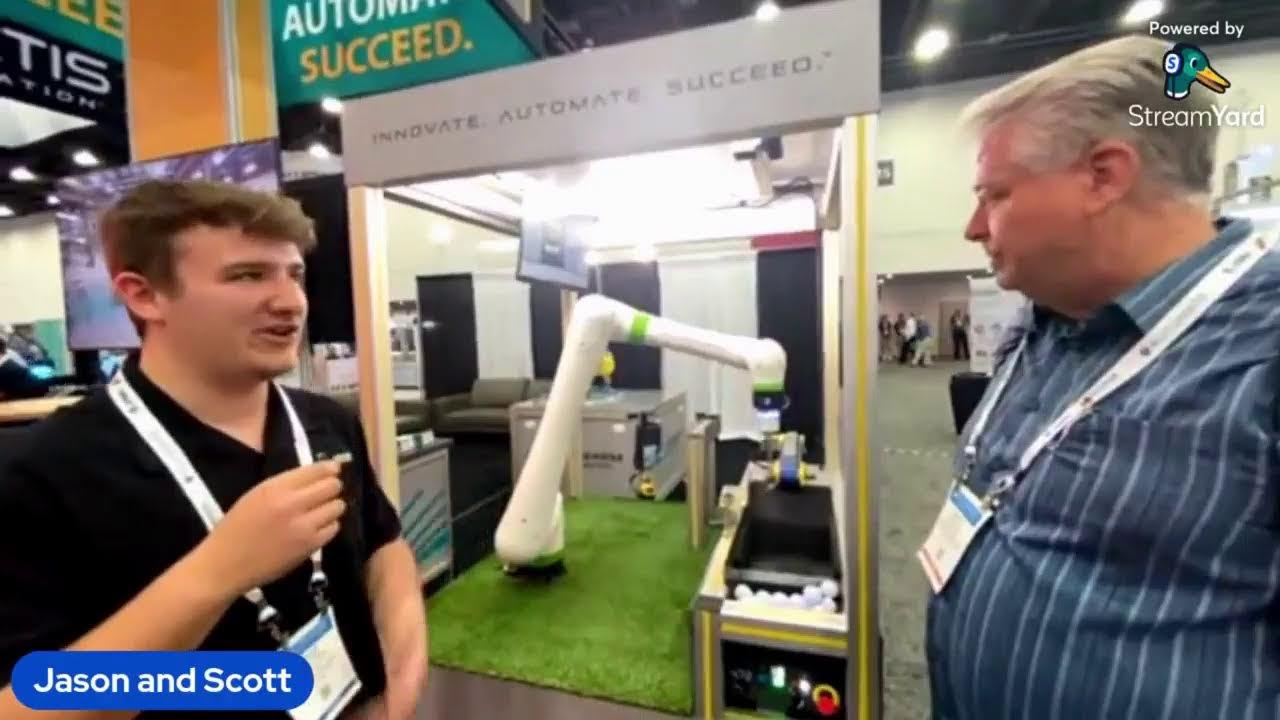
So Edgewater is a full-stack system integrator. So that means anything from the quoting process to the install process and everything in between is done all in-house. We have a few divisions: Edgewater Automation, Manufacturing, and Pharmacy. And so we do all kinds of scale-up jobs, different types of technology. I mean, one thing we pride ourselves on is that we're in every industry. And yeah, that's a brief overview of what we do at Edgewater. So this right here is using a FANUC collaborative robot. And we're also using 3D Vision up top. What this allows us to do is 3D bin picking. And through that process, it means that customers don't have to deliver their parts perfectly on a pallet and such. We can pick them out of different environments. This means it's easier on the customer end and it makes it a lot more dynamic for us.
So you guys have like solution architects and stuff, right, that are working with your end-use customers?
Yes.
And then you're designing a work cell to accomplish something?
Yep.
And then sometimes you're just building it on site, right? Making sure it works. Absolutely.
Yep, that whole process is all done in-house. So you start as a sales rep, move to an applications engineer. We give you a prototype, we give you a quote, and from there we pass it off to our engineers. It goes through the mechanical process, the electrical process, and then it's built, debugged, and then installed at your facility.
And you probably work with just a diverse set of manufacturers of all different components.
Yes, exactly. So we're not strictly FANUC. FANUC is what we use primarily, but if a customer wants a KUKA or any other company, we're able to work with them. It doesn't have to just be our standard.
Right, right. Thank you, Bryce. Yeah, thank you. Appreciate it. Yeah, thank you so much.
Yeah, so there's, you know, there's probably a dozen or more companies like Edgewater here. They're one of the better ones, but you do have the machine builders, system integrators, and And also you have high-tech automotive distributors that are here. You know, they sell a lot of these parts to the integrators and to the end users. And so we're just going to kind of end our show here. This is the Automate Live booth. So this is where a lot of the social media is happening. Folks that are with the I4O Club or watch any of our videos, Uh, might recognize some of the people. Um, we got Megan in here, uh, interviewing somebody. This is where, uh, Jake Hall hangs out, uh, and several other people. So what's really great about Automate is they have the demo area that we showed you at the beginning, they have Automate Live here, and then they have a live event studio with activities and educational stuff going on, um, on the shop floor all 3 days. And then in the other parts of the hall, they have educational series being put on by A3 for certification. So I think that's it. I hope this was helpful, and I encourage anybody, if you've never been to Automate, try to get to it in the future.










