Digital Integration. An Integrator's Point of View on Industry 4.0
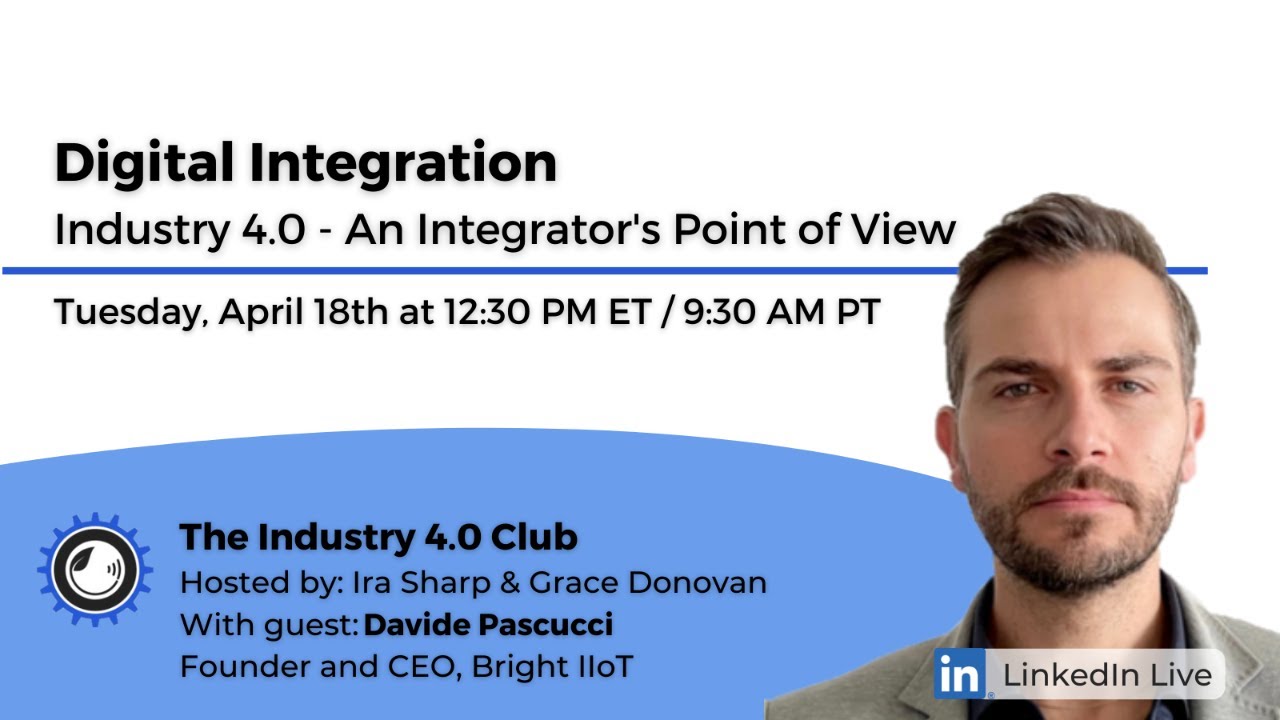
In this Industry 4.0 Club livestream, host Ira Sharp interviews Davide Pascucci, CEO of Bright IIoT (BrightEye IoT). Pascucci shares his journey from oil‑and‑gas engineering in Italy and the Middle East to running a U.S. IIoT integration firm. The conversation explores the practical differences between oil‑and‑gas and discrete manufacturing, the importance of IT/OT collaboration, and the day‑to‑day realities of system integration. They compare two open‑source SCADA platforms—Inductive’s Ignition and TADsoft—detailing licensing, scalability, and the role of MQTT brokers (SerialLinks vs. HiveMQ). Integration challenges with ERP/MES systems (SAP, NetSuite, SepaSoft, OPC Router) and the need for flexible, vendor‑agnostic connectivity are discussed. Pascucci explains a 60 % existing‑PLC/analog data, 40 % new‑sensor strategy, emphasizing simple photo‑eyes and vision where needed, and highlights production‑focused analytics such as OEE, scrap, and dashboard metrics that deliver clear ROI. The biggest hurdles are IT‑department gatekeeping, network security policies, and aligning corporate and plant‑level priorities. Their typical customers are large, multi‑site food‑and‑beverage manufacturers. They touch on emerging AI/ML—vision systems, cloud‑based model deployment—and note that most manufacturers are still building basic data pipelines before advanced analytics. Sustainability is mentioned as a future driver, with power‑usage monitoring as a first step toward net‑zero goals. The interview ends with practical advice, contact information, and a light‑hearted suggestion to digitize whiteboard data via OCR.
Chapters
All right. Hey, everybody out there. Welcome to our livestream here as part of the Industry 4.0 Club. My name's Ira Sharp, and I'm here with the Future of Manufacturing somewhat weekly podcast here. And joining me today is David, and we're gonna have a great conversation from an integrator's point of view, really looking at IoT, Industry 4.0, how all these things play together. And, and, you know, regularly here on this channel, we really like diving in, looking at the happening things in manufacturing, where things are going. Having great guests on to kind of explore every nook and cranny of things. If you are joining us here on LinkedIn or YouTube or Twitter or wherever you may be joining us, if you have any questions, comments, whatever it is you'd like us to dive into in more depth, I'd love if you could put it in the chat and we'll try to pull those in throughout the conversation. But without further ado, let's go ahead and get started here. So, David, thanks for joining us. And why don't you give us a little bit of an idea of who you are and where you're from, and then we can start to unpack some of these topics.
Yeah, sure thing. And, you know, first, you know, thank you for having me on the show. And again, you know, my name, you know, is Davide Pascucci, and I'm coming, you know, from Italy. So my, you know, my— I can give you, you know, a little bit back, you know, background history. So again, I'm coming from Italy, you know, I start working in the industry, you know, mostly it was like on engineering and designing, and my background is in the oil and gas. Okay, so I was working there for, you know, like different contractors, you know, big, for big like facilities like oil and gas. Again, I've been, you know, working in the Middle East and North Africa. And then, you know, all of a sudden I met my wife. You know, she's, you know, US citizen. And then, you know, we decide, you know, to move over here in the US. And then from that point, you know, obviously there was like a little bit of struggle, you know, to get up to speed and everything, right? But from that point, since we moved like, you know, in the mainland and my first job here, you know, like in the industry, it was in Houston, you know, still in the oil and gas. And that's where, you know, I really, you know, get into, you know, like the programming. Uh, before, most was, was most, you know, mostly, you know, theoretical, like paperwork, a lot of, you know, like, you know, blueprints, things like that. But when I came over here in the US, it was like, you know, we— I started actually, you know, doing more, you know, like, like in the field, you know, practical stuff, right? And then, uh, and then I've been working like, like I said, you know, in the oil and gas for, you know, I started like 2014 and up, up to, you know, like, uh, I would say, you know, 3 years ago, right? And then, uh, I, uh, I kind of got, you know, tired of the, you know, the lifestyle of, um, you know, the oil and gas, a lot of traveling, you know, like the environment, etc., you know. And then you start having, you know, like kids. It's like, yeah, I want to stay a little bit more home, right? Uh, and then, uh, I said, you know, I got, you know, obviously I've been, you know, LinkedIn, obviously, like, and, uh, you know, looking at this, you know, manufacturing, manufacturing, you know, robotics, and it caught my attention, right? So I said, let me, you know, dig into it and see, you know, maybe I can, you know, switch and transition to the manufacturing industry, right? And that's what I did. I start studying and studying. I said, automation is automation. Programming is the same across the board, right? And that's what I did. And then I start working for another company. And then after a year and a half, I decide to open Bright IIoT. Uh, and, uh, we are, you know, up and running, you know, full speed since last year, you know, April 2022. Uh, but I started as a side business, uh, in 2021, so it's not that long, you know. And here we are, you know, uh, 2023, you know, second quarter, and, uh, you know, pretty busy, uh, you know, thankfully. And, uh, that's kind of, you know, where I am.
Well, that's awesome. So first of all, one of the big reasons I had you introduce yourself is because I could not do your last name justice. So that was, I mean, that's the key reason right there. No, and I, and I knew you had, had a long history here, right? And I think that's, it's so great. And that's why I love having conversations with people that have such a rich history in different areas, different industries, different locations, because I'm sure things aren't quite the same in all these different areas here, and you've learned things along the way, and it's probably really helped you develop to where you are today. So, you know, I know we had some chats before this, but, you know, I am kind of curious. One of the things I didn't ask before, but I'm really curious now, is, you know, you made the jump from oil and gas over to manufacturing. Mm-hmm. What do you say the biggest differences are between those different industries or different types of systems? What are the biggest differences between those from your point of view?
I would say, you know, first are, you know, the way you do sales. It's like totally different. You know, it's mostly, you know, in the manufacturing, it's mostly like what you usually see on sales. In the oil and gas, it's like kind of a closed circle and you really need to be, you know, there where things happen. You know, that's my kind of the main differences, you know. And there are like local events. I mean, not that they're not, you know, in the manufacturing, but it's mostly like, you know, like I said, closed circle. You need to live there to just really make it happen, you know, make the connections. And so that's the main difference, you know. And then, you know, the technologies. Uh, oil and gas, you know, when you get— let's say, you know, I did tons of oil well pads, and you know, when you get the one into 2, they're, you know, repetitive, right? So something that it's hardly— I mean, at least to find, you know, uh, in the manufacturing, you know. Yeah, you have lines of production, right? But then you have different equipments. It might be, you know, that 2 plants are, you know, like mirrored, but it's hard. I mean, for what I have seen, they are like pretty, uh, do pretty much the same, right? But they, within, you know, the plants, they— I, I've seen a lot of differences, you know.
Yeah.
They, they're doing, you know, the same thing, but, you know, this one's got like this equipment, you know. Uh, instead, you know, in the oil and gas is more like, you know, cooking cat.
Yeah.
And yeah, we do have well pads. They're all the same. You know, you add like, you know, they start with 2 tanks, 4 tanks, you know, you just— and at some point with some company, we created like some, you know, like standards, right? Even on the programming side, you know, we were, you know, activating, deactivated, you know, piece of the logics to be able, you know, to commission quicker, right? But, you know, in manufacturing, yeah, it's—
Yeah, and it's interesting you say that because, you know, when I really look at the 2 industries from my standpoint, so in my experiences, is looking at the manufacturing industry, it can be different from manufacturer to manufacturer, just like it is in other industries as well, but largely there's a similar kind of way of going about things. So if you're, you know, and upstream and you have well pads and you're doing production, yes, there are nuances in how that gets done, but largely you have some sort of extractor, you have various tanks, you have, you know, things for water, these types of things. And there's lots of nuances that go in there, but it's almost like buying modules and the scale of that is so mass.
Yeah.
It's very much like, you know, we've done a lot, I've done a lot in like data centers and it's very much the same kind of thing where, Buildings may be slightly different, equipment might be slightly different, but at the end of the day, there are large modules that you need to get, which is like, okay, you gotta have the incoming power, you need to have the power distribution, you have the server racks, you have the cooling, you have the hot side, you have the cold side. The frame of it is very much the same. And there are elements of that that are the same in manufacturing, but it is a little bit more custom, a little more dynamic, and there's lots of things to consider there. there are nuances, I think there is more commonalities to some of these more traditionally processed or where there's like this extreme need for hyperscale. Like you just gotta build out as quickly as possible because, you know, being on a supplier side of the oil and gas industry, I know when they get moving, it's speed, speed, speed.
Yeah.
Safety, safety along the way, 100%, but it's How fast can I get that hole in the ground safe producing?
I would say, yeah, it's sometimes, you know, like—
Okay, well, we'll say safety. We'll say safety for the sake of this stream. Yes. Yeah.
But yeah, you're right. And especially, you know, when you, you look at the market, right? So the oil, you know, curve, like you look at the trends, right? So when it goes up, and like you said, perfectly said, they're going in a hurry. I wanted this for yesterday. And then you go there and like you said, it's like serially putting this in place and infrastructure needs to be there, right? So then, yeah, you have to wait for power to come in. Yeah, it's a process. It's something different for each industry has his own things, right? Yeah.
Yeah. So when you shape this up and you're looking at it from, you know, what you're doing in these various locations and from this integrator standpoint, I know you do a lot, well, system integration. And you with Bright IoT are getting more and more on the data side of things as well. So from, I guess, just like a high-level visualization standpoint, visualization has been done in industry for a long time.
Yeah.
Different types of SCADA out there. What are some of your experiences with this in terms of how things are being deployed and what your thoughts are on that type of element of the integration itself, the data side, getting into some sort of visualization and the data movement?
Yeah, I can start first for what we see. day by day, you know, because most of our customers are, you know, like customers that already have, you know, a plan, they already have something in there, you know, it's not like a greenfield. And some, you know, have like, let's say, you know, there's, you know, software companies that, you know, at least I don't know that they propose, you know, software, and sometimes they put like hardware in place, right? And there are, you know, we have experienced, like, limitation and frustration from the customer perspective. And some, you know, the customers are deploying, you know, from the corporate. So there are, like, different scenarios where, you know, they're deploying, you know, from several plants or, you know, from the corporate. So, and they make different decisions. So what we have seen that there are, Really, you know, a lot of you know customer with this you know custom software, and they are struggling you know with connectivity. You know talking about IoT, so they are not able to connect wherever they want, right? So I want I like to pick this you know barcode scanner, you name it, IO link device. No, we can't. You need to use just the one that are listed you know for this you know. Software, right? You know, manufacturer. Yeah. In other cases, yeah, that's the main, you know, problem I would say, you know, that we found. So our approach instead is, you know, like to keep things, you know, open source because the second problem with this, you know, companies is like, you know, support after, after, you know, like sales support. And that it's kind of, you know, nonexistent sometimes. And, you know, the ability also, you know, to modify, make changes, you know, after the sales is done, you know, there is no support, even though, you know, they sold like support, like, you know, after sales, right? So instead for us, you know, we propose like a couple of platforms, you know, that are open source that everybody knows, you know, I can make the names as, you know, one is Ignition by Inductive and the other one is TADsoft. The reason behind is, like I said, you know, because they are open source. So eventually customers, they're not all the same. Some, they have the knowledge, like, you know, to write codes, you know, I want to give the ability to them, you know, to add something, you know, if they want without, you know, even calling me. I mean, I want to, like, you know, I need to bring, like, you know, a value to the company. It's not that, hey, you need call me anytime, even for 5 minutes change. That's not the approach we have. The ability to move with this open source scenario and then Ignition, it's powerful. It's a powerhouse. You can do a lot of things. Our approach is with a customer that has a big infrastructure or big thinking where I wanted to start big. I wanted to really put this in place. That for us, say, okay, maybe Ignition with the plugins and all of that, we can make things moving faster. That's where we switched. Ignition, it's like a big picture. Not that TADsoft can't get there, but the advantage of that software is for us that with the small and medium size application, that's where I think Ignition lacks because it's like full-blown license or Edge license that is limited. It's made for remote site. We are using it in conjunction with the main application we are deploying in the cloud, etc. Again, if a customer say, hey, I want to grow a little bit, right? So step by step, I want to add these devices, a couple of devices, see how it goes. And then with TADSoft, you have the ability to scale your plant step by step.
So with the 2 different platforms, I'm just curious because you framed it well, at least your view on it, right? And how you do it. So you have kind of like, I would see, so I think about it as going to McDonald's, right? And you got the large size, you got the medium size, you got the small size. your large size, maybe down into the medium, you have your Ignition, and then medium light to small, you have your TATS office, the way you're going to frame it.
Mm-hmm.
You know, is there different ways of communicating to the assets? Do they have the same types of connections? Because I'm sure there's people out there that are listening to this right now, and whether they're users, they're integrators, or they're technologists or whatever it is, you know, they're kind of wondering, okay, well, maybe Googling it and looking up the systems. And I think you'll find with both systems there's going to be a plethora of ways to connect to them. So, you know, are there differences? Are there ways that are kind of more native to one to the other that would help you choose?
I mean, from the bottom up, you know, from let's say the plant floor up, it's kind of pretty much they are similar. You know, they have their own, you know, drivers, but, you know, and then even, you know, on the MQTT side, you know, one uses SerialLinks. It's already, you know, like it's a plugin, it's working great deployment, it's really fast. You know, the other side is HiveMQ mostly.
Which side is which?
So sorry, so Ignition is, you know, SerialLinks. Not that you can't do Mosquitto or, you know, HiveMQ, you can do that. But SerialLinks has got like a partnership, right? So And we have used that.
So it's got the broker built in so you can connect right to your office.
Yes, it's a plugin. You know, you buy this other piece of license, you add, you know, between like the edge and the main application. And like I said, deployment is— if the IT, you know, it's good at listening to you, it's working great, right? And on the other side—
You never have any problems with IT at all?
No, never.
No, I'm kidding. I'm kidding. I'm kidding. Anyway, sorry, I interrupted you.
But yeah, I mean, on the other side, they've usually a HiveMQ, but the goal is the same, transmitting MQTT instead of OPC UA. But if you need to bring the sensor from the bottom up, it's kind of same technologies, Sparkplug B, sensor OPC UA. We are talking about the same type of connector. But then, so when we work with the manufacturing, we have this aspect, which is the ERP system, right? So, and sometimes, you know, most famous is SAP or SAP, right? So, and then, and then, you know, NetSuite too. It depends on the customer, right? So one side, Ignition, you can do like, you know, hard coding or write your code, or you you use SepaSoft, right? So SepaSoft is again another plugin, uh, that, uh, you know, allows you to connect very quickly, you know, at least the connection and even the deployment of, you know, like the application. They, they have a lot of features, right, uh, that, um, that allows you, you know, to, to— because, you know, it's, it's kind of, you know, you need to define, you know, I'm gonna spend tons of hours or I'm gonna spend money in buying the plugin or the software, the piece of software I need to make this happen. That's where— and most of the time I would say I would prefer you not buy software because otherwise you're going to need to spend tons of hours building something custom. On the other side, you have the same ability, but they're using what is called— is a company from Germany to make like this ERP connection is called OPC Router. And it kind of looks like a Capware, kind of, but from, you know, Capware works like, you know, from the field app, right? So then Router OPC, it works like from, from the MES, let's say your SCADA, to the ERP and back and forth, right? And then, you know, all the cloud connections are, that are pretty much the same, you know, like with within AWS and Azure, the most famous, they are already in there. You don't need to do any particular stuff. And now Ignition will, like in September, I guess they are going to put in the market this Ignition Cloud version. So that's already, it's pre-installed and everything. It's got some basic stuff. You will pay like monthly, like if it was like, you know, a cloud subscription. But yeah, but if we still stay on-premises, you know, it's kind of like that, you know, the differences.
So, you know, so looking at all this then, if what I'm hearing is, you know, Ignition from your point of view is the bigger systems, right? And it's got a lot of things built into it. It's a little less à la carte. And it's a little bit more purpose-built, or, or can be. It has all the widgets available to it that you can license and make available, and then boom.
Mm-hmm.
Um, where, uh, other systems are going to be more bolting various things together, which could have advantages and disadvantages, I'm sure. Um, but there's a higher degree of, um, uh, customization or customizability to it. And, and it sounds like there's more of a need for integration on the entry-level systems and maybe lower systems and the higher-level systems, not that there's a need for integration, but it's integrating the platform of Ignition versus integrating various components and hooking them all together. From a scalability standpoint, you know, is there— I would assume Ignition will be your scalable platform in a bigger way from your descriptions.
Yeah.
And that's probably what you use, is that correct?
Yes, you know, we are using, you know, a lot of, you know, Ignition. And, but yeah, yeah, for scalability, yeah, it will give you like all the tools and then you will, you know, add as you go. You know, you can do like for both, with both, like I said, you know, I don't want to like give you a preference. I'm just selecting, you know, depending on the customer, you know.
Right.
Basically, it will fall down, you know, on the price, right? So because With Ignition, you need to make like a bigger investment than, you know, Tatsol, for example, you know, if you want to even start small. So that's my point, you know, where, okay, I need to figure out, okay, do you want to like, you know, to invest, you know, and then, you know, we scale and grow, you know, start from small, you can do the same thing, you know, or, you know, on the other side, do you want to really spend, you know, with the smaller license, and then we can, you know, Upgrade.
Yeah.
And go bigger. You know, that's kind of where I make, you know, like my— and I propose to the customer, look, we got these 2 options. You don't want to invest right now, I'm fine. But the good things, you know, with Ignition, we can really, you know, like build your application. And then when you're ready to deploy, then you buy the license because there is the trial, right?
Yeah.
That taps out.
You know, so I mean, it makes a lot of sense, right? So at the end of the day, you're kind of looking at the customer scenario, you're looking at what they want to do, what they're already using, these kind of things. You make a decision on kind of where that is.
Yeah.
What, what in general, you know, in your integration of these kinds of systems are the biggest challenges? Is it the selection of the system? Is it the tying in of the ERP? Is it actually the collection of the data and how you do that? Is it Is it everything?
What's the biggest challenge? The challenge would be like, again, I know it's like a hot topic. It's interfacing with the IT group because it depends. I mean, it could be like I have companies that the IT is involved up to the plant floor. You can't even connect your laptops, you know, on some companies I have. Some they did really well where they put a firewall and the OT network is just behind the firewall and then obviously, you know, respecting, you know, the subnets, etc. But, you know, we have freedom to change, modify, add, you know, and obviously, you know, we all the time, hey, with the customer, I'm going to add this, I'm going to modify this, I need another IP. But there is freedom. It depends on the customer. But the biggest challenge I would say, and obviously the more you go with deploying MES applications, it's the IT group. It's really hard for us because IT group most of the time are internal. Sometimes they are outsourced, but they're internal. So they have more power than our contractors, right? So we need to say, hey, okay, that you might need to do this. But, you know, and then, you know, I can say, you know, I kind of, you know, I'm an expert in the automation, you know, field, and I don't know anything about IT. So I'm not gonna put my hands, but there is this, you know, kind of trying to take over our space. That's that's the feeling, you know, at least I've experienced, you know, and it's not like, you know, theoretical for me. It's really, you know, like talking, having meetings and saying, yeah, we want to put the switch on, you know, we are going to put this, you know, policies, and then all of a sudden connection goes down. And then who they're going to blame? Us, you know. And then you have to try to justify, you know, and say, okay, That's not really us, but maybe you added that switch the other day. And yeah, so that's how the conversation goes. We are trying to collaborate with everybody. Our goal is to make the customer keep running and happy, right?
Yeah, it makes sense. So as a quick reset in the room here, so you're listening to an Industry 4.0 Club presentation or livestream here. My name's Ira Sharp and I'm here with David, who's the CEO of BrightEye IoT. And we're just discussing integration and IIoT and kind of how it all looks and kind of pulling it all together. And yeah, it's been a really great conversation so far and look forward to the rest of it here. So, David, I've run a number of these events here and I've also posted a number of times and sparked up conversation. And this IT/OT topic is one that is really hot.
Yeah.
Rightfully so, and that it's, that it's a hot topic. And I'm not necessarily one to say that it's right or wrong one way or another. But, you know, this, I call it a convergence. We can have a big debate on whether or not it's a convergence or not. You know, that's, I think, a 4-letter word that I just said, and there's probably comments blowing up, and probably rightfully so for that. But, you know, there's this, this point where things are coming together. And whether there's a bifurcation between the 2 points or there's harmonization between the 2 points. I think there are different tools, there's different needs, there's different requirements. But I do really truly believe that there needs to be understanding in both worlds, the carpet side and the, and the concrete side. And if those worlds are not understood between the 2 points, it just makes everybody's life much, much harder. And it can really stifle what everybody's trying to do. Because if there's too many rules imposed, and I'm sure you've seen this, Yeah. in a particular area, people will just skirt around them in some way, shape, or form.
Yeah, no, I agree.
And then if there's too much freedom, they may not be secure enough or being considerate enough of various security policies. So it's a little bit of the Goldilocks, you know, where it's like, you know, it's too hot, it's too cold, it's just right. I don't know if there really is a just right, but there is a just right for this customer. And communications is key. and understanding the risks involved and taking a look at everything and really having some ownership and going down this way. It's really, really important, I think, in everything you're saying.
It is.
It is. That's my point of view. If you're willing to comment on it, because let me tell you, people can be very vocal about it for very good reason. But, you know, what are your thoughts on that topic?
Well, I agree completely with you and the conversation, it's what needs to happen every time and get together and figure out a plan of action, right? So how we're going to tackle this problem, right? And on the OT space, we can bring our expertise, right? So especially maybe when you have motion control application and sometimes, I mean, on new ones you need to use time synchronization, you need to use particular switches, right? So you need to set up those switches in a manner that, you know, everything will be synchronized within, within that machine that you build, right, or wherever it is. So cases like that, you know, and I can bring up, you know, more cases, you know, but, and, uh, and, and for that reason, like, also, you know, I'm, I've been, you know, it's a friend of mine, I guess, you know, you know, Josh Fergie is, you know, when I have like this type of you know, situations is, is my man, you know, is really, you know, like, he is an expert on the OT network. And thank God, you know, he is, you know, like 1 hour away from here. And, and it's great to have him, to have him, you know, around. And, you know, we always, you know, communicating. But again, you know, when I have like, you know, a network There you go, Josh, come over. And that's what we are trying to do too. We know, like I said, automation, integration, things like that, but we're trying to partner with either Traceroute or an electrical contractor. So we're trying to put this team together to tackle projects. But yeah, communication is key. It's what needs to happen, like bringing both expertise and and try, like you said, customize for that particular scenario or customer and trying to make it work at the end.
That's good. In your experience then, in the different types of applications that you've done, and maybe looking at your whole career, what are the best applications that you're seeing people actually do with IoT collecting this data? Is it just simply visualizing things and visualizing alarms like via SCADA, or what are some of the killer apps that you're seeing?
Well, I would say that the most demanded, at least in the manufacturing, it's like the metrics to the dashboard in the trendings, you know, the production, you know, and some customer we have, you know, they're really looking at the number we are popping up into this, you know, we are building dashboards and reporting. So with that, you know, like number, they're really gonna build the customers they have. So that's one, you know, like really helpful for the customers. On other ones, you know, hey, we really need to know, you know, like how much we, you know, we produce This plant between, you know, this other, you know, plant between Plan A and Plan B. Uh, some they're, they're doing like, you know, there's, there's, um, they call, you know, Operation Excellence. Some of them that, you know, they go through, okay, they, they, we are looking at the, at the devices, at the equipment, at the machine, what we can, you know, extract from, you know, like the machine. So again, OE metrics. And then some of them, they already have like, you know, the OE platform, you know, the MES platform. So we just need like, you know, to build, you know, what is needed, maybe, you know, add some sensor, you know. And, you know, talking about sensors to count this stuff, it could be like simple, you know, photoeyes. It doesn't need to be, you know, rocket science. So we start always simple, you know, like we say simplified automation for that reason because Keep things simple. It's easy to troubleshoot. And you always, I think, at least I think like always 5 steps ahead. What could cause if I put in place this device for the maintenance guys? What could cause for them to troubleshoot and fix if something goes wrong? So yeah, I mean, for sensors, we put a lot of photoeyes. If something, it's more complex, then we go with the vision. But things like that, there's nothing crazy or super complex at the beginning, at least if it's not needed. But yeah, like I said, application like IIoT from lights, light curtains, sensors, photo eyes, you know, and then that allows us, you know, to build like this, you know, metrics eventually. You know, we tied into an existing machine, reusing, you know, the same PLC, modifying the codes, get this number sent to, you know, a data concentrator that the customer already have. Then from there they can, you know, fish and grab the data and, you know, put on the screens.
So it sounds like it's a lot of metric-based data that is faced or centered around production, which is nice because it has a very clear ROI. You know, if I see these types of production and I know that I can go push on that, I can get potentially more production or potentially look at why things aren't going the way I want.
You know, and then the other side of the coin would be the scraps, right? So you want to go to the production side and see the scraps and check the balance ultimately. Then you can go deeper, monitor your pressure, your pH, temperature, you name it. Then from there, you really can get deep in this. First, IIoT, have the machine fully connected because sometimes they retrofit this machine and we have done a lot of retrofits, but they're still mostly mechanical or pneumatic. Right? So they really don't have like too much, you know, like sensors. So we can, you know, we have added and we can add that, that those type of sensor to bring it back, right? So then from there, just, you know, by, you know, like coding and putting together, do some math basically, you know, and we can, you know, show to the customer, hey, that's what you're making. That's, that's what, you know, the temperature was like that, you know, start logging, you know, and Yeah, we can grow from there, but first thing needs to happen is, you know, on the plant floor, what, how, you know, the machine is visible from, you know, like your, you know, MES system. What data are you getting there? Nothing, maybe, you know, I don't have anything, you know, it's like, yeah.
So with this, you know, that you're saying about, you know, focusing on OEE and scrap and All those production metrics, right?
Yeah.
What is your typical customer base? Like, are they like small to mid-sized manufacturers? Are they large-scale customers? Not looking for specific names. I don't know if you could share that, but, you know, just in general, because I'm just curious on the—
They are, yeah, big, you know, big-scale manufacturers. Mostly we have, you know, I guess for the area, it's, you know, food and bev. But we have a variety, you know, and so yeah, the tendencies is, you know, like big size, you know, and they are, you know, in multiple states, even, you know, worldwide.
Mm-hmm.
But, you know, where we operate is like, you know, mostly locally. We have, you know, some customers, you know, in the East Coast, some, you know, in the Midwest, but, you know, mainly it's like, you know, local right here where Where, you know, our starting point is, you know, we are trying, you know, to reach out, you know, to these customers first. But the starting point for us is, you know, like troubleshooting, you know, first approach, you know, something goes down and then from there, you know, we just, you know, move on. Hey, by the way, you fixed this, then take a look at that.
Yeah, you build that reputation there. So You mentioned that you talk with more of the, just the OT side and doing the integration and these kind of things, and then IT gets in the room and, you know, you can have those conversations or help facilitate that with partners. Do these organizations that you know of have different types of groups that are focusing in on IoT or Industry 4.0? You mentioned operational excellence, you know, do they have teams that are focused on smart data and looking at things more from a data perspective than just a—
Yeah.
This is what I'm producing perspective.
Yeah, I mean, ultimately, you know, they want— corporates want to know, you know, like, you know what, they want to like really have a grasp of what's going on, you know, in the plant. And there are, like you mentioned, teams that are involved in this, you know, from the corporate level are involved on, you know, this, you know, operation, you know, excellence, you know, they call different names, right? But ultimately, it's like their goal, you know, from the corporate standpoint, to come to every plant. And what they're going to do, they're going to do a hold it, right? Kind of, and see, you know, where you stand and then identify, hey, this is, you know, like this line is really, you know, making a lot of money. But, you know, what we are making here, you have like the whiteboards a lot of times, you know, you write it down, numbers, and some are transferred to their existing system. But again, you know, they really want to like real-time data coming in, and then they task you, say, hey, add this, add that, find a way to read the production from that lines. That's the way it's developed.
So with what you just said there then, if you're looking to get new data, maybe data that's not exposed today, is it typically sensors that already exist? Are you installing sensors? I'm sure I'm sure it's a mix, but it is like, what would you say the majority is? Is it like that sensor data is already in that PLC and I'm gonna actually modify the code of the PLC to produce it in some way or have it output an analog so I can get that? Or are you strapping on a new sensor and literally getting in an entirely different direction?
60/40.
Which way?
60 existing, 40, you know, new.
Okay.
I would say. Okay.
Yeah, that's a pretty decent chunk of new sensors then that you're connecting in.
Yeah.
And is some of that sensor like doing something that another sensor is already doing, just going a different location? Are they redundant?
Yeah, I would say, you know, different locations. Some, you know, are not even in there. Like I said, you know, some machines are like old enough that You know, they have like sensors to define, hey, turn, you know, display conveyor, you know, right, you know, and move the, this, you know, like servo, you know, from point A to point B. But there is not really like, you know, any OE built in, right? So we are talking about, like I said, you know, 15 years old machines, you know, 20 years old, you know, that have been like, you know, like upgraded with You know, new controllers with the capabilities like Ethernet IP capabilities, right? So, but again, the machine, the mechanical aspect, you know, it stayed the same, right? So just the control were upgraded.
And, and then that's what you have, you know, it's like, yeah, the machine is working great, you know, it sees that, you know, and, you know, do whatever it needs to do, like, and, but Well, you know, I mean, looking at all that then, so you've installed new sensors, you've dealt with big customers, small customers, large SCADA systems, small SCADA systems or IoT systems, you know, you've kind of tied in with different ERP systems and MES systems, it sounds like. So it's a pretty wide array of experience.
Yes.
Thus far, what have been your kind of like lessons learned or best practices Is there like, duh, stay away from this kind of customer, or this is perfect, or this is whatever it is? What are kind of some of the things that stand out as a good thing or as an IT showed up, so just leave kind of scenario? I don't know.
For us, you know, we can't afford to be picky, at least at this point. You know, we are new. We need to be like, you know, be out there and trying to help, you know, we actually, you know, try to get as much as possible, you know. And then from there, we learn a lot of things every time. Every time it's different. So we, we don't have the luxury, in other words, you know, to say, hey, you know, I don't want to really to work with this guy. We are trying to help everybody at this point, you know, if it's possible, right?
Mm-hmm.
So, uh, but, you know, I'm always like, like I said, you know, collaboration, communication, always try, you know, to, to work what what the customer is, you know. And sometimes, you know, you got frustrated. Yes, you know, I, I've been like, you know, like on plans where, you know, for 3 days I couldn't do anything apart like, you know, setting up their laptop with, you know, the right software because I couldn't use mine. But when we passed that, that, you know, period of time, then I could do the works, you know. It's like having, you know, be patient. It's like, you know, knowing Well, how the customer works internally and at the corporate level, you know, knowing, like, meeting with the people internally. And then when you figured out that, then, then, you know, it's kind of, you know, it goes smoother, I would say, you know. And you know who to contact, you know. It's like, yes, again, you know, we're trying, you know, avoiding— I mean, it's like, at this point, I would say, you know, I have some that if it breaks, you know, they call you, you know, something breaks and they don't wanna really like invest. And those ones, you know, I, I still, you know, trying to help them, you know, if, if I have time, right? So, but, uh, for me, you know, like, yeah, you really don't wanna like to fix the problem from the root, right? So it's like putting patches. And temporary patches are fine, you know, to keep you rolling, right? But, you know, the long run, you really want it to be like, that's what you want, you know, you want it to really be productive, right? So, and they're staying down like 2, 3, 4 weeks. Yeah, it depends. You know, it's always like, you know, a fight with the corporate, you know, I had like, you know, a recent like troubleshooting that I was able to fix it, but he took me like, you know, 3 days because this machine was coming from China and all components, you know. And then the, the, um, the PLC manufacturer, you know, even though it seems like they have like support here, is I call like 5, 6 different numbers, you know, no one answered.
Wow.
So I tried to figure out as much as I could, you know, I could fix it again, you know. But yeah, those type of customers that say, yeah, if it breaks, it breaks. But you've seen, you see like the manufacturer Sorry, the, uh, the maintenance, you know, like, uh, people that are going crazy, you know, every week something broke or something they need to fix, you know, and then they go like to the prince, it's all Chinese, you know, it's, it's like things like that, you know, are difficult, you know, to, to, to deal with. Non-death, like I said, you know, trying to help, but, you know, and yeah.
Yeah, makes sense. Yeah, well, um, so We're nearing the end of the conversation here, but I got another big question for you. And I'm curious if you're seeing it all, and if you're not seeing it or you are seeing it, I'd love to hear that. And then also just your general idea of it. So AI right now is kind of all the rage and everything that's going on. And then in manufacturing, you know, I think there's machine learning, which is part of AI, getting into deep learning and all this. Are you seeing that at all? Are you deploying it at all? Like, what are—
Well, The first example is like a vision system. So those devices, you need the most famous, they already have embedded AIs in there to recognize from good and bad and from different snapshots and pictures, right? So that's the first example. But then going more deeper, I don't think we are there yet. We are still in this phase to bring what the machines already have up to speed, like what we just discussed. It's moving along, but even the machine learning side, you need to really have the computing power in the cloud, using the cloud, and develop your model and then push it back to the edge. It's kind of, I think it's the next step, you know, moving forward. Uh, we are gonna see more and more. Maybe, you know, some OEMs are gonna have like, you know, like boxes, you know, or, you know, there's already stuff, you know, out there for sure, you know. But we aren't— I don't think we are, you know, there yet. And then, you know, also, you know, with ChatGPT now it's booming, you know, and, uh They're all tools, right? So that again, you know, we are moving that direction. But, you know, at this phase of, you know, like the, our, you know, industry, it's mostly like, you know, to get them up to speed. Some are, you know, close or closer, some not. There will be someone left behind, I would say. Yes. If they don't start, you know, doing it. Yes.
Yeah.
But, you know, Yeah, go ahead.
And that'll be interesting. I mean, like, because I also agree, you know, and it's interesting what you're seeing from your point of view, you know, in the integration side of things, because, you know, from a manufacturer perspective, regardless of industry, I think if you're not collecting data, you're behind a little bit. You need to start collecting data. You need to do it in a normalized way so then you can leverage that data and utilize that data. It's got to be across the entire facility and, and kind of all the nuances.
Yeah.
Because you got to visualize your process, and that'll give you a grander view of how you need to deploy resources, how you need to call in support, all these kind of things. And then if you extrapolate that to the next level, and if you employ AI or ML or deep learning on those topics, maybe it can help you identify things you hadn't thought of. And then if you incorporate that with other types of processes, Natural language processing or whatever it may be, you can get some strong insights on your system and facility. But that's, I think, definitely looking at the future of what it is.
Exactly.
You gotta start somewhere.
You need to get there first. That's what I'm trying, you know, to explain, you know, that first we need to get there when we have like all the data. Like, you know, we are adding devices like we discussed, you know, when we got like we got to that point, then, you know, we can move to the next level, which is, you know, like the, the height of, you know, AIs and things like that, right? So, but I go, you know, walk down the plants, they still have, you know, this big whiteboards, people writing by hand. So, and these companies, they, they need to put themselves against, you know, their competitors, okay? So if one of let's say one of their competitors are start— they already, most of them already have like Ignition in there, you know, sitting in there, you know, doing 2, 3 things. Let's say if they are going to transfer all of this, you know, like, you know, writing enhanced stuff to, to a more automated, you know, uh, system. So they are going to take, take an edge, you know, an advantage from you, right? So what you're going to do, right? So are you gonna like try to keep up? now, or, you know, just left behind. And maybe, you know, ultimately, you know, you're gonna close, right? Because then the technology evolves, they're gonna— they can get things out, you know, faster, they can identify where their problem is in real time. Oops, here, you know, like, that's where I have the most, you know, 95% of the downtime is right there. So let's, you know, address these issues right away, not after 6 months.
Right.
And then—
So I got the perfect product for you. I have the perfect product for you, David. So what you need to do is this. So in those manufacturers where there's that big whiteboard, I know they exist. This is a little tongue-in-cheek, but, you know, if they're writing down all the data and all their metrics on this whiteboard, maybe what you can do is you can set up a vision system that takes a look at that, uses OCR to pull that into a digital system so then you can analyze it so that they can manually put it on a whiteboard so they can digitally put it in their system.
Right, yeah.
So then the next step would be to remove that system and replace it with sensors so you can get that automatically. And then you can move that to the next customer to help prove out that process. Maybe that can be your gateway, you know.
Yeah, that's a good idea, you know.
The temporary free trial of your whiteboard reader to digitalize your data. Just make sure you have all the variables properly defined, you know, line 1, Machine 2, door 3, so on, so on, so on. So yeah, yeah. So, you know, as we again kind of come to a close here, you know, is there anything that you wanted to make sure that we discussed, chatted about, whatever else it may be from your side?
No, I think, you know, we cover, you know, all the aspects, you know, and this last question, that's what I wanted, you know, to to bring in, but it came in naturally, you know, like the status of the different customers. And yeah, I think, you know, we— I think we're good.
Okay, good. So, you know, then looking at everything, you know, it's interesting to hear, you know, I think there's a lot of movement that happens in all different types of manufacturers and the types of manufacturers you're dealing with, particularly in the food and bev. You know, one of the things that was interesting to me is when I think of food and bev, you know, I think of, I think of like shows and I don't know if you know this show, but like Pack Expo.
Yeah.
It's a big, huge show. It's focused on food and bev. And if you look at the Pack Expo show that's coming up later this year, you know, sustainability is like the big trend.
Yeah.
It's the big word that's there. I mean, are any of your customers screaming about that or collecting data or pushing for that? Are you involved in these kind of efforts at all, or is it just, um, people just trying to figure things out right now?
Sustainability, I mean, no, they didn't bring like that topic in. At least I didn't hear yet. You know, there are like, you know, some, some companies, you know, they, they use, you know, recycled product. If you— I guess you're talking about like, you know, reusing and and be sustainable, like not producing too much waste, right?
Well, I mean, it could really mean anything.
Yeah.
And I've seen lots of examples. From my side, I would say one of the biggest areas that I've seen people making sustainability claims and really pushing is on electricity use and trying to be net zero. So if you use this much power or you get this much energy, you're producing this many fossil fuels, whether it be through production or through energy. How can you offset that? How can you generate that? How can you reclaim things? How can you do these different things to basically make yourself neutral in the, in the grander environment?
Okay, okay. From, from that side, yeah, I mean, I didn't see, you know, too much stuff, to be honest, uh, so far. Uh, you know, running these big facilities and be, you know, net zero, I think it's gonna be a big challenge. And especially, you know, using, you know, alternative, you know, like energy resources. But that's my point, you know, just my opinion, you know. And so we, in other words, if we keep going at this speed, you know, of production, and you want to like to Yeah, there are ways obviously to save money. Maybe, you know, you're wasting, you know, energy, like, because I've seen like conveyors running even if everything is off, right? So, and that, that, that's a waste, right? That's the most common, you know, things that you can see in the plant. So maybe, you know, tackle, uh, those, you know, like little things around the plants. It could definitely help, you know. And then what, what I've seen a lot of issues is on, on the Power surging. Yes. So power surging that, that have destroyed devices. So they, the companies want to, wants to protect their, their assets. And we are, you know, doing that too. Again, utilizing, you know, like one of our, you know, like partners that they, they sell this, you know, type of devices.
Mm-hmm.
You know, even on the 480 side, you know, Um, but yeah, it can be done like that way, you know, uh, net zero. Uh, you know, when you have like these facilities working 24/7, and most of them like that, you know, food, like you need to stop, like, you know, for cleaning. But again, the facility is kind of on, it's not like completely shut down, right? So, and then 24/7, we have others, you know, 24/7 production. It's a lot of power demand.
Yeah. Yeah. And that's what I was curious about. And it's good to hear that from your side. I mean, I see it as, you know, as companies want to become more sustainable, they first have to have a baseline. Baseline is, you know, what are your emissions? What are you doing currently? What is your power usage? And you can do that with some big power meters, and then you can take a step down and figure out what's going on with this machine, that machine, this conveyor, that conveyor. You know, what is your scrap? What are your, you know, if you're using any kind of burning, you know, what are all those emissions all rolled up into one? And then what are the things that you can do to augment? Are you bringing products back? Are you shedding off into areas where maybe you're still pulling power from the grid, but maybe it's green power instead of dirty power or whatever it is? You know, there's lots of different things there.
Yeah.
But understanding from your point of view kind of where things Were was really what I was looking for.
Yeah, right now, yeah, I don't see, you know, anything, you know, major like, hey, we want to really, you know, monitor our consumption and things like that. I have, you know, a customer in particular, they are monitoring that, but because, again, they are billing against, you know, the wattage on the kilowatts. But it's mostly like for them to make money, not just looking, you know, at the sustainability sustainability factor. But yeah.
Okay. All right, well, that's good. Well, thank you very much for that insight, and I think this has been a fantastic conversation. And for everybody out there, you know, you've been listening to a podcast from the Industry 4.0 Club focused on the future of manufacturing. My name's Ira. I've been moderating this conversation with David, And David, thank you so much for your insights and kind of give us an overview where things are. You know, I'll give you a chance here for any parting words you may have, give everybody an idea of where they can find you. And, you know, I know you own the integration company, so, you know, if anybody needs any help in the area, I'm sure you'd be willing to help them out. So yeah, maybe a little plug from your side.
Yeah, first, you know, thanks for having me, Ira, and I appreciate, really appreciate you inviting me, first of all. And then, so we are based here in the DFW area of Texas. You can find us in our website. First thing, we just upgraded the website as brightiiot.com, and you can book directly if you go to the Contact Us. You can book directly with Calendly, 30-minute meeting. It's working really good, I would say. We just implemented that, so that's the easiest way to do it. Or like on LinkedIn, you can request, send me a message right there.
I'm really responsive.
My email address is davidp@brightiiot.com. That's where you can find me.
That's awesome. Well, thank you so much, David. I'll say from my point of view, the biggest thing that I took away from this is that, you know, things are happening on the factory floor, particularly in your area, particularly in the food and bev industry. And, you know, things are always advancing and there's different scales of implementation of these systems. And it was great to hear some, some real boots on the ground life experience of what's going on there. So really thank you for your time and appreciate it.
Thanks.
And with that, yep, I guess we'll go ahead and close it out. So Grace, if you can help us and hit that button.










