Digital Natives: What is Motivating the Gen Z Workforce?
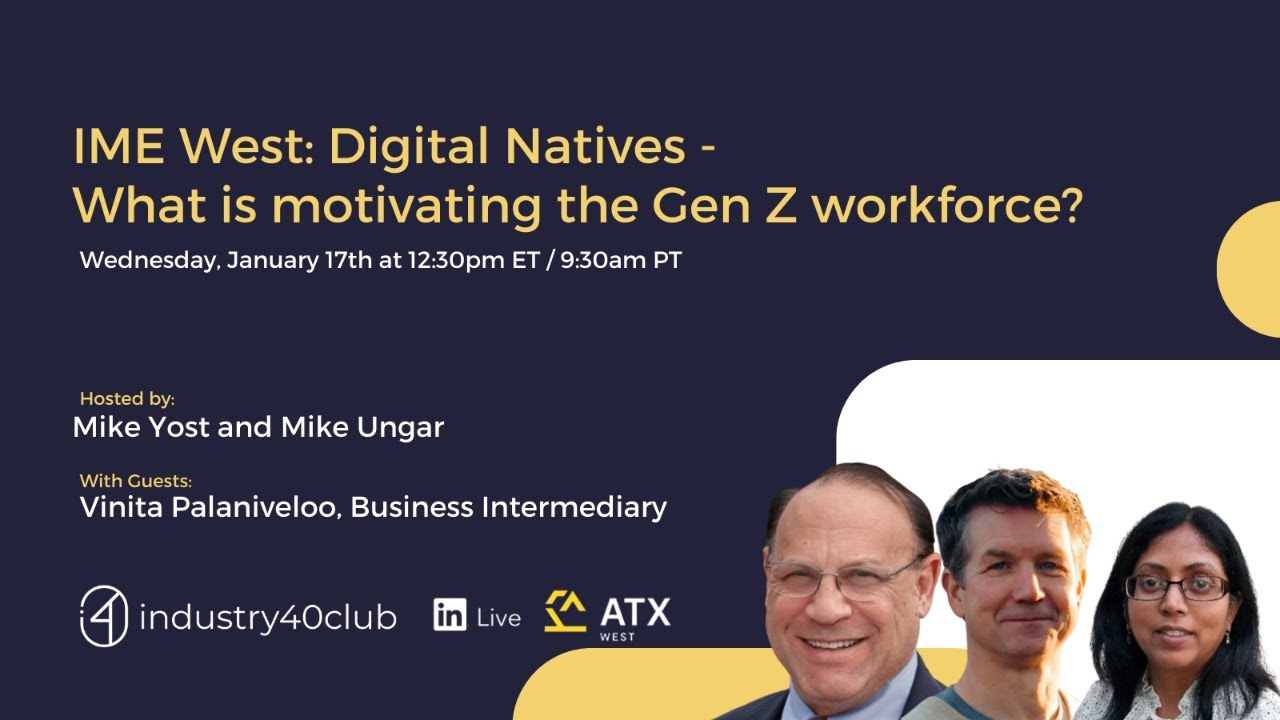
In this Industry 4.0 Club fireside chat, co‑founder Mike Unger welcomes Vanita Palaniwala‑Liu, a PhD‑holding AI/ML researcher, SWE activist, and diversity‑org collaborator. Vanita explains her role as moderator of the upcoming IME West panel “Digital Natives: What’s Motivating the Gen Z Workforce,” describing the diverse panelists (engineers in medical devices, robotics, automation) and the emphasis on gender, ethnicity, and immigration diversity. The conversation shifts to generational contrasts: Gen X’s work‑life balance, Millennials’ focus on personal worth and career growth, and Gen Z’s upbringing in a hyper‑connected, pandemic‑shaped world. Vanita identifies Gen Z’s primary motivators as financial security, community‑oriented purpose, environmental and socioeconomic equity, and a desire for meaningful impact. She outlines how manufacturers can attract and retain Gen Z talent through mentorship, community‑focused programs, purpose‑driven communication, and leveraging AI/IoT to let younger workers contribute directly to product and process innovation. The dialogue also highlights diversity.org’s STEM outreach at IME West, bringing high‑school students onto the expo floor to spark early interest in engineering. The chat concludes with a call‑to‑action inviting listeners to register for the February 6 panel in Anaheim and to engage with the broader IME West conference.
Chapters
Good afternoon, good morning everybody. My name is Mike Unger and I am one of the co-founders of the Industry 4.0 Club, um, and we're really happy today to have with us As our guest, Vanita Palaniwala-Liu. I hope I don't mess that up too bad, Vanita. Thank you for your patience with that. So this fireside chat is the 3rd of a series of fireside chats leading up to Informal Markets IME West event, which is going to take place in Anaheim, California from February 5th to February 8th. The Industry 4.0 Club has been busy putting together a great agenda, a group of speakers that are going to be part of the advanced manufacturing track. As well as some speakers on center stage. And we've been highlighting some of those individuals during the month of January. As I mentioned, our guest today is Vanita Palaniwela Velu. Vanita was born and raised in India and later decided to make the world her home. She obtained her PhD in computer science and engineering from the University of New South Wales in Sydney, Australia. She's also part of the AI and ML group at the university, where she did research in the application of a formal methodology for electronic design automation. She first got introduced to robotics at the university, and really technology and problem-solving, she says, is what makes her tick. So that's— I think I've gotten to know you a little bit. That certainly makes a lot of sense. So she's an immigrant and a mother, and she understands the dilemma that women face in choosing between family and the love of their profession. One of the passions that Vanita has is that she's an active member of the Society of Women Engineers, and she focuses a lot on helping and creating programs to support women's reentry into the workforce after a break. So we really are excited because Vanita is going to be moderating a panel for us at IME West. That panel is going to be titled Digital Natives: What's Motivating the Gen Z Workforce. Vanita is going to be with this panel on February 6th from 11:15 AM to 12 PM at the Anaheim Convention Center. Welcome, Vanita. We're really glad you could join us today.
Thanks, Mike, and thanks for the opportunity to put together a panel. It's been exciting run, like selecting the panelists.
Well, that's funny you mentioned that. I was going to ask you, can you talk a minute about who's going to be joining you? Who's going to be on your panel?
Uh, it's a great panel, like I mentioned, and we have gone and selected people from diverse backgrounds. We have focused on diversity in the area of gender, ethnicity, and immigration status because these are early career engineers. We want to understand, uh, what makes them tick. They come from different walks of life with different myriads of dreams and ambitions. Just to give a brief of the people that I would be having on the panel are Jennifer. She is in the area of medical devices, and we have Salma and Tarun who work in the area of robotics and automation, and Marlee, again, she works in medical devices. So I'm excited to have them all.
Yeah, so where did you meet these folks? I mean, I know You're in SWE and you do lots of things in the community, but where have you met these folks?
A lot of them were through the connections that I've met through the community. I've let the word out asking to shortlist people who are interested to be on the panel. I was going through the process of vetting and selecting the people who I know would be a good fit. to put them on the podiums of IME West.
Yeah, that's great. You shared a lot of their bios. In fact, the bios are available on the IME website, but you shared a lot of their bios with me, and they're a fascinating group of individuals. I can't wait to hear from them. One of the reasons we want to hear from Gen Zs is obviously every generation we characterize with different perspectives. What differentiates in your mind a Gen Z individual from a millennial?
Coming from Gen X, I find that Gen X are more independent and we focus on work-life balance and collaboration with people. We also focus on having empathy for people in front of you and we try to be polite. So when we look at the millennials, we say that they are not as polite as us. Then I went on to explore what makes the difference between millennials and Gen Zs. Why is there so much of complaint? What I see is that millennials are in the between their late 20s and late in their late 30s, and they grew up in a place where they value personal worth. and creativity in their workplace, and career growth is their focal point. Whereas Gen Zs, they are people who are in the prime of their youth between 21 and 25 years old, and they actually grew up with the internet.
Yeah.
For them, they are bombarded with a lot of information, and they started their career in the height of pandemic. And they started their work in a hybrid and remote workplace. And they've seen a lot of uncertainty in terms of whether it's pandemic or whether it's financial instability. So their focus is more on having a workplace that would give them— make them feel financially secure. That's their focus. Their priority lies in financial stability.
Well, yeah, I hear a lot though, that they also want to have purpose in their work. Is that something also that you understand?
Yes. For them, it is the social cost, the community well-being is their primary focus. It's equality, the socioeconomic status of people. It's the environmental consciousness. So these are their primary focus. And They are more focused towards the well-being of the whole community rather than just their personal growth.
Yeah, no, that's, that's interesting. It's, you know, I'm a baby boomer myself. So I'm on the other end of the spectrum. And, you know, we have, I think we hear today that we've got 5 generations in the workforce. And so understanding each and bringing them all together is quite a challenge for a lot of companies. When you prepare for the panel, what types of questions are you going to be asking them?
What I see in Gen Zs is they want more of financial security, work security, which will help them to focus on what they could give back to the community. My question is more geared towards, understanding them to see what would make them feel secure, and how to make them commit to the workplace and deliver in the workplace as they focus on other things that's important in the community. It's bringing together a place where we can empathize where they are coming from. We can create a workplace where we could help them thrive and grow, As the leader for the— as future leaders.
Yeah, I think it's interesting. I know you've got a really diverse group of people that you've got, 4 people who are going to be on the panel. I think it's going to be interesting to see if there's any conclusions we can draw from their answers or the other thing we know is that everybody's unique also in their own perspective. I'm anxious to see how their responses come together.
Yes, and I've been like contemplating on things like, uh, how happy like as a Gen Z you are when you get a bonus or a promotion.
Yeah.
Whereas, uh, when it, when it comes to, uh, Gen Zs, their thought is like, okay, it's a one-off thing, and how, how, how is that going to impact me in the long term? So, uh, it's trying to understand where that loyalty lies. and what's important for Gen Zs versus Gen X or the 5 generations that are in the workforce.
That's true. It'd be interesting. I'm excited to listen in on it. If we think about— because we're targeting— this is part of the advanced manufacturing track. Part of what we want folks to begin to think about manufacturing in particular, is how they attract and retain Gen Z workers for their businesses. Can you— what are your thoughts on that? And that really, how should manufacturers attract those folks and retain them in a way that they're going to really bring value to their companies?
I'm thinking like, The companies who want to grow or who are going to be in that growth cycle are the companies who put effort in retaining those Gen Zs and who are able to bring them together to build up their company. What we need to do is inspire those leaders who are mentoring the Gen Zs, to come up with programs that can help them contribute or give back to the community and provide a way for them to express the things that Gen Zs value most. That's where we need to come together in bringing together programs that is going to help the company and also going to help the community.
Is there something— I know we're going to learn more from the panelists, but is there something that you've seen already in other companies that someone's doing that's unique because of the Gen Z population?
Um, I would say that from the group that I've picked, uh, they are trying to add more of mentorship in there, uh, to actually, uh, integrate the younger generation into the workforce.
Yes.
And I'm also like, we had a panel at Society for Women Engineers where we were talking to women from big, large Fortune 500 companies, where the companies are providing incentives on the times that they spend towards community projects. And that is kind of helping the younger generation develop the network and give back to the community. There's some things that the companies can do in terms of letting the younger generation expand their network.
That's really good. I think about my background, I spent 35 years with Michelin. When we would have our French colleagues come over, to work in the US, they were always very impressed with, in general, about how our society focuses on community. In a more socialistic society, a lot of that's done by the government, and in a society like ours, it's more done by the community. It's interesting to see that that emphasis is more and more because I think it's already in some ways a unique part of our culture. But I think Gen Z may actually help it become even more pronounced.
Absolutely, I agree with it. That's something that I learned or experienced when I was part of the diversity.org panel at IMV West, how they are impacting the younger generations to get an equal opportunity in the workforce for people coming from disadvantaged background. That is giving back to the community, like opening up opportunities opportunities for people and creating equality. It's happy to see the things that makes this Gen Zs tick.
I've got a follow-up question. Karen's listening online with us now, and I'm going to put her question up here. Maybe we can respond to it. Karen asks the question, she says, given the importance of purpose-driven work for Gen Zs, How can manufacturing organizations emphasize the meaningful impact of their own products and processes to motivate and engage younger employees? What are your thoughts on that?
I think as Gen Zs come into the workforce, we are going to see a lot of AI and IoT-driven technologies coming in there, which I think, like, in specific, the manufacturing area requires people to be present in the workflow and contributing it. There's going to be a slight shift in the way the workforce of the future is going to be. I think those new technologies will pave way for people to actually go about doing what they like as well as contributing to the product and process in the workplace.
Thank you for that. It'll be interesting to hear, and that might even be a question that we can ask of the panelists too a little bit to see what their perspective is on On how they choose a company and how important that element is to them.
Yeah.
That'd be great. Yeah, I know. It'd be interesting. It's going to be so rich to hear from these young folks. I call them young folks, but I can't wait to understand how they see the workplace. Folks that attend the session, what do you hope that they come away with from being part of the audience listening to the panel? What are you hoping that they learn?
The questions that I'm focusing on is to provide the key takeaway in the area of empathizing where Gen Zs are coming from, from what has shaped their life in terms of the internet, the pandemic, the financial insecurity, and also for the companies to tailor the rewards and the communication to grow that younger workforce so that they can actually reap into the creativity and energy of this untapped potential that lies there.
Yeah, thank you. That, that'll be real interesting. I'm with you on that. I hope that folks come ready to learn a little bit about those things. That's fantastic. I wanted to ask you about one other thing. And I think last year, and I think this year as well, you're participating with diversity.org in their work at the conference. Is that right?
Yes, I'm helping them put together a panel for diversity.org.
Can you talk for a moment about what that's all about as well? Because I think that's something that'd be interesting for our listeners to see what else is going on at IME West that you're involved with.
I was impressed by what diversity.org, the nonprofit organization, was doing. in terms of providing an opportunity for people from a background— in specific, I'm going to talk about how they help with the engineering community because that's something that I've seen at IME West. They brought in students, high school students from Orange County School District to walk the floor of the IME West Expo and look at the technologies or the future. There were so many students who got the exposure to see what engineers do and what is the future that we are building. Coming from a place where, for me, the first exposure to computer was a Turing computer that was brought into my school. I was so excited when someone asked me to type in the prompt my name, and all that computer did was it said, hi, Vineeta. It was like, in text. And then at that moment, I was thinking like, I should be able to do what those people are doing. So that's something that you plant the seeds in younger— the heart of the younger youth, and they are doing it. And we are going to see the impact of that in the future.
Yeah, that's fantastic. Well, it's a great program. I I don't know that everybody always recognizes what goes on behind the scenes with Informal Markets and IME West, but the work they're doing with diversity.org at many of their events to engage the local high school population in exposing them to tech, just like you described for you. Yeah, that's a really great thing that they do, and it really sets up the future of bringing more and more people into STEM careers, doesn't it?
Yeah, because you have to see it to be it. You have to know what exists, and that's something that they're bringing to the younger kids.
That's fantastic. Well, you got a lot planned out there in Anaheim between the panel and diversity.org. First of all, thanks for what you're doing to help advance individuals in STEM careers. for, for women and Gen Zs and for really everybody. Um, you know, each of us has our own ability to make an impact, and, uh, yours is certainly, um, uh, one that appears to be felt quite, quite widely. So thank you. Um, do you have any last thoughts for our audience today, um, as we begin to wrap up, just to— in terms of what to expect or what to look forward to?
Uh, I would invite them to come in and visit us at, uh, the Informa Markets Expo and also invite them drop in a personal message on anything that they would like me to ask the panel.
Fantastic. Thank you, Vanita. Just a reminder, Vanita is going to be moderating a panel. It's titled Digital Natives: What's Motivating the Gen Z Workforce? That's going to take place on February 6th from 11:15 AM till noon at the Anaheim Convention Center. The conference that is a paid conference and I'm putting into the— I think I can do it. I'm going to put the link into the chat there so people can see how to register for this event. I've got it on LinkedIn. We're also going to show it here on the screen so you can register. So if you're interested in, in coming to this, uh, conference where Vanita and the panel will be speaking, here's the link to register. Go to the, uh, imeengineeringwest.com and, and click on the Education, Events and Education, uh, dropdown box. Click on the, um, conference section and then go to Discover Engineering and build and register. So we hope that we see you there. It should be a wonderful conference. And Vanita, thank you for taking the time out of your day to join us. And I hope that— I can't wait to see you in Anaheim in a couple of weeks.
Same here. And thanks for having me, Mike.
No, thanks again. And everybody, hope we see you as well in Anaheim. Have a wonderful day.
Thank you. You too.
Bye.










