Discovering Better Manufacturing Through Sales Automation
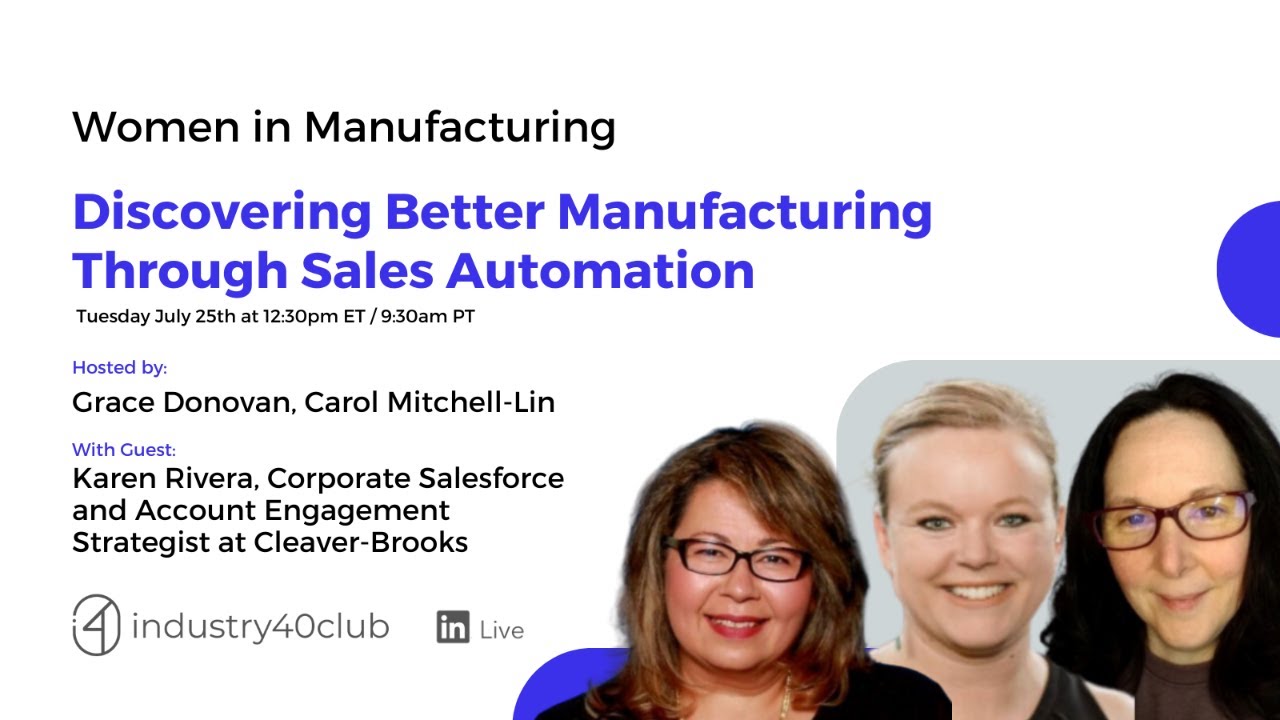
In this Industry 4.0 Club Women in Manufacturing episode, hosts Carol Mitchell‑Linn and Grace Donovan interview Karen Rivera, Corporate Salesforce and Account Engagement Strategist at Cleaver Brooks and Texas chapter chair of the Women in Manufacturing Association. The conversation weaves Karen’s personal journey from a 20‑year hospitality career into manufacturing, illustrating how up‑skilling and transferable skills (resourcefulness, problem‑solving, sales mindset) enabled her to become a tech‑focused change agent. She outlines the core competencies for her role—customer focus, continuous technical learning, empathetic training, and adaptable communication— and explains how she applies them to drive user adoption of sales and marketing automation. Karen shares a change‑management framework that treats internal adoption like an external marketing campaign: identify pain points, gather feedback, communicate via small touchpoints, and cultivate “change champions.” The discussion expands to her volunteer work leading the Texas Women in Manufacturing chapter, describing its servant‑leadership model, a member‑driven book‑club, and efforts to improve the talent pipeline for women. Karen defines a good ally as someone who simply shows up and pushes people toward untapped potential. She critiques industry reports for overlooking the early‑career journey of women leaders and stresses the need to surface those pathways. Throughout, she emphasizes lifelong learning, the personal benefits of digital transformation, and uses the film Hidden Figures as a metaphor for embracing technology. The episode closes with practical takeaways: up‑skill, be a tech‑embracer, prepare before being asked, and leverage community networks (LinkedIn, womeninmanufacturing.org).
Chapters
Hello and welcome to the Industry 4.0 Club. I'd like to wish a good local time to everyone. Also referred to as the I40 Club, our main purpose to is to engage diverse worldwide talent on a wide range of educational Industry 4.0 topics. We do this by hosting respectful, thoughtful, and interdisciplinary conversations. This is Women in Manufacturing, our Tuesday conversation with a focus on tech and manufacturing. In this space, we discuss the perspectives and challenges of women at work, and at home. In this series of Discovering Women in Manufacturing, we're taking a look at unique roles in the industry, and our topic of discussion for today is discovering better manufacturing through sales automation. I'm Carol Mitchell-Linn, an Industry 4.0 Club co-founder, and for over 6 years I've been creating content for I4D adoption in manufacturing. When I'm not supporting my fellow co-founders, I'm a content marketing specialist at Fuse Data. Fuse Data is a startup in Toronto, Canada, where we help enterprise teams transition from the dreaded spreadsheet scramble to meaningful actions with real-time reporting. First, I'd like to introduce my co-host and fellow i40 Club co-founder, Grace Donovan. Hi, Chris.
Thank you, Carol. Good morning or good afternoon. It's early in the morning for me out here. So as Carol mentioned, I'm also a co-founder of the Industry 4.0 Club, and I've been co-hosting with Carol for almost 2 years now. And we're delighted to start the summer series with Discovering Women in Manufacturing. I'm the executive director of the Rural Engagement and Vitality Center. It's based at Eastern Oregon University, and our role is to connect local communities and private enterprises with talent at the university. So bringing in students and professors to do hands-on learning and encourage professional development in rural America. So I'm really excited about this new position and how it can still connect to manufacturing. And we're delighted to have Karen here. So I'll pass it back to you, Carol.
Thank you, Grace. Yes, I'm excited to announce we have our special guest, Karen Rivera. Karen is the Corporate Salesforce and Account Engagement Strategist at Cleaver Brooks. Hi, Karen.
Hello, ladies. Hello.
We really appreciate you taking time to be with us today.
No, thank you for having me.
All right, we're gonna make you front and center. Oh, okay. Um, as we get started, I was curious if you could tell us a little bit about your background, kind of your career path and the journey that brought you to where you are today with Lever Brooks.
Oh, wow. Man, you start hard. I actually come from— my previous life was in the hospitality industry, 20+ years as a hotelier, from operations to training and development. And my jam during that time was being part of an opening team, opening a hotel or a restaurant. I just thrived on it. The roller coaster ride that is my life had some interesting twists and turns. And now I get to spend the second part or the second act of my career in the manufacturing industry.
And It's—
it— I look back and I just laugh now because, um, as a kid, the one Christmas gift I always wanted was a board game called, uh, Mousetrap. Never got it, but Mousetrap.
Yeah.
Never in a million years did I imagine or dream that later in life I was gonna end up as an accidental admin for Salesforce And now I get to work at a digital version of a Rube Goldberg machine. And I figure out all of the different ways that I can optimize technology to help people succeed. It's just hilarious how things work out. Now, how I got there.
Mm-hmm.
I am a recession survivor and living proof that upskilling works because that rollercoaster experience Because of that experience, I am obsessed— passionate may be a more lighter word— in maximizing the potential first and foremost of people, because it was done to me, processes and platforms so they get a chance to shine and amaze others with all of the great things that they can do. And That, that is my story and I'm sticking with it. Upskilling works.
Yeah, love to hear it. And transferable skills as well. I think that's something that perhaps gets lost when we think about, you know, transferring industries. You build a set of skills that, you know, did really well for the hospitality industry, but that's not to say that it can't also transfer across industry. But sometimes it can take a way to translate that. So I'm curious how you Like, as you made the switch from hospitality to manufacturing, kind of as you were learning and on that learning curve, realized what set you up really well for success in this new industry? Like, what skills came with you that were really beneficial?
Resource management, resourcefulness, and That mousetrap mentality.
Yeah, I really like the digital Rube Goldberg machine.
Yeah, it's like, how do we get this to work? And yeah, that— it's really the 3 things that I brought over. Now, making the transfer was a hard sell, so I, I will add to that selling skills, trying to sell a manufacturer that a hotel person can do good in manufacturing. Um, but yeah, it's resourcefulness, problem solving, and yeah, just that mentality of how do we make this better? What can we change to make it better?
Oh, Carol, you're on mute. Phrase of the decade.
Yeah, okay. Yes. Now, I'd like to continue this conversation actually on skills. Because your role places a significant amount of impact on your ability to provide user training and transfer knowledge, your knowledge to others to make their work better. Now, but—
Okay.
But specifically, You're working with software solutions. Now, what skills are needed to excel in a role like this?
A combination, but they're not— it's not an odd combination. It'll almost end up being like, oh, okay, yeah, I could see how that goes together. As corny as it sounds, First and foremost, customer focus. The only difference is that your customer comes in a variety of forms. It could be your coworker, it could be a department in another building, it could be a rep network across the globe. And by staying customer-focused, you're asking yourself, how do I meet their needs? How can I enhance their user experience? How can I tailor the solution to fit the specific context that they're having or problem to result in a valuable, relevant product so they can have a competitive advantage and be successful? So that's the first thing. So everything that you do, everything that you think of, every training material is how can I set the stage for this person, this department to be successful. Technical proficiency, it goes without saying, but notice that I did not say expert. Technology evolves so fast that you need to embrace the idea that to be successful in this realm, you have to be a lifelong learner and continuously learn what's new, what's been updated. But not only that, Know how you can apply the situation to a specific— apply the solution to a specific situation and what best practices would come into play. So it's not just what it does, it's about where will it best fit in my series of problems to solve. Training abilities. I'm going to go back to hospitality days. Structuring the information in a coherent manner, facilitate effective learning experiences. But above all of that, especially with technology, patience, empathy, and the ability to adapt to different learning styles. Because you could have— you could dominate the technical aspect, but if you can't communicate to someone who's not technical, then it gets lost, and then people are going to struggle. So adapting that communication style to the different audiences, because yes, you're going to come across tech-savvy people, non-tech-savvy people, and you have to think on your feet to come up with an example that relates to what they do in order for the dots to connect. Sometimes it's a fishing example, sometimes it's a manufacturing example, but communication on that level is key.
You mentioned something about being a lifelong learner, and I definitely agree with being an expert at learning stuff. Because if you're in a role and you think, oh, I learned everything, that's good, then there's a greater chance that you're going to get stuck or stall out in your ability to help people where you are.
I would probably have to say I became a lifelong learner Because I was that person.
Okay.
And I was stuck and frustrated. And that's when you have honest conversations with yourself and you're like, okay, what are you gonna do about it? Well, this is progressing. And, and that's when you get nosy. Like, you know, what's the top platform now? How does it work? What does it do? How can I apply it? And then you just go from there. It's— if, if you are stuck, um, and this is coming from experience, obsolescence is right behind. And I tend to like being employed. So, um, yeah.
I was wondering if you've ever— sorry, Grace.
No, no, go ahead, go ahead.
I was wondering if you ever thought about writing a book. about teaching technology with different learning styles?
Not really, because I figured someone's already done it. And I don't find myself to be a good writer. I'm a good explainer, but not a good writer. If anything, it would probably be— have some comedy Um, in it, because when I first started my role, very few people understood what I did. Most of the times I didn't understand what I was supposed to do. And I used the example, um, there— I don't think they're still on the air, but there was a comedy skit program called Key and Peele. Oh, love them. And during the Obama administration, they had a skit called Luther, Obama's Anger Translator. So, uh, in the skit, the person playing Obama would say something, you know, very PC, very reserved, and then Luther would break it down, um, and, and translate it in anger mode. And so like, okay, so you have that image in your head. I do the same thing with technology. So I'm the tech translator at my company. So I'll have business units that that are saying, I want this and this and this to happen. And I see my software people going, what? And it's like, okay, what they mean is they need to automate this to this to this and integrate this to do this. They're like, oh, okay. And then they'll start getting all geeked out and techie and start explaining something. And I'll look over to the business side and they're like, huh? It's like, okay, what he said is This is gonna happen and then this is gonna happen. And they're like, oh, okay. So that the running joke was that I was the company's tech translator. I'm the, the CB version of Luther.
That's a great example. And yeah, it's, I think, I don't know if it's underestimated, but the impact that people have when they have, like, when they, you know, are clicked into something, they understand it. It's really powerful because it kind of builds up that self-confidence, that professional confidence of like, yeah, let's go out there and get it. Versus when there's some misunderstanding, there can be a little hesitancy. We can tend to be a little bit tentative with going out for things, which is not an approach that works in sales.
No.
At all.
Some things can apply though. Some things can apply.
So with the adoption of Industry 4.0, so, or even when the shop floor is implementing some type of automation that changes someone's day-to-day, there are good and not so good ways to introduce change. So again, we're on a constantly changing landscape. The adoption of change kind of in the sales and marketing automation piece is also something that we want to touch on. So what tips do you have for people who are like getting constant challenge or who might be kind of experiencing change fatigue to help them make their working life easier?
To help— I think here's where I would put my marketing hat on. And with change management and digital transformation, you need an internal marketing campaign. Think about when you're selling to selling a product to an external customer. What campaigns does marketing put out to address objections and convince them that we're the best provider for what they're looking for? You can apply that same concept internally. The, the things that differ is the same way you identify pain points for your external company, your external customer, you do it for the internal customer. by getting their feedback, getting their input, and then coming up with solutions to make it easier for them. Again, the same way you would with an external customer. And that could also be communication-wise. It could be just a small post or a little announcement at the cafeteria to get them used to the idea. And, and really, it's The best way to explain it is digital transformation, and please tech people, don't hate me for this comment. It's not about technology at all. It's all about people.
Mm-hmm.
And our biggest challenge is how do we convert the reluctant who embrace technology just to keep up? How do we convert them to visionaries? Who embrace it to leap forward. Once you get a handle on that, change management becomes easier. Change fatigue isn't as much because now it's more strategic in terms of change. And how do we get visionaries so not only the person but the company can leap forward?
That approach makes so much sense to me. And I think I've seen it in action in some of the companies that I've worked for, but I've never heard it articulated in this way. But as you were describing that, I'm like, yeah, I experienced this here. I experienced it there. There are times where that didn't translate and that caused some friction.
Mm-hmm.
But I think it's incredibly true that not only do you need to have that marketing kind of on the outside of like, hey, this is changing, this is what's going to be good about it. And in sales, I'm sure you're familiar with the term objection handling. It's part of training of like, how do we deal with the objections of clients that are incredibly valid? But let's make sure that we're prepared to handle that and help them kind of move from someone who's reluctant to someone who's a visionary. And that needs to be applied internally as well.
Absolutely.
Because just as you have people that are reluctant for change on the outside, Same thing can happen inside. So it needs to be happening simultaneously where you are creating these visionaries. And I've been fortunate to work with people that are very effective at that. And it creates that alignment and like, here's our singular focus, which I think helps people stay within bounds of like, have clear lines about where we're going, where we're focusing. Because without that, it causes some uncertainty. And again, that kind of really can undercut your process specifically in sales. Like, that's really tough.
Yeah. And uncertainty is— I don't want to say the kiss of death, but it will make your job a lot harder, whether it's whether you're selling a product or selling an idea. And when you're talking internal customers and digital transformation, involve and engage. And I always hear, oh, involve and engage the stakeholders. That is true. Key stakeholders need to be involved, but so do the end-user employees need to be involved because— and early in the process, not when you're about to deploy. Oh, by the way, we're launching this. And they're like, what? Seeking their input, involving them in the decision-making process, and incorporating their feedback builds ownership. They now have a skin in the game. And that sense of involvement is going to create people who are more receptive to change. And you just helped create your change champions.
Mm-hmm.
And they're the ones— and bad analogy, uh, multi-level marketing— they're the ones that are gonna talk to their coworkers and, hey, you really need to check it out, this is really cool. And And then the message starts to get across as opposed to it just came from the higher-ups. Create, identify, and develop those change champions, and it will make your life a lot easier.
Yeah. Kind of find that evangelist, right? Just going to go out and spread the word. No, I really appreciate having this conversation. So as someone who just came from a sales role at a startup in manufacturing, I think I only ever really spoke to people that were also kind of in the software world going out into manufacturing. And it's interesting that these kind of worlds didn't always overlap for me, where I wasn't interacting with a lot of, you know, people that were selling like, you know, physical products or like coming from manufacturers to other manufacturers. So it's interesting to see all the similarities, which makes sense, but I think often there's a little bit of a divide. But that's just my musings.
It happens. It happens. We're really not that different.
No, we're really not. But it's, um, yeah, it's just finding those opportunities to talk with folks that are in, you know, similar pots or, you know, industries or roles. Sometimes there's these impressions that it's very different, other times it's not. Anyway.
Yeah, let's, let's move on to Karen, the Women in Manufacturing Association. You are the state chair for the Texas chapter of the Women in Manufacturing Association. And I've got to say, from my experience with the chapter, that It's very active and really cares about its members. And so I think you're doing a great job. Well, thank you. And I wanted to know what your role, the role that you have there, and how you transfer your experience with your working life, with your volunteer life, how you're transferring those skills to To make it better for the members.
Oh, okay. My role, the best way to describe it is I am a humble servant leader to over 1,300 amazing women and allies from a plethora of industries, companies, and positions. And when I look at the membership roster and like names pop up because I've had personal interactions with them, it's just— again, it's going to sound corny, but it's such a beautiful, intricate tapestry to see the different skill sets, the different professions, the different education All of these pieces coming together to show the incredible things we contribute to the industry. And it's like, wow, that is freaking awesome. The 3 main words that they use in Women Manufacture, I am a firm believer in, it's to promote, support, and inspire. So I ask myself, how can I best set up the leadership team and the members for success? How can I prepare my replacement so their job's easier when that time comes? How can we make the process of onboarding, event planning, sponsorship easier or more organized so that it's not a struggle? And how can we use technology to help the chapter? 'Cause it's like, great, Karen, you're talking about digital transformation. Are you applying it in the chapter? That answer better be yes, because you got to walk the walk and talk the talk. So that's what I do.
Oh, go ahead, Carol. Sorry.
It sounds like you're essentially treating your fellow members as customers.
Absolutely. Absolutely. Because they could be a member at any other organization. They have the right to choose and the freedom to choose another organization, so I need to make sure that they want to choose us.
And as part of your— some of the things that you offer, I know you're leading a book club, and so I wanted to ask about the books that you guys are currently reading and, you know, who or what they're about.
We are on our When— 4th installment, wow, of our book club. And the books are selected when we're halfway through our current book. A poll comes out on the Slack channel, what they call a poly, where you can— here are 3 choices, you can vote, or you can recommend a book that you like to add. And then when the poll closes, then the person with the most— the book with the most votes, it becomes the next book. But then that gives us time to reach out to the author, see if they want to join us for the kickoff, what insights can they provide. And we've been very lucky to have authors that are more than happy to join. Like, our current book is called Shatter the Skies, and it's by Meryl Retired Colonel Meryl Tengisdahl. And if you do not know who she is, man, you better start Googling now. She is an amazing woman, and, uh, she was even on the show Tough as Nails. And the sweetest, most down-to-earth person that I've ever come across. And I met her, uh, actually thanks to Angela, crashing one of Angela's conferences on aerospace.
Just to mention, also Angela's with us today. I'm so sorry, but who else but you could get this author to kick it off?
Oh, it, uh, I, I guess relentless, or how it's, it's always how can I convince someone to do X. The sales, I guess I am a salesperson. I never, I never thought about that. And, uh, but what she doesn't mention is that when they say yes She's the one who gets the phone call with me completely geeking out going, "She said yes! She said yes! I can't believe she's my guest." So yes, that's awesome.
And can you tell us? So you shared a little bit as we were preparing, but she's the first.
She is the first and only African American woman to be a YouTube pilot for. the Air Force.
Yeah.
She is an electrical engineer. She's a mother of 2. And the book is about her life story. She started out in the Bronx, and I'm from the Northeast, and, you know, I know exactly where she, she lived. I know the area well. And, and just listening to her story progress, I even mentioned to her, are you sure you're not my sister? from another mister, because my goodness, I'm listening to the book like, yep, I remember that. Yep, that happened to me too. Yep, I hated when that happened. And it's like, oh, and then the stories— her story in the military and the challenges that she faced, but not only the challenges, how she worked around them, through them, over them.
Mm-hmm.
It was just no one was stopping her. Plain and simple. And it was— it's a fascinating story. She narrates it because I, I usually do the books on, um, Audible, especially if the author is narrating, because again, it just feels like we're having coffee at the table and just sharing stories.
That's awesome. And I also just want to highlight that, you know, it's because you stepped maybe like outside of your lane to go to this you know, leading ladies in aerospace, which is not something that was, you know, part of your wheelhouse, but it's a way to really expand perspectives and meet new people but have very similar experiences and a lot to offer. So I just think that's, you know, that oftentimes we can limit ourselves and say, I'm going to stay in my lane, or that's not for me. But there's so much that we can gain from, you know, broadening our horizons and, you know, testing the waters in new places. So I just wanted to affirm that.
Oh, thank you. And I met amazing people. There was one couple that was a startup, and I could have talked to her for hours because it was like, what was that like? And what was that? And so they're probably wondering, what is this lady with all these questions? But my first encounter with Salesforce, I just saw Salesforce in the event title and I signed up. If I would have read the description a little more, I would have known that it was directed, or the audience was CIOs, which I am not.
Yeah.
So here I walk into a room of executives and computer geeks to the nth power, and here's— here am I, barely knowing how to program the VCR. And it's like, you want to talk about fish out of water? I just listened, and I asked my perpetual question: Tell me more. What's that like? How did that work? And half the stuff was going way over my head. All I knew, you know, when I got home, I was just Googling like a madwoman. And then it just went from there. And the same thing with Leading Ladies. Half of the stuff and the technical stuff they were talking about, what am I going to do, argue and say, no, that's not it? Just nod and say yes, Google it later. Oh, Oh, that's what they were talking about. Okay. And go from there.
And I think, you know, there's a lot to be said for just asking those simple questions of, tell me more, how does that work? Because it's inviting people and it really— you don't need to ask very highly specific questions in order to gain a lot of that information. So those are really powerful questions and I want to highlight that for anyone listening that, you know, you can keep it simple.
Yeah, keep it simple.
We have a question, Grace.
Yes. So we have a question from Mike Ungar. So he mentioned that you support over 1,300 women and allies as part of your leadership role in Women in Manufacturing. Can you describe what makes a good ally?
Wow.
Simple answer would be just showing up. When I went to my first in-person summit, there were about 50 men there, and I was just tickled pink, and they couldn't understand why. And it's like, I'm pretty sure those 50 men could think of 100,000 other places they would rather be than at a convention for women in manufacturing. Their insight, just the fact that they made the effort to be there just blew me away because again, they could choose to be elsewhere and they didn't. A good ally, just being there, the support in— and I look back to my bosses who were my allies. I'm not gonna lie, they were pains in the butt half the time because they were constantly pushing and pushing. I was like, are you trying to, you know, get me to quit? What is the deal? And they finally said, if you saw the— if you saw the amount of potential I see when I look at you, you wouldn't question why I push.
Mm-hmm.
Once that was clear in my head, When people push me now, it's like, okay, they're seeing something I'm not, so let me really pay attention to why they're pushing, where they're pushing me to. And so for allies, it's— you don't have to move mountains to be a good ally. You just need to Be there to support, to push when you see the potential not being maximized or untapped. And the word says it: an ally by my side, behind me sometimes, shoving me if you need to. But yeah, it's not shattering. thing. It— and I don't expect an ally to understand a woman's journey because you're not a woman, okay? But it's kind of like, even as I'm an ally to others, it is not my job to understand. My job's just to be here and support.
Mhm.
Because I, I can't understand other people's journey. It's not mine. But I can support, and I could be there, and I could push and be like, I, you need— I'd really think that you have what it takes to do this, and, and things like that. So I don't know if that answers your question, Mike.
I'll go ahead and speak for Mike, but I think yes, absolutely. I think, and, um, maybe one thing that I would add to that too is, you know, why it's also so encouraging to see so many men show up to like a Women in Manufacturing conference or participate in the chapter is that it generates kind of empathy and understanding for how their experiences, how the experience of women in manufacturing is quite different from their own. And by having that understanding of like where those differences and gaps are really does allow them to kind of push in the right direction or be an ally when other women are not always in the room. And I think we talk about that like with mentorship and You know, mentors and allies are like, they're the ones who are going to speak up for you when you're not in the room. And by generating these instances where there's crossover and kind of sharing of experiences is really important to help people be, you know, good allies.
Yeah. Just in my corner.
Yeah.
Now in my corner to support me, but also in my corner when I do something stupid, it's like, really, Karen? Do you really think that was the best way to approach that? That is still an ally.
100%. So kind of speaking about kind of in the vein of having allies kind of like in our corner, there's a report came out that Women in Manufacturing Associated supported with Axometry. And Carol and I have been following reports on women in manufacturing for quite a few years now. And I think they reported that 1 in 3 manufacturing professionals and 1 in 4 manufacturing leaders are women with no significant change from 2021. So we've had a couple of years, like there was a big jump in that in 2020, but then it's kind of remained stagnant for the past 2 years. So I'm curious if you have views about what contributes to this, perhaps like stagnation. And again, we're at 1/3 or 25% in leadership. And what Women in Manufacturing Association is doing to improve that through the work of promoting, supporting, and inspiring. That was a big question, so I can break it down if you need.
Well, I'm trying to think of the PC way to answer, and I can't. Not to diminish the report, But I think there's a focus point that's missing on the report.
Interesting.
It is fantastic to highlight the accomplishments of professional women in manufacturing. So think of the career as a journey. You have the beginning, the middle, and the end. The end is retirement, just be clear. And the manufacturing women, manufacturing leaders, are kind of Here in the journey. The focus points that, that is missing is over here, because these successful leaders in manufacturing that are women did not wake up one day and lo and behold, they're here.
Mm-hmm.
They didn't wake— just wake up in their role. It wasn't a fairy godmother or anything fairytale-like. That missing piece is how did they get there? What did they do to get there? How did they overcome the obstacles? That information is really helpful to the women starting here in the beginning.
Yeah.
So they know the pitfalls to avoid, the mistakes to avoid. How did, you know, how did she— how was she successful with this? How can I apply that in my career? And so that missing focus point is the beginning of the journey and also awareness to get people to the beginning of the journey so that you have the data to report on the report that you have.
Mm-hmm.
Because you can look at the people who are already there, great, but let's take a peek at who's in the beginning and how can we get them there. And awareness is even more important than the development and And I know that's really a big point with Women in Manufacturing Texas chapter. It's that talent pipeline.
Mm-hmm.
I stumbled across manufacturing in pure survival mode. I want to make sure that other women who are in a similar situation or not, I want them to know that manufacturing is an option. that I am willing to bet money you haven't even considered. And here is why you should consider. There is an option in manufacturing that women are not aware of.
Mm-hmm.
And that is hurting the pipeline. And that is ultimately hurting women entering the industry, progressing in the industry, and becoming leaders in the industry. Because a lot of women don't even know that that's an option.
option.
So the promoting and supporting and inspiring— yay for the leaders who are here, kudos, you're an inspiration, keep up the good work. But I need to focus over here to make sure that we have a good supply coming in so we have more over here.
I completely agree. And the good news is, I think, is that we are seeing— so the same report put this out, and while I agree that there is a lot of pieces missing in kind of the data was very simplified. We are seeing upticks in women recommending, like both men and women recommending careers in manufacturing to women. So people that are within the manufacturing industry now are more likely than they've ever been in the past to recommend manufacturing as a career path. So I think that message is really taking hold and it's still going to take a couple of years for us to really see that impact. But I think folks are being more intentional, like, as a whole about communicating, hey, this is a path and this is an option. And then as that pipeline kind of comes in, there's going to be plenty of options to provide that guidance and support. Because it is true, lots of women fall into manufacturing unintentionally. Like, that's kind of how I came to manufacturing as well.
Mm-hmm.
It was unintentional or it was adjacent to what I was doing. That's incredibly interesting. But it wasn't something that I prepared myself for or sought out intentionally. And that's something that this, by actively promoting manufacturing as a career, more women are hoping, like, that's the ultimate goal, is that they'll choose that proactively and come in with this mindset of like, okay, this is what I'm choosing and this is what I need to know. Versus sometimes, you know, falling into it could put you on your heels a little bit. So there's a lot to be said for seeing more promotions. So I wanted to end on a positive note.
Yeah, because even if you stumble onto it, um, even if the stumbling is not the most pleasant circumstances, okay, you're here. Let's talk about how you can kick butt and take names and really progress in this industry because the opportunity is here. And just shine from there.
I don't know if you've ever seen— I forget the website, but there's a supercluster in Canada called the Advanced Manufacturing Supercluster, and they have a secondary website that talks about other jobs in manufacturing besides STEM. It's really good to let people know, as you say, there are opportunities in manufacturing, in marketing, sales, food technology, all sorts of areas, finance. And it is definitely an option.
And maybe you're right that people are starting to talk about manufacturing as an I have one example, and she's probably tired of me asking her to be a speaker. She is a culinary grad. So of course, close to my heart, hospitality. And I use her as an example when I talk to younger women. It's like, I know a chef. Okay, what about it? In manufacturing. They're like, what? It's like, where do you think the recipes of your frozen foods and your packaged foods in the supermarket come from? Thin air? No. There's a chef who develops the recipes and there's a food technologist who tests the recipes. There's a biologist who talks and a nutritionist and they all work in manufacturing. And there the jaw just drops like, really? And I was like, yeah, really.
And it's some really interesting and cool stuff as well about, you know, how you just— the different techniques and things that go into, you know, making like food in a, in a like high volume way to achieve the qualities that you want. I love personally watching how it's made, specifically food items, because it's really interesting. So it makes sense there's chefs behind that. But I think there's just a lot of dot connecting that is, is hard for folks to do sometimes in manufacturing, especially if you're outside of it, right?
Oh goodness, yes, yes. And that's where the awareness really comes into play, um, to let them know that there are options.
Okay, Karen, let's move on to The series that you're the first guest, we've called it Discovering Women in Manufacturing. And I want to take it— I want to get your take, really, when you first think about that, what it means to you, and then take it another step further. And what does women in— discovering women in manufacturing mean to you?
I'm gonna be completely honest, this one hits close to home, and, uh, so no guarantees that I won't get emotional. I think I used waterproof mascara, so I think we're good. Um, I used to think my previous career was my dream career.
Mm-hmm.
On paper, I was Living the dream. Exotic locations, working with government officials, top of my game. When in reality, it was killing me, literally. And it took a near-death experience, a week in ICU with multiple pulmonary embolisms in both lungs, to end my career. Just as 2009 recession hit. So when I say I lost it all, all— health, home, cars, everything— wiped. In sheer survivor mode, I took a temp-to-hire job as an executive assistant at a boiler company. The temp company wasn't even enthusiastic about this posting. And for several years, I was angry, resentful, and it took therapy and self-reflection and a lot of work and a brutally honest conversation to make me realize manufacturing saved my life. Little did I know how much I was going to grow, how much I was going to learn in this manufacturing company, how my bosses continuously challenged me. I would have never imagined that I would end up working in tech. When they offered the opportunity, my response was, you do know I've never programmed the correct time on my VCR, right? And yet here you are asking me to do what? Sales what? Now I have an even more rewarding career, work-life balance, a higher salary, ability to work from home. I was able to care for my mom when in her final years, and I have opportunity to meet ladies like you, the ladies from Leading Ladies of Defense and Aerospace, the Women in Manufacturing. But the North Texas Machining Association, Chris and his group, a great bunch of people. So my take on it, I'm forever grateful manufacturing discovered me.
That's really lovely to hear, and I'm very happy that that's been the journey. I think we all start out sometimes in life thinking that we're going to have a linear path and it's going going to be a continually upward trajectory.
Yeah.
Now, there's a book that I recommend to everyone that is experiencing life transitions, and it's called Life Is in the Transitions. It's by Bruce Feiler.
Yeah.
It's an easy book to read, and it talks about the bumps and twists and turns and just the rug getting pulled out from under you in career and of people of all levels across all areas of the state. It led me to quit my job, which was like—
Oh, wow.
Because I worked for the company of the author's wife.
Um, it—
but it's, it's just very, very reassuring, and I, and I— it's nice to know that other people have those experiences, and there's always hope after transitions like that. And your story is just, you know, kind of Proof of you can have, you know, you can think that you're at the top of the game, but there's still more to come. There's still more that life has to offer. And that's incredible. And I'm so glad you found that in manufacturing. And I think that's just like people really need to hear.
Redirected. I look back that God was redirecting me. I just kind of wished he used a more softer approach.
Oh, don't we all?
But I was being redirected in Yeah, now I'm with my tribe.
Yeah, there's no, there's no denying that it can be really, really hard. Yeah, and very humbling. But, you know, with time, you can see it with much kinder eyes.
Most definitely.
Oh, Karen, actually, it would be fantastic if we could just end on this note. It was just a perfect answer to the question. But we have some more things that I'd like to finish with, and that's really last thoughts and final takeaways. And I'll let you have the last word, Karen, but we'll go to Grace first.
Okay.
All right.
I just, I think what I really take away from our discussion is kind of what we you were just touching on in terms of, you know, life is full of bumps, but it's really important to know the transferable skills and to be open to opportunities where they come up. Sometimes you say yes to something that is really wonderful. Sometimes it doesn't always work out that well. So I'm so happy that saying yes to manufacturing worked out so well for you, and there's so many opportunities. And I think that's, you know, there's a lot of opportunities there for a lot of folks. And knowing that you can be successful and being confident in yourself to be a lifelong learner, just as general advice to everyone, is if you know that you can learn, you can be successful in what you put your mind to and surround yourself with people that are going to encourage you. And that's definitely what I hear in your story too, is you had a lot of people pushing for you and rooting for you. And so making sure that you identify those people in your life and you know, say thank you to them. So that's my takeaway from our conversation today.
Great, thanks, Grace. And yes, my takeaway does go back to earlier in the hour, and that's something that I like to stress, and that's being an expert at learning. And once we can manage that and practice Practice learning and learning how to learn is definitely something that is a good practice through your work life and even in your personal life, keeping that curiosity alive as we all age. How about you, Karen? I'm done. Wow.
Final thoughts. Number one, upskilling works. I'm living proof. And you, you, they talk about all of the benefits of digital transformation and Industry 4.0 to the company or the organization or the industry. And I would probably say that my final words would be there are benefits for the individuals as well. And be that person who embraces the technology So you can leap forward. And, and the best example I could use is the movie Hidden Figures. Though many people focused on the main character of the 3 ladies, my favorite was Octavia Spencer. She played Dorothy Vaughan. She ended up being the leading Fortran programmer of her time.
Mm-hmm.
And I— my favorite part of the movie is she saw the big computers come in. They're coming to Langley. No one knew how they worked. She didn't wait for others to instruct her. She read the manual, tested and retested, and continued to learn and build on what she knew. When the time came, her and her team were ready. The rest just needed to catch up. And that's when they realized how invaluable, or how valuable they were. And I walk away from that movie going, little girls aren't the only ones who were able to see themselves in that movie. So my, my best advice I could give to people is embrace the technology.
Mm-hmm.
Do not wait to be asked. Prepare now so when the time comes, you are ready. And the rest who were reluctant and just tried to keep catch up with technology, now they have to catch up to you. Be ready to leap forward.
Wonderful advice, truly. And I have reason to go back and watch that movie again. Always looking for that excuse.
I like that, how you ended that, Karen. Embrace, embrace the technology and leap forward. And that's the perfect way to end today. Thank you so much for joining us.
Oh, my pleasure. Let's see. Oh, I did wear I'm wearing waterproof mascara.
You're good. And yes, thank you so much for being here with us today. It was really a pleasure to talk to you and wish you all the best this next forward, this kind of this upcoming season. And we will stay in touch. Where is the best place for people to reach you if they want to connect with you or with the Women in Manufacturing Texas chapter?
For me, best place is going to be LinkedIn.
Perfect.
And then with Women in Manufacturing, I'd probably say the best place is to go to the womeninmanufacturing.org website, and then under the chapters tab, look for the Texas chapter, and you can affiliate with our chapter and be up to date on all of our happenings and goings-on. To really stay up to date with everything that's going on, LinkedIn chapter page. Follow us.
All right. You heard it here.
So we're looking.
I'm sorry.
Oh, I said you heard it like you heard it here, folks.
So before before we say goodbye, we have like a few housekeeping and announcements. So if you liked this episode of our series, first series, look out for more upcoming episodes in the month of August. And you can do that on LinkedIn with the Industry 4.0 Club page on LinkedIn. On a short announcement, we have a call for speakers for the IME West Advanced Manufacturing Track. It's taking place in Anaheim in February 2024, February 6th and 7th. So if you could please reach out to us through LinkedIn or the Industry 4.0 Club— so that's industry40club.com— or email us from the website there, we'd love to hear from you. If you'd like to speak or have a panel proposal for us, reach out it to us. And for updates and notifications, we encourage you to follow us on LinkedIn or subscribe to our Substack newsletter called Shaping the Future. You can do that from our website as well. And I'd like to wish, wish you all a great rest of your day. Thank you.
Thanks, Carol.
Bye.










