Driving Better Business Results Through the Connected Factory
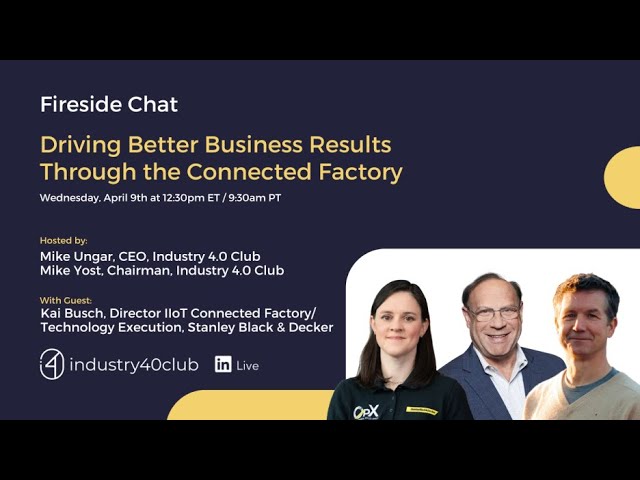
In this Industry 4.0 Club fireside chat, host Michael Ungar and co‑host Mike Yost interview Kai Busch, Director of Industrial IoT, Connected Factory and Technology Execution at Stanley Black & Decker. The conversation opens with Kai’s observations on cultural differences between German and U.S. manufacturing workplaces, highlighting formality, time‑tracking, and the “80/20 rule” versus exhaustive engineering. Kai then defines the Connected Factory for Stanley Black & Decker as the systematic networking of all shop‑floor assets—both new and legacy—through a mix of direct integration and external smart‑box sensorization. She explains that her team sits within the Operational Excellence (continuous improvement) organization, acting as a technology‑enabled improvement function. The discussion moves to how the program balances corporate strategy (a global rollout roadmap) with tactical “fire‑fighting” requests from individual plants, and the importance of change management: taking people along, communicating a clear vision, and ensuring stable, mature processes before layering digital tools. Kai describes the vision shared with operators: real‑time production monitoring that eliminates manual data collection, gives instant KPI visibility, and enables quick corrective actions that can lift performance by several percent. When asked about ROI, Kai frames the connected‑factory effort as building a “road” – an infrastructure layer that must exist before value‑adding use cases can run. Early wins come from production monitoring and KPI dashboards, with the expectation that a standardized data foundation will later support broader analytics and automation. She also references the SESAME Smart Manufacturing roadmap, noting past failures, a major overhaul, and the shift to a standardized, plant‑wide approach that now yields comparable KPIs across sites. The chat concludes with promotion of the upcoming Manufacturing X.0 Southeast event (April 23, Greenville, SC), where Kai will discuss mindset change, people‑first digitization, and practical lessons. Both hosts encourage listeners to develop roadmaps, start small, accept failure as learning, and engage with the Industry 4.0 Club’s community.
Chapters
Welcome to the Industry 4.0 Club's fireside chat. The club's purpose is to engage the power of diverse worldwide talent to accelerate the global evolution to Industry 4.0. We accomplish this by hosting and supporting respectful, thoughtful, and interdisciplinary open conversations and creating quality content on wide-ranging Industry 4.0 topics to expand the reach of our community. My name is Mike Ungar, and I'm the CEO of the Industry 4.0 Club. I have over 40 years of leadership and management experience, with most of that being in manufacturing at Michelin. I'm joined today by my co-host, Mike Jost, who's chairman of the club. Mike, would you introduce yourself, please?
Sure.
Thanks, Mike. Welcome, everybody. As Mike said, my name is Mike Yost. I'm the volunteer chairman of the Industry 4.0 Club, one of the co-founders, and Mike's co-host here on these shows regularly. I've been in industry for 35 years, the last 15 on the industrial nonprofit side. We enjoy having these types of conversations and learning from people who have something to share, like our guest today. If I could introduce our guest, we're joined by Kai Bush, the Director of Industrial IoT, Connected Factory, and Technology Execution for Stanley Black& Decker. Kai will be at the 4th Manufacturing X.O Southeast event in Greenville, South Carolina on April 23rd. She's going to be part of a panel that's speaking about how to converge digital work instructions, mixed reality, remote experts, AI, and connected worker solutions to confront productivity, recruitment, and retention problems. So that should be a good one. Today we're going to be discussing driving better business results through the connected factory. Just a little bit of background on Kai. She has over 20 years of experience in the manufacturing industry. She's highly accomplished and respected for her ability to lead diverse teams and develop both emerging technologies and established products. She holds a bachelor's degree in computer science and business administration from Stuttgart Academy of Economics. She began her career as a software engineer working for companies in Germany, and before relocating to the United States in 2008. In 2016, Kai earned her MBA from the University of Connecticut, and later that year she was honored as a Woman of Excellence in the metal forming industry. for her leadership and her skills and her role for inspiring young women in the industry.
So welcome. We're glad, glad that you could join us. Before we get into our first question, I just want to highlight the MXO Southeast event. It's become the go-to gathering for manufacturers in the region to connect, collaborate, and learn from real-world examples of successful digital transformation shared straight from the horse's, or shall we say, manufacturer's mouth. Since 2022, the event has empowered local manufacturers to advance their careers and businesses through valuable knowledge exchange and impactful networking opportunities. So we're, you know, hopefully you'll join us there. So with that, welcome, Kai, and we're glad you could take time out of your busy schedule to join us.
Thank you, Mike. And Mike, thanks for having me. I'm glad to be able to join. And chat with you a little.
Yeah, thanks. So, Kai, you know, in your, your bio, it's interesting, you mentioned that you started your career in Germany for a German company, and now you work for an American company. Can you talk a minute about some of the differences you noticed between, you know, those 2 sort of different cultures?
Yes, sure. Because I've definitely quite noticed some, some difference between working in Germany and working in the US. here. I would say in general, German companies are way more formal than American companies. For example, you don't address your boss with the first name. You always say Mr. So-and-so. So it's very more formal, more structured. In American companies, you basically try to get your work done. You don't look at the hours quite that much versus in Germany, you clock in, clock out. With that, you're really very much bound to your time that you spend. But then that's also like one difference that I would like to highlight because that's something that I really was only able to understand when I actually came over here. And it's when I worked in Germany, I worked with partners here in the US across the big pond, and I never understood why the Americans need to be so fast and quick and do everything just go, go, go. Versus in Germany, we try to engineer everything. We make sure it's right and we discuss it. We almost, yeah, over-engineer it. And then I came here to the US and I started to understand because the market is different. You just need to get the product out in the market and deliver. And basically the 80/20 rule is king. You just get a product, you develop it up to 80%, and then it's good to go. Versus in Germany, we go all the way. and we make it right. And I was really not able to understand that while I was in Germany. So I came over here and I started to understand. And with that, I would actually encourage everybody who has the opportunity to go and see and experience different cultures, different markets, go and do it because you're only really able to understand it when you are in that situation.
Well, that's fantastic. So I will refer to Mike as Mr.
Ungar from now on for the rest of our No, Kai brings such a great point up, Mike, about, you know, experiencing different cultures and seeing how they work. I too have had different— an opportunity to work in different cultures, in different factories. And, you know, it's not that one is right or wrong, it's that there's best practices to take from each.
Right.
And in fact, if you're wise, you take the best practices from all of them and you outperform any one of them. And so I think it's a really good point. The differences are real, but it's not that one's better than the other. It's that there's different things to take away from each, I think. So I appreciate the comparison, Kai.
Yeah, and you have to really adjust to the market and to what's needed, what your customers want. That's important. And that's what I learned, that you have to adjust to the situation that you're in.
Well, excellent. Let's talk a little bit about the connected factory then, part of your responsibility. Could you give an overview, give a sense of what that means for Stanley Black& Decker and how long the organization's been working on that? Yeah, sure.
So at Stanley Black& Decker, that means we're connecting all of our shop floor assets that are involved in the production process. So every machine that is touching one of our products in some way or fashion, we're connecting it up to our networks. And that means developing different solutions for different machines. Because Stanley Black& Decker has historically been built on acquisitions, we have all kinds of assets on our shop floor. It's a very diverse landscape of machines that we have, and with that, my team is really challenged coming up with different solutions and deploying them to the shop floor to make sure we get the data that we want out of our assets. And once we have the data, we then supply that upstream into our applications. We visualize that data to our shop floor leaders so that they can actually make use of that data and learn from the data and use that on a daily basis to improve the shop floor performance. We also utilize the data to manage our KPIs. We have certain KPIs set forth for our plans to be evaluated, and that data that we collect flows into those KPIs.
And organizationally, would the organization tend to look at your team as being a technology-centric team or a continuous improvement team, or how would people look at your role?
So within Standard Black& Decker, we're part of the operational excellence team, which means we're part of the continuous improvement within Standard Black& Decker. Black& Decker. So we're a sub-team under that department driving technology that supports continuous improvement.
I think that's an invaluable lesson right there. I know many companies, some that have been working on these initiatives for a long time, that have not recognized the importance of what you just talked about. So I think that's a really powerful point.
I'm thinking about something you said about connecting your equipment, and you mentioned the diversity of equipment that you have. Talk about how old— not to— but if you can say, your older equipment must have been more challenging to connect. And were you concerned that by connecting it, you might slow it down at all?
So our older equipment is actually that old that we can't really connect it because it's so old it doesn't have that capability. So we sensorize it externally. And for the machines that you probably talk about, Mike, is we've developed solutions like a standard smart box that we apply externally and hook up. It has then different capabilities in terms of relays or PROFIBUS or whatever that equipment can do to make it more or less standard approach to connect those machines. Because what we figured is if we have to solution for every single asset that we come across, it makes it quite difficult. So we've come up with that solution to be faster, to be able to deploy to a plant more quickly.
Yeah.
And with that, we don't really have any concerns in making these assets faster. We haven't experienced any of those issues.
Well, that's— and thanks for highlighting that. I think a lot of companies today, or many anyway, you know, they run older equipment because it's very efficient and the investment, it's paid for and it's making good product for the client. And so they ask that question, well, can I really hook it up? And I think what you're saying is You can find ways to connect and sensor anything, just a question of how you do it, not whether you can or not.
Correct. Yeah.
That's great.
I'm wondering, Kai, how do you balance the strategic and the tactical? Is your team primarily driven by a corporate strategy for connected factory that has defined global metrics, or are there fires in the business units that people are looking to put out and they're calling you in to help with a technology solution?
So it's been an iteration within Standard Black& Decker. We've tried different things. And at this point, we're at a place where it's a corporate strategy to roll out our initiative to the plants. We've done before where we went into plants, did a little piece here, did a little bit there, and did one use case here, but at this point we just figured it doesn't make sense to do these ad hoc things. We need to drive it from a global perspective to get our plans connected and get everybody also on the same level.
I guess quite— that's great to hear. I'm wondering from your personal perspective, or from— I worked with an organization, I was working in the States, but the The company was actually a German-headquartered company, and they took a very disciplined approach to making sure that corporate standards were set and followed in the plants. And I know there was bristling and pushback and struggles in the plants, but they stuck with it from a long term and, you know, were successful in getting people to buy in. So are you seeing that working effectively? As you roll out the corporate strategy?
So yeah, we definitely also see a lot of pushback, and that's something that we learned along the journey, that Industry 4.0 digitization is actually a lot of change of the mindset. You need to digitize your, your whole approach, not just bring in tools, not just implement the platform, because you need to take the people along. You need to have what we call our makers, our people on the shop floor, our employees, you need to bring them along. They need to understand what you're implementing, why they have to change what they're doing, and what the bigger picture behind that is. Because if they don't understand, the moment you look away, they're going to fall back to their old structures and their old ways of working. And with that, the whole initiative will fail.
Right.
So yeah, it's a big change in the plans, and change management is a big piece of it and needs to be taken care of. That's a big piece of the learning that we had over the past, I would say, 6 to 7 years that we've been working on this initiative.
When you think about, you share change management, one of the big— and going back to Mike's question about the shop floor and your comment on the shop floor, One of the key elements for change management is sharing a clear vision about why you're doing it and where you're trying to go. Can you talk a minute about, if you can comfortably with Black& Decker, what kind of vision do you share with the operators or the folks working on the floor to help them make this transition?
So yeah, at this time we have a clear roadmap and a clear strategy in terms of bringing production monitoring to our shop floors and integrated into our Stanley Performance of Excellence program so that they understand that this is part of a bigger piece and they understand it's tied into with their operational processes that they're working on. For us, actually, it's a requirement before we come in that where the processes are stable and mature, that they have those established, and then we bring the digital products on top of that. So before we actually go and implement production monitoring, we want to make sure they have a certain set of processes in place that we can actually digitize that, and we don't go in and digitize random processes in, in the plants. And with that, by having them understand what their digital or in general their maturity is, and they only get the digital piece on top of it, they can see how things work better for them because they don't have to then manually do stuff like reporting numbers out or track on a piece of paper how many products they've made or how many bad parts there were. So with that, They see the bigger picture and how it falls into place.
That's great. When an individual understands how this actually makes their job easier and they can focus on serving the customer versus writing down numbers, it can be really powerful. That's really great.
In some plants, we actually have whole teams of— they walk around and collect the numbers, write it on a piece of paper, then it goes to the next instance and they have to enter it then into the system. All of that will fall away, will be obsolete basically, and it makes the people happier because they don't have to do this manual type of thing.
These are great lessons that Kai is sharing with us, and I would certainly encourage everybody to get to the Manufacturing X.0 Southeast event here in a few weeks to engage with her and learn more. Because, Kai, I think I used to be part of a nonprofit that was— has been around for a long, long time. And, you know, a decade ago, as we were talking about how do we make an impact in industry, the topic of culture would come up and everybody would say, that's too hard. We can't talk about culture. And we would shy away from it. But it sounds to me from the things you're talking about, like understanding people, knowing that you have to have your processes stable before we can come in and digitize them.
Yeah.
That, you know, this is really ingrained into the culture at your organization. So can you talk to us a little bit about that, like how it got started and, you know, I guess any lessons that you've learned along the way of this culture?
Yeah, it took us definitely quite some time to get there within Stanley Black& Decker. Initially, we started out as a kind of startup for Industry 4.0 within the company. And it was like a center of excellence almost, sat there, and we tried certain things and we also failed pretty hard with certain things, didn't work quite out. We went down the rabbit hole with some of our solutions and we overhauled all of it. And now we're at the point where we recognize that Industry 4.0 digitization is part of that bigger piece of continuous improvement. It needs to be part of operational excellence. And we've implemented it now that way that first our partner team goes in and makes sure all of those mature processes are there, they are established in the plant. And once that is in place, then we can come in and digitize the processes. And we also figured that it doesn't make sense to do any one-offs because we want to make sure we create standards across all our plants. And with that, we can then get KPIs so we can get actually to compare all of our plants at the same level, because that's a problem that we had also before. All of our plants would go out and buy a random one-off solution, some kind of digital platform, and just create their own standard. But every plant is different, and every plant has their own set of calculations and formulas to get to their KPIs. And with that, there's no comparison available, and our management is looking at the plants and doesn't understand how does that come to play with that. And now we're actually able to equalize and level set all of our plants with the same set of KPIs. and create that one single view on standard Black& Decker.
Yeah, you said something that an old boss of mine used to say all the time, that standards are so important that everybody creates their own. And that's, that's true, right? I think another point that you, that you mentioned, though, you mentioned failing, right? And obviously, it was okay to fail. So maybe a moment on that, the fact that You didn't get reprimanded or punished, or the initiative didn't stop because, you know, you incurred some failures along the way?
There was definitely a big overhaul of the whole initiative. I wouldn't say we got reprimanded or punished for it, but there was definitely a big change in mindset and how we looked at things and how we set things up, and hence the change of org structure and making our Industry 4.0 initiative of a bigger picture with continuous improvement.
Yeah.
It definitely took some time to get to that point of view, to understand that it can't go by itself, that there needs to be that maturity in our plans. And what helped me personally as well, I did 1.5 years ago together with one of my coworkers and now boss, the SESAME Smart Manufacturing class, and we learned how to build a roadmap, how to understand, to assess your business, what is needed, and building that roadmap along the way really helped to get us along and understand what we should focus on in terms of Industry 4.0.
Well, that's fantastic.
Yeah, I think I really appreciate the discussion. I think A lot of companies today are still going after that shiny new toy or working on a once-off without a strategy, and then they wonder why they can't sustain what they've spent their money on. Which leads me to the next question is, how do you justify a connected factory? You know, is that— 'cause that's an investment that in many ways without leveraging the data doesn't have an ROI, I guess. Or help me understand how you guys handle that.
Yeah, so that's one of the biggest discussions that we have and probably everyone has. Where's the ROI for connecting assets? And how we've pictured or how we framed it to our leadership is that we're building the infrastructure. We need to build the road that we can drive on then. If we don't have that road, there's no way that we can go anywhere. So we've sold it to our leadership that we need to build that road first, and then we can drive and implement use cases that actually bring in the money. Right now we're doing like very small basic things to get that buy-in from leadership, like production monitoring, like giving them the data for, for KPI management. But in the end, there will be so much more that we can do once we have built that road, that infrastructure, that it will pay itself off. But how we phrase it is we build the road, we lay out the infrastructure.
So you mentioned some use cases, KPI management and process visualization, things like that. Are there particular use cases that you can highlight? I guess, what are the types of use cases or business areas that you're focusing on?
Yeah, right now we're focusing really very much on production monitoring. So we give our shop floor leaders the ability to see what the performance on the shop floor is so that they can say, do we win the shift? Do we win the hour? Actually, how many parts have we made? What is the downtime of machines? So that they can drive then directly improvements based off those numbers and don't have to wait 2, 3 days till they get actually some manual written pieces of paper. No, they actually have the data in real time, can see what's happening on the shop floor, and with that work directly on the improvements. Typically you say just by putting out the bad, like putting something out that's red, your results improve by 5%, and that's what we can actually see just by visualizing the data. Things improve immediately, and it definitely helps our shop floor leaders to see real-time what's going on and understand what's happening on their shop floors.
That's fantastic. You know, we've been talking with Kai Busch from Finland Black& Decker for about the last 25 minutes or so. And as we kind of reach the end of this discussion, I kind of wanted to, to maybe ask you, kind of shifting our thoughts towards MXO Southeast, What do you hope folks will take away from the panel discussion that you'll be on?
I hope to give some insight in how you look at Industry 4.0 and digitization and that there's a change of mindset needed in your— into your facilities. It's not just about bringing in tools or a platform. It's really about taking your people along and making them understand what's happening rather than just pushing something from top. and getting them to understand, hey, things are changing, but they're changing for the better and they make your life easier rather than pushing a tool on somebody and telling them, hey, you need to use that new shiny tool.
That's good. I can't wait to hear from the panel and I'm sure that it'll be real educational for those that are in attendance. We're getting to wrap up here. As we get ready to wrap up, maybe I'd like to just hear some final thoughts. Maybe, Mike, what have you taken away from the conversation today? And then Kai, before we close. Mike, you want to start us off?
Well, yeah, sure. You see me writing notes here feverishly because I knew you'd ask this question and there's a ton of great stuff that Kai has laid on us. First of all, Mike and I are both big proponents and supporters of the SESAME roadmap process. It's great to hear folks that are putting it into practice. Having a direction, building the road that you're going to drive on. I mean, you talked about culture, your people, stable processes, and the fact that there were failures along the way, but it didn't take you off the path. And I think that's just— I think those are fantastic messages for people to hear and learn from. So appreciate you sharing those.
And my final—
go ahead.
Sorry. So my final thought is I want to encourage people to just go ahead. Even if you fail, it's not the end. Just continue going. Don't give up. Start small if needed. Build your roadmap and know where you want to go. And with that, you're going to be successful.
Yeah, thank you, Kai. That's, that's excellent advice. Thanks, Mike, as well. So I want to thank Kai and Mike, but for joining us to give us a preview of her participation at MX.O Southeast, which will be happening— her panel will be happening on April 23rd in Greenville, South Carolina. And we hope that you decide to join Kai at the event, um, and the Industry 4.0 Club will be there as well. So if you're a manufacturer or interested in attending, here's the link. It's not too late to sign up. I know we're a couple weeks away. But there's still room for additional folks to join and be part of this great event. So please go to the website here at www.mx0southeast.com and register for the event. I know you won't be disappointed. The Industry 4.0 Club would like to encourage you to take action. You know, one of the things we've heard today is the actions that have been taken at Stanley Black& Decker. To advance the deployment of Industry 4.0 and smart manufacturing. Read an article, attend a workshop, develop a roadmap— something we've talked about— for your plant or your company, or challenge your organization to move forward in the deployment of Industry 4.0. We'd like to know what you've decided to do. Drop us a note on our website at www.industry4oclub.com or on our LinkedIn page. We routinely host conversations like these on YouTube. And LinkedIn. If you'd also like to consider joining us on one of these conversations, let us know as well at our website or on our LinkedIn page. And with that, again, thank you, Mike. Thank you, Kai. Would like to wish everybody a wonderful rest of the day and rest of the week.
Excellent.
Thanks, everybody.
Thanks for having me.










