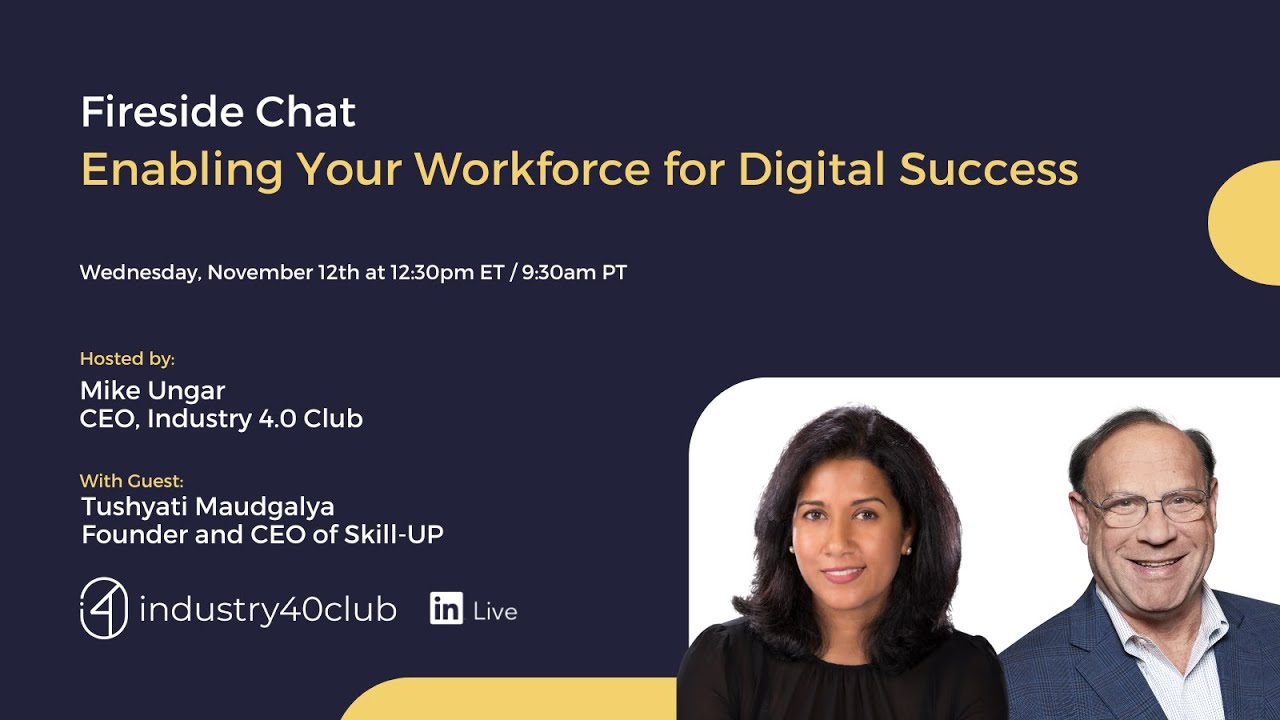
Enabling Your Workforce for Digital Success
Tushyata Madgalia, CEO of SkillUp, explains how manufacturers can upskill frontline workers for digital manufacturing. She identifies three core problems: aging workers losing knowledge, technology rolling out faster than people can learn it, and high turnover among younger workers. Her approach: start with small pilot lines, embed learning into daily work, use peer champions, and show ROI in 30 to 60 days.
Chapters
Welcome to the Industry 4.0 Club's fireside chat. Thank you. The club's purpose is to engage the power of diverse worldwide talent to accelerate the global evolution to Industry 4.0. We accomplish this by hosting and supporting respectful, thoughtful, and interdisciplinary open conversations and creating quality content on wide-ranging Industry 4.0 topics to expand the reach of our community. My name is Mike Ungar, and I'm the CEO of the club. We have— I have over 40 years of leadership and manufacturing experience, most of that at Michelin. Our fireside chat this afternoon is entitled Enabling Your Workforce for Digital Success. To help us discuss that topic, we're really fortunate this afternoon to be joined by Tushyata Madgalia, who's founder and CEO of SkillUp. Welcome, Tushyata.
Thank you, Mike. Thank you for having me on the Industry 4.0 Club.
A little bit about Tushyata. I think it's interesting to to hear about her, her background. She's the founder and CEO of SkillUp, which is a New York City-based startup focused on bridging skills gaps among frontline industrial workers. She's got over 17 years of experience across engineering, operations, strategy, and smart manufacturing, and brings a deep understanding of how people and technology intersect on the factory floor. Her work centers on human-centered approaches to digital transformation, empowering workers to thrive in the age of Industry 4.0, and helping organizations unlock the full value of manufacturing digitalization. So for those listening on LinkedIn today, if you have a question for Tushyanta during our time together, please put it in the comment box and we'll be glad to get it to her so she can respond. So again, we're glad to have you this morning or this afternoon depending upon where you're listening.
Thank you.
So, so just to get us started, you know, with your background, um, you've done a lot of work with industrial engineering, you've worked for Siemens, and you've also been a consultant. So that's quite a, quite a list of accomplishments. How have those experiences prepared you for your work that you're doing today at Scale-Up?
Yeah, it's funny, it was just something I was thinking about a few days ago. So, um, I started my career in digital manufacturing at Siemens, and this is in Cincinnati, Ohio, in the, in late '90s. So I spent a lot of time there in those initial years working closely with frontline factory workers and supervisors in the aerospace and automotive sectors. And also, a lot of my neighbors happen to be very active union participants and union leaders. So all these interactions basically helped give me a perspective into the realities and values that drive factory shop floor work. And post-business school, I was a consultant. Like you mentioned, I was at McKinsey and then later at BCG. And this gave me exposure to a very different kind of work. But what I started seeing was—
Yeah.
What I started seeing was that even a lot of our digital initiatives for our industrial clients were often stymied by the shortage of workers with the right skills. And again, fire and hire was the common approach in those days, but to bridge workforce gaps. But somehow this didn't quite sit well with me because I felt that there had to be something different, something that was more people-friendly, something that was more sustainable. So we go forward a few years. I spent a lot of time with Apple's supplier factories in Asia. And that's where I could— I got a chance to firsthand experience how knowledge transfer and informal training occurred on the front lines, especially in product production environments that were rapidly changing and lines that were changing from week on week. And when I returned to consulting, and this is back in the early 2020s, the global state had changed. It was very clear that there was a global shortage of workers and fire and hire was no longer an option. And that's where the germ of this idea started taking shape, where— you could help companies start factoring— where companies now had to start factoring in upskilling solutions into their strategic workforce planning. And all these experiences came full circle with SkillUp. It's my solution to making workers more effective, more engaged, and more adaptable in today's changing manufacturing floor.
Yeah, so thank you. That's really great. So thank you for sharing a bit about that background. So let's talk a bit more. Let's focus in on the workforce. And you mentioned skilling up, helping employers upskill their employees as a way to sort of—
Mm-hmm.
What are the challenges around that? What are some of the challenges in doing that? Because that— it's not as straightforward as just saying, well, we got to upskill folks.
Correct. So there are, so let me just clarify the question. So it's mainly what are the challenges that manufacturers are experiencing? So, you know, in these last 2 decades, I think there are 3 clear problems that are affecting manufacturers. And this is not just in North America, it's worldwide. So I think the first one would be an aging workforce. And you're seeing this problem worldwide. You have more experienced veteran workers who are set to retire or have retired from the workforce, and you have fewer and fewer newer younger workers entering the blue-collar workforce. And what this is doing is it's leading to a skill transfer issue. It's leading to a knowledge continuity issue because older workers are retiring with a lot of tribal knowledge in their heads. And there are— most places do not have structured mechanisms in place to help younger or newer workers onboard quickly and become effective on their jobs quickly. So, and it's also influencing choices about virtual or classroom training versus on-the-job shadowing. It's influencing apprenticeship pathways. It has lots of ramifications. The second thing we are seeing, the second big trend after an aging workforce demographic shift is this whole issue of technology deployment. So we are seeing a lot more technology being deployed on the shop floors and like Industry 4.0 transformations. And this new technology is requiring newer ways of working. It requires newer skill sets. So again, you're running into a wall with this. And then the third thing that's happening is you now have a newer generation of workers who are very, very unlike previous generations of workers. So you're seeing high levels of attrition, almost 51% and higher in the first 6 months in a lot of cases. Now, what's happening is this newer generation of workers is very different from previous generations in their work styles and their work preferences. They are digitally extremely fluent. They want more autonomy, flexibility. They are more informed and they're also very, very diverse. With this— Yeah. We're also seeing reshoring happening in the US. Go ahead.
Yeah.
Well, go ahead.
That's interesting you comment on those 3 different challenges. Does it vary by area of the country that you know, or— I mean, you're located in New York City. Is it the same everywhere, or tell me, what do you think? It depends on where you are in the country in terms of these challenges.
Yes, I can definitely speak to Florida. I mean, on the folks that I've interviewed in Michigan, in Florida, in the Midwest, and of course here in the tri-state area, New York, New Jersey, and Connecticut. I can also speak to what's happening in India and to my supplier contacts in China. This is a global problem. And even in a place like India, where you could argue that the cost of labor is less than in a developed country, than in the US, you are still seeing the shortage of labor because you are not seeing workers, younger workers willing to come into the manufacturing trades. There are a lot more options that are more comfortable. And you're seeing this play out in Europe. You're seeing this story play out in North America.
Yeah, that's interesting. You know, you talk about folks that are young workers that are more tech savvy and talk about the aging workforce. Let me get to the aging workforce for a minute. It's interesting because, I mean, a couple years ago I got a chance to get a picture of one of our factories here in South Carolina, in a rural area of South Carolina. And the challenge is even greater than maybe people understand. A third of the workforce still did not have a cell phone. You know, so how do you bring folks along who don't really even have the sense of technology that's necessary as you speak about it?
Yes. And, you know, that's a great point because that is something that a lot of manufacturers are contending. Because if you have an older workforce that is not that digitally savvy or accustomed to it, how do you even bring in new technologies that provide task-relevant or on-the-job point of communication? So one is, of course, it would have to be training. And there are different mechanisms that are happening. In a lot of the— there are lots of initiatives where they are trying to push out tablets. A lot of companies in India are creating low-cost tablets to serve workers. in content that's very visual. And you're seeing that happen even in the US. A lot of the SMEs that I've spoken with, even though they traditionally did not have allowed devices on the floor, are now looking at devices.
Okay.
So that is changing, but of course it's a behavior change. It's about, and it goes beyond just tablets or phones on the shop floor. It's about how do you go ahead if you have an older workforce And you have newer technologies coming, how do you reconcile that? How do you go ahead and make it part and parcel of their workflow? It's not pushing something on them. It's about seeing what would be— what would have the least friction in fitting into their workday and their work styles.
Yeah, that's a great point. I think you highlighted there that, you know, recognizing that and then coming up with solutions that fit that need is really the key. So it sounds like that's what you're alluding to.
Absolutely, because what could work in one factory could— may not work in another factory. And that's where it's— you and I have spoken about this whole— the whole lean thing, when everybody jumped on the lean bandwagon. But it's not about blindly applying the principles. It's trying to understand what fits and what needs to be contoured for a particular context or organizational culture.
Yeah, that's a great point. So what are some of the other alternatives that manufacturers can pull on or can implement to address some of the challenges that you've brought up?
So in the last 12 months, so essentially, okay, so just to recap, what we are really seeing here is all these macro trends are resulting in 2 main things, 2 headwinds. Labor shortage and a skill gap issue. So in the last 12 months, I've been speaking with, in the connection of SkillUp, I've been speaking with a lot of SME owners in the industrial sector and senior management. And this is a question that comes up again and again. And it's interesting to see what people have started working on as well to combat these issues. So essentially, there are, it could fall under 3 buckets. So, and I think of it as people development, technology to automate where it's applicable, and the third thing is partnerships. So in people development, it's basically the first measure would be invest in people. And we are seeing this also, it's becoming more and more rampant because it's not about technology, it's about how technology empowers the worker. It's not a headcount— technology is not a headcount reduction mechanism alone. So investing in people development is paramount. And what that really means, it runs the gamut from creating systems that can capture or leverage tribal and tacit knowledge to promoting leaders who are not just operators but also good coaches, to creating more effective task-based training rather than classroom training, to creating a culture where workers feel like they're more contributing members and continuously rather than just cogs in the wheel. The second one lever would be deploying technology strategically, and I emphasize that word strategically because it's about focusing how technology can drive a process, how it can work around a worker or empower a worker to make more informed, faster decisions at the point of work. Not again, not merely to replace headcount, and as A technology that's implemented around work processes, around a person workflow, has far higher chances of being sticky and producing positive outcomes. So on the shop floor, you need technology, one, to make informed decisions, but you also need that technology to drive that process discipline, which will lead to more stable performance, better cost measures, a more competitive cost structure, and higher quality.
12:44 PM.
Sorry, and that was my iWatch. And then you have the partnerships, which are my personal favorite because this is the bucket where I see so much innovation happening. So on the, say, for on the front of recruitment, I saw one SME head who told me about how he's actively recruited— his recruiter is now a white-collar recruiter because he realized that with so many workers, white-collar workers displaced with the AI wave, They are extremely trainable. They bring a sort of work ethic which he can train within his factory. So he's focusing on non-traditional workers to bring them into his arena, industrial arena, and he's extremely happy with the results he's got in the last 2 years. Then I've seen partnerships with vocational schools to not just focus on technical content but also on content like trainability. Critical thinking and first principle approaches which can stand the workers in good stead in a changing manufacturing environment.
12:45 PM.
Then the third one is, of course, the whole focus on looking at— I'm just looking at my— yeah. Basically, novel approaches for succession planning and job shadowing. How do you accommodate that when you have fewer people? Some people are resorting to virtual ways to record completed work and send it back to an expert back on the side who doesn't have to spend the entire day with you. Companies are coming up with different measures and this is my favorite because there's a lot of innovation here.
Yes. That's great. I just want to remind our audience, we've been talking for the last 15 minutes with Tushyanta about how we enable the workforce for digital success. If you've got a question that you'd like to ask her, please put it in the comment box. And we'll get it to her while we're still here live on the broadcast. So, well, those are really good examples that you share there about ways to pursue that. The partnerships is really quite interesting because there's a lot of folks out there that can help you. But how do you pick the right partner? It's an interesting thing, you know, because we find there are a lot of people who are trying to, quote unquote, sell certain things. There are lots of schools. Yeah, I mean, how do you choose the right partner to be able to help you really move forward? Because that's a— for a small and mid-sized manufacturer, they really can't afford to miss when they go forward. You know, they don't have the resources or the money to do something over again, you know.
Yes. And, you know, that is a great question because it's forcing us to start thinking we are in the realm of, hey, you can do this, you can have this solution, this could do this, but how does it feel from the other side? So if I put myself on the other side, what would really matter? So let me just backtrack a little. Most of us think that small and medium enterprises are behind on adopting technology and how do we cater to them? I don't think it's because they're behind because they're slow, it's because they are simply very, very busy. Every single SME that I've talked to in the last 12 months are extremely lean organizations. You have general managers who are doing procurement, who are doing scheduling, who are jumping into HR issues, who are even filling in gaps on the floor when somebody is called out. So the first thing, to come to your question, the first thing I think would be not putting technology for technology's sake. You cannot go in there with you have to address something that they're experiencing here and now. So the first thing would be to go ahead and go tackling some operational pain point. So it's not so much about, hey, everybody's doing AI and we can show you how to do AI and I can help you build your data lakes. That's not what they want to hear. Instead, if you go ahead, and I'm just using an example from my experience, Sure. Go in and say, hey, the time to take to really get someone up to speed is about 8 weeks. We can show you how to reduce it to 3 because that will make them more effective faster. 2 people who are basically your experts for this line. We can show you how you can go ahead and capture that information and make it more accessible to others so that you can reduce the bottleneck here and get better customer service scores. So it's basically going headfirst with an operational pain point that's really, really relevant to them. And I learned this the hard way. When you go in with a problem, when the problem that you're trying to solve is extremely specific, then the value is obvious. You don't need to talk about it. Then the second thing is focus on, as what, what if I was looking for a provider, I would focus on someone who can offer me low friction, as in I'm not about high features or the bells and whistles. I'm about low friction. So as an SME, you need to focus on a tool. You don't have the time or the resources to waste 3 months in setting something up and having a dedicated admin to keep it alive. You need something that can survive and do the job quickly. So, you're looking for someone who can help provide you with solutions that integrate easily into the rhythm of your shift, into your work culture. And the third thing is, I want a tool that does not require me to be dependent on the external provider for its adoption. So, and what I mean by that is something that encourages internal champions. Again, taking an example from what I've seen, like having a couple of frontline, well-respected frontline folks who say that, hey, we are recording information, what we've seen, we are recording our best practices, we are sharing them, we are talking about how we are doing it. That actually brings a lot more credibility among the others. It's basically peer-driven. Then finally, work with someone who can show me value quickly. I don't have a year or time to go through big dreams of ROI models. It's basically in 30 days, what can you show me? What can you show me in 60 days? What will I get? So when you go ahead and show someone who can show the SME fewer changeovers, faster new hires gaining confidence faster, fewer go-find-Joe situations, it's these little things that actually drive that momentum and trust. So That's the long-winded answer.
That's great. I picked up on a couple of things that are very important, I think, that you mentioned. One is you don't do technology for technology's sake, you do it to solve a problem. I think that's really key. The other thing you talked about is being able to implement relatively quickly to show a return so that they can see right away. That means scoping. I think what that allows me to think about is scoping the first installation or the first implementation small enough, if you will, so you can see those results right away.
Absolutely. It's basically start with one line, one task, one small group, and then look at it and then go ahead and scale what's working to other areas.
Then the third thing I heard, which I think is really also very important is to involve the workforce, make sure it's peer-driven, get folks who are willing to be first adopters, if you will, from the workforce to help you make it happen. It's interesting, we get this question quite often, and that's how do you make the change? How do you bring digital change to the workforce? There's got to be— where do you start? Do you start with the leadership or do you start with the factory floor? What are your thoughts on that? Because, you know, you have to have the support of the leadership to be willing to commit resources to it. But they don't know what the floor— the folks on the floor know, right? They have to use it. So how do you balance that ownership at the top level and ownership at the shop floor level?
Okay, so the answer is complicated. And, you know, from all the academic training, the The right answer is no, it has to go from bottom up. And of course, in B-school, it was honed in that no, the stakeholders, the main guys have to decide what goes down and figure out how to push it up. In practice, as an entrepreneur, I've realized it's complicated. So, and I'll give you an example about— so essentially what happens is, again, taking the example of what I've seen, for this to work, the signal has to come from leadership in the sense a supervisor should say, Hey, it's okay for you to take time during your shift to just look at a 90-second video before a changeover, before a tool change. And that signals to the operators that, oh, they are okay with me learning on the job. And it's not a distraction, it's an enabler. So that signal has to come from the top management.
Yeah, that's great. That's the point. So it really, It really requires the right level of involvement from both for success, doesn't it?
It does.
Yeah, you can't— it's not one or the other, it's both.
Correct. And we sometimes make the mistake of thinking it has to be bottom-up or it has to be top-down. It doesn't work that way. It has to be a mixture.
So we— you also alluded to this issue of partnerships. I want to come back to that a bit further. So quite often we think of small and mid-sized manufacturing, and you alluded to this already, being slow to adopt technology, you know, they don't have time to investigate solutions. They have challenges, they've got to fix those challenges. Where should they go in the ecosystem really to, to get the support to prepare them for the future, thinking about today's environment?
So what I've seen in this last 12 months is that the MEPs actually have very very, very, um, they have a lot of organizations that small and medium enterprises can tap into. So one, you can go into the MEPs, are the Manufacturing Extension Partnerships, and, uh, I've interacted with quite a few of them in Florida with Florida Makes as well as here in the tri-state area, New York, with ITAP and the others. And they have a lot of, they do a lot of sessions both to educate small and medium enterprises as well as to give them access to consultants who can come in and share best practices or help them look at their particular situation and go ahead and help chart a path forward that's just right for that organization. So there are loads of those, there are loads of organizations. The other thing I've also seen is that you have national-level organizations too that are creating a lot of content. Because right now with the whole focus on reshoring or building up manufacturing and industrial capability back in the US, there is a lot of efforts being done at the federal and at the state level, and especially focused on small and medium enterprises because they are seen as the backbone for this growth.
Perfect. Thank you for that. Well, we've been talking for the last 25 minutes. about this important topic, this idea of how do we enable our workforce for digital success. If you had to leave our audience with a final thought about what we've talked about today, what would it be? What would you like to share?
If I had to leave, my parting thought would be essentially it's that the future of manufacturing isn't really going to be won by the companies with the flashiest, newest technology. Rather, I think and I believe that it's going to be won by the— the winners are going to be the companies that figure out how to learn quickly and adapt quickly. So every plant already has deep rivers of expertise, and it's like the person who can listen to— the people who listen to machines and know what's going wrong, the ones you approach where, uh, to get a production line back on track, the ones with the grime under their grease where you know what they're saying definitely will make a difference. And the challenge is that a lot of this know-how is in the heads of a few people. And when those few people either move or retire, or simply they can't be everywhere at once, the whole system experiences a negative impact. So with SkillUp, what we're seeing is that when you make this kind of know-how visible, more accessible, and more shareable, then you reduce onboarding time, you reduce rework, you reduce the stress on your go-to champions in the— or experts in the work in the factory floor. And most importantly, you start building confidence among the operators on the floor. So it's not in theory, it's actually in tiny daily tasks every day in their daily work. So it's not so much about digitizing learning, it's about making learning part of how the plant operates and in small, practical, in the flow of work. ways. And so if we focus here, if we start thinking about how to equip people, honor and recognize expertise, create simple ways to share what works, then technology adoption won't be seen as the leap of faith or the painful experience that a lot of people think of it to be.
Yes.
So it becomes just a natural extension for a workforce that's already capable, engaged, and feels supported. And that, I think, is the, the clear competitive advantage and a golden opportunity for our manufacturing floors for tomorrow.
Yeah, well, thank you for that. That's wonderful. I think when I heard you talk about that, like, it reminds me that, you know, the adage, you want to eat the elephant one bite at a time. You know, it's, uh, it's about taking small steps and, and continuing to walk almost, you know. And one day you wake up and you realize that you went a mile.
Correct.
That's fantastic. That's wonderful. Well, thank you for that. So really want to thank you, Tishata, for taking time out of your busy schedule to share your insights really about using technology to upskill our manufacturing workforce. Really appreciate that a lot.
Thank you.
Just a quick comment about the club. We would like to encourage you to take action to advance the deployment of Industry 4.0. Read an article, attend a workshop, listen to a webinar, or even develop a smart manufacturing roadmap for your company or your plant, or challenge your organization to move forward in the deployment of Industry 4.0? We'd like to know what you're doing, so please reach out to us on our website at www.industry4oclub.com and share your thoughts, or on our LinkedIn page. We also routinely host conversations like this and would love to have— if you're listening— have others on as our guests. So if it's something you're interested in as well, please reach out to us on our website or on our LinkedIn page and let us know of your interest. With that, again, thank you for your time, Tushar, and I want to wish everybody a wonderful rest of the day and week. So thank you again.
Thank you, Mike.