From Design to Delivery: Integrating PLM and CLM for End-to-End Manufacturing Excellence
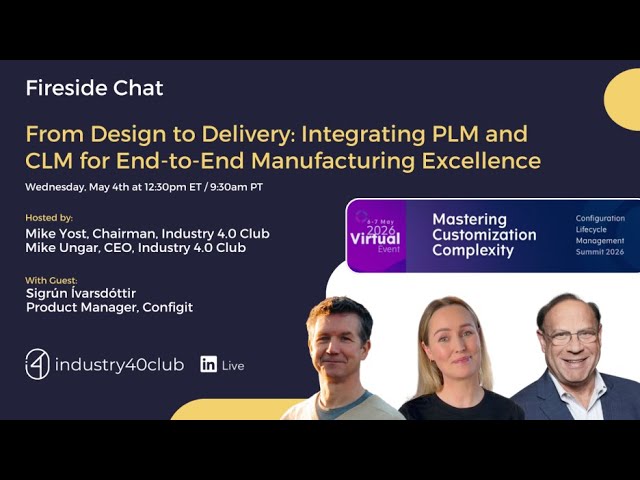
In this Industry 4.0 Club fireside chat, host Michael Ungar (CEO) and co‑host Mike Yost (Chairman) interview Sigrun Iversdottir, Product Manager at Configit, about integrating Product Lifecycle Management (PLM) with Configuration Lifecycle Management (CLM) to achieve end‑to‑end manufacturing excellence. The conversation begins with an overview of how engineering, sales, manufacturing and service each view a product differently and operate in separate, siloed systems. Sigrun explains that CLM acts as a bridge, breaking down these silos, automating data exchange, reducing errors and late‑stage rework, and freeing engineers and salespeople to focus on core tasks. They discuss who typically champions a CLM initiative—often IT or business owners who understand product logic—and the importance of assigning end‑to‑end ownership, sometimes within supply‑chain functions. The dialogue moves to the concept of a reliable digital configuration thread, emphasizing that trustworthy data is essential for traceability, insight into product complexity, and for making strategic decisions about which options add value. By visualizing the full solution space, manufacturers can identify and eliminate non‑value‑adding complexity, improving margins and capacity. Challenges to successful adoption are identified as attempts to merely connect systems without aligning product logic, and a lack of holistic, organization‑wide ownership. Looking ahead, Sigrun highlights that AI can only be effective on top of a solid data foundation; deterministic, traceable data is required for manufacturing, but AI can accelerate market‑responsive configuration and analysis once that foundation exists. The session concludes with a promotion of Configit’s upcoming CLM Summit (May 6‑7), where participants will learn about building reliable data foundations, avoiding siloed solutions, and leveraging AI for faster, higher‑margin customization.
Chapters
Welcome to the Industry 4.0 Club's fireside chat. The club's purpose is to engage the power of diverse worldwide talent to accelerate the global evolution to Industry 4.0. We accomplish this by hosting and supporting respectful, thoughtful, and interdisciplinary open conversations and creating quality content on wide-ranging Industry 4.0 topics to expand the reach of our community. My name is Mike Ungar, and I am the CEO of the Industry 4.0 Club. I have over 40 years of management and leadership experience, most of that in manufacturing at Michelin. I'm joined today by my co-host, Mike Yost, who's the chairman of the club. Mike, would you mind introducing yourself further, please?
Not at all, Mike. Thank you. Welcome, everybody. As Mike said, my name is Mike Yost. I'm the volunteer chairman of the Industry 4.0 Club and Mike's co-host here on the fireside chats. I've been in industry for not quite 40 years. The first half of my career on the solution provider side, technology solutions, and the last 16 years or so on the industrial nonprofit side. So really excited for what we're doing here at the club and the conversation we're going to have today. We have the pleasure of speaking with Sigrun Iversdottir, the product manager at Configit, and we're going to be talking about from design to delivery, integrating PLM and configuration lifecycle management, or CLM for end-to-end manufacturing excellence. So by way of introduction, Sigrun is working to bridge the gap between engineering and sales. She uses configuration lifecycle management, or CLM, to connect systems such as PLM and sales, ensuring that complex products can be sold and delivered effectively. Her focus— her work focuses on helping manufacturers turn product complexity into a strategic advantage in today's Industry 4.0 environment. So welcome, Sigrid.
Thank you very much, and thank you very much for having me.
Of course.
Before we get into some of our questions, I just want to highlight that ConfigIt is hosting the 11th Configuration Lifecycle Management, or CLM, Summit on May 6th and 7th. This event will focus on how manufacturers can master customization complexity by establishing a strong data foundation for future growth. Oh, virtually over 2 days— 2 half days, excuse me— the summit brings together B2B manufacturing leaders to explore how connecting systems, data, and logic enables organizations to manage complexity more effectively. So to discover how CLM approach links systems and configuration logic across the entire enterprise, turning product complexity into confident decisions. Throughout the product lifecycle. Join us for this exciting 2-day event. So with that, maybe, Sigrun, we can get into talking a little bit about, you know, PLM and CLM. So many manufacturers, just to get us started, engineering and manufacturing and sales, they still operate in separate worlds. So can you talk for a minute how these worlds are different, and where do you see critical gaps in connecting them?
Yes, so manufacturing and engineering and service and sales, they all kind of see a little bit different views of the product. So that engineering, they are focusing very much on the technical aspects and the technical rules and options and the bill of material, whereas then you have sales, which is focusing more on on what is offering, uh, what you're offering to the customer. So the packaging of the product and the markets that it should be sold to and the pricing and so on. Whereas the engineering part, that is more focusing on, as I said, on the technical part, but also on what can actually be built and designed. And then you also have the manufacturing side, which is then focusing on what can actually be delivered. So all of these things, they of course, need to be as a whole to fulfill the product and sell something to the customer, but they are maybe not always aligned. So they have like these different views of it. So I think you're muted, Mike.
Yeah, this is my first event, so I apologize for that. Geez, what a rookie mistake. What I was trying to say is that not only is it the views of the people in those different roles, but it's also the systems, right? So they have systems in place specific to their type of work and the perspectives that you talked about, but then they also have different systems that need to be stitched together. And that's where Citus comes in, right?
Yes, exactly. Because today these are often working in a lot of silos. So you have each of these systems and then each of these domain experts work within their own systems. Working on the either than the technical aspects or the more sales aspects. And when you don't have these things kind of connected, then of course you can easily think of that you might have some misalignments across these various different systems. So CLM is kind of that bridge to try to get all of these silos broken down and get these different parts of the organization more aligned.
Well, that's a really powerful point, and part of the value proposition of Industry 4.0 obviously is that we have all the information that we need, you know, to make decisions in real time. But if you're stuck in organizational or technical silos, then it really makes it difficult for people to make informed decisions across those boundaries. Is that accurate?
Yes, absolutely. That is definitely very hard to make those informed decisions if you don't know what the other parts of the organization is doing. And we can also sometimes see then that, for example, sales might be trying to offer something that actually cannot be delivered. So that, of course, can lead to a lot of frustrations and so on if you're trying to sell something that you need to then come back to that customer and say, I'm sorry, that actually isn't something that we can offer you.
So, but that's a great comment then. So, What have you seen so far when you actually can connect or integrate your PLM with CLM, or really engineering through fulfillment? What kind of outcomes have you seen when you can address the issue you just described?
So there are a lot of positive outcomes that you can get when you're combining PLM with CLM. And first and foremost, you're of course breaking down these silos, and then you can get that alignment, which also makes this whole process more automated so that you are not having to share like these spreadsheets or documents and doing like these manual processes of trying to do that alignment in a more manual way. And that also frees up some of the, for example, engineering time if they're maybe taking that ownership of trying to do that alignment, then they can focus more on their actual engineering work, trying to— instead of trying to do that kind of bridging between. But there are also more tangible kind of benefits that you can also get where you have like these fewer errors and you also have less rework late in the process. So this late-stage rework, because sometimes you might have some change late in the engineering part and it might not be reflected quick enough on the sales side. And then you, of course, run into, into these issues.
Yeah. You know, I remember, you know, in my experience, we would often bring the sales guys into the plant. And, you know, we could— we had no way to document. Let me show you something. And we would bring them over and say, this is why we can't do this. And this is why you can't offer this anymore. Because— and there was no other way for us to explain to them or have it be documented. Other than actually have to bring them in and show them, because without the context, they wouldn't even understand what we're saying. And it sounds like what CLM is doing then is it's bridging that gap where it informs them without having to really provide that intimate, like, this is what I mean when I say X or Y. Does that make sense?
Yes. That's definitely one of the positive things when we are getting the CLM aspect into this is that we are then putting this whole thing into one executable model that you can then do this combined validation on so that you make sure that everything is validated across the entire organization. So instead of just having something that looks valid in one system and it looks also valid in the other system, but then when you try to put it all together, then actually have some misalignments and something that breaks. And now with the integration and this joining these 2 together, then you know that upfront and you can do that validation and you see already, okay, here is actually something that is a little bit mismatching. Is that what you actually intended to do or is that something that just happened without you realizing? And now we have the possibility to go and address it proactively instead of realizing it later in the process and then you need to do—
Yeah.
Some fixing afterwards.
Well, and it frees up— it then frees up the time we would take trying to either fix the error or explain the complexity to allow us to focus on, for the sales guy, more sales, right? Or the manufacturer on their particular mission. So that you can turn that time of trying to have to explain or rework into real productive time. That's really great.
Exactly.
I'm curious, moving away a bit from the technical side to more of the organizational dynamics that you deal with, with manufacturing customers. Who is— is there a typical profile of like who tends to champion a CLM-type solution? So is it people that are on the PLM side or on the sales side, or is it senior leadership or IT since it crosses so many different departmental boundaries and systems boundaries? Do you have a typical— champion, I guess, from a role perspective inside of an organization?
Are you thinking who would then kind of take the initiative of starting to align this?
Right. Yes, exactly.
I would say that that would be the kind of IT owner or someone that has to do also with their IT setups and want to make sure that they're aligned in this, but also the kind of the business owner wanting to make sure that the logic is in place. Because I think that is sometimes also the, the challenge that people run into is that they try to solve this by just integrating the systems, but not integrating the actual product definition and the logic underneath it. So it needs to also be somebody who has kind of that understanding of, of the importance of aligning the actual logic.
I think that's a really, really insightful point. We historically get trapped into just sort of the point-to-point technical integration, but if you don't have the perspective of the overall process and product definition as you're talking about it, and that overall business view, you can really end up stitching yourself into corners that you don't want to be stuck into.
Yeah, absolutely.
Well, I'm curious, I believe that product complexity and customization is increasing. So it seems to be, you know, as consumers, we want more options, as manufacturers are looking for competitive advantages and stuff. So how do you talk with folks? Like, how does connecting the PLM and the CLM, the manufacturing systems and stuff, actually help create a true digital thread that, you know, is valuable for one of your manufacturing clients?
So I will say that the digital thread has been around for some time, and it has been very much focusing on the lifecycle of the product. But with this increased demand in customizable products, you also need to kind of extend on that term and talk about like the digital configuration thread, where you can track that configuration over time. And it's so important when you also want to do that, that it's built on reliable data. And with combining the PLM and CLM, and you get that validation throughout the entire chain, then you also get a more accurate digital thread because you want to be able to use the digital thread to kind of track and trace back also like where did this configuration come from? How was it designed in the beginning? How was it then offered? What did you actually sell to the customer? And how have you like maintained it and serviced it over time? So with that validation aspect, that's combining PLM and CLM, then you get also more kind of accurate digital thread that you can easily trace back and make sure that what you are tracing back is actually true and you can rely on and the output that you get from it. So I think that is very powerful.
Very true. Yeah, it's got to be accurate. It's got to be right. Like you said, the data foundation, you know, it has to be right. If you can't trust the data, especially if we're talking, I mean, anywhere within the organization, but certainly if I'm in my department, you're in your department, you mentioned earlier having different views of the product. And if the data coming out of your system I don't trust in my department, I'm not likely to trust what you're saying if we're getting any sort of a tug there about who's right in some sort of a scenario like that.
Exactly. And like you mentioned also with the complexity, because of course with more customization there also comes more complexity, which can— it's not always a bad thing, but it can also be challenging. And also to know which complexity actually drives value and which complexity is not something that you would like to have. And I think by also doing that combination of PLM and CLM, one of the other benefits of it is that you get much more insight into your data so that you can also start to clean up some of that complexity that is unwanted complexity and try to utilize in the best possible way. Because you can start to kind of have these insights. And because of the virtual tabulation or the VT technology that we have at Configit, then we are building up this solution space upfront so that you can get this insight into the full end-to-end solution space. And you can use that to do so many cool analysis that you also, in this ever-changing market that we live in today, it's so important that people can quickly see the impact of changes. So then you can start to utilize that insight of that data and that solution space to kind of see how market change will have an impact of the actual solution space and what complexity you can also try to kind of simplify.
Sure.
And especially when you then put the sales data on top of it, what you have actually been selling, then you can start to map up like these configurations, they are actually doing really well, whereas these ones we rarely sell them, so maybe we should try to clean up something here.
Well, I think that, that's a really great point because, you know, I can imagine then the benefit of that is getting rid of the things that don't add value. And of course, there's a limit to what you can do a lot of times from a cost perspective. So when you get rid of the things that aren't— you don't need, that means you may have capacity to add things that you do need.
Yes.
And it opens up that capability, which, which sounds really exciting.
Yeah, it is very powerful when you start to have that insight into the data that otherwise has been maybe available, because I think the problem, it isn't that people are lacking the data, it's just the visibility and the kind of having that combined view of the end-to-end data.
So, so what are some of the biggest challenges? You know, we've talked about this, this alignment that we're trying to get. What separates those that are successful from those that aren't relative to really making a CLM work for them?
So I would say that those who struggle, they are the ones that are trying to still solve this within the silos. And they are the ones that are maybe trying to connect just the systems rather than trying to go one level down and actually think about the logic and the product definition itself. And those who succeed, they think of this more as a holistic problem across the entire organization. And they want to make sure that there is this connection throughout the entire part. And you have this one executable model that everybody's relying on. And they also think about, like, with the ownership and making sure that there is somebody that has the end-to-end ownership. Because if you're not having somebody that has that kind of end-to-end view, then it's really hard to stay aligned and make sure that you capture these pitfalls early.
Where have you seen that end-to-end view? I know we kind of touched on this earlier, but where do you— which organ— which part of the company typically owns the end-to-end view from your— from what you've seen? Or does it vary a lot?
Yeah, I think that is based on the company a little bit. So it's up to the processes, how they see it. Often maybe customers create a special role that is also dedicated to making that validation and that bridge between. It can also be somebody from one of the parts of the organization that takes on that role. But I think with this automation that comes with combining PLM and CLM, then that becomes also a smaller portion because it's something— somebody that of course needs to navigate that validation inside of ACE, the configured product. But otherwise, it is something that manually happens as a part of getting all that data into this one executable model.
Yeah, you know, I'm thinking about, at least my experience, we would have typically put it with supply chain. Honestly, you know, the beauty about supply chain is they see the organization there. They already have some function to see the organization from end to end. And so at least, at least my experience that, and so it would kind of make sense that they would try. It's ironic, at least in my experience, we relied on supply chain to try to do what you're talking about without the, like, knit things together, you know.
Mm-hmm.
Like, hold the have the conversations between departments and between functions. And yeah, I can imagine the supply chain holding the responsibility for the system, at least in my experience.
Yeah, I think that makes a lot of sense.
I'm curious too. I mean, it's a great point. And again, one of the promises of Industry 4.0 is it's not new, as you mentioned earlier, Sigrid. You know, we've been talking digital thread, we've been doing bits and pieces of this and promising these things for a long, long time. And as we talk about the supply chain, as we talk about the systems, does it extend into the customer base? Do you get involved with customers connecting with supply chain systems, sharing information with external either suppliers or customers, or is it typically— is that outside the realm of the manufacturers that you're dealing with?
I think we have mostly been focusing on within these, these parts and not so much focusing on the supply chain. But of course, the, the insights that you also can get from having this visibility into the data, and then you can start to also connect it to the supply chain because then you can start to also say, if for example you don't have the possibility of this item no longer, like you don't have access to this part anymore, something that should go into the bill of material, then you can start to also see the impact, the ripple effect of doing that, and also vice versa. So if you're suddenly, you don't want to sell to a specific market, you can also see the impact and say, okay, these items here from a supply chain aspect, they are no longer needed, or you don't need to focus on them.
That's another really good point, because just because a system or information from one of the systems is not physically connected to an external system doesn't mean it's not valuable in making decisions that have an impact on those relationships and such.
Yeah.
So I just want to pause for just a second and remind everybody that we are speaking with Sigrun Iversdottir, the product manager at Configit, talking about integrating PLM and CLM for end-to-end manufacturing excellence. And so we're enjoying the conversation here, and I guess, Wanted to just look into the future a little bit, if we could, Sigrun. Where do you see the future of, you know, PLM and CLM integration heading? Especially, you know, we've been talking about insights here a lot. Now we have the rise of AI, we have the increasing speed of business that can't be sacrificed. You can't sacrifice quality, can't sacrifice face cost and output, but we want to make things faster. So where do you see the future of this integration going?
Yeah, so AI is of course on everybody's minds, I think, right now. And that is a lot of cool things that you can get with AI, but it's only as good as the data that it also relies on. So if you don't have reliable data foundation underneath that AI, then the AI can only amplify the problem that might be underlying and this misalignment. So I think by having this good, reliable data foundation, then you can start to also build up better AI solutions on top. Because of course, the problem with AI is that that is probabilistic. And then for manufacturing industry, you need something that is deterministic. You can't say something that is like you have a configuration that is probably valid or this— Bill of material is likely correct.
It might work.
And you have— you would like to know at least what you are kind of having your hands on. And of course, in many ways, that determinism is maybe not so critical, and you would say, isn't 90% enough? And maybe it would be, but the problem is that for these 10% where actually things start to go wrong, you also would like to have that traceability. You would like to be able to trace back, and why did this fail, and why did why did this happen and how can we fix it for, for later on? So you need to have that kind of reliable data foundation underneath. But once you have that, then you can definitely utilize AI to build solutions on top. And then you can, like we talked about this, market changes and all these things, and you want to have quick adaption in your solutions to, to quickly adapt to these ever-changing markets. then you can definitely use AI to help you with those type of solutions and situations. So I think that is definitely something that we should keep our eye out for.
For sure. And your organization's actively working in that domain, right? Leveraging AI and, you know, different models and such. So yeah, it's fantastic.
So just as we begin to wrap up, I wanted to ask you about the summit. Coming up on May 6th and 7th. For those that attend, what do you hope that they learn? I mean, we're, we're only a couple days away from, from the summit. So what do you hope those that participate learn from being participating with you?
I think one key element that I would like people to take away is this importance of the reliable data foundation. And also this part about not trying to solve this need of customizable products within silos, but think about it as an organizational challenge that needs to be solved across all parts of the business. And yeah, and try to utilize the AI on top of it and use the power once you have that reliable data foundation and and see the power that you can get from it to adapt quickly and increase your revenue and margins and so on, because you have all this power at your hand once you have the reliable data foundation.
That's great. That's excellent. So we've reached the end of our discussion. I really appreciate, you know, Sigrun, you taking time to join us to talk about the integration of TLM and CLM. We'd like to remind our audience of the upcoming summit. We mentioned that a couple of times. It's happening just in a couple of days on May 6th and 7th. There's still time to register. So here's the website. Please go to the website, drop your name in there, let them know that you're coming. It's again, 2 half days. And the timing is great. So if you're in North America, it's in the morning. And if you're in Europe, it's in the afternoon. So Really set up well for everybody around the world to participate.
Thank you very much for having me. It's been a pleasure.
The Industry 4.0 Club would like to encourage you to take action to advance the deployment of Industry 4.0. We'd like to know what you're doing, so attend the summit, read an article, participate in a workshop, drop us a note on our website at www.industry4oclub.com. Or on our LinkedIn page and let us know what you're doing to advance the deployment of Industry 4.0. We'd also like to invite you to join us on a future broadcast. So if you'd like to be part of that, again, drop us a note on our website or LinkedIn page. And with that, again, Sigrun, thank you for joining us. It's been great. Mike, thank you as well.
Of course. Thank you, Sigrun.
Thank you very much.
Have a great day. Thank you. Thank you.
Bye.










