From Experiments to Edge: Making AI Part of Your Business Strategy
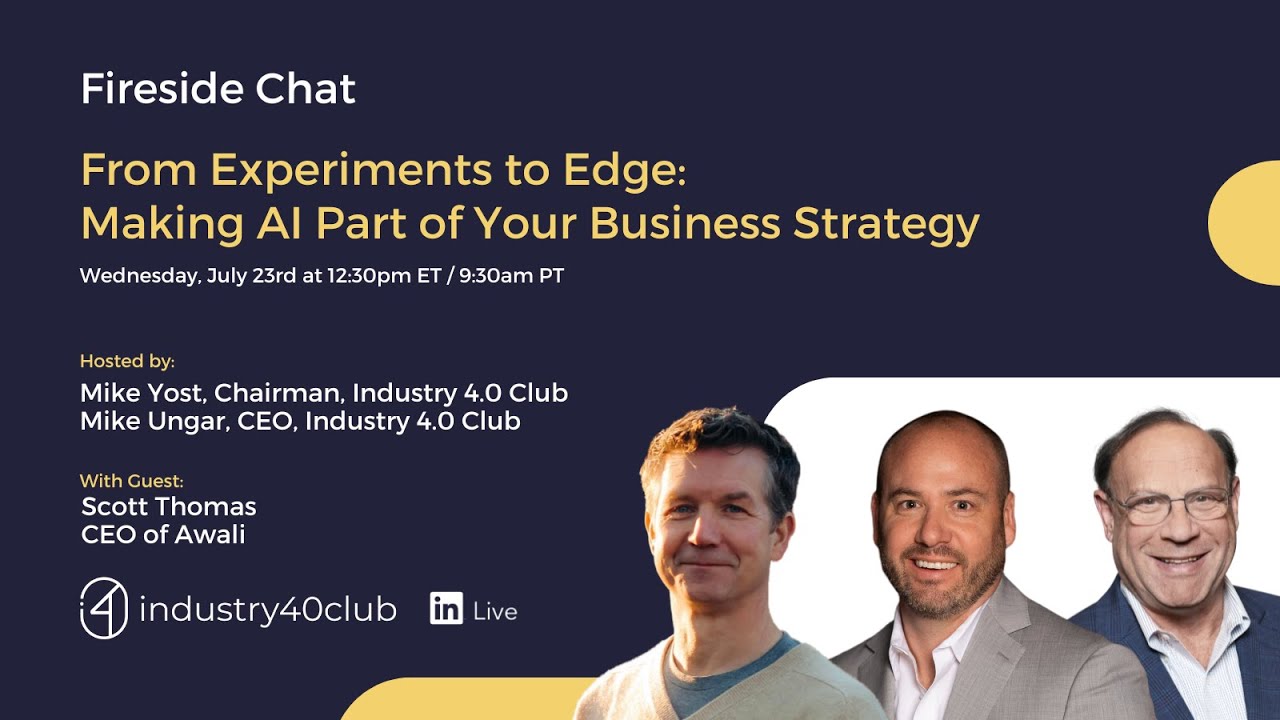
Scott Thomas, CEO of Owali, explains how to embed AI into business strategy using a three-part framework: single-task automation, end-to-end workflow automation, and integrated AI ecosystems. He draws on Air Force leadership lessons to argue that AI succeeds through people-first culture and outcome-focused experimentation, not technology hype. Clear business outcomes, reversible low-cost experiments, and unified data foundations turn AI from a smart intern into a strategic advisor.
Chapters
Welcome to the Industry 4.0 Club's fireside chat. The club's purpose is to engage the power of diverse worldwide talent to accelerate the global evolution to Industry 4.0. We accomplish this by hosting and supporting respectful, thoughtful, and interdisciplinary open conversations and creating quality content on wide-ranging Industry 4.0 topics to expand the reach of our community. My name is Mike Ungar, and I am the CEO of the Industry 4.0 Club. I have over 40 years of leadership and management experience, most of that in manufacturing at Michelin. I'm joined today by my co-host, Mike Yost. Mike is the chairman of the club, and Mike, would you mind introducing yourself, please?
Absolutely. Thank you.
Welcome, everybody.
As Mike said, my name is Mike Yost. I'm the volunteer chairman of the Industry 4.0 Club and Mike's co-host in these sessions. I've been in industry for 35 years, the last 15 on the industrial nonprofit side, and so really excited to have you here with us today. and also to have our guest with us today. Our session is entitled From Experiments to Edge: Making AI Part of Your Business Strategy. To help us discuss this topic, we're joined by Scott Thomas, who is the CEO of Awali. And just a little bit of background on Scott. He's a seasoned tech CEO and growth advisor with over 20 years of leadership experience driving transformative results. He's led 17 technology companies, including as group CEO at Constellation Software, overseeing $120 million plus in combined revenues. A former Air Force captain, Scott applies battlefield-tested leadership to complex industries like healthcare, utilities, and government. He serves as the CEO of Owly, an AI-driven data infrastructure company, where he helps the organization unlock smarter, faster decisions by integrating AI into their operations. Something is very relevant to us and something I'm sure we'll dive into here today. As a partner at Next Level Growth, Scott works directly with CEOs and leadership teams to uncover practical, high-impact ways to leverage AI and align strategy, systems, and talent to drive both profit and scale. He's known for cutting through the noise and translating emerging technologies into clear, actionable business advantages, which again is right in line with what we're working to accomplish here at the club. If you are joining us online now at LinkedIn, we encourage you to go ahead and ask questions and we will get to them as we can. But with that, welcome, Scott.
Thank you for having me. It's a pleasure. Mike and I have known each other, or Mike Ungar have known each other for a while, and it's exciting the mission of this organization and how you're Not only serving the space, but organizations and at the team and employee level. Honorable what you all are doing.
Well, let me just jump in quickly before Mike takes over and thank you for your service. Thank both of you for your service. We're really excited to have you here with us.
Awesome.
Scott, talk about— I know we talked about Mike, thanks for mentioning our time in the military. But Scott, with your time in the Air Force, I know one of the things that Mike mentioned in the introduction is that You have some lessons you learned in the Air Force from your military service that help you today. So what motivated you to join the Air Force to begin with? And then what are some of the key things you've learned that you still hold dear today through the work that you do?
You know, I think when I was— first off, I was inspired to join to serve a higher purpose. Not an uncommon reason amongst those that have kind of signed up. And at the time, I was getting a degree in civil engineering and realized, well, wait a minute, I can go do this while serving a higher cause and travel the world. And it was shortly after 9/11 happened when I was in college. And so it was kind of an eye-opening experience that like, wow, this is something that I can be on the front lines and really affect change. And, you know, there's plenty of lessons you learn through deployments and really overcoming adversity. I would say that leadership is an obvious one. Anyone that has an opportunity to serve, clearly leadership is the backbone and really understanding how to get behind a why, how to take care of your people, how to realize that you're not the smartest person in the room. The crusty chief master sergeant or senior master sergeant, they're always going to be smarter than you regardless of of your officer rank and being able to really rely on those that have been there, done that, and been in the trenches. And then I think the other thing that I didn't really realize at the time, but I realized after serving, was the value of systems, checklists, SOPs, and kind of repeatable ways of doing things and how that drives results for organization as well. And so Beyond that, just adversity. When you deploy and you're away from your family and the challenges that come from being in a combat zone, you also put things in perspective of what really matters in life and really helps you prioritize as an individual, a leader, and a professional of kind of where to take your career and what to pour into and what maybe doesn't matter as much.
I think there are so many things there, Scott, that are really valuable. in what you just articulated. And when we talk about technology, which we do oftentimes as the Industry 4.0 Club, we always point to the importance of leadership. And, you know, I think also to your point about the folks with experience are often smarter than you are, I think that's a really, really valuable lesson that, you know, we can take as well in the manufacturing industry. It's not just, those with the titles or those with the fresh degrees that know what's going on.
Absolutely. Yep.
Yeah, I think the other thing, I appreciate what you mentioned there too, about, you know, we talked about people. You know, even though we will talk about technology, we almost always come back to the folks that use it. You know, people— seldom does technology fail because of the technology, it fails because of poor change management, poor Poor adoption, poor training. It goes back to the people. Something that I'm sure you took away, I know I took away from my time in the military, was a saying that we used to say, and excuse me for using it this way because I was in the infantry at a time when we only had men in the infantry. We used to say, mission first, men always. And it's the idea that you can't— the only way you're going to get results is through people and with people. You can't prioritize one over the other. You got to do both. And so I think that's something else I think I heard you allude to a little bit there about how important people are. And it's the same thing today with Industry 4.0, and I'm sure we'll get into AI, but it's still people that are going to make it go.
Absolutely. I, uh, yeah, talk a while for that, about that. Yeah.
So talk about— so how, how'd you get involved with AI? I mean, I know when you started doing technology, you probably weren't— AI probably was just an idea. So how'd you get involved, interested in going down the path in terms of AI?
Yeah, I would actually, I probably would back up and ask the question around where did I get involved with, when I first get involved with ideation and innovation. And really the common thread through my career in leading multiple software companies in varying capacities is fostering a culture of ideation and innovation and really autonomy and empowerment. Because like you just mentioned, from a people perspective, your best ideas likely aren't going to be yours as a leader. It's about listening to those that are on the front line, understanding the customer, being attuned to where there's pain, where things are dumb, and how to fix that. And a lot of times organizations, when they hear innovation, they think of, oh, it's coming up with a new widget, but it's also coming up with a new way to do a process, to rethink a structure, to rethink a problem that's maybe been solved before, but maybe now there's a better way to solve it. And AI, artificial intelligence in itself, that term is just so limiting. We can get into that later, but it blows the doors off of it. It's a catalyst for fostering ideation and innovation. Not only does it help surface the ideas, but now it becomes a means at speed to take those ideas and make it into reality for an organization, for an entity, for a personal, you know, in your life as it relates to how you interact with your kids, with organizations. Like, it seeps into everything. And so, you know, to ask how I got involved when it was really just a natural progression, because if you're hungry for new ideas and experimentation, It's just like when this— I first was exposed to it, it was just like, holy crap, is this real? And then you— and obviously every week the progress and the new things that you can do with it, it just blows the doors again off of your expectation and continues to rewrite the script of how you leverage it. And so I'd say that's really where I got the start, was really starting to challenge things, and then it just naturally progressed.
Scott, I tend to eat hook, line, and sinker everything that you just said. And so to challenge myself for a second, like coming from the military, right? And you talked about leadership and that culture of ideation, innovation, et cetera. And then coming into the private sector, right, where there isn't the same chain of command or the same— it's just different a bit, right, as far as leaders trying to lead. And you have people that, you know, rank and file and versus employees. Do you see a major difference there between the two worlds, you know, being in the military and being in the— private sector, or do the same principles apply and you see people having success? Maybe we can get into where AI might fit in.
It's very much organizationally dependent. There's definitely trends to industries. In the technology space, you do see usually flatter organizations where there is less about rank and title and more around how do we just go accomplish the mission. And for sure, the military has its structure, And to your point, I think that there's definitely— there are significant kind of rules of engagement that you see in the military that you don't see in the private sector. But I also think that there's things that are empowering in that structure as well. And so I would say it's dependent on industry and organization.
Well, good. Thank you for that. So maybe just Sticking with that, maybe some of the common applications that you see from an AI perspective in companies today, how are you seeing it? You said it's everywhere, right? And I agree with that, but where are you seeing some of the most common applications?
Yeah, so I would say I try to give the analogy of dimensions. If you think of the first dimension, it's almost like a singular point, it's a coordinate. A lot of organizations are at that level where, hey, it does this one task, does this one thing, you're leveraging it to write an email, et cetera. Where organizations really start to see more value is those that are pushing into the second dimension where now you're automating an entire workflow, you're automating an entire process. That's actually more prevalent in manufacturing. Manufacturing is more on the leading edge as it relates to probably second dimension AI and how to automate QA, manufacturing, production, supply, et cetera. And then the third dimension is where you really start to see differentiation. It's interesting because I think the statistics, like 83% of CEOs believe that AI and generative AI are gonna be a competitive advantage for them, but only 18% are really doing something that is actually starting to differentiate themselves. And so where you really get that differentiation is in that third dimension. It's almost like the ecosystem where you're starting to understand the interdependent and perspective of how different AI automation tracks, agents, all are starting to work together. That's also where you start to see ontologies play out and the benefit from those, and I can go into that kind of later. But when you're asking about where most organizations are, they're at that first dimension. It's Hey, let's look at a chatbot. Let's look at automating marketing. Let's look at automating follow-up on these types of sales or BD efforts. And for sure, there's opportunity there, and I highly encourage organizations to experiment, to really start to understand where they can best leverage it because you got to start there. But I also encourage organizations to prioritize outcomes rather than pursuing a solution because if it's not an outcome that's not important for your organization, Why put in the chatbot? Now, if you say, hey, you know what? I've got 400 customer service reps and I can automate 22% of all tickets that come in. Awesome. There's a real savings for you and now there's a real outcome for your business. But I think I see a lot of CEOs that are going after shiny object without really looking at, does it move the needle for strategy? Does it move the needle for the outcomes and results that you need? And are you thinking bigger picture opposed to just something that is transactional that can be easily disrupted?
Yeah, I would look at that like, you know, simplify or to kind of summarize what you said. Is it a technology looking for a problem or a problem that you're trying to solve? And therefore it's the technology you're choosing to do that. And I think there's a— that's a huge difference. And it's really one of the challenges I think a lot of small and mid-sized manufacturers face today. We were talking before we got on this conversation about there are a lot of vendors out there you know, who are outselling their wares, right? They're selling the technology in many cases rather than talking about the problems that they solve. And, you know, it's hard for manufacturers to know sometimes, well, do I— should I go down this road or not? I think your point's exactly right. If you start with what do you want to achieve, what are the outcomes you're looking for, then you'll know whether or not that the technology is right for that issue. Yep.
Yep, absolutely.
You know, so you talked about— so maybe we just could share for a minute. Maybe you mentioned the third dimension is where you were going with that. But what are the less common applications of AI that you're seeing kind of evolving out there?
I would say it's operations or organizations that are truly Leveraging ontologies to drive results and outcomes with an integrated AI approach. And data is the other big one. And really, I'll unpack the concept of ontologies. Probably haven't— most of you haven't heard of that term, to be honest. I didn't know it a couple months ago, and then I was like, oh wow, that's right up what we do. So when you think of ontologies for an organization, It's really being able to understand the blueprint or DNA of your business. When you think about generative AI, generative AI is essentially like a really smart intern. Generative AI is creating content. It's creating a photo. It's writing an email. It's drafting a white paper. It's helping you create an RFP. And meanwhile, Without ontologies, it's just this dumb— or not dumb, sorry, it's just this smart intern. But as you know, for anybody that's a CEO or a business leader, you know that interns, their ability to affect change only goes so far because they don't really understand the company. They don't understand how to get stuff done. They don't understand all the teams and departments and workflows and everything else. When you incorporate ontology, now you're starting to understand how things interrelate and are dependent on each other. where there's breakdowns, where things are slow, why this team is the final approval for, you know, AI or whatever it is, and why it's so slow for cash to come in the door. And so now when you have ontologies, generative AI is no longer dumb autocomplete. It's no longer just looking at the library of datasets in your organization. It's actually becoming a strategic advisor. And so that's where I see organizations are not touching on that or realizing that it's a huge differentiator. There's a lot of noise around all these solutions out there, and we probably all get bombarded in our LinkedIn inbox of all the people that can help change our tomorrow. But the truth is, so many of those are limited in scale, scope, and exposure to actually how they move the needle for an organization.
That's interesting because I think the, you know, we, you mentioned being bombarded. I mean, we do hear about AI. I mean, if you every day, if you pick up the news, there's somebody talking about something with respect to AI. And so really knowing how to kind of work through some of that noise is pretty, it's pretty challenging. What advice do you have about that? I mean, I think that's, you know, people want to be able to move forward, but how? I mean, I get there's just so much noise about that. What are your thoughts?
I'd say it comes back to outcomes, understanding what are the outcomes you're trying to drive as an organization and is this something worth entertaining? And then the other lens that I encourage individuals to look at is, is it a reversible decision? Is it a revolving door that you can go in and then come back out as it relates to your buying power, your buying decision? I have a peer that I was just talking to earlier this week.
Yeah.
And one thing they do in their organization, they give a budget to every single staff member of $150 a month. You can go use that to subscribe to any different AI platform or solution to try it out. You can turn them on, you can turn them off. You just have to be able to provide feedback on what you learn from it, how it's helping you, how it's not helping you. And what's great with that is that that's where I come back to that reversible decision is experimentation is key. I think so many organizations are slow to try to adapt or they think they have to make these big decisions. So I would also, Mike, I would challenge that if it's helping you experiment and just getting smarter on what's out there, There's value in that because you're not going to probably make the right decision the first time. And that's why being able to figure out where your organization is, how it's different, and what kind of tools are out there that can move the needle, as long as the cost is low, like, why wouldn't you try?
Yeah, I think that's a really powerful lesson. And I don't necessarily have a question formed here as much as a comment, right? I think one of the things that's a challenge in manufacturing is that Oftentimes it's somewhat counter to innovation, right, because you're trying to lock a process down, make it as repeatable as possible, right, continuously improve it, and that doesn't necessarily always work with the idea of experimentation. But we're starting to really challenge people to come away and always ask the question that you just stated a minute ago about what did you learn? And I think that that idea of experimenting with GenAI tools and even just doing it— maybe there is a question here. Oftentimes we can say, all right, there's a corporate strategy of what we're going to do with the technology or where the business is going or with AI. But what you're saying is turn it loose with the individuals, let everybody in the company play with the AI tools and see what they can learn from it.
Yeah, I would say that one thing that I stress to business leaders to be successful with an integrated AI strategy over the next 3 years, I don't even want to talk about 5, like you want to have a culture of ideation and innovation, which means you want a culture where people are willing to challenge the status quo, experiment, speak up, have a voice. And we all nod our heads because we've all read plenty of business development books and we're like, oh yeah, yeah, yeah, Good to Great. We all know that, but most organizations don't do well with that. Oh, I have my office hours once a week. Are you really listening to your team? Yeah. And so if you don't have a culture that fosters that, you're not going to have a culture that's going to be able to embrace what you can do with AI because people don't feel empowered to have a voice or to try. And so that's something that really resonates as it relates to kind of shifting the mindset of your people to realize we all are part of this. It's not going to be Scott or Mike figuring out the next cool widget with AI and how to change tomorrow because it doesn't work that way. It's iterative and you're gonna have to dial it in.
I know we, you know, for manufacturing, if I've got— I know we don't want to limit ourselves to the conversation on manufacturing, but just A quick comment there. You know, we— it's been proven pretty well that to improve reliability and quality, that predictive AI, predictive tools through AI are useful. And there's been more and more, you know, lots of evidence that that's the case. You know, the noise about generative AI that's come along now, I think in some ways we're struggling to know How to use that. What are you seeing broadly about, you know, you mentioned agents, but what are some of the other things you're seeing where folks are really bringing generative AI into their workplace?
I think there's so much opportunity on the sales front. That's usually where the low-hanging fruit is for most organizations. Still a lot of noise, but I mean, just diligence, you know, never before could you really understand a potential customer before stepping into an office with them. And anybody has access to that level of insight. And then, like you mentioned, agents, where you're starting to see organizations that are kind of more at the forefront, not only are— now they're not just automating a task, they're replicating a set of tasks that a function within the organization does that is fairly repeatable. And I wouldn't say predictable, but there's a level of lanes that you can put to it. It's a customer service rep. It's this person that always does follow-up. And now you're seeing kind of this shift into replacing this seat. And it's not just workflows. It's now you're saying, I can replace a seat. And then you can actually build interconnectivity with that where I have this role or this agent, and then this agent is different. And now I can have different agents performing an interview to a candidate without actually having a human involved. And they're actually helping vet from different perspectives. And so those are just some things that obviously are just— we could talk about this for a while, but you're really starting to see where these different types of interconnected leveraging of types of AI tools and approaches and agents are working together to drive outcomes.
Well, I just want to remind everybody here, we've been talking for about the past 25 minutes or so with Scott Thomas, who's the CEO of Owali, talking about making AI part of your business strategy. And so if you have any questions for Scott, please feel free to put them in the comments field. We'd love to take them here in the time that we have left. And Scott, you know, being in industry, in the automation industry for 35 years, there was a long period of time where we really had a hard time talking to people about automation because it was equated with replacing human beings and, you know, having a negative impact on the workforce. And I think we've moved past that on a number of fronts. But I'm wondering, as you think about the future, where do you see the impact of AI on the workforce of the future?
You know, that's a— it's a big question, and no doubt it will have a meaningful impact on on every role, similar to the internet. 1999, the question was, hey, what's your thoughts on the internet? And it was like, we look back on it, it was like, that was the wrong question. It's everywhere. It manages our thermostats. It manages how we do things. It's our communication. It's our dating. It's everywhere. And so I think it's similar where it's going to be integrated and a part of so much of what we do without us even realizing. And I think that will there be a shift from our workforce? Absolutely. You're going to see an increased need of how roles can train and leverage and maximize where AI models are driving value for their space and interpreting how they think for business leaders and understanding how to translate business needs and nuances into an AI engine or model for its respective applications as well. I don't remember the statistics and I'll probably get it wrong, but then again, majority of statistics are made up anyways. But they were predicting the amount of opportunity that's created from AI is predicted to be the equivalent of GDP of several countries in Europe. I think it was like France, Germany, and Spain or something like that. But I can't remember exactly, but it just speaks to the huge potential here. And so it's really about figuring out how it starts to create these new spaces, these new solutionists that really start to connect the dots for organizations.
Well, and I think one of the things that I've grown tired of over the years is people talking about how do we make manufacturing sexy again, right? Or if it ever was sexy, but right, like get over the stigma of being dark, dirty, dangerous. But when you start talking about the things that you're talking about, right, like problem solving at scale, innovating, ideation, problem solving. I mean, manufacturers are problem solvers. They solve problems every shift of every day. It just really seems to me that there's an opportunity with this kind of outlook, leveraging these kinds of tools to really show people that this is— there's a lot of opportunities to do a lot of really cool things. But then I think that that would come back to the top of this discussion, which is that's a challenge for the leadership. Right, to cultivate that kind of culture.
Indeed.
Yeah, so we've been talking really for the last half hour or so with Scott Thomas, who's the CEO of Ouali. And Scott, as we wrap up this afternoon, maybe throw it to Mike first and then to Scott. Do you have any final thoughts? So we've had a great conversation about AI and its impact on business in general. Mike, your thoughts as we wrap up today?
Well, I don't know if people could see, but I was feverishly scratching notes and drawing things in 3 dimensions. So like lots of really powerful takeaways here today, Scott. Really, really appreciate it. Probably the one thing I'll just— I'll come back to is that analogy that Scott used about having an intern and then applying an understanding of the business and such to turn that intern into a strategic advisor and using that as the analogy with where AI is today. I think that's a really, really powerful metaphor and one that I'm gonna dig into more.
Awesome.
And I think, you know, for me, it's as CEOs and executives leading companies, you want to know how do you have a force multiplier so that you get more bandwidth so that you get a greater return on your life And that you're not the only one asking the tough questions. You're the one, you know, how do you leverage this to be able to accelerate results for your organization? And, you know, I would leave the one challenge for leaders to think about is what is the state of your data? Because that is very dependent on the results that you can drive tomorrow. If you're still working in spreadsheets, if you're still writing everything down on a clipboard, Yeah. You don't have visibility into that. And so you're not gonna be able to solve that overnight. But I also encourage CEOs and leaders to think about how do you make that shift? How do you start to get everything into a singular location, into a singular data lake? Because you can't have the visibility, the ontology, and the understanding of your organization unless you have the data. That will be the limiting factor for businesses tomorrow. They're not feeling it yet, but keep that front and center because— That's going to change you tomorrow.
Excellent. Well, thank you, Scott. Thanks, Mike. So just want to thank you, Scott, for taking the time out of your schedule to— and sharing your insights about integrating AI into business operations. It's been very helpful and interesting. The Industry 4.0 Club would like to encourage you to take action to advance the deployment of Industry 4.0. Read an article, experiment with AI a little bit, you know. consider a smart manufacturing roadmap, or encourage your company to take any of these actions. We'd like to learn from you about what you're doing, so drop us a note on our website or our LinkedIn page and give us some feedback. We also would love to— we also host these sorts of conversations every week, and if you'd like to be on one of our conversations, we also would be happy to entertain that. So again, drop us a note on our website or on our LinkedIn page and let us know of your interest to join us. So on behalf of the club, Scott, thank you again. Mike, thank you for taking the time out of your schedules to be part of the conversation today.
Well, thank you. I appreciate it.
Thanks, Scott. Appreciate it. Take care, everybody.
Take, take care.










