From Hard Hats to High Tech: Women Redefining Manufacturing
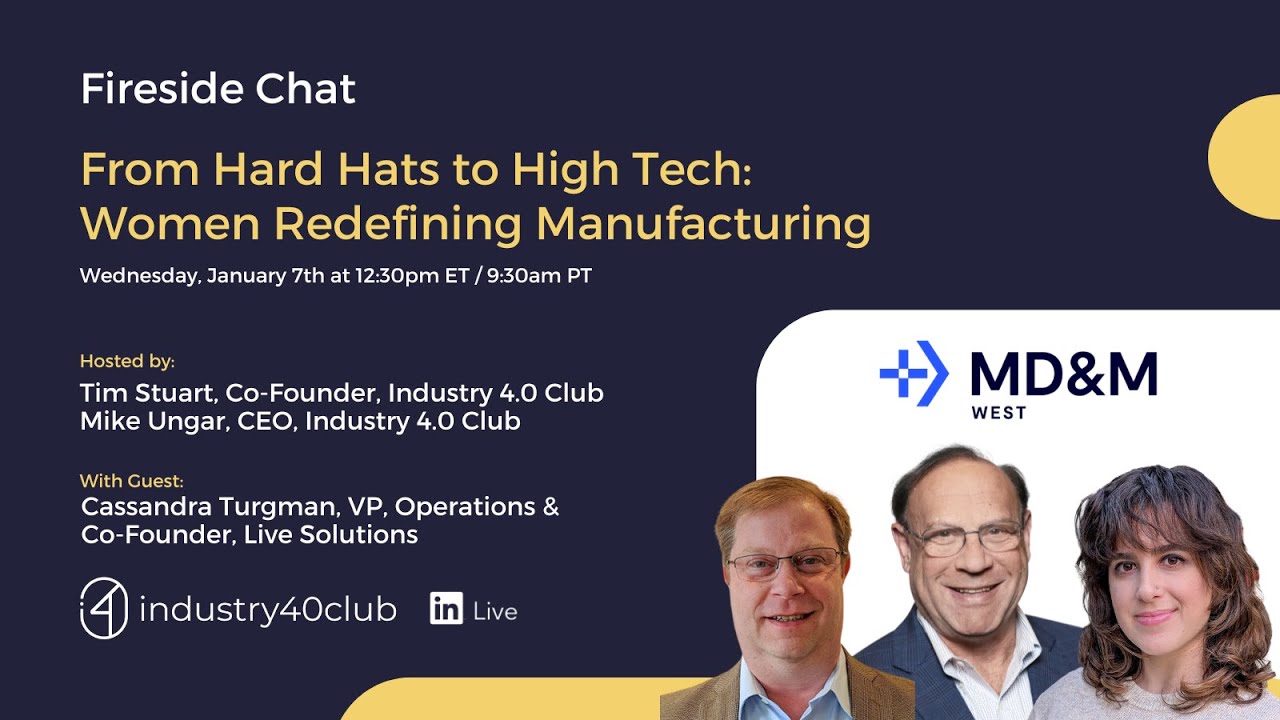
In this Industry 4.0 Club fireside chat, host Michael Ungar (CEO) and co‑host Tim Stewart introduce guest Cassandra Turgman, VP of Operations and co‑founder of Live Solutions, who will present at MD&M West on "From Hard Hats to High Tech: Women Redefining Manufacturing." Cassandra shares her personal path from a bioengineering degree to a career in process and manufacturing engineering across medical‑device, pharmaceutical, and climate‑technology firms, highlighting why she gravitated toward fast‑moving environments. She outlines the current landscape for women in U.S. manufacturing – 3.7 million women employed, 81 % would recommend the field, yet the industry suffers from low brand awareness, outdated perceptions of physical, dangerous work, and limited automation in many plants (50‑70 % have little or no automation). The conversation delves into multiple barriers to attracting and retaining women: cultural stereotypes, lack of visible role models, compensation gaps, inflexible work arrangements, and insufficient career‑growth pathways. Cassandra proposes concrete strategies: early outreach to colleges and community colleges, partnership for curriculum, manufacturing‑week factory tours, open‑house events, leveraging social media, improving salaries/benefits, providing childcare facilities, and redefining career ladders from production associate to engineering and leadership roles. She stresses the importance of women in leadership, citing that only 26 % of leadership positions are held by women and promotion rates lag (81 % of men vs. 81 % of women promoted). The dialogue also touches on DEI challenges—avoiding tokenism while ensuring qualified leadership—and the role of Industry 4.0 technologies in making manufacturing more attractive to STEM‑trained women. The hosts and guest close with a call to action for the audience to attend the MD&M West presentation, engage with the Industry 4.0 Club, and champion cultural and structural changes that will redefine manufacturing as a high‑tech, inclusive career path.
Chapters
Welcome to the Industry 4.0 Club's fireside chat. The club's purpose is to engage the power of diverse worldwide talent to accelerate the global evolution to Industry 4.0. We accomplish this by hosting and supporting respectful, thoughtful, and interdisciplinary open conversations and creating quality content on wide-ranging Industry 4.0 topics to expand the reach of our community. My name is Mike Ungar, and I am the CEO of the Industry 4.0 Club. I have over 40 years of leadership and experience, with most of that being with Michelin in manufacturing. I'm joined today by my co-host Tim Stewart. Tim is the co-founder of the Industry 4.0 Club as well. Tim, could you introduce yourself further, please?
Sure. Uh, Tim Stewart. I run a company called Visual Decisions. We've been in the business of collecting information from the shop floor and using that to improve manufacturing operations for 25 years now. Happy to be here today with everybody, and I'm also happy that today we have the pleasure of speaking with Cassandra Turgman, VP of Operations and co-founder at Live Solutions. Cassandra will be presenting at MD&M West in Anaheim, California on February 4th of this year. The title of her presentation is From Hard Hats to High Tech: Women Redefining Manufacturing. Cassandra has a BS in bioengineering from the University of California Riverside and over 11 years of experience in the manufacturing industry. She's a Lean Six Sigma Black Belt and a SESAME-certified Smart Manufacturing Roadmap Professional. Her mission is to transform manufacturing in the United States through innovative technologies and forward thinking. At Live Solutions, Cassandra spearheads operational excellence and strategic growth initiatives while managing critical projects and teams. Her engineering and leadership experience spans multiple sectors, including pharmaceuticals, food and beverage, consumer electronics, and climate technology. Throughout her career, she has consistently delivered results in quality improvement, process optimization, And waste reduction. So welcome, Cassandra.
Thank you for having me.
So for those— thanks, uh, Tim. Welcome, Cassandra. So for those listening on LinkedIn, um, if you've got a question for Cassandra during the, the time we're together today, please drop it in the comment box and we'll do our best to get to her to respond. Um, so we look forward to the, to the conversation. So just to get us started, Cassandra, you've got a very interesting background. When you were growing up, what motivated you to pursue a degree in bioengineering? It seems that that wasn't as prevalent as it is today.
Yeah. So I was really interested in biology as a, you know, elementary, middle school student and going into high school. I just really enjoyed the idea of going into a field that could help people. And can really transform the world. And so I thought, you know, biology and engineering sounded interesting. And my brother and CEO of Live Solutions, Anthony, he was a chemical engineer. So he kind of introduced me to— it's my older brother. He introduced me to engineering, and I thought it was a great career opportunity. And so instead of chemical like him, I decided to go into bioengineering because I was more geared to Working with people and just the human, the human condition.
But then you also chose to go into manufacturing. So how about that turn? How about that turn from bioengineering?
Yeah, it's very interesting because every time I tell people I have a BS in bioengineering, but I'm a manufacturing engineer and I'm in manufacturing, they're like, well, How did that happen? And so, um, it is, it is interesting, but it's less interesting than you might think. So my first job out of school was at a company that was doing medical devices for patients in, um, African countries that needed, uh, HIV diagnostics without, you know, any sort of electricity, places out in the field that, that they just couldn't get access to a doctor or full facility. So I was the process engineer for that device manufacturing process. That was my very first position. And, and from there, I just kind of ended up sticking towards process engineering and manufacturing because I really liked it. But I ended up veering off into different industries. So I worked at, you know, another medical device company you might have heard of, Genentech. They do— well, they're more known for pharmaceuticals, but they do medical devices as well. I was in that division, and then I moved on to another pharmaceutical company, AstraZeneca. And from there, I just decided I was kind of tired of that industry in general. Not because of, it's not because of what they're doing, but just mostly the internal processes. I thought it was a little bit harder to transform manufacturing and actually pursue change, and any sort of change management took months, if not years. So I wanted to work in a more fast-paced environment where change was more accepted.
Yeah, I've done some consulting work in pharmaceutical manufacturing, and it's just everything has to be, you know, going through the process, and it's just a pain.
Yes.
Make even small—
It's a lot of red tape, and it makes sense just given the seriousness of what you're dealing with there. But for me, I'm just really into change and making things better and improvement all across the board. It was just really tough to break in there.
Makes a lot of sense. That's fantastic. Let's turn our attention to the talk you're going to be giving at ND&M West. Really, as I've gotten to know you a little bit, where your passion is. Why do manufacturers have such a difficult time attracting women into the manufacturing workforce? From your perspective?
Great, great question. So my perspective is shaped by research and just my own personal lived experience. But first, let me say that it has improved. Currently today, 3.7 million women are now working in manufacturing, which is the highest level on record. And women surveyed, 81% would recommend a career in manufacturing compared to 74% of men. So once they're in, they tend to stay and they tend to recommend the field to others. However, manufacturing is very far behind in, you know, awareness, brand awareness. The industry as a whole is seen as very male-dominated and still seen as physically grueling work in a maybe less than ideal environment in a factory. People are concerned about safety as well where they work. They would prefer to have a job that is more comfortable. And I'm not just saying this for women, but women specifically do prefer to not have to do any grueling work, right? I mean, we are all different. I don't mind it, but a lot of women, they just don't prefer that work, and that's okay. The difference though between manufacturing now and manufacturing back in 1960 is that there's more opportunity for women who hold college degrees. So, it's not just about physical labor. It's about tech-focused roles for women with STEM degrees, bachelor's and master's. So, currently, I think the optics are not currently there with manufacturing. Branding and recruiting people is kind of, not focused on in the ways that are more innovative, like tech startups focus on really tackling college campuses, getting people involved in manufacturing, factory tours, things like that. A lot of people don't know that manufacturing is the 7th largest economy in the world, our manufacturing in the United States. So it's very, very important, but people are just not really aware. The education is not there. And then you tack on workplace culture differences, right? If women see that, oh, well, I'm just going to be the only woman in a big team of men, I don't really want to participate in that. I don't feel heard. And so there's a lot of different factors at play, but I would say that there's an opportunity for manufacturers to tap into the pool of talent that's out there with women, especially STEM.
Yeah, there's still the perception out there that manufacturing is dark, dirty, and dangerous, right?
Yes, exactly.
And it's mostly not true these days.
Mostly, yes. It's— I mean, there are a lot of great examples of manufacturing companies out there today The thing that's interesting too is that although we are seeing an increase in spending and an increase in movement towards automation, Industry 4.0, advanced manufacturing technologies, still 50 to 70% of US manufacturers have limited or no automation. And so that leaves them with focusing on entry-level production, manual labor roles, roles where college-educated women are not interested in participating in. So these women are looking beyond these roles and thinking more about their futures and trying to really advance their careers. And that's where I think the tech needs to match with where the workforce is.
Right. So, and I think that's true of the entire younger generation entering the workforce as well.
Correct.
So yes, it's not specifically targeting women with that. It's really addressing the shortage that manufacturing has overall of trying to pull talented, skilled people into the field.
Correct. Yes.
By adding that more forward-thinking, tech-oriented mindset to things.
Yes. And the companies that have implemented a lot of those technologies, you'll see a higher, you know, diverse workforce in those companies because it's It's people from all different backgrounds that are focused on really progressing the company towards those tech-focused technologies and innovations and things that can be really transformative in manufacturing rather than just somebody sitting on a line all day for 8 hours a day, you know, putting things into a box or assembling, you know, a widget or something like that. So It's definitely the interest, I think, is just, you know, people need to know that there are manufacturing companies out there with those jobs. And in fact, they are— there's a, you know, like you said, there's a labor shortage, and it's not just for those manual positions. It's for, you know, tech-focused engineering roles. There's a lot of those roles out there currently. It's just people don't know about it.
In addition to tech, which we've been talking— you guys have been talking about, what are some other strategies that manufacturers might pursue that would help to attract more women into their work environments?
I would say definitely it starts early. When you're thinking about how can we recruit people, I think the first thought is, and go to college campuses. And I think the strategy needs to be very focused on education about manufacturing and partnering with schools, universities, and community colleges to help students understand the importance of manufacturing, but also the career pathways. that are offered in manufacturing. I think people think, well, I'm just going to be stuck in one position and there's no growth. And while that might be a little bit unfortunately true in manufacturing, that the growth pathways are limited, I think companies need to combine their recruitment focus— that's one strategy— with their career growth pathways and really redefining those. And what do those look like for people, right? Let's say somebody does enter as a production-level associate, how do they get to become an engineer? How do they get to be involved in controls or automation, even if they don't have a technical degree, let's say? But for those with a technical degree, what does that growth path also look like, right? How can they extend into leadership positions and really try to change, change the whole industry, right? Right? And how companies operate in manufacturing. So I think that's one strategy. And another strategy is to become a competitive player. And I'm talking about salaries and benefits. When you look at tech-focused roles, if you're looking across different industries, you might see someone working in AI or somebody working in data science, right? I mean, those jobs are available in manufacturing. They're also available in software companies. And when you look at the 2 side by side, you'll see that manufacturing just is not as competitive. And I've gone through this my whole career, but luckily I'm in the Bay Area and engineering is more— it pays more here.
Sure.
But if you're looking at places in the Midwest or something like that, it might not be as competitive. And on top of that, you can't really work from home if you're in manufacturing. I mean, you can, Potentially, but you have to take that into consideration. Now people are thinking about all these things, maternity leave, PTO, how, you know, if I'm getting a 25% higher salary at a tech company doing almost the same job, why would I go work in a manufacturing company? So considering they are such huge players in the US economy, It's really surprising that manufacturing companies aren't willing to pay their employees more. So I think that's a really big thing. Ultimately, that's what people are looking for, right? So, yeah.
You've mentioned a couple of things in terms of, you know, young women entering the workforce, looking at their career path and where they can go and so forth. How much does it hurt manufacturing that there aren't a lot of women in leadership positions? And so when young women are entering that workforce and they're looking at where they can get to, if they don't see women in leadership positions in these manufacturing companies, how much of an influence is that?
That's a huge influence. I'm really glad you asked that. I have a quote here from Sally Ride on my presentation that says, Young girls need to see role models in whatever careers they may choose, just so they can picture themselves doing those jobs someday. You can't be what you can't see. And I think that that is so true because for me, I didn't see this growing up. I didn't see women in any sort of roles like this. And so it really makes a difference. It makes a difference from when you're a little kid, right? And you're seeing, oh, What kind of jobs are there? What do you want to be when you grow up? You know, what 7-year-old girl's like, I want to be a manufacturing engineer? You know, like very few. So, I think it's really important. And you talked about women in leadership. So, women account for 29% of all manufacturing roles and 26% of all leadership roles in manufacturing. It's so low. Every, almost every company I've, I've worked at has been a male boss, and his boss is a male, and his boss is a male, and it just keeps going up, right? And so for me, it was hard to even feel accepted in the industry just because there weren't more people like me around. So 100% agree with, with that. And, and the promotions are Definitely important, right? Currently, for every 100 men promoted to manager, just in general, for women across the board, not just manufacturing, only 81 are promoted. So only 81 women are promoted. So it's a big, big gap, right? And this is something that we've heard a lot about. But manufacturing, it is definitely more visible and more of a problem.
You know, with that, the— we hear— not to talk politics, but I mean, we have to go into that a little bit. But we hear today, you know, that there's this sort of this pushback on DE&I, right?
Yeah.
And the challenge is, in my experience, is you want to make sure that you put somebody in a leadership role who's qualified. Accomplished. How do you get that done when there's a smaller pool of people available to do that without those experiences? It's really a challenge.
It is.
Nobody wants to be promoted based upon their diversity dimension either. They want to be promoted based upon their skills. Talk about that challenge, that That dilemma that exists today?
I mean, it's huge, right? And I'm not one of those people that just harps on, you know, we have to put metrics on, you know, how many women you hire and this and that. It doesn't, it doesn't work that way. You can't just slap a goal on something and be like, hey, we're gonna meet this goal and that means that we've seated. No, it's, it's not, it's not right, and it's not fair to people across the board who feel like they have a fair chance at getting, getting a position, right? So, like I said, I think it all has to start before, right? You need to build the pipeline of women. You need more women in STEM. You need more women engineers. And that number has gone up. I mean, there are A lot more women in tech now than there were 20 years ago, right? But it's just the companies they're looking for right now are not manufacturing companies. People aren't like so excited about manufacturing companies and the benefits they offer and the job types and things. They don't know about it. They don't, you know, hear about it. And I think that the old school ways of recruiting recruiting that manufacturing companies focus on is just not working. They need to change with the times and get creative here. When you see companies starting to use social media to market to younger people, that's not really manufacturing companies. They're not really innovative in that way. So they need to start competing right from a marketing brand awareness perspective as well. So it all kind of ties into each other.
No, that's really— yeah, that's really good. Uh, I think you're the— that's part of the challenge we face today, and that was, as you alluded to earlier, we've seen it evolve and it's better than it was, but we're not where we want to be yet. And I don't think it's instant pudding, you know. In other words, like, we kind of like— we're in this instant gratification society where we expect Okay, it should change overnight.
Sometimes it doesn't work that way.
No. So I think, I think this intentionality, you know, and there's things you can do. I mean, I know from my experience in manufacturing, we would hold a Women's Day, if you will, at the plant. And we would, we would put up, we'd put up signs. This is not from an engineering perspective, but for shop floor workers. We'd go to the laundromats. Okay. And we put signs up there and say, hey, we've got an open house in a smaller community. Come, come see the plan.
Yes, that's great.
And then you'd have to also think about things like, where did— where does someone go for childcare if they happen to be in that role and creating that benefit, if you will, or having that You know, in one case we built a childcare facility next to the plant. So it was still independently run, but that, you know, you could— with hours where you could drop your child off, come to work, and then pick your child up after work. So there's things you can be real intentional about as a company.
Yes.
Invest in that and make a difference. But I think it's that intentionality about thinking through How to do that.
Yes, I totally agree. And I think that investing in things like that, benefits and culture upgrades at companies, can really help appeal to more women who, you know, are wondering about that or were curious and worried about childcare. And it's a very real problem, right, in this country. very expensive and it's very hard to manage a tech job and a higher-level C-suite job potentially as a woman with a family. So it becomes very important that companies change their approach and really start to invest more in people. And I will say that I love that factory, come in and see the factory day thing. I did mention that in my presentation. I will talk more about that. But In where I live in the Bay Area, Berkeley, we have a week, and this is across the board, I think, in the entire US. It's called Manufacturing Week, and it's in October. And where I live specifically in Berkeley is the west side where all the industrial stuff is. And so all these factories open up and they have tours and they have samples and things like that. And I love it because People can bring their families, right? You, you build a connection with your community. You show your community what kinds of companies are operating in your neighborhood, and, and then you, you immediately are like on them, on the radar already, right? It's free marketing right there, um, and educational awareness. So.
That's neat. Well, so as we think about your presentation, at MD&M West. What do you hope people will learn from coming to hear what— to hear from you?
Well, my goal is to really highlight firstly the evolution of manufacturing and how it's really changed from what we know, what we picture in our minds to what it actually is today. The types of jobs that are available in manufacturing. Why women remain underrepresented despite being highly qualified and interested in tech-focused roles and project management, business management roles, and practical solutions for recruiting women, building sustainable talent pipelines, and educating the public about manufacturing and its role in our economy. So I think overall I have some pretty neat strategies and decent, you know, decent approaches that manufacturing companies can actually look at. And I think the first thing is listening to people like me who have experience in manufacturing as a woman and really taking our lived experience to heart and, you know, and taking those recommendations, hopefully. for the future of manufacturing.
Well, thank you for that. So we've been talking with Cassandra Togren for the last 25 minutes or so about her upcoming presentation at NDN West, referring to— it's entitled From Hard Hats to High Tech: Women Redefining Manufacturing. So as we wrap up, Tim, final thoughts for the audience, and then maybe to Cassandra?
Cassandra, you mentioned, you know, as a young girl, you know, if you said that you're dreaming of becoming a manufacturing engineer, you know, some people may kind of, you know, raise their eyebrows and so forth. You may not get the support for that career choice that other girls get for other fields and so forth. And I'm wondering if, you know, one of my takeaways is thinking how we address that as a society, because that's not a problem for an individual manufacturer to address. It's just, right, you know, how do we change those perceptions over time and so forth?
Yeah, I think that it plays a part, like home life, Yeah. Education from when kids are young, right? When I was in school, nobody told me about any of this, even college. I didn't know anything, right? I just kind of landed in the field. Nowadays, schools are a little bit more, you know, open to involving more curriculum early. But I think that it's a combination, right? And I think families need to also work with their schools and kind of say, hey, well, My daughter brought this up, or I'm curious about this, and how can we incorporate that learning into the school? And really, it's as simple as just explaining how to do stuff with your kids, right? Like home improvement projects and taking them on those factory days, right? And, and going away from the gender stereotypes where girls play with Barbies and boys play with cars and tools and construction. and things, right? Like, my niece is doing Lego builds, like really elaborate Lego builds, and I didn't do that, you know, as a kid. So it's, it's great. It's getting better. But I think that just working with inquisitive kids and having them really be hands-on at a young age and know what these tools are called and know how to, you know, do things around the house and how to make things. Baking is another great example of manufacturing something, right? That's something that me and my niece do as well. So I think it's a combination, and I'd love to get into it more, but hopefully that gives you a little bit of an understanding on my perspective. Yep.
Thank you.
So there's a— we just have one comment here. I wanted to catch before I wrapped up from Colleen. She's, she's asking what your specialty is in robotics or mechanical. Do you have a specialty in manufacturing that you would share, Cassandra?
I don't have a specialty. I would say that right now in my role as operations, I would say that that is currently my focus, working on project management. I'm actually working on a PM certification currently. So I've kind of moved away from, you know, the hands-on stuff, and I'm now working on high-level operations management leadership. But when I was doing manufacturing engineering on the floor, we were focused on a lot of quality improvements, running the day-to-day, and Lean Six Sigma waste reduction. I did a lot of initiatives on, on, you know, cutting costs and things due to defects in manufacturing. So it was like really my, my specialty there.
Okay, well, thank you. So we want to thank Cassandra for joining us for a preview of her presentation at MD&M West. She'll be speaking on February 4th at the Anaheim Convention Center in California, and we hope you're going to decide to join us, Cassandra and the Industry 4.0 Club at MD&M West. If you haven't already, here's their website. We're only 3 weeks, 4 weeks away from the conference, so we'd love to have you sign up and be part of this great event. Join us at MD&M West. The Industry 4.0 Club would also like to encourage you to take action. The purpose of getting someone like Cassandra together, is so that we can share some thoughts and ideas about how to advance in manufacturing. So, you know, read it, read an article, attend a workshop, or encourage your plant or company to do a smart manufacturing roadmap. There's lots of things you can do to advance the deployment of Industry 4.0. We also hold discussions like these routinely. If you want to be part of a future conversation with the club, please visit us at our website at www.industry4allclub.com. Drop us a note or drop us a note on our LinkedIn page, and we'd be glad to host you. And with that, thank you, Cassandra. Thank you, Tim. It's been a great conversation, and we look forward to seeing both of you in California in a couple of weeks.
Yep. Good. Thank you both.
All right, have a great week.
Bye-bye.
Bye.










