From Pilot to Plant: A Real-World Journey to Scalable AI in Manufacturing
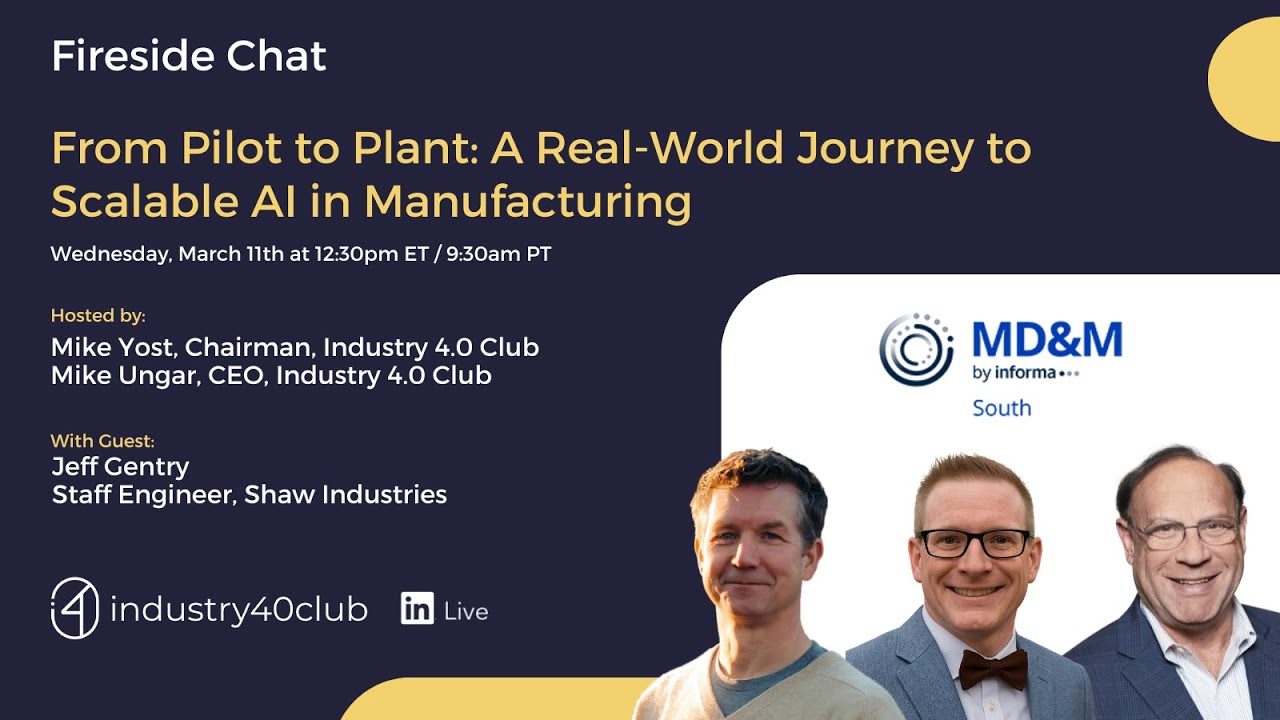
In this Industry 4.0 Club fireside chat, host Michael Ungar interviews Jeff Gentry (Staff Engineer, Shaw Industries) and Uli Pauli (CEO/CTO, Excela AI) about their end‑to‑end AI deployment for visual inspection and box/barcode counting on a manufacturing line. The conversation covers why computer‑vision AI was chosen as a low‑risk, mature first use case; the manual counting problem they aimed to solve; challenges in gathering high‑resolution image data; selecting optics and industrial‑PC compute to handle 5,000 × 5,000‑pixel frames; the complexities of OT/IT integration, data ownership, IP rights, and open‑source licensing; cybersecurity approvals and network firewall constraints; the importance of assigning a clear project owner and metrics to avoid “pilot purgatory”; how they documented processes to streamline future projects; and advice for other manufacturers on starting with a clear problem, experimenting with AI, and scaling pilots to production. The discussion also promotes their upcoming MD&M South presentation on April 22 2026.
Chapters
Welcome to the Industry 4.0 Clubs. Fireside chat. The club's purpose is to engage the power of diverse worldwide talent to accelerate the global evolution to Industry 4.0. We accomplish this by hosting and supporting respectful, thoughtful, and interdisciplinary open conversations and creating quality content on wide-ranging Industry 4.0 topics to expand the reach of our community. My name is Mike Ungar, and I am the CEO of the Industry 4.0 Club. I have over 40 years of leadership and management experience, most of that in manufacturing at Michelin. Today we have the pleasure of speaking with Jeff Gentry, who's a staff engineer with Shaw Industries, and Uli Pali, who's the CEO and CTO of Excela AI. Jeff and Uli will be presenting at ND&M South in Charlotte, North Carolina on April 22nd, 2026, and they're going to be talking about a really great topic which we're going to get into a bit today called From Pilot to Plant: A Real-World Journey to Scalable AI in Manufacturing. I'm real anxious to hear more about that today. So quickly introduce Jeff and Uli. Jeff has a BSME and an MBA and is a seasoned engineering leader at Shaw Industries. With a robust background in mechanical engineering and business management, he excels in driving operational excellence. and efficiency and innovation. Currently advancing his expertise through graduate studies, Jeff's passionate about AI, robotics, and strategic organizational development. Uli is an AI expert and IT professional with over 25 years of experience in manufacturing. His core competency is building solutions for manufacturing customers that leverage technology as their key competitive advantage. to drive revenue and reduce costs. Uli holds a Bachelor of Arts degree in Business Administration from Karl-Franzens University in Graz, Austria, and an MBA from Heriot-Watt University in Edinburgh, Scotland. So welcome both of you. We're glad that you guys could take time out of your busy schedule to join us.
Thank you. Glad to be here.
Thanks for having us.
Yeah, just a quick note for those listening on LinkedIn. If you have a question for either Jeff or Uli during our discussion today, Please drop it in the comment box, and we'll do our best to get to it so that they can give you a response and, and hit and you'll hear from them directly. So I wanna just jump right in if I can. So maybe, maybe we'll start with you, Jeff. What made this AI use case the right first step for you at Shaw?
I think there's a couple of things that make it make sense to be a good first step. One of them most importantly is that choosing AI means a lot of things to a lot of people, and depending on your background or what you know about the technology. And today most people think of LLMs as AI, but there's some robust AI technologies that are much more mature and that are more easily implemented in use cases. So in this instance, using AI for computer vision to do object detection is a more mature technology to go with. And then another really important piece for probably any operation is that there's almost all upside to this application and really not any downsides. So what I mean by that is if we're able to work and put it in operation, then we can see benefit. But if we don't, it's not going to totally change the rest of that robotic setup that we were doing. It's something that could be added to and enhance it, but not something that's going to be a showstopper.
Well, what was the, what was the problem you were trying to solve when you went down this road?
So the current state is all product is counted by humans, and then barcodes are verified in the same manner. So there's warehouse management, and that warehouse's management system is keeping up with products and what pallet they're on and what's about to be shipped and what do we have. But that doesn't mean that it didn't get moved 20 minutes or 2 days ago that's been undocumented. But once it makes it to that final step before it's about to leave or be built at a robotic cell, it's great to have that double check to know, is what I said I have really what I have right now? And the solution enables us to count all the boxes. on a pallet of our product and verify all the barcodes. And that's done in a few stages in the program, but it's all just one, one step to us.
So, Uli, you were involved in making this a reality. When you first were introduced to the project, were there some things that excited you about being able to do this? Was this new for you, or was this something that you guys have done before?
No, it wasn't new for us. The core of what we're doing is actually building tools, AI tools for manufacturing, and visual inspection is where we spend most of our time. What changed it probably was that for this specific solution, we really needed, you know, high-resolution images. So it was a bit of a challenge for us to Select the right hardware, the lenses, and then obviously behind that, enough compute in the industrial PCs. So it was kind of a bit of a change in the hardware selection, but the actual task at hand was not new to us.
Yeah, that's great. Jeff, were there any particular challenges you had in making this go, this particular project?
Let's see. I would say data collection was challenging at the upfront, but not on the backend. So early on, we were making sure that our proof of concept worked. We had limited access to a lot of different product types without unwrapping, moving product, unwrapping it, checking, taking images, and then wrapping it back. So we did a lot of warehouse walking to look for things that might happen to be unwrapped to collect that data. Sometimes you think of data collection as I look it up in a table, I pull what I want, and now I've got that data. But when you're talking about computer vision, the data is pixels, and the only way you get pixels is from an image. So if you don't have a plethora of those in the kind of shot that you're looking for, then you've got to collect that. Later stages, though, we're presenting the product to the system, and so to increase training data is a much simpler task.
Excellent. Uli, for you, you mentioned the challenge of the optics, choosing the right camera. Was that an iterative process for you, or did you already know really pretty much where you wanted to go with that?
We had an idea of where we wanted to go, but the images basically were looking at a fairly large surface and are using high-resolution images. So basically, you know, roughly speaking, 5,000 by 5,000 pixels. And selecting the right camera wasn't really the challenge, but once you've got such a big image, it is a challenge for the computer to actually, you know, run the models in the AI And so we were not sure enough in the beginning would actually be, you know, the industrial PCs that we had selected, would they be large enough to do the compute given the time constraints as well, because there's only so much time we've got to process the whole thing. So that was new to us and, you know, a little bit of a trial and error.
Yeah, thank you. No, it's great to learn a little bit about the project. Maybe kind of switch over and talk to Jeff a little bit more about the, the actual management side of the shop floor side for a moment. What surprised you most about the, the, the need to bring together OT and IT, if anything did? And then talk for a minute, if you— depending upon where that goes, talk a minute too about cybersecurity, if you would.
Okay, let's see. OT, so OT/IT. Well, first off, I'd say I don't think anything surprised me, but I would say that it was more difficult given what we were asking to do than if it was a more traditional project. So there were a lot more questions from both sides than normal. For instance, we're wanting to train on a cloud machine that doesn't Doesn't necessarily, when I say exist in reality, so we're spinning up a machine to do training on, but it is outside of our network, but it's not part of Axela's network either. And figuring out how to get over that hurdle led to questions about, well, who owns the IP and then who has what when this is over? So that came up multiple times. So Do we own our data? Are the images ours or not? And then if so, where are they housed? Like, where do we keep that and store it? And then the question was, well, are we buying— are we buying this program like a regular piece of software? And the answer to that is not exactly. We are buying training, and then we are going to be delivered a model that then runs on our device. So the hardware is ours. And the model is ours, but the ability to produce other models is not ours. We could produce new models for us, but we cannot build other systems out of this because we aren't buying— we're not buying the company Axella, we're just buying a service from them. So some of those things, and how, how do we make that clear so it's not like downloading a program, uploading your images to it, and then you're just using that program as software as a service? It's It's more complex than that.
Yeah, you obviously overcame it to make it happen. Obviously, otherwise we wouldn't be talking about it today. That's really interesting to think about that.
By the way, Mike, sorry. We've run into this issue with other customers as well because actually the AI world, and I'm not so sure the public is really aware of that. Of course, the folks in IT are, but probably not, you know, people at the management level. Most of the AI that we have these days is somewhere in open source, whether it's PyTorch or something else. So that's being used by everyone, you know, by the big technical companies, by smaller implementation companies like ours. And this is IP in the public domain. And so, you know, when we go to customers, they, you know, may not be aware of that, right? They're thinking they're either acquiring the rights, and we don't have that because we use it just like everybody else. So initially, there's always a bit of confusion on who owns what and what do we need the rights to. Because, for example, when you do an AI project, it is not work for hire. So you don't, You know, pay for it and then you get this project like Jeff just said, this software. We couldn't even sell the software, the core software to you because it doesn't belong to us.
So ultimately, Jeff, then you— I'm assuming that you own the data, right? Shaw Industries owns the data, right?
We do own the data and we own the model produced from the training.
Okay, so that's great. And what was there anything unique then about cybersecurity for this project that— or—
I would say maybe not necessarily unique, but approvals to be gained, because a lot of these packages have to be— they reach out to the web to get what they need. And our firewalls don't like to do that unless it's explicit. And unless we know it's secure— so what we let out is important to us, but also what we let in may be even more so important because we don't want something in that doesn't need to be there. So determining where those endpoints were going to be and if communication was going to be going out or coming in, and then between these 3 types of systems, and one of them being one we've never used here before, created a lot of, I would say, weeks. There was probably weeks of back and forth over that before we got an approval.
Yeah, but that's, that's great though, because I'm sure, I'm assuming then this approval or this approach sets the stage for other projects potentially in the future in a similar working relationship.
Kind of like once you, once you have done it once, recreating it is easier the next time around. And I took a lot of, I know other people did too, but I took a lot of notes and documented Which groups need to be talked to, what requests need to be made. And because of this relationship with Accela, I've tried to maintain some of that open access already through our own systems so that if we do another one in the near future, we don't have to start at the beginning again. We've got a lot of that approval in place and being checked every 90 or 120 days.
Yeah, really, it, it does make it easier. We're actually just starting a second project. And one of the things that we don't have to worry about anymore is VPN access to Shaw. So we're already, as a vendor, we are already able to kind of reach inside to certain systems. So once you're above that hurdle and have kind of figured out what needed to be done in the first project, for subsequent projects, it's much easier. But at the beginning, there is certainly that issue.
Yeah, that's fantastic. Well, I want to remind our listeners that we're talking with Jeff Gentry from Shaw Industries and Uli Pauli from, uh, Excela about, uh, their upcoming presentation at MD&M South titled From Pilot to Plant: Real-World Journey to Scalable AI in Manufacturing. And wanted to mention that if you're listening and have a question for Jeff or Uli, please put it in the comment box on LinkedIn, and we'll be glad to pose it to them during this time that we're live with them. So you alluded to the vendor relationship, really how easy it is once it's established now, much easier to continue to work on future projects. Was there anything that— what was probably the most challenging thing in really establishing that relationship when you guys got started?
It was really, as Jeff had mentioned, the cybersecurity piece and then Another thing that we saw was around the discussion, IP, kind of the legal contracts. And again, this is not unique to SHAAL. The whole AI area with data has become so important because companies obviously understand that the data that they have in the model can represent a competitive advantage that At least not at the moment, the legal teams go overboard in just their caution when it comes to writing the contract about who owns that, both the data and the application. So it can take weeks or months to actually overcome that. So the funny thing, Jeff mentioned that the AI that we are working on, which is really for visual inspection, is what I would call sort of settled AI as opposed to the new generative AI. So the Claude and ChatGPT of this world. So it was kind of funny that actually the technology itself is something that we consider fairly mature because it's 6 to 8 years old.
Yeah.
But the infrastructure is still not that well understood and takes a while to, you know, to settle in form of contracts and statement of works and so on.
Very good. So, Jeff, kind of turning our attention to kind of a different thing, I'm assuming when you started, you had a limited pilot, limited approach, maybe one area, one part of the process, and then now you've expanded. Is that fair or not?
That's a fair statement. I mean, this started— so at Shaw, this started over a question of how are we going to count these, and then is anybody on a vision system? And the answer was, well, not at the moment. And it was kind of a side project, um, of mine for a little while of how can I use open source to produce, um, a neural network that would give me Meaningful results from. And that was starting from complete scratch, going out to GitHub and seeing what's available out there that is completely open source to use, and then iterating until determining how to make that connection. And once, once I had some results of, of seeing, hey, that's viable, we still knew we weren't just ready to operationalize it. And you, you— it's one thing to have something running on your computer or a small box somewhere on the floor. And knowing that you can put it in operation and use it. And one of the partners on our team, Wes Moore, had talked to a sister company and they were using Accela. And that's how we determined to reach out to them and then told them what we were doing and kind of had the back and forth of, hey, is this a good use case or not?
Right.
Which they said, hey, we're already doing that. That sounds, sounds like it's upper alley. So that's sort of how that launched. That answer that question? I feel like I've digressed a little.
No, that's good. I did want to ask you though, I mean, a lot of, a lot of folks enter into Industry 4.0 or smart manufacturing projects, and they, they do a pilot, and then the pilot doesn't go anywhere. So you started, and then you're able to proliferate what you've learned. What's some of the things that you had— you put in place at Shaw to ensure that pilots don't end up in what we call pilot purgatory?
Yes, Ulysses mentioned pilot purgatory to me before. So we have a lot of projects that end up in there, and I don't think it's for— sometimes it's because the technology didn't work and they should not be a pilot to move forward. However, Sometimes it is as simple as not having an owner assigned once you realize you have a viable pilot. So the automation engineer is probably very involved, or a process engineer, somebody that's shown that it can work for an application, maybe even an IT project manager, you know, people like that. However, they're not on the plant floor and they are not the end user, and they don't have the buy-in or the leverage to make sure that that proliferates into something Bigger than that pilot. So I think it's super important to have somebody that is the owner, um, that has the metrics. They're at least the owner of the metrics that this needs to meet, whatever those might be. And a lot of times we do not do that. We make a pilot, it's really cool, everybody likes it, and then nobody has the ball for that next step. And so having a plan for— even before you get to the next step, have a plan for who would own this, and then Make sure that they're on board so that they can own it in the event that there's a successful pilot.
Yeah. Can I separate, just make sure we're on the same page for, for how we're thinking about pilot? So some companies will have what I call a lab. Okay. A place to go tinker and try new technology. But that's not what I think of when I think of a pilot. Are we on the same page with that? I mean, we're talking about something that's being tried on the, on the production. Yeah.
I probably called 2 things the same thing as a pilot, but we kind of did a, lab pilot and then a proof of concept with Accela where we said this is what implementation would be at a minimum viable product. And then we went to a full project out of this. So is that, is that kind of what you're asking?
Yeah. Well, I mean, I think what I guess I'm trying to say is sometimes those little proof of concepts are important before you get out on the production floor or doing a pilot that's actually producing results.
Yes, absolutely.
Yeah, so that's kind of what I'm saying. So I think there's a place for— I'm going to use the word tinkering, um, trying new things. And, you know, you know, that's where maybe just the engineer and the vendor are working together type thing to see if they can make it work, proof of concept like you alluded to. But then there's, okay, we're going to try this on our first, uh, in our first area, um, and that's, I think, what you're alluding to where you need a project donor And real focus on metrics. Am I right? I think that—
yes, yes.
Yeah, so there's a real distinction between those 2. Is there any— so I think, I think your, your comments about having an owner are real important. Did you also envision a proliferation plan before you went out to that pilot? Like, what would we do if we're successful?
I did. I don't know if other people have, but the application for this that we picked Or not application, the use case that we picked has applications in multiple places in our company. So in the event that somebody says, we like that, we want to move it forward, that groundwork is there to move to other pieces of operation or potentially even kind of different applications of the same technology, different use but same technology.
Okay, great. Well, I wanted to kind of move forward and just, you know, we're gonna— you guys are gonna be presenting at MD&M South, as we mentioned earlier, on April 22nd. For those that decide to attend the presentation, what do you hope that they take away from listening to you share more about this story? And we'll start with you, Willie, and then go to Jeff.
So I think that if you— no matter which side of the AI fence you are, how much you understand about where that technology is, whether it be traditional machine learning or deep learning and neural networks, or if it's transformers and LLMs, that AI is not magic, it's just engineering. It's just a new kind, or more interesting in my opinion, uh, kind of engineering. Um, and that if you come to that, I want you to see that you shouldn't wait to find out what somebody tells you what to do. Uh, find the people that are curious in your organization and be motivated from that presentation. To do that and then give them a little bit of bandwidth to be able to experiment some with this because the people inside your company are already going to know what they need to do or have a good idea for what use cases are or how your operation works today. And then the ones with ideas know how it could look different. And if they've had a chance to use some of those technologies or tinker with it, I guess, as you, as you said, Then you're going to have better connections of what's possible with what you need.
Okay, great. Uli, how about your thoughts? For those who come to your presentation, what do you hope that they learn?
Well, I, you know, I think if you look at manufacturing, I think it's an industry that tends to be fairly conservative, right? Where people say, okay, we've got these developments, you know, let's wait a bit, see how this works, right? And I want people to really understand that the kind of AI that we're doing for like visual inspection is very mature and it's actually a chance to get started in AI. And now with the advent of GenAI, I mean, I think we're in front of a huge tsunami that will really run over the entire manufacturing sector. So it's almost like, for crying out loud, if you haven't started yet, at least, you know, take some easy-to-pick fruit and get started on it, because you absolutely need to do this now, right?
No, you're— I appreciate the perspective. You know, while, as you alluded to, while generative AI may not be well developed for the manufacturing area, certainly using AI for predictive, in this case, quality, and, and yeah, for, uh, predictive maintenance, and to help you, um, better manage the production floor, very much so is proven, and many companies are now successful in doing it. Yeah, well, um, go ahead.
Yeah, and, and, you know, I, I think AI, uh, GenAI is getting very close. If you look at I've been working with Cloud Code, for example, for the past 24 months. The way it has evolved, you know, I can really vouch for it as a software developer. The process has been staggering, and I think it's going to get better and better. So GenAI will mature really rapidly, and within the next 2 to 3 years, I'm absolutely convinced it's a technology that you can, without any reservations, deploy on the on the shop floor, but you need to have the staff and the organization and the processes in place to actually do it. And that's why I said earlier, you need to get— if you are not doing it already in the form of small prototypes, you need to get involved so that you can rev up your organization and learn how to use AI, both AI, right? Classical as well as GenAI.
Super. Thank you. Well, we're getting ready to wrap up. It's been great to talk with both of you. Any final thoughts for the audience, Jeff?
Final thoughts. I don't— you don't have to be an AI expert. So if you're listening to this and you think, I'm not an AI expert, I need to be to even start this, you, you don't even need to have a good idea. You just need to understand your process, And what you might want to be better about it, or what you could envision being done differently. Not, not a great idea, just something. And then find the right partners to help make that a reality. Sure, I do think it helps if you're curious and that you have an idea about the technology you want to implement. But really all that does is open doors to discovering other technology that you can use that you may not be aware of. So a combination of the two, but you definitely do not have to be an expert to get started.
Thank you for that. Uli, any final thoughts from you?
Well, you know, if you think about Industry 4.0, right, and look at the history, and then manufacturing was always, always believes in continuous improvement, right? In my mind, AI in that sense is just kind of the next wave, right? It's another tool that we're using, like we had CAD before or something else. And, and so there's a new tool that's at our disposal where we can do what we have always done, right? Make manufacturing more reliable and take cost out of, out of the chain. And that's what it is.
Well, thank you both for your thoughts on this. I would just like to, for my final thoughts, emphasize start with a problem or an opportunity or something that you want to improve. I think that's the other thing we want to be really intentional about when we go after engaging and using technology to help us solve those problems. That you have to integrate technology like AI into your tools that you use to help you solve those problems. But start with the problem and go from there. So thank you guys so much for the time. It's been great to hear from both of you and for you to give us a preview. Of your presentation at MDN South, which will be happening on April 22nd at the Charlotte Convention Center in Charlotte, North Carolina. We hope that you're gonna decide to join Jeff and the Industry 4.0 Club at this event. If you haven't already, here's the website. Go there and register. And again, we hope to see you there in April. The Industry 4.0 Club would also like to encourage you to take action. So attend an event like MD&M South, read a book, attend a workshop, start a smart manufacturing roadmap within your own facility, or encourage them to do so. Whatever you decide to do, take action and engage in Industry 4.0. We'd like to know what you're doing, so drop us a note on our webpage at www.industry4.0club.org. industry4oclub.com or on our LinkedIn page. We also host conversations like this weekly. So if you'd like to be a guest on a future conversation, please again drop us a note on our LinkedIn page or our website, and we'd be glad to talk with you about being one of our guests. And with that, again, thank you, Jeff. Thank you, Uli, for taking time out of your schedules to join us.
Thank you.
And we'll see you in Charlotte.
Thanks.
Bye-bye.










