Growing Your Business through Local Sourcing
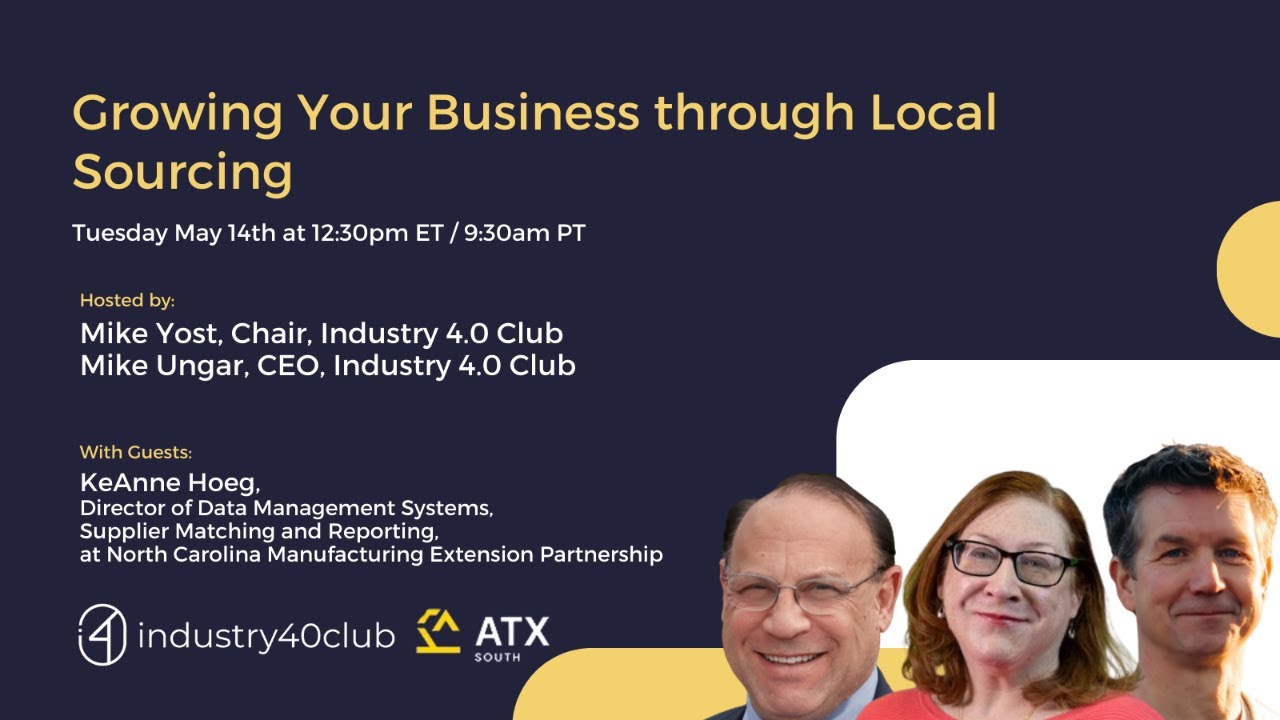
In this Industry 4.0 Club fireside chat, host Michael Ungar (CEO) and co‑host Mike Yost interview KeeAnne Hogue, Director of Data Management Systems, Supplier Matching and Reporting at North Carolina State University’s Industry Expansion Solutions (IES) and the North Carolina Manufacturing Extension Partnership (NCMEP). The conversation serves as a preview for KeeAnne’s upcoming IME South presentation titled “Growing Your Business Through Local Sourcing” (June 6, 2024, Charlotte Convention Center). The dialogue explores several post‑COVID supply‑chain trends – persistent disruption, heightened sustainability expectations (including ISO 14001, consumer demand, and circular‑economy initiatives), and the growing importance of workforce and automation. KeeAnne explains how local sourcing and supplier diversification can mitigate risk, reduce transportation and fuel costs, and unlock untapped manufacturing capability in North Carolina (≈11,000 manufacturers) and across the national MEP network. She describes NCMEP’s data‑driven supplier‑matching program, the breadth of partner resources (textile, polymer, community‑college training, etc.), and how manufacturers can access these services. The hosts emphasize the strategic‑tactical balance manufacturers must strike, the role of Industry 4.0 technologies, and the need for manufacturers to engage with the ecosystem early. The session closes with a call to register for IME South and a reminder of the Industry 4.0 Club’s regular webinars on people, process, culture, and technology.
Chapters
Welcome to today's Industry 4.0 Club fireside chat. The Industry 4.0 Club, their purpose is to advance the deployment of Industry 4.0. For manufacturers across the United States and abroad. We do that by connecting providers and promoters and manufacturers together to help them make the best choices to become more competitive. My name is Mike Ungar, and I am the CEO of the Industry 4.0 Club. My background is 35 years with Michelin in a variety of continuous improvement, operations, finance, and HR roles. And today I'm a business coach and executive coach with Focal Point. My co-host today is Mike Yost. Mike, would you introduce yourself, please?
Sure. Thank you, Mike. As Mike said, my name is Mike Yost. I'm one of the co-founders of the club, and I've been in industry for about 35 years, with the last 15 years on the nonprofit side, so helping to facilitate these kind of conversations and figure out the role and value and fit of technology for manufacturers. Excited to be here today.
Thanks, Mike. Well, today's fireside chat is one of our broadcasts leading up to Informa Markets IME South, which is going to be taking place in Charlotte, North Carolina from June 4th to June 6th. The Industry 4.0 Club has been busy putting together a fantastic group of speakers for the advanced manufacturing stage, and we're highlighting some of those individuals during the month of May. Our guest today is KeeAnne Hogue. She is the Director of Data Management Systems Supplier Matching and Reporting at North Carolina State University's Industry Expansion Solutions and the North Carolina Manufacturing Extension Partnership. She describes her job as playing with data, which I think is great. I look forward to hearing more about that. In addition to overseeing the required stakeholder reporting and systems, KeeAnne manages the organization's supplier matching program. She has worked with— at IES for 23 years, and prior to moving into her current position, She worked in IT and marketing as a web developer and social media manager. KeeAnne has a Bachelor of Arts in English from Meredith College and a Master's in Library Science from UNC Chapel Hill. So welcome, KeeAnne.
Thank you. Happy to be with both of you, Mikes.
So KeeAnne's going to be— we're really going to be really lucky that KeeAnne's going to be presenting one of the presentations at IME South called Growing Your Business Through Local Sourcing. And that's going to be taking place on June 6th at 1:00 PM at the Charlotte Convention Center. So, Kian, just to get us started, so what are some of the trends that you're seeing in manufacturer supply chains since COVID I mean, that's created a lot of change for us.
Oh, well, I think one of the big trends is that the challenges that we're seeing to supply chain, they aren't going to end, and that needs to become something that we're just used to— intermittent crises. That there's always going to be something going on. And that's due to the fact that since we are part of a global economy now, that we realize more acutely, I think, that impacts in the other parts of the world affect us both as businesses but also as consumers. And so whether it's due to, say, another illness or pandemic or some sort of a global political issue that's going on, or even just sort of natural disaster, that those are going to be impacts that we're going to feel here, and that's something that we need to be prepared to deal with and to mitigate.
So I know that— so I'm a recovering solution provider. I came from the vendor community, and we used to always talk about the fact that disruption, you know, supply chain disruption was a possibility. Not that any of us were smart enough to predict the global pandemic, but Did that reinforce, or did that— in what you're seeing with the manufacturers that you work with, did all of a sudden they go, oh, disruption is something that we have to be more prepared for?
Yes. I don't know if I would say it's completely widespread yet, but there is more of awareness of, yes, we're going to have to do something about that. And we see that not only with companies who have presences overseas, but even companies who are located in the United States. I mean, we've had our own issues here where there may be one facility facility making baby formula, or, you know, where we see one bridge collapse that all of a sudden it's going to scramble our domestic logistics capabilities. And so we ourselves, even if we're located completely within the United States, need to be able to mitigate that risk.
Yeah, that's for sure. Are you seeing— so when we talk about trends, one of the other trends that, that seems to be playing much more into our conversation these days is sustainability. Can you talk for a minute about how that's impacting supply chain?
Yes, we have a number of suppliers who are— who their clients are beginning to have expectations and to make requirements for them around sustainability. Especially, we work quite a bit with companies who are in the EV supplier space, and they have a lot of European OEMs that they're working with, and they're requiring them to be ISO 14001 certified because they themselves have emissions requirements that they need to meet. And part of it too is due to not only their own requirements, but also because the consumer is beginning to demand that. And I think that's something that we're going to see more and more, that the consumers are very concerned about. Well, I want to know that this product that I'm buying is made sustainably, that it's not contributing to anything, that the environmental footprint is not detrimental. And we're even seeing that locally. Companies that aren't sourcing overseas or aren't part of any larger overseas supply chain who have just decided, you know, my consumers, this is becoming a big deal for them. We need to, to focus on this. We need to figure out how we can do more energy assessments and environmental audits or even go for an ISO certification around that because that's going to be a differentiator for us. And as the generations are coming up and changing, they're going to demand that. They're going to, they're going to require that if they want to buy from you.
I was going to ask something. I think you started to answer what I was going to ask. How do people— is there a specific definition of sustainability that people are working off of, or is there more of a general understanding that we want to be better corporate stewards and we want to source ethically and we want to save energy and things like that? How are people defining sustainability?
I think that it probably differs. For those who are supplying the larger— who have larger customers, they probably do have a more defined, accepted definition of what sustainability is. sustainability means for them and actual metrics around sustainability that they even to their shareholders are going to have to point to and say further down our supply chain, this is what we do. For others, it's probably more of that general sense of we want to be good environmental stewards. We'd like to save energy. We'd like to reduce our environmental footprint. And then how do we go about that?
That's— when we talk about this and you mentioned definitions, then I start thinking about circularity. So is that, I guess, is the— is that, I guess, the utopia of sustainability? Is that one way to think about it?
Maybe. We're seeing a lot of interest around the circular economy, especially within textiles. We have just received— a few NCMEP partners have just received part of funding from an NSF grant around the circular economy with textiles because there's been a lot of interest in how can we reuse these fibers, how can we try to extract as much usability out of them because maybe we can't get them, or maybe we don't want to have to grow and develop and put all those resources into that. There's still a lot of, dare I say, life in these fibers that can be extracted. But we're also seeing it from manufacturers who are perhaps taking some of the cast-off metal from a different manufacturer, and they're able to recycle that and turn it into something else themselves. So it's kind of all over the place. It's not It is recycling, but I think it's also broadening our understanding of what could be recyclable, what could be circular, and that there's still a lot of use that we can get out of these natural resources. And when we're talking to companies, that often becomes like, I want you to know that we're doing this. We're taking this material that is cast off from another manufacturer, and we're using it to make our product.
So just— I'm sorry, Mike, if I jump in with a quick question here. We've talked about disruption and sustainability, which are sort of strategic kind of topics. Energy obviously has a direct impact on costs and things like that, but still is oftentimes more of an afterthought. So one of the things that we've seen, and we're always questioning about, is balance between the strategic and the tactical, right? People are dealing with labor issues today and things like that. So What are you seeing in your area with regard to manufacturers having labor challenges and dealing with sort of the day-to-day realities versus the more strategic drivers that we've been talking about so far?
I think it is a balancing act and it's a fine line to walk because we know that we still have just huge workforce issues. Now, one way that that is being mitigated is that we're seeing that increased level of automation. And it's also clear that workforce issues It's not going to go away, and there's not going to be one policy that's going to suddenly make workers appear. There are going to have to be some broader conversations around workforce and what that means. But yes, at the end of the day, the manufacturer needs to get the product out the door and to their client. And there are other factors that may weigh into that as far as, well, if I don't get that, they're going to start fining me because I've missed my deadline. I need to— this is perhaps more important. But as pressures keep coming to bear from from who they're supplying, this is going to have to be something that they're going to have to figure out how to, how to handle that day to day with the strategic imperatives, or else they're going to go somewhere else. And I'm wondering about some of the transparency that's starting to be required through some of the ESG requirements. A lot of the larger clients are demanding transparency from their customers, and they want that visibility all the way down. And that's one way that we can begin to mitigate that risk. for supply chains so that they can see what looks like this company, they may be facing a shortage here, or, oh, it looks like maybe they're down 3 or 4 people. How is that going to impact us all the way to the end user? And so through that, I think that we're going to start to see that pressure more and more to have the manufacturers really add that sustainability pressure to their day-to-day operations.
That's Yeah, that's really interesting. There's so much more attention now on this question of sustainability than there was even like 3 or 4 years ago. It's quite a dramatic shift, I think, in the marketplace.
It really is because I know that we had energy audits for a long time. We've offered ISO 14001 for a long time and a lot of other things. We always were able to provide them, but it didn't get as much attention. Now it is everywhere and it's not just by itself, it's aligning it with supply chain, it's aligning it with their continuous improvement and then also aligning it with even their organizational development and their workforce needs, because a lot of the workers that they're trying to hire, they care about this. They really— they don't— if it's a choice between working at a facility that they know is going to have a strong environmental record and be a strong partner in the community versus one that isn't, we see more and more that they want to be with the one who has that presence in the community and is a good environmental steward. So I really think that's going to change how we think about all of this. We can't think of them in isolation anymore. Sustainability is going to have to be a just a part of how we do business now.
Yeah, that's, uh, that's neat. You know, Mike mentioned earlier, asked the question about labor, a little bit into the labor. You know, one of the reasons historically that companies went offshore for supply was cost, right? Labor cost. Can local companies compete with these, with, you know, the low-cost countries? What's your thoughts on that?
I think that they can, and based on the conversations that we've had with our manufacturers, it may not be as direct as if you are only focusing on labor costs. Costs always come up in every conversation that we have with the manufacturers. The labor costs are certainly not the only cost, and that is part of that— the risk that has to be mitigated. If you have a local supplier that you can go visit and you, you get to know them, and so you know the problems that they're having, then you could maybe work together on a solution. So, so maybe, maybe there are other costs, but you save money because you can work more closely with that particular vendor. Or the transportation costs, the fuel costs, being able to find someone who's just a little further away versus overseas. And so those are all trade-offs that need to be factored into that, into that figure as far as that calculation as far as, well, how much does it really cost? Are we only looking at labor? Are we taking into account— it's, it's all very well and good to say that we can make it for this very, very low amount because the labor costs are so low, but if it's going to take you 20 days longer to get it here and the fuel costs are increasing, then have you really saved anything by the end of the day? And so that's a shift as well, helping— we're trying to help clients throughout the MEP, all of us, we're trying to help clients to understand that you have to start looking at that big bigger picture, that it's not just one cost in isolation because it's going to be eaten up by your fuel costs or your transportation costs.
I love where this conversation is going, and I'd love to continue to drill down into it because I have another point, but I'd like to make sure that we touch base on, you know, what you're talking about at the event and what people— what you hope people get out of it and Learn more about your organization and what you're doing.
So could you maybe touch on what you're going to talk about at the event? Certainly, and I'll be happy to answer any questions. I've been— it's become my mantra here. I could talk about this all day long. But one way that we can mitigate a lot of the risks and the challenges for the global supply chain and even the domestic supply chain is through diversification. And in North Carolina, for example, we have 11,000 manufacturers and they cover all the different types of manufacturing. And so we feel very strongly that we're very well positioned. We can find someone here who can make it if you want it sourced domestically. We can find that capability. We, we can find someone close to you. We could find someone across the state. We can do that. And if we can't, then we can certainly help find it across the country through our network and our participation with the other MEP centers or other partnerships that we have. And so we feel that especially coming out of COVID that there has been a We don't even really know what's here anymore. And a lot of times we have the capability, but maybe they haven't been asked to provide that part. So one thing that I want people to get out of this program is we have resources and we can ask for, can you make this? No. Well, do you think you could? How much would it— how much time would it take for you to shift your production to make this? You know, we think there's a lot of untapped capability and that all we really need to do is help them get to know each other and to know what's, what's available here. We hear the story all the time. I've been hearing it for 15 years that I had no idea that XYZ manufacturer was in the same industrial park as I do. If I'd known that, I wouldn't have been buying from a different country because I could have just gotten it from across. And it was just as true 15 years ago as it is now. And so that is a big focus of this program, just to get to know who's here, what capabilities are here, and, and help match them up.
Excellent. That's—
yeah, that's neat.
The— in, you know, I know you're focused on North Carolina, so a quick question about that too, and just makes me think about it, is, um, the— you mentioned— we mentioned labor before, the unemployment rate. I mean, when you talk about can you do it, um, you know, we want business to grow. Are the— is the labor resources available locally for you guys in, in North Carolina? I know Being here in South Carolina, it's pretty tight. I'm so curious kind of what North Carolina looks like.
It's pretty good. There are certainly pockets of the state where they have more challenges than others, and it's for various reasons. Not all the reasons are the same, but for the most part, there are the jobs and there are workers and the resources can be found.
Yeah, I think that's the same. You know, it's great that you say that. I don't think that answer is unique to North Carolina. I think across the country, In a lot of places, it's just a question of, okay, here's what we want to try to accomplish. How do we go about doing it? Who do you partner with? How do we help folks come even to the point of advertising in other places that you have jobs available?
Well, another part of it too, and I feel like a big theme of everything that we've been talking about is a paradigm shift in how we think. Because I think that when it comes to how manufacturers approach workforce, that's going to have to change. Not every manufacturer can be like a Toyota who's going to have an onsite discounted daycare or a clinic. But the manufacturers that we're talking to, they are looking into ways that they can— maybe they have mentoring programs, or maybe they're looking into certain types of leaves that they can offer employees that they hadn't done before. And so there is a lot of attention being paid to how can we put in a flexible workday for manufacturers so it's not the same basic schedule that has been around for decades, or what kind of benefits do we need to look into and offer now, or what are the benefits that are resonating with with the workers. So it really is, it's just all of this is a paradigm shift and it all is aligning because you can't talk about supply chain without talking about the workforce and you can't talk about sustainability without also talking about workforce and then advanced technology. And so it really all goes together.
So I'm curious, Ken, there may be folks listening who are not familiar with the resources that you're talking about. They might be in that industrial park you were talking about and not know how to get ahold of you. What do you find that that manufacturers— are you typically going to find them and pull them in, or do you find them typically looking for help? And, you know, that everybody understands the MEP structure and all the resources that you have available through the state and the university?
I wish everyone understood the MEP structure and that we existed. I'm sure in every state we would all agree that we could call ourselves the best-kept secret in each state because We've been an MEP center for almost 30 years, and we've— we, we have a mix of both. I mean, there are some who come to us. We have a lot of repeat business that we do, but also through our relationships, we have 8 partners that are part of the, of the NCMEP grant in North Carolina, and they're all in mostly different sectors. And so they bring in a lot of different clients, and maybe they don't know one of our partners, but they know that if they have a textile need, they go to the Wilson College of Textiles. Or maybe if they need an extrusion test done, they don't know NCMEP, but they go to the Polymer Center. And so once they're in with that, or the community college system for customized training.
Right.
And so we have a lot of different ways that we can have outreach and bring in manufacturers into the fold and introduce them to all the resources that NCMEP can provide. But this is also what we're hoping to do with this supplier matching and get around and have webinars and present at conferences is help them understand that this is just one resource that we can provide. We have a lot of different resources that we can provide through all of our partners, and also we have a lot of local and regional and other state economic development groups that we work with. And so, you know, we're constantly trying to build that and nurture those relationships so that we can make sure that the manufacturers know that we're here.
Yeah, just to come alongside what you're saying, it's been my experience as though we were joking beforehand that my forehead's flat from 15 years of being in the nonprofit world and banging my head trying to engage with manufacturers. I don't know that there are all sorts of resources that are available. So I feel that and certainly hope that people will attend the session and learn more, even if they're not from North Carolina, right?
I mean, it's a national program. Absolutely. And we have very strong relationships with all of our other sister MEP organizations, and we also are building some very strong supplier relationships with our southeastern states as well. And so we are constantly all talking, and if, and if we can't find something here, we're going to reach out to them and vice versa. So, you know, we have very strong relationships. The border does not end at North Carolina.
So just to kind of— we've been talking for, uh, 20 minutes or so, and just to kind of, kind of bring us closed here, I know you mentioned, you kind of alluded to it earlier, but would you mind summarizing one more time What do you hope folks learn from the session that you're going to be sharing with them? And maybe share any final thoughts for the audience today.
I hope that they learn, first of all, that supply chain, it may not have become a current risk for them, but it will come, and that it's better to start thinking about how they can mitigate that risk through local diversification, preferably within North Carolina, but of course through our network presence in the United States, because that is the purpose of the program, because we do believe very strongly that we have the capability, we have the know-how, we just need to match people and get everything together so that we can build that. And then most importantly, how they can get access to those resources so that they can contact their, you know, North Carolina MEP representative. If they're in South Carolina, they can talk to theirs, or their Georgia, their Tennessee. So you know, it'll get to the right place where it needs to go and that we're certainly always here for them to contact. And if we can't do it, we'll make sure to pass it along to someone who can.
Super. Thank you, Kian. I'm really looking forward to hearing what you have to share in a couple of weeks. Mike, any final thoughts before we wrap up?
Yeah, I mean, as part of the Industry 4.0 Club and our focus on the technology adoption for the benefit of the manufacturers, one of the things that I always sort of get on my soapbox about is I don't believe, or I always challenge manufacturers not to buy into the idea that you're starting your journey when you buy your first piece of technology, when you deploy your first system, right? Getting to know the ecosystem, getting plugged in, understanding that it's responsibility. I mean, you mentioned workforce and the HR and the leadership and the supply chain. I mean, it impacts All aspects of the business. And so really, I think people getting involved and starting to make themselves aware and starting to make connections is really, really— if you walk out and say, what's one thing I could do down the Industry 4.0 path today? And if it's listen to Kian, get to know what resources are available to me, I think it would be a step well taken.
Absolutely, because they are certainly not the only person who may have concerns about any of these issues or challenges in any of these issues. And there are other people that they can talk with. We can help with any of that because at the end of the day, it's all about helping manufacturers thrive in the state and the country.
Yeah, thank you so much. So just to— as we close here, just to mention or restate that KeeAnia is going to be presenting Growing Your Business Through Local Sourcing. She's going to be doing that on June 6th at 1 PM at the Charlotte Convention Center. in Charlotte, North Carolina. You can register for the IME South Conference at the website I've got listed here on the screen. We really hope that everybody decides to join us, and really for Kian's presentation and some of the other great presentations that we've got planned for the 3 days. Also, this has been a great conversation. Kian and Mike, thanks for taking the time. The Industry 4.0 Club hosts fireside chats like this one, typically on Wednesdays. We also host a Women in Manufacturing series, the Future of Manufacturing, which focuses on a technical topic related to Industry 4.0, and of course People, Process, and Culture, where we look at some of the softer side of deployment of Industry 4.0. We do this typically on Tuesdays and Wednesdays at 12:30 PM Eastern time. So this wraps up our time together, and we, we really want to thank you, Kian and Mike, for your time, and we look forward to seeing everybody in Charlotte.
Thank you. It was my pleasure.
Excellent.
Thank you.










