How Manufacturing Intelligence Unlocks Operator Productivity
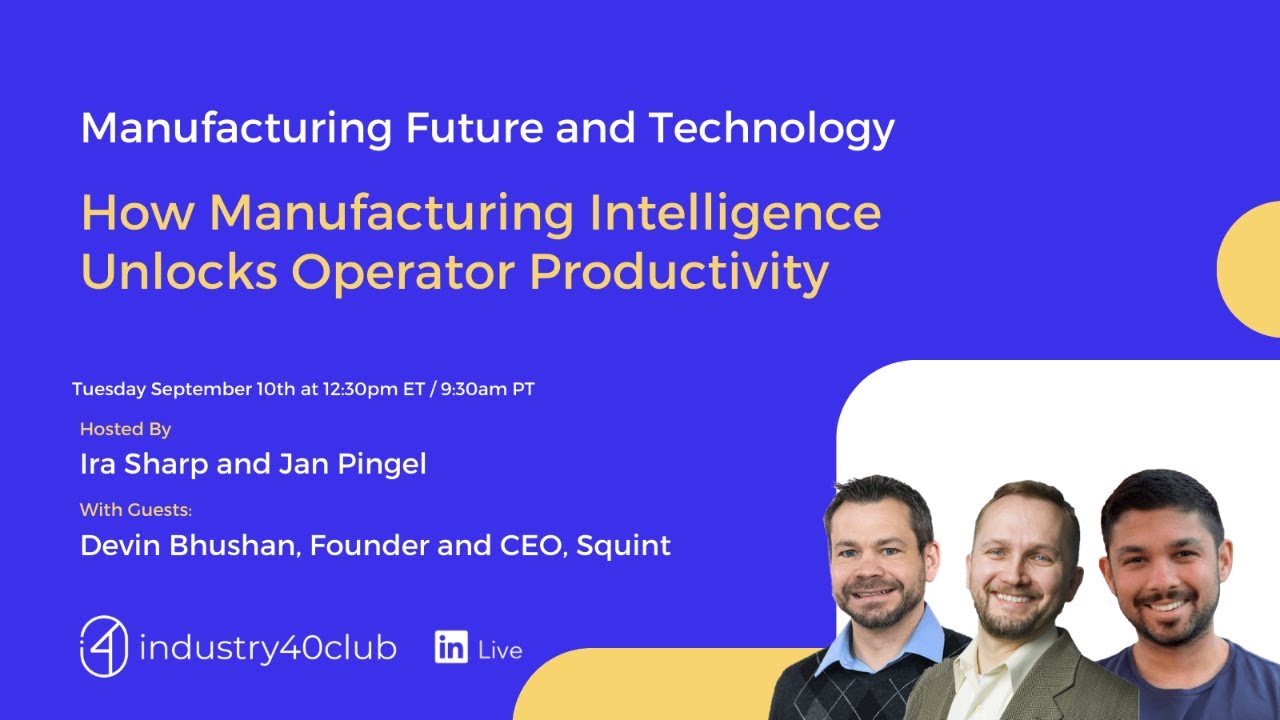
Devin Buchan's Squint platform uses AI and AR to turn operator videos into step-by-step guides that verify work in real time. It cuts SOP creation from 8-10 hours to 20 minutes and one factory achieved zero scrap after adoption. The system learns a machine's shape in 45 seconds without needing CAD models or QR codes.
Chapters
Hello and welcome everyone to our Industry 4.0 Club livestream for Manufacturing Future. We are here today to talk about manufacturing intelligence. We have a guest here, Devin Bouchon from Squint, and also my trusted co-host Ira Sharp here as well. We bring interesting leaders and practitioners in to talk about what they're engaged in in various areas of Industry 4.0 and manufacturing. And so today we'll talk about something around augmented reality and AI, which is a combination of 2 things that's very interesting. So we're looking forward to that. And my name is Jan Pingo, and I am one of the co-founders of Industry 4.0 Club. And when I'm not here with Ira and Devin and others, my daily job is I'm a product leader for our digital solution at Ingalls Oran. And that's where we make our equipment smart and connected and make sure that our customers can enjoy less downtime and more information about how they best use our equipment. Ira, over to you.
Thanks, Jan, and good to be on here. Good to have Devin, and I look forward to this chat. I mean, augmented reality and AI, I mean, these are like buzzwords upon buzzwords, and it'll be great to unpack them and kind of explore kind of how it all connects. So As a quick introduction, my name's Ira Sharp. Been in the industry for about 19 years. And of course, been part of the Industry 4.0 Club here for some time as a co-founder. Also involved in a couple other IoT Industry 4.0 type of communities. And really enjoy conversations like we're gonna have here today. My day job is I'm the Director of Product Marketing for Automation at Phoenix Contact in the US market. And as always, you know, just really enjoy having interesting people on to explore new and interesting topics. So Devin, can you give us a little introduction of you and let's start the conversation?
Hey, thanks for having me. I'm super excited for this. My name is Devin Buchan. I'm the founder and CEO of Squint. So I can share a little bit about Squint, but before that, I'll just share You know, I'm based in San Jose, California. My background is software engineering, and you've probably figured out looking behind me, I'm a huge sports fan. So, big baseball and football fan, so it's a fun time of year with the NFL season kicking off. Let's see, I can talk a little bit about Squint just to give folks an idea of what we do. So Squint is a manufacturing intelligence platform. Basically, it's an app built for operators on factory floors, to use with a tablet or a phone. And the way that this works is it connects an operator to what they should be doing, it shows them how to do it, and then we use augmented reality for some of that. I'll show you more in a second. And then actually, while they're doing the procedure or the work, it actually verifies that they're doing it correctly and provides help if they get stuck. So behind the scenes, what we're doing is we're creating a whole audit trail While also automating away some of the tedious, like, paper processes, like inspections, preventive maintenance, and more. So if it makes sense, can I share my screen and I'll actually show everyone a quick example of how Sprint works?
Absolutely, go ahead.
Okay, I'm gonna hit play here and it might be a little loud for a second, that's on purpose. But what I'm about to show you is a video that someone took and uploaded it into Squint. And then you'll see kind of the magic of Squint, that it takes that video and automatically generates an SOP using AI. So let's watch that and then I'll walk you through what happens.
Downtime expected.
First map— So I'll mute there for a second. Um, did you all hear what he said? Did you hear the instructions? It's kind of hard to tell, right? Um, I think the interesting thing about Squint is it was able to take that video, remove all of the signal, um, that was, you know, noise, uh, and actually process what happened Both listening and watching it. And then the AI actually wrote this 5-step work instruction for us, starting with, do you have the proper PPE on? A couple of instruction steps, and then at the very end, it added another step for evidence upload so that we can verify and create the audit trail that the lights were green at the end of the procedure. Now let's look at what that looks like once you actually feed that into Squid. So Squint has now created this content, and now what you're able to do is when you hand the device over to a new operator, they're able to follow the— they're able to use Squint and follow this procedure using augmented reality. So let me hit play and we'll— I'll walk you through what you're seeing. So now this operator is asked, do you have the proper PPE on? When they get to step 2, You actually see it enter augmented reality. You see there's a yellow pin showing them where step 2 is. For step 3, it's actually guiding them over to the other side of the machine with these arrows. At the bottom left, there's— Following and moving further down the line, we are going to then check off— There's a thumbnail that they clicked, which actually shows this video. And so the interesting thing is here, Squint watched that original video and automatically clipped and trimmed it into a bunch of smaller segments created these steps and attached the small videos. So if you get stuck on any single step, you can watch just the part that matters. And then obviously it's guiding you through this process. And then it has interesting engaging steps. Like in this case, they're supposed to take a picture of the status lights to prove that they were green. So if there's ever a quality issue in the future, you can actually pull up the audit trail and you can say, hey, we did this correctly. Everything was actually completed properly. And here's a photo. evidence and timestamp of when we did that work. Now, the, the last bit that I'll share here is what happens when something goes wrong. So what happens if, let's say you're on, you know, I don't know, step 17 of a lockout/tagout and something was supposed to turn off and it didn't? Now what do you do, right? So you can actually ask Squint, conversationally, you can say, what do I do if the red LED is on? And Squint has context about who the operator is, what they're supposed to be doing. It knows what they're looking at, and it can actually answer that question in context by looking through all of the documents that the manufacturing company has connected. So for instance, you can connect Squint to a SharePoint, and maybe you've uploaded your 1,000-page manuals. and a bunch of notes over the years that you've compiled. Squint will go through all of that, find that answer, summarize it for the operator to quickly unblock them. And then most importantly, with these AI agents, I think there's a serious lack of like trust potentially. So what we've done is we've enabled no responses will come back without a citation. So if you look at the bottom, there's actually a link here. to where it got this answer from. So I'll hit play. You click that and it actually takes you to whatever it was, page 30 of this manual where it was talking about the LED light statuses. So just an example of kind of how Squint works. I'll stop sharing, but hopefully that gives everyone kind of a good idea.
But yeah, maybe— That's pretty cool. Yeah, no, that's pretty cool. We talked before a couple times. We've been at the MXO conference in Greenville where you guys have been showing your software as well as I think you guys won 2 years ago, like the innovation something was pretty cool for you, I'm sure. But one of the things that for me clicked was I've been seeing some AR applications for a long time in my career when they originally started, right? And they always were very— they always showed well. Like, you know, sometimes you can even see the inside of the machine on your tablet or stuff like that. But at the same time, for us that was kind of a little bit involved in it, we also really understood the effort that had to go into it. Like, it wasn't like a—
Yeah.
It's not like a 15-minute video that went into that to create those kind of demos. There was a lot of detailed work and understanding. And can you tell me a little bit about how that has changed now with AI and GenAI, where it seemed like, as you showed, fairly straightforward and easy and something that any manufacturer could put in place without a lot of effort, I would think?
Yeah, yeah, we can. I mean, you hit on a lot of great points. We can break it down maybe even a little bit into how maybe augmented reality has evolved and what leaps we've made to make that process easier just to even construct this experience. And then I can also talk a little bit about how GenAI has sped up the speed of creation and the quality of the creation. So maybe we start with the GenAI side and then I can talk about the experience itself.
Yeah.
But I think the Really interesting thing is, um, GenAI, I think the, the naive use cases have been, you know, uh, a generic chatbot or, uh, create some content for me. Um, those are like the, the sticker things that people think of. Um, but one thing that we saw an opportunity of was, hey, I think that we can build a custom pipeline that can take in a video and audio and actually basically tear it apart, use a bunch of AI to understand what's happening and have that model know what an SOP looks like and actually then construct an SOP based on what it watched. And the reason we focused on this problem was our customers were telling us, you know, this is really great, I wanna invest a lot of time, but everything's always on fire. Like I don't have time to go write, you know, digitize all my procedures. It could take us 10 years if we were doing that to manually write how everything is done into Squint. So we needed a faster way. And so we had this idea and we're like, hey, I think this might work. And we started using it and we've tuned it a lot with some of the early releases and working with our early customers. What we've gotten to is actually pretty remarkable. I think one example, One of our customers actually recorded videos of operators doing work that was already digitized and documented that they thought they had control documents for, and they saw the SOP come out of Squint, and they realized there were process improvements that people had made on the line that no one had ever documented, but now they were able to capture that. You know, so from a, like, a tribal knowledge aspect, it's actually really powerful when you use something objective. Like, you know, GenAI to process what it's seeing and hearing, and it writes like exactly what happens, which like that doesn't lie. Where if you, you know, ask that same operator to write it down, maybe they'll like look at the sheet and be like, oh, it's actually like pretty close, I'll just leave it, you know. Um, so there's, there's interesting things there, but that's really empowered, uh, very fast creation. A lot of our customers, um, it's just the, the time it takes you to record the videos what it takes to create this content. I think you referenced a really interesting thing, which is a lot of the existing augmented reality solutions needed a lot of work to also stand up the 3D interactions and components. I think I can speak to that for a second. When we first started this company, I actually did not want to start this. My background is I've been working on augmented reality as well as our initial team had been working on this space for 4 years prior to starting Squint. And so I was thinking of starting a business and our old CTO at Splunk where I used to work, he had just become an investor. And so I was like, hey, I want to start a company. And he was like, okay, cool, start an AR company. That's like what you're world class at. And I was like, no, it's never gonna work. It takes way too long to create those experiences. You need like 3D models or CAD models and you need QR codes and then you need to go like put those things everywhere. And if anything changes in the slightest bit, it all breaks. Like there's no way the whole world can consume things in AR. We're just not there. And so I was like very adamantly against starting an augmented reality business. And he was like, well, why don't you just fix that? That sounds like an easy way to differentiate yourself from everyone. So the first few months, what we spent our time doing was figuring out how do we just make this completely seamless? And so there's a couple things that we've built that I think are pretty cool. One is we don't now— we don't need any sort of 3D model of the machine. So for instance, if you want to build a procedure around an extruder, You don't actually need to upload a CAD model of what that extruder looks like for Squint to recognize it and for all the 3D components to work. The way it works is we basically took inspiration from Face ID on the iPhone. And you know how when you set up Face ID, you kind of move your face around and it recognizes you and you do it twice. And now if you get a haircut, if you shave, no matter what happens, it still kind of recognizes your structure. We needed it to be that tolerant. And so we built basically this, we call it an area map technology, but it's kind of like Face ID for machines where it takes about 45 seconds. You just move your camera around pointing at the machine and it kind of spray paints the machine showing you what it's understood. And once you've done that, that model of machine is learned forever. And it works in the daytime, it works in the nighttime, it works before you clean it, after you clean it. If there's a cart in the way, a lot of our customers are, you know, they have outdoor equipment, so it works with snow on it and it works in sunlight, which actually has like enabled this technology to scale for the first time. So those are, those are some of the things I think that have really unlocked these use cases because the value prop was always there. It was just like, Was the juice worth the squeeze? You know?
Yeah, and I think you also changed kind of the concepts around who's doing it, because in the past, what I was at least experiencing was that the OEMs were creating it on their equipment. Now you actually moved it to the factory floor, to the actual end user, able to create their own kind of AR solutions with a lot less effort required.
Yeah, and I mean, I think the, the, that's kind of the power of something like manufacturing intelligence, because you're using AI and you're applying it in a way that enables the actual, like, the knowledge holder to build a custom experience, right? Because you're giving them all these tools that speed up the content creation. So you might as well have really custom content because it's so easy to make. So you don't need it to come from the OEM. and go through this complicated distribution model because it's so specialized and so expensive to make.
Exactly.
Or it used to be is what I mean.
It's really interesting because if I'm hearing this right, in general, when I think about AR experiences, it's always been the, okay, I'm using a Unity engine and you got to do all the 3D renderings and then you got to do the QR. And yeah, like you said, I mean, it's, it's a lot of effort. And then, then you got to make sure you have like the right angle to like catch it in. And God forbid you'd ever go outside of the, that sweet zone, because then you got to go to kind of go back to the start to get it keyed in. I mean, you're really doing all this keying. I'm sure, I'm sure you're still keying in on certain topics, but you're doing it all on the fly by breaking down the images. Is that correct? So like when you're looking at those buttons, You're looking for what? Like, how are you keying in on these different types of topics? Is there, is there any method to the madness there, or is it just kind of just the AI figures it out as it goes along?
Yeah, I mean, all the things you just said, like, I'm scarred, right? Those are the things that we were—
I could see it in your expression as I was mentioning that.
Oh no, um, no more of that. Uh, yeah, no, I think, uh, A lot of it was like, it's a really hard math problem. You know, ultimately what it comes down to is we had to be cognizant of the fact that our customers don't actually want you, want us, the vendor, like the software provider, to create and store images and videos of the floor. So like for them to go map out all their proprietary equipment, we had to reassure them that we are not storing any of this stuff. Um, so what we are storing is actually no images, it's just a bunch of vectors. It— we reduce it all down to, um, effectively a bunch of numbers about what this looks like, and then we match. We know how to turn images and videos into numbers, and we match those to see if they look the same. Um, that's, you know, simplifying a little bit, but, um, that— that's— it's a bunch of pattern matching, and we've built it to be very tolerant of change. Because some of these things move, and if on a factory floor, like, you know, this machine breaks and the fix is let's weld on an arm, and now it's working again. So now the machine has been kind of Frankensteined from the original version, and all the processes and the SOPs still have to work. That can't break it, otherwise, you know, you're creating downtime, not reducing it.
And is there like a list of types of machines that are supported? Like, Because there's so many types, it just—
No, it's completely self-serve. So I mean, that's the— that's been the really, I think, the reason for how sticky and how quickly Squint has spread. We're a fairly small company and we are supporting like really large manufacturers. And it's because that this creation experience is fully self-serve. So it's one app. Admins have the ability to create content and then operator profiles have the ability to consume that content. But it all happens in the app. You don't ever have to talk to us. It works on literally anything. We work with toothpaste factories and tire factories and Volvo uses it to create trainings for drivers on trucks. And there's thousands of these trucks, so they didn't scan every one. You just scan one per model and you can kind of create your web of content and distribute it out to the world.
So what has your experience been with, like, I don't know if the right word is, but, you know, like large manufacturers with a lot of history and structure and process that had their kind of own existing manually created SOPs and now You come in with something that is different for sure, but it also— there's now you kind of have the mix between you've got these new visual SOPs and then you got other SOPs that are not really machine related. But how do you combine those 2? Are you able to maybe even load in an existing set of SOPs in and then start adding the graphical content to the ones that are relevant?
Yeah, yeah, actually. So I didn't, I didn't show the video of this, but We're using AI in like every possible way, I would say. So one really cool thing that we've launched, actually, I haven't talked to you since we did this, Ira, but, or Jan, and I think the funny thing is this was a question we used to get, and I think for 90% of things, you can go record a video and it's actually faster and better what the output is. But for 10% of things, there's like really controlled things that they, our customers need to use the existing control document. And so now with Squint, you can actually take that PDF or, you know, whatever format you kind of have it in before, and you can drop that in and our AI will go read that document and turn that into the Squint version of it too. So we've just tried to make it like super easy to create this stuff because the end experience is greater than or equal to what you started with. If we make the cost of that zero, then it's like the world is your oyster. You can make everything better. That's what we focused on.
That's interesting because we got various different SOPs and instructions that we sometimes— you get training on, you got to go read out the different areas just to make sure that you know what's in there. But it's, it's going to be different than what you're creating. And I'm also thinking from a maintenance perspective, I can, as you mentioned before, there was an area where they didn't realize that there's been some changes in the process. So I'm also assuming that, that actually going forward, there should be areas where even though you have already recorded, you're going to re-record it because there's something new you want to talk about. Is there— so how are the operators kind of interfacing to that element of saying, hey, there's something is missing here, or we need to update this, or— I saw your interaction with the question, but it could also be something where the instruction is not adequate anymore or whatever, right?
Yeah, it's a great, great point. I think one of the cool things that some of our customers have done, I think the way we've set up Squint is worth calling out. Like, we've basically built building blocks, and so there's different step types you can add to procedures. And so it's kind of up to the process that you follow, because not all customers have the same, you know, manufacturing culture, I would say. So maybe some of them really want input from operators, some of them want to empower the operators to make the changes to the process, and others really are just like very top-down, like, this is the way it's done. You know, do not change it, or—
Yeah, yeah.
There's like a spectrum there. So what we've done is we've created different step types that you can add. One of those step types is actually operator input. And so if you wanted to construct that procedure, if you remember the one I showed you, um, for step 6 or something, you could actually add a final, like, a suggestion box, and you could say, hey, do you want to report any issues with this procedure or any potential improvements that you saw? And they can talk into their phone and just be like, hey, I noticed that step 4 could be a little bit improved. I don't do it this way anymore. I found that the whole thing works faster if I do it this other way. And then that gets collected and shared with the owners and approvers of that specific procedure. So there's a bunch of creative things you can do when you have these building blocks. It's a lot like Photoshop, right? You can make art or you can make more professional photos.
Right, right. Oh, it's, uh, it's interesting. So if you— one of the things we didn't talk about is I remember when you— when I met you first time, I think, and then, and you, you were at MXO, but at that time it was, I think, was before GenAI really took off. So what was the technology you guys started with? Initially, was just, uh, uh, ML, or what were you guys working on at the time?
Yeah, well, I mean, um, a lot of this, the augmented reality side of things, that was the original, you know, like we started there. The product worked very similarly, um, in terms of once the experience was created, it was the same, uh, or I mean, we've improved, but like, you know, it was roughly the same experience. On the procedure perform aspect of things. What really changed with GenAI was we no longer needed people to fill in a form or write their procedures from scratch. And that turned it into like image of PDF or, you know, like image of an existing document turns into something, or a video goes in, it turns into something. And we've you know, like basically sped up content creation a ton. Um, one of our, uh, we've done this a couple times, we've benchmarked like what does the before and after look like for creating SOPs, um, before and after Squint, or, or really like effectively using any of this GenAI, um, content to procedure workflows that are available.
Right.
And, um, our customers have found that it used to take them like 8 to 10 hours per SOP to go through the full, like, you know, learn the, learn the content, write the content, revise the content, publish. Um, and they've gotten that down to something like 20 minutes, um, because we've sped up, like, you know, the 95% of the creation process. And that's like the big impact that GenAI had, um, which I think has been— I mean, I don't know, I think this is maybe one of even the more higher ROI use cases of GenAI. It's just not talked about that much because A lot of the focus isn't on manufacturing's uses of AI.
Wow.
Yeah, yeah, yeah.
Go ahead, Daya. I was gonna say, I mean, and, and like, well, in the way that you're using it, it's, it's like the exact— it's, it's the same direction, but it's the exact opposite direction that many people think. It's like, hey, I go to Midjourney and I type in a prompt and I get an image. or DALL-E or whatever, but you're taking an image and then creating the prompt or the details of that image in vector form. From there, you're extracting, you're doing the opposite transform, which is really fascinating. And you mentioned it in terms of manufacturing, but man, when you— and I'm sure this isn't— but in the audience here is manufacturing, but the use cases It's huge, right? I mean, you're a baseball fan and you could be recording someone doing a baseball swing and you could probably tell them exactly how far that ball's gonna go based on the video that you're sending in there in the same way that you can look at a machine and these kind of things. It can get pretty crazy pretty quick. I am kind of curious from a manufacturing perspective, looking at the work instructions and all these other things that we're talking about, but Does this tie into any databases in terms of real-time data or anything like this to tie in with the analytics systems that may be running or should be running or, you know, helping in that regard? Because I know that's another—
Yeah.
When you look at these areas of improvement, you know, yes, trying to type down all this information, it's going to be wrong probably if people are typing it in versus taking a video. You know, these kind of things to input it into your system so you can dissect it. But I would think there's so many other pieces. We talk about this all the time with manufacturers on the data space. Like, it's a big gap that people may have data, but they're not getting it to the right places. Like, I couldn't see this necessarily fixing everything, but it's a lot easier to put a camera in than a bunch of sensors. And if you can extract the data from different parts of a system or process with a camera and pulled into a system, it may be a way to collect some information. Has that been considered at all, or is that too far out?
Yeah, no, actually, I mean, I think that's kind of— if you think of, you know, what does— like, we're calling this manufacturing intelligence. What does that, like, do for a business, right? I think the intelligence part is actually at the end of the flow, not just at the beginning. So the beginning is it takes, like, video and turns it into content, makes it easier for people to operate. But what's really, really cool is what's happening on the backend is we're capturing data that's like truly never been captured before. So, you know, like, and you guys both know this, but over the last like 15, 20 years, the focus has really been in manufacturing on installing, you know, IoT or sensors, different things that can capture machine metrics. Right? And I know this just as well. I was working at Splunk prior to this, which is a big metrics and data store company. And so we focused a lot on this. And I think what went kind of unnoticed, or maybe just because it wasn't possible before, was what is the data that we can get from the humans on the floor? Like, what are the human actions that are being taken? on top of just what's happening with the machine. Because what's happening with the machine tells you, you know, like the status when things go in and then the status when things go out and when things break along the line. But it doesn't tell you or explain the variability that you see between 2 workstations run by 2 different operators. One is high performing and one is low performing. It doesn't— the machine metrics can't tell you why. It just tells you that it is this way. So now with Squint, we're actually starting to capture like operator behavior, where they're getting stuck, which steps they're spending more time on, and starting to do anomaly detection on that. So both in terms of like which operators might need more help, and also in terms of, hey, these processes need improvement. So like, if you're going to do continuous improvement, you should probably focus your effort on step 7 of this changeover because 90% of people get stuck or get it wrong. And I mean, one thing we didn't talk about is kind of the visual enforcement aspect of Squint. So that's another place we're using GenAI. But it's similar to what you said. It's like the backwards of the Midjourney use case where you can actually point Squint at an operator doing the work. And so while an operator is performing a procedure, The camera's on in the background and it can watch that and it can actually say, hey, don't go on to step 7 because you actually did step 6 incorrectly. The valve is not fully closed. I can visually identify this, or the PSI reading on this meter is not within tolerance, so you shouldn't move on. And so that, like, verification through AI is catching critical issues before they get too far. And then the data we get from it is like, hey, something would've happened here. You should probably look at this process or help this person. So like, there's a whole like data story here that is super, super interesting. As we roll this out and we collect more of it, we can find more of these threats, if that makes sense. Does that—
It makes perfect sense to me. And I love, you know, the manufacturing intelligence piece even more now because, You know, I'm a big fan of, okay, great, IoT, Industry 4.0, even this topic, right? Data is data, but it's not usable and becomes information or it becomes intelligence, right? And that's really where your magic is. I mean, yes, you have a lot of magic in extracting the data. You know, that's probably the core of it, but really taking that data and making it usable and understandable information to actually make a system or process or whatever more intelligent. It's pretty cool stuff.
So yeah, and I mean, I think the, the most powerful things we've seen are like, this is allowing manufacturers to really challenge the way that things work today. So some of our customers, you know, like one thing, one thing I heard just the other week was they, they were doing a recap on, they've kicked off Squint, they've been using it now for a few months and doing, doing an internal like review of how things are going. And the thing that they said was, what if I told you that we could just eliminate training? Just the concept of training does not have to exist because we could get rid of operator errors and just make sure that they know what they're doing on the job and make sure that they do it and catch it before they, you know, make an error that could lead to a safety or, you know, a quality issue. And that's like, It's one of those questions like, what if I told you I could eliminate training? Is so— it questions like the fundamentals of everything, right? And that's the difference that I think AI can really impact things and completely eliminate things that we used to think were a tax that we paid, you know, in order to do things right, you had to have a really intensive training process. But now what if this actually just makes sure that you can't do it wrong? And as a result, you don't— like, if it's a complete failsafe, you don't need it. And so an example, the same manufacturer, they went through their results after they started using something like this, and they found— they pulled a report of the last few months of people who were trained and used squint, and then the operators who were not trained on squint and didn't use squint on a different You know, different line that they hadn't deployed it to. And the data literally showed 0% scrap from the line that had adopted this. And that's what they were like, is this data fake? It looks fake. But it's not, right? Like, they went back, they ran the numbers, they double, triple checked it. And that's the kind of impact that it can have if you get something like this, you know, put in the hands of the right people for the right use cases.
Yeah, that's, that's actually very interesting. It's all the added benefits that you don't initially identify coming in with this. We had a, a pilot when we just started doing IoT in Ingersoll Rand, where our technician had to install it in the field, and it took like 3.5 hours. They had to drill a hole and all kinds of stuff for the antenna and put it in place and screw and connected and tested, whatever. It took like 3 and a half hours on average. And then they, uh, added like this, uh, little headset and put the procedures in again with a lot of effort because it wasn't using AI or anything like that. But they put some procedures in, not so much like it wasn't overlaid or AR, it's more like they had the procedures step, step, step in that, in the goggles. And then now it was down to like an hour and a half. And, and I can just imagine with what you guys are putting in It's not just that they don't have to do the training, but the person that does it the first time is doing it almost as efficient as the one that's been doing it, you know, for a year or multiple years.
Exactly.
Yeah. Um, so, so it's not just that you don't have to do the training, but you also, you got somebody that they're efficient from day one almost. Uh, with a little bit lower, but, uh, yeah. That's interesting. Do you, do you see that, uh, that it's, it's mainly for— well, no, you know, I can see if it's operating instructions and with feedback, you want everybody to use it constantly. Not like even if they've done this process for many years and they feel so comfortable about it, you still want them to do it the same way because then you get the input, you get them to register, you know, the steps they did and record the values as opposed to record and all that stuff. You still want to keep on using the system.
Yeah, you can build into Squint. One interesting way to think about it is you can build different experiences for different experience levels. Squint can also perform— another really interesting use of GenAI is it can do knowledge checks. So it can surprise you with a quiz and say, hey, you've now done this procedure, here's a quiz. I'm going to jumble up some of these questions based on the procedure and I'll make up the quiz and I know the answers. And it speeds up that whole process of like checking for if someone understands the process and it will quiz them on it. And if they pass to a certain degree, you can actually flip them from like the beginner mode SOP to the less detailed, faster, you know, Maybe it's not even AR because you know it so well, we just need to capture the data, you know?
Right, right.
And you can flip them over into like different spots on the spectrum of help, essentially.
Just go back to one thing you said before on collecting the data, like the pressure was not right or whatever it is. Is that connecting to IoT data or is it the camera seeing the pressure sensor on the machine.
Yeah, I mean, I, I think like the most powerful thing we're going to see over the next 5, 10 years is the camera is going to replace a lot of APIs. Um, I think APIs are actually going to be, uh, a thing of the past. Integrations, native integrations, are going to be very expensive compared to point your camera at something And let AI just read it. You know, that's, that's way faster than us figuring out how to integrate with that version of SAP on the floor to understand what that value was on that IoT sensor. And so we actually are just using the camera for all of our data intake, and it sped it up because we don't have to build anything special for your sensors, you know, versus—
Yeah, yeah.
Different, different company. So.
But it still requires though that there's some kind of metering or value that's visualized as opposed to something internal, right?
Yeah, yeah. So if it is an internal value, then of course, I mean, that's where I think even today with AI, like, you still have to connect to the system to pull that out of the database. Yeah, but I think like— yeah, sorry. No, I was just gonna say I think the value is a lot of today's factories are built also for humans. And so as a result, a lot of things are visual and available to the human. And even if it's just an HMI, Squint can read data from there, right? So there's a lot of places where we can get this as long as a human could get it.
Yeah, I was thinking more like, you know, if you had some of the IoT data, for example, like a temperature, and you could overlay that the machine is like more reddish because it's going to be hot before you touch a specific area or something like that, right? That could be interesting.
Yeah, absolutely. That's, that's something we're thinking about right now. We, we haven't, um, I think the challenge is like picking the right first partner and provider to integrate it with, um, but we're definitely thinking about it. We've actually built what you just said at Before we started Squint, that was a product that we had built, was connecting to sensors and showing a machine that was red when it was on.
Yeah, yeah, that's cool. So a lot of the things you talked about is the procedures inside a manufacturing plant floor. What are some of the other use cases that you at least can see, but also some, if there's other use cases that you actually doing. I'm thinking more here like, uh, service technicians in the field, um, you know, across, uh, you know, uh, performing service on an equipment that's not their manufacturing floor but it's a customer's. I can also see even exposing some of this stuff to like a, a DIYer, uh, that is just trying to fix something on a machine and they have some kind of access to, uh, Almost like a smart YouTube or whatever you want to call it, right?
Yeah, I mean, ultimately, you know, the vision for Squint is that we can help anyone get to the information they need faster. And we've tried to like remove all bottlenecks to get to learn what you're supposed to do, how you're supposed to do it. And I think the applications for it are actually super broad. One fun thing that I do with Squint is at my house I have a lot of plants and I actually, I travel a lot for work. And so I've built procedures in Squint that have the input was watch me water my plants and I've created a schedule. And so now whoever's home when I'm not here can know for every plant when is the next time they're supposed to water it. how it works, if they have to mist this one or they water this one from the bottom, or you just pour, you know, X cups of water in, and it walks them through how to water all my plants, which is actually not that different from performing a changeover on a machine, you know. So the applications are kind of endless. Other, you know, more practical applications that we've seen are we have some customers doing field service. We're also working with some OEMs that we're working on rolling out, you know, as if you buy this equipment, it comes with Squint on how to use it, how to perform the right preventive maintenance. There's a couple of use cases that we have also in oil and gas. And so field service, oil and gas, I think are similar but different.
Right.
It's both, you know, it's outside, it's one person going to an asset, integrating with things like an asset management system, Thinking through work orders and integrating that into Squint's workflow. So there's a bunch of different ways you could apply this technology, but at its core, when you look at these things, they're just all so similar, right? They're not all that different from how to water your plants and when to do it.
Yeah, I just came up with an idea while you're talking about watering your plants. I'm just thinking all the meal recipes, like you can't remember what grandma used to put in that was so special, but if you Taped it, you will know exactly how much curry to put in or whatever it is, right? Yeah.
Um, I'll have to—
yeah, go ahead.
No, I was gonna say I, I'll have to send you a video I, I made of using squint for making a smoothie. So yes, that's funny.
That's funny. That's very cool. It's, uh, it's been a very interesting conversation. I, I I'm glad that you were willing to come on here and talk a little bit about this whole area because I think it's— there's a lot of areas in Industry 4.0 that, um, you know, that has gotten a little bit of a transition from the old style Industry 3. Now we're doing some more digital integration, uh, data, etc. But this is really an area where I think GenAI has had an immediate impact, uh, on this whole whole area. Um, you talk a little bit about, you know, what people typically think about GenAI. And, and, and we, we had a, we had a, we had a live stream, uh, it was like last year, I think, just when it started to come out. One of our co-founders had, had played with it, and one of the things we found is really what you found too, is it knows structure like it, like an SOP. It knows various different structures. If it, if it's a specific type of document that has a very specific structure, it's very good at taking the input and put it into that particular structure. And that's something that's especially very valuable in, in the manufacturing industry. And not a lot of people really realize that initially before they actually see it in action. And that's, that's what you guys put in place. So I think this is very, very cool, and it definitely opened up my eyes to some opportunities for utilizing GenAI in other types of areas in manufacturing. I think that's definitely an area that manufacturers should think about, not just— they should definitely think about what could be done with what you guys are doing, but really also thinking about where GenAI can, instead of creating Midjourney images, whatever, to fill out your PowerPoint, There's a lot more stuff that you can really use GenAI for that can have a huge impact on the manufacturing floor.
Yeah, one final thing I'll share is, like, I think the most powerful and enticing aspect of this is that all of this can be retrofitted to their existing environments, right? Like, it's so much easier to test something like this. A manufacturing intelligence platform really can be rolled out, out of the box. It's just software, right? You don't have to install sensors. There's not a lot of like change management you have to do. It doesn't integrate into a lot of things out of the box if you don't want it to. You can use it and it can magically speed up the way that you work. So I really think it's like low-hanging fruit for a lot of factories.
And so, Devin, You are a software guy, right?
I am.
And you said it's just software, like, as it's all just casual, like, ah, it's just software. Like, there's a lot that went into that software, but I know what you mean. From a user perspective, it's just software. But I say that because, you know, as the marketing guy in the company, I'm like, ah, well, it's just software. And my development guys are like, yeah, it's just software. It's monumental task to get over things, but it's the interaction.
Yeah, great call out. What I really meant was, as a user, a lot of this is an application available to you and not software you have to develop. It's not hardware you have to install. There's very little overhead to putting it to work.
Very low barrier of entry and a quick return, you know, and immediate feedback in its operation, which I think is So different than, as you had said, to a lot of the other things that we talk about. And when you talk about the sensors and getting the data and the firewalls, the IT/OT, and all these other things that come into it. I am curious though, one barrier that I could potentially see, and maybe you get involved with this or not, but with the cameras and the use of them on machinery and looking at people's interactions and all these kind of things, like, What has been the people aspect of this? Like, are people like, sure, absolutely, you know, video this all and tell me where things are going right and wrong? Or are they more like, nah, I don't really want to. I've always done it this way and I just want to work. I don't need a machine to tell me what it is like. What does that people interaction look like?
Yeah, I mean, I think the, the fundamental thing that we've noticed is Uh, documentation is not something anyone really has fun doing. There's very few people that are like, that wake up and they're like, oh my gosh, I get to go document today.
Write this down.
Yeah, let me go write 20 pages this morning. Um, so that's like, yeah, that, that's not quite, um, I think it's not as contentious as it seems if we tell them we can actually document everything for free to them, you know, like, it's like the, the aspect of just turning a video of you doing your work, which you were going to do anyway, into the documentation that you now no longer have to write or help with. I think that is like super exciting and gets people in the door. And then when operators actually use it, I think the, the bottom line is that if it's making them safer and it's making, you know, fewer incidents happen and they start to see that, that drives a lot of buy-in. You know, one, my favorite sign of this, of the adoption and the stickiness and kind of the love that we get from customers is, I think, when our customers actually tell other people about the product. And so we've had so many occasions where an operator meets up with a friend at another company, And brags about how like they like their job now because their workplace invested in something like Squint. And usually what happens is a few weeks later we find out because we got a call from that other company and they're like, hey, I need a proposal for the Squint thing because all my operators are talking about it now. And that's like the, that's like the put your money where your mouth is part of this, right? Yeah, that's awesome. When you start to see that.
That's great to hear. That's really great to hear because I could see that being a barrier. It sounds like you said in the use case of, oh sure, someone can go in there with a clipboard and stare at you for hours on end writing everything. Nobody wants to do that.
Absolutely. When you're talking about barrier, just a last point I think before we end here today. This is GenAI. A lot of people talk about where the data goes. And especially in manufacturers. And when you're talking about this kind of information, which could be like even manufacturing recipes that you are running, what, uh, I'm, I'm pretty certain you guys are, are containing all this stuff by customer, by customer. Just talk a little bit about more what you're doing and what your response has been from some of the manufacturers.
Yeah, I mean, um, you know, I think if you go to our website, you can see a bunch of the manufacturers we work with. some of them make products that the other ones make, and I don't think they want to be sharing recipes. So we've, um, obviously all of those, uh, deployments have been approved through like these global security and IT teams, um, so that speaks to it a little bit. But, um, you know, at— on a holistic level, the way that we've operated is we've basically built up a silo for every customer, and all of your data lives in that silo. we host and manage it, but it's all encrypted. It's fully encrypted end-to-end, and all of it is managed by your license. And you have the ability to turn on things like SSO such that someone who's not employed at your business, even if they do somehow, you know, get access, they can't actually log in. Other, you know, there's other like security things there. We could, we could go on for hours, but I I think the approach that we took was we have to build this for the enterprise from day one. My team's background was we came from Splunk, which, you know, had a bunch of customers with 3-letter acronyms that were part of the government. And so we were building security software before this. And so to build from day zero effectively, with security in mind, that was just a natural inclination. And so we're fully audited, we are SOC 2 compliant, we have been through all the processes that you need to go through to deploy software like this in an enterprise.
Well, hey, again, I really appreciate you joining us here today. It has been really a pleasure. And I got, again, as I usually get, so much knowledge. in such a short time. And I really, uh, think that, uh, everybody that is interested in this particular area should watch our livestream here. It's going to be— it's recorded, it's, uh, you can review it again both either on LinkedIn or on YouTube. Um, any last, uh, last, last comments, last thoughts?
No, thank you so much for having me. I really appreciate it. This is a great show that you all put on, and, um, I'm excited for the next one.
Absolutely. Ira?
Yeah, it's just great to hear. Yeah, great, great to hear a different, different way of thinking about a lot of the things that we've talked about over the years. And, and I look at it, it's always been collect data, use the data to make information, to make intelligent and more meaningful decisions on your system or process. And I think this is just fantastic because Like you said, there's so much already there for operators to see, to use, to make sure things continue to operate. Why not use those things and make that your data source rather than trying to retrofit things in these other ways? And I think it's a good approach. And yeah, it's interesting, especially the dissecting of everything to not live in unity and to bring up all those bad things for you again.
Yeah.
know, the QR codes and things and do things in this different and unique way. It's great stuff.
Thanks, guys.
Thank you very much again. And for everybody that's been watching us here, come back. We are constantly having live streams every week. I just want to put a little quick plug in for Manufacturing XO Midwest in Cleveland, which is going to be September 25th and 26th, I think. No, just the 25th. I think we are going to be live on on, on there as well, um, and talking to different manufacturers and vendors on technologies. Um, with that, I will, uh, end our show here today. And again, thank you very much, Devin. I, uh, I was looking forward to this, and you have definitely not disappointed. It's been very interesting and very informative. Appreciate it.
Thank you.










