Human-Centered AI: Building the Future Workforce in Advanced Manufacturing
Anitha Kapu, Director of Manufacturing and Quality at Crusoe Energy Systems, argues that AI should augment human work, not replace it. She allocates 20% of employee time for safe AI experimentation and cites aviation's regulatory model as a template for human oversight in safety-critical decisions.
Chapters
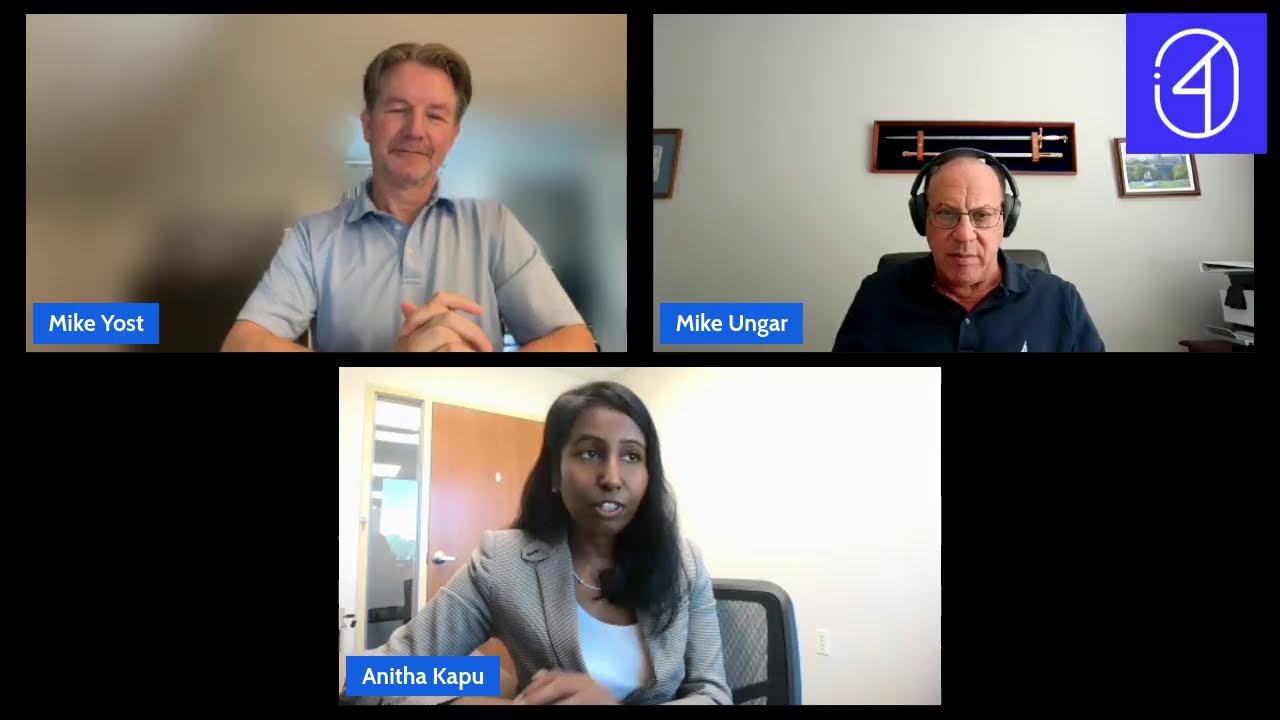
Welcome to the Industry 4.0 Club's fireside chat. The club's purpose is to engage the power of diverse worldwide talent to accelerate the global evolution to Industry 4.0. We accomplish this by hosting and supporting respectful, thoughtful, and interdisciplinary open conversations and creating quality content on wide-ranging Industry 4.0 topics to expand the reach of our community. My name is Mike Unger, and I'm the CEO of the Industry 4.0 Club. I have over 40 years of leadership and management experience, most of that with manufacturing at Michelin. I'm joined today by my co-host, Mike Yost. Mike is chairman of the club. Mike, would you mind introducing yourself further, please?
Not at all, Mike. Thank you. Welcome, everybody. As Mike said, my name is Mike Yost, the volunteer chairman of the Industry 4.0 Club. And I myself have been in industry for almost 40 years, a little over 20 years on the technology solution provider side, and the past decade and a half or so on the industrial nonprofit side. So really excited that today we have the pleasure of speaking with Anitha Kapu, who's the Director of Manufacturing and Quality at Crusoe Energy Systems. Anitha is going to be speaking at the MX.O Midwest event in my hometown of Cleveland, Ohio, which will be held September 30th to October 1st. We're going to be previewing that conversation, and she'll be talking about human-centered AI, building the future workforce in advanced manufacturing.
Mike, the MXO Midwest event is, is really considered the go-to gathering for manufacturers in the region to connect, collaborate, and learn from real-world examples of successful digital transformation and workforce solutions shared by those who are making it happen today. Beginning in 2024, this event has empowered local manufacturers to advance their careers and businesses through valuable knowledge exchange and impactful networking opportunities.
Yes, and like I said, it's my hometown, so this will be the 3rd year that the event is here in town, and we're really excited to have folks with the experience and background and passion like Anita. So just a little bit more background on her. She's a global manufacturing and Quality Engineering Operations Executive with over 17 years of experience scaling mission-critical hardware systems across aerospace, automotive, AI data centers, and robotics industries. She's led multinational engineering teams across North America, Europe, and Asia for leading organizations including SpaceX, Tesla, Walmart, Amazon, and Motorola Solutions. Anita currently focuses on advancing next-generation manufacturing systems and intelligent automation that power future AI infrastructure and humanoid robots. She's a world traveler, as you can tell. She's a fascinating individual talking about a fascinating topic. So anybody who's following along with us here on LinkedIn, if you have questions, please go ahead and put them into the comments. section, and we will do our best to integrate them into the conversation here over the next half an hour or so. So with that, welcome, Anita. Thank you for joining us.
Thank you, Mike. Fantastic introduction. I really enjoyed it. Thank you.
So let's jump right in and start this conversation if we could. So Anita, you've worked for a lot of different organizations, and as you think about AI as it becomes more deeply embedded in manufacturing in particular, What does human-centered AI really mean to you, and why is it important that manufacturers keep people at the center of their digital transformation strategy?
Yeah, this is a good question. Thank you, Mike. I wish we didn't coin this word AI as artificial intelligence. I wish they could have coined this word as augmented intelligence. That's how I see it. And what I mean by that is augmenting human capability human capacity, human empowerment. Again, the title of the discussion is human-centered AI. I would like to put people first. That to me is human-centered AI. It is obvious. How can we empower people with technological advancements and automation so that they can make better decisions quickly, accurately, and in an efficient manner, especially in the context of manufacturing? Um, how can we enable people to not repeat the laborious, monotonous, repetitive tasks and can incorporate— by incorporating AI into those type of tasks and then enable humans to make critical judgments and creative thinking and those sort of— in a nutshell, yeah, AI to me is how can we enable humans with AI, and then how can we coexist in an ecosystem of machine intelligence and human judgment?
Right.
And Erin is going to—
Yeah. Argumented intelligence is the word that I would like to prefer than artificial intelligence. There is a little bit of a pessimistic notion around this AI. Again, we'll get into this topic in detail in a minute or so. I would have preferred argumented intelligence. by putting people first and by putting people in the center. And also, how can we integrate people, processes, systems into one unified ecosystem?
Right.
So I think that is— you can't pick extremes in this context because at this point of time it is inevitable that AI is everywhere, automation is everywhere, intelligence automation is everywhere, everywhere. So we just need to find a healthy, harmonious a balancing approach to enable humans with AI so that, you know, we can coexist and then make better decisions in the context of manufacturing for productivity, accuracy, and efficiency and those type of day-to-day responsibilities.
Yeah, you know, you, you speak about— it's funny because I listened to you talk about it. So in, in my background, I've deployed lean in companies, and what you've just described are many of the lean principles that we like to talk about. For example, engaging and empowering people. Having a passion for eliminating waste, well, what you just described was taking away the routine and mundane things from the folks so they can bring more to the table, bring more of themselves, and make more of an impact. So it's waste elimination. You talked about productivity gains, well, that's what Lean's all about ultimately, right? Better serving our clients.
Absolutely.
So you've really touched on, it's funny because We're really talking about the same principles that we've been talking about for decades. Yes, we just have another tool now to help us do that more effectively.
I'm glad you brought that topic up, Mike. What you're talking about is Lean Six Sigma. I'm also a Master Black Belt Lean Six Sigma, and within which, you know, we talk about eliminating waste. We have 5S systems, eliminating variation and all that stuff. Again, to achieve that, you need to process— you need to collect, process millions of data points. I think that is where AI can help us. You don't have to take care of this laborious mundane tasks. Let AI do that low value add while putting human judgment as top priority. Speed is one thing which we can take advantage in this context of data analysis, predictive analytics, right? Quality and manufacturing is all about data, in my opinion, because you collect millions of data points every day. How many non-conformances on shop floor? How many breakdowns on machines, for example, right? So these are like critical day-to-day. You are now at advantage of having millions of data points, but how do you sort them? How do you identify patterns? is something we don't have to spend time on anymore because AI can do it easily, effectively, and quickly. Now, having said that, with that infrastructure enabled, how can you make quality decisions, especially in the context of safety-critical environments where speed is important?
For sure. Yeah, well, and to your point, on some level, it should be comforting to us that we're still talking about the same principles that we've been talking about for a long time, but also there are things we need to understand and how we use these tools. And I guess as we have this conversation so far, I know there are people out there that are thinking that AI means the end of jobs, that it'll be replacing jobs. And so if we think about, you know, your experience, what you're seeing for the workers themselves, how do you see AI changing the role of engineers and technicians and quality professionals? And what new skills do you think will be most valuable for the future workforce?
That's a very interesting question. Million-dollar question. Everybody would like to understand.
Well, that's what you're here for.
I am not a believer of AI replacing jobs, so I have a very strong opinion on this. I strongly believe that AI can displace some jobs here and there. Like, I'm, I'm excited, actually. The new job market and the new job skills and the new job titles are going to be exciting. I'm a latest new-gen technology leader, and I would prefer to think in that angle. There is a lot of pessimism around this AI replacing jobs, and I would like to dispel that notion. Please, please, I want to assure all of us in the manufacturing industry and non-manufacturing industry that is not true. There is no data available officially, formally to back that statement, right? I truly believe AI is not going to replace jobs, but it will displace to some extent. I don't want to paint it as a rosy picture. It's going to be some— there's going to be some disruption for sure, as any technology has brought. Innovation brings some level of disruption. When you first invented a plane, when you first invented data centers, internet, autonomous taxis, robo-taxis, There's going to be some disruption for sure, but I don't think it's a one-on-one ratio. Okay, this AI has come, and so there is going to be this job replaced. So it's a preconceived misconception, and also media sometimes portrays as a— they have a different narrative, which I don't agree with.
Yeah, yeah. I'm just wondering, do you think that the everyday workers, pretty much all of us. You know, one of the things that I've always loved about manufacturing is that I think manufacturers are problem solvers.
Yeah.
And so you see constantly, we talk about innovation with a capital I and we talk about the big things, but day after day we see people like in their station, in their plants, in their areas, innovating, getting things done. Do you see AI being a tool and would you encourage people to be thinking about how they could use tools to help them Yeah, even just daily with the little, I guess, the small i innovation areas within their workplace where they can, they can make continual changes?
Yes, AI tools and digital transformation at this point of time is inevitable. Actually, I'm investing more time, my CapEx budget, in bringing new ERP systems, new QMS systems, new MES systems, because they're much more powerful. They can process millions of data points in a much faster fashion.
Sure.
So I think at this point of time, there is no debate about this topic. If you are not catching up with these tools and technology and then the digital transformation ecosystems, you are going to be way behind. And which is why I would like to classify manufacturing industries as new era manufacturing industries, and there are traditional manufacturing industries like gas, oil. There are some industries who are like catching up Silicon Valley-based tech manufacturing industries like robotics, AI, physical AI, they are way ahead. There's a significant gap between traditional manufacturing industries and then tech-based manufacturing industries like drone industry, for example, right?
Yeah, yeah.
AI tools, yeah, for sure. To answer your question, Michael, for sure we need to invest and bring in those tools and technology as quickly as possible.
Right, right. I just want to take a quick second to remind everybody that we are speaking right now with Anita Kapu, who is the Director of Manufacturing and Quality for Crusoe Energy Systems, ahead of her presentation about today's topic, the human-centered AI, at the MX.io Midwest event in September— I'm sorry, in Cleveland at the end of September. And if you do have questions for Anita, please go ahead and put them into the, uh, into the comments. Um, we'll do our best to get to those. So I'm sorry, Mike, didn't mean to cut you off.
No, that's good. I was, um, you know, reflecting on this concern that people have that you were talking about, about AI replacing jobs. I think a great deal of it still comes from the fact that people don't really understand and know what AI does and can do for you. You know, I think it's like a lot of things, the There's fear of the unknown.
Yep.
And so I think a lot of what I really appreciate in this conversation is thinking through now, how do we bring it closer where people see it and go, oh, that's no big deal. It's the same thing we used to talk about with technology before AI was such a big conversation. A large company would create a small lab in a facility or in a company And allow their employees to go in and play with technology so they wouldn't be afraid of it, right? They wouldn't be scared of it. I think we need to do more of that with AI as well so that people understand that, okay, now I know what it is. Now I know what it can do for me. Okay, I don't need to be afraid. I mean, have you, have you thought about that approach and the things that you do?
Yes, I, I did think about that approach, and I'm glad you're bringing that up, that point up. We have 20% of time given to employees in my organization to play around these AI tools and technology, and this is not going to be reflecting on their performance, right? I am buying this fancy AI-enabled ERP systems, but now it's training and education to enable and empower the judgment of manufacturing decisions on a day-to-day basis. So that fear is something that I have to eliminate from human minds in my team, right? I'm responsible as a manufacturing leader. It is my job to make sure that they embrace technology but not fear technology. And for that, I have to create an ecosystem where they can go and play around safely and then, you know, like have that excitement than fear. If I'm telling them, okay, I'm purchasing this software Go and use it. But if you make a mistake, if I'm going to be— if I'm holding them accountable for performance, then that's not going to be helping. Find different ways and give people freedom to play around and then learn from the mistakes. Mistakes will happen because AI is not as efficient at this point of time as we would like it to be. AI revolution has just begun. We're also learning as a team, as an industry. There are technological inefficiencies and disadvantages that we're already dealing with. And then how people use the technology also has some concerns, fears, insecurities, like the AI replacing jobs and that. So if you can— me as a people leader, if I can create an environment, a safe environment to play, then holding them accountable for performance gaps. I think optimism can be achieved.
That's great. That balance you're talking about between letting AI drive decisions, let AI decision-making happen versus human judgment and letting folks play to learn, that is really important. However, for a company, how do you put the guardrails on because An error can have pretty big consequences. How do you balance that? As you describe, how do you put the guardrails on where you— small mistakes that aren't costly, fine, it's learning. Big mistakes that are costly is learning, but it's also too costly.
I'm glad you— this is one more interesting topic, which is a challenging topic to me because it's not easy. It's not easy to put guardrails on this topic, especially around AI, because we don't know what we don't know. We are learning on the go, right? We can predict to some extent that these are the type of things that can go wrong, and then you can put policies and guardrails around it. But when you don't know what you don't know, you're also like figuring things out, right? So that is the phase right now I am in. I'm excited about technology, but at the same time, sometimes I'm also apprehensive about deploying too quickly. I need to make sure that my team is ready with the training and digital transformation and adoption. Sometimes it's slow because we have senior-level workforce on the shop floor, like on the front line, and then we have executives who are using fancy technology and we have middle-ground engineers who are too much into data. You have different set of audiences and then a common technology platforms. It's not easy to cater to all audiences, so it's my job now to find the policies and procedures in place so that we can draw boundaries between where human judgment plays a role and where AI can play a role. I'll give you an example, right? In aviation industry, safety critical, mission critical. We have tons of telemetry data coming from different sensors of the hardware, but we don't let AI make a decision. We have to have a human judgment. It's it's FAA that is dictating us sometimes, and if that is also sometimes we also have internal. protocols that we can't trust AI completely because there's going to be an automation bias. Automation can help you make decisions faster, but there is also— too much automation is not good, right?
Mm-hmm.
Understanding these nuances and then designing policies around drawing boundaries between what AI can, can do and where human judgment is essential, and educating people on those policies and procedures is very important.
I think that's a really interesting point for people to take away as well, is that understanding of the different audiences. I think that's really, really an astute judgment to put forward. So thank you for sharing that. I'm wondering, you know, as companies adopt, as companies start rolling out, you know, AI-powered systems and automation, robotics, et cetera, What are the biggest workforce challenges that they underestimate?
Not being ready with the digital infrastructure transformation that it takes to deploy AI. What I mean by that is like AI is going to be a GIGO model, garbage in, garbage out. So you have traditional ERP systems, NET systems, and PMS systems, whereas the, let's say, ChatGPT or Claude that you're trying to put the models that you're trying to put on these traditional manufacturing systems is not a compatible solution. So you need to empower people with AI. You also need to disrupt your digital infrastructure. Some people still question on CapEx decisions, like, why do I have to invest $1 million to purchase this software? You can purchase sometimes, but it has to be compatible with existing systems. That is also going to demand more investment. So that is one challenge. And also skills. For example, we have senior-level workforce, tribal knowledge. We can't— they're essential for the foundation of the manufacturing. But at the same time, there is a challenge for them to learn these technologies quickly. That is one challenge. Skill gap is keep widening, and we need to find ecosystems to quickly train them. And also, if I can go slightly off the context, regulatory bodies and certification bodies and government bodies are not as fast. They don't have a deep understanding of technology. I'll give you an example, right? I come from Amazon. drone industry. I work with FAA on a day-to-day basis very, um, actively. We are way ahead of the technology, but FAA is way behind. Sometimes those conversations are difficult to hold because 80% of my job is like educating them, which is also my responsibility. I'm not saying that I don't enjoy that. You need to go— you need to have an extra time. Like, the government entities are not as savvy as Silicon Valley-based tech companies. So I have to educate them and then work with them to design the policies, because we also need that critical independent judgment from FAA and NASA and all the government bodies. Um, yeah, there is an AI literacy and digital literacy gap that is sometimes very interesting, also sensitive to talk about, but that is a reality, right? I mean, in the beginning of the conversation, I set up my mind to go in a constructive discussion. And that is a real challenge for me. You know, manufacturing industries, oil and gas, drone industry, aviation, automotive, especially robotics and driverless car technology is like very, very new. Uh, tech companies are somewhat ahead, but non-tech companies is like something we have to keep educating them and evangelizing them.
Well, we'll have to pull you in. Ohio is obviously the birthplace of aviation. Now it's the, you know, one of the primary industry focus areas is advanced air mobility, so drones. I think the Cleveland Clinic is starting in the next month or so to deliver prescriptions by drone. So there's a lot of conversation in the region. We'll be glad to pull you in to have some of those conversations about how, you know, the technical infrastructure and the policies and those things like you're talking about, we'd love to— Pull you into some of those.
Yeah, that's going to be an interesting conversation. Yeah.
Well, when you, when you look ahead, so looking ahead, I mean, this is, it's a, it's hard to think about the future when there's so much to think about, about the present. But looking ahead 5 to 10 years, and really, as you think about AI infrastructure, intelligent factories, humanoid robots, and because these things become more common, Yeah. What do you believe the manufacturing workforce will look like, and what should manufacturing leaders be doing today to build organizations that can thrive, you know, 10 years from now?
5 years and 10 years from now, it's going to be a coexistence of physical AI, digital AI, and humans. Critical decision-making, critical judgment is still going to be human-based. for sure. Um, but we will be more physical AI-based companies like humanoid robots. I worked on Tesla shop floor with humanoid robots where we have a humanoid supervisor, which was a shock to me. I've seen deploying humanoid robots on factory works like sorting, you know, like assembling the work, car factories. things like that. But I've never seen a humanoid being deployed as a human supervisor, which was like a pleasant shock to me, right? I love having that coexistence of human and humanoids, but it can be too much for some companies. So I want all manufacturing leaders like us, and I want to urge in a positive note that this is not a textbook concept anymore. This is not a Hollywood concept anymore. This is real. I have seen humanoids being deployed in factories as workers as well as supervisors making critical decisions. So we need to find an ecosystem and embrace that ecosystem of coexistence of human and humanoids. So physical AI, I've seen like 40 startups popped up in 2026 itself on this space, which is very exciting, which is also sometimes concerning. The concerns can be addressed. We just need to embrace and then find an optimism around this topic. Some of the investments is education and culture change. Anybody can put money and then deploy softwares and bring technology adoption, but it's not about technology adoption, it's about people transformation. There are a lot of notions, fears, insecurities like AI replacing jobs we just talked about. So we need to invest time in that area and then dispel all these fears and notions to prep the young workforce as well as the senior workforce to live in this ecosystem. And also invest money in education, training, give some wiggle room to commit mistakes, learn from mistakes. That culture change is going to be significantly important. People think Putting 1,000 softwares, deploying billion dollars, employing cloud everywhere in factories and smart factories, digital twins and all that is good, but that's not end of the day. You need to make sure that people are happy, people are delivering better results than yesterday, people are making better decisions than yesterday, people are sleeping well, because you don't have to make this laborious, monotonous jobs anymore, right? Let AI take care of it. If you don't see results in that direction, I think that's the first step for you to go and figure this out. Again, put people first. This topic is about human-centered AI. Put people first and get the feedback in a constructive and collective manner so you have much more feedback while you are deploying all these AI transformation systems into manufacturing floor.
Yeah, very good. Well, we've, we've been talking with, uh, Anitha Kapu for the last, uh, 28 minutes, and as we reach the the end of our conversation today, we wanted to kind of ask Mike and Anitha for a final thought for our audience if we could. So Mike, maybe we'll start with you and what have you picked up that you'd like to kind of reiterate? And then Anitha, we'll let you have the final word. Sure.
Yeah, I guess a couple of things. One, you know, some common themes we've heard about how, you know, how manufacturers are going about what they're doing today has the opportunity to be different, but what they're trying to do is built on principles we've been working on for a long time. We talked about lean and process efficiency. We always talk about quality and safety and productivity and such, so that should be reassuring for folks. But I think Anita's points about, you know, the balance between AI-driven decision-making and human judgment and the fact that you apply those, you know, you apply that same principle likely across all the different audiences that Anitha referenced, but maybe exactly how that gets implemented would be nuanced based on what audience you're dealing with. So I thought a lot of great insights and a lot of good reasons to come to the event in September and talk more from Anitha and dig in deeper.
Thanks, Mike. And Ethan, how about you? What are your thoughts as we conclude today?
I would like to conclude this discussion on a positive note. It's an exciting time, at least for me as a manufacturing leader, because I've never imagined that physical AI is going to disrupt manufacturing. Digital AI, yes, for sure, is expected, but physical AI like humanoid robots and robotics is innovating the industry at leaps and bounds, which which is exciting to me. Having said that, I do acknowledge there is some fear, there is some insecurity, there are some concerns which will be addressed in a positive, constructive manner. And I'm working on that. I'm partnering with government bodies, certification bodies, and, you know, across evangelizing. To Mike's point earlier, establishing policies and guardrails so that we can coexist peacefully between humans and AI. I want to dispel the notion that AI is not going to replace the jobs. It will displace jobs to some extent, but be excited because you don't have to do these mundane laborious jobs anymore. Focus on doing creative jobs. That to me is an exciting thing.
Fantastic. Well, we'd like to thank you, Anitha, for taking the time out of your busy scheduled to join us and share your perspective on humans under AI. It's been very insightful. As we wrap up today, the Industry 4.0 Club would like to encourage you to take some action to deploy Industry 4.0. That might be reading an article or attending a workshop or encouraging your plant to put together a strategy on their deployment of digital and Industry 4.0. We'd love to hear what you're doing to make that happen. Drop us a note on our website at www.industry4oclub.com or on our LinkedIn page and let us know what actions you're taking to help advance the deployment of Industry 4.0. We also host broadcasts like this weekly, and so if you'd like to be a future guest with us, reach out, let us know of your interest, and we'll do our best to get you scheduled. With that, Mike, thank you. Anitha, it's been a pleasure. Really enjoyed hearing your perspective today. Thank you.
Yes, thank you, Anita.
Thank you. Thank you, Mike. And thank you, Mike.
Yeah, have a good day, everybody.
Take care.