Katherine Briley and Kate Arndt discuss how manufacturers use data to drive Industry 4.0 transformation. They picked OEE as their North Star metric and raised yield from 98% to 99%. Start with business value, rank use-cases by ROI and feasibility, then run quick-win pilots.
Questions this video answers
Kate: Start with the desired business value, then brainstorm use‑cases and rank them by impact (ROI) and feasibility (digital readiness), aiming for quick‑win pilots to generate momentum. Katherine: Use‑cases can be driven by clear ROI expectations (e.g., a 5 % OEE lift) or by operational necessity (e.g., eliminating paper processes); both approaches are used.
Chapters
Hello and welcome to the Industry 4.0 Club. I'd like to wish a good local time to everyone. Also referred to as the I40 Club, Our main purpose is to engage the core of diverse worldwide talent to accelerate the global evolution to Industry 4.0. We do this by hosting respectful, thoughtful, and interdisciplinary open conversations. I'm Carol Mitchell-Lynn. I've been a marketing professional in the advanced manufacturing sector for over 6 years. I have a passion for strategic content. and SEO, and I've been a co-founder of the i40 Club for almost 2 years. So let's get to this panel preview we have for today. First, we're excited to be at IME East event in New York City next week. We've got a 3-day lineup of presentations and panels right from the advanced manufacturing stage taking place from June 13th to the 15th. That's Tuesday to Thursday. I'm really happy to introduce the panelists from our upcoming conversation on leveraging data to improve our business. First, we have a fellow I4D Club co-founder, Catherine Briley. Hi, Catherine.
Hi.
And new to our live streams, we have today Kate Arndt. Hi, Kate.
Hello.
Good to see you both.
Thank you. Now, Katherine, you've been live with us several times before, but not everybody may know about you and your background. If you could give us a bit of a short bio for us.
Sure.
So my name is Katherine Briley. I work for a small-size manufacturer based out of Pawtucket, Rhode Island. We have 4 manufacturing sites in the US and in Canada. And we manufacture polymer-coated fabrics. So things like billboard materials, commercial roofing membrane, things of that nature, flexible, plastic-like, and reinforced with fabric. We're an extrusion company, and I lead the effort around what we call our Manufacturing 4.0 initiative. So I am the director Director of M4.0 integration for the company, and I work across our sites to deploy tools and technologies that will deliver data and information to different parts of our organization in order to make improvements.
Excellent. Thank you, Katherine, and we're really happy to have you on board with the panel. Thank you. And Kate, like I mentioned before, welcome to the Industry 4.0 Club. It's your first time live with us. If you could give us a short bio, then the listeners will have an idea of why we've asked you to join as well.
Sure thing. Yeah, so I am an industrial and manufacturing engineer. At least that was my education. I then went to work for ExxonMobil for several years, and the some of the roles that I participated in at that time gave me a lot of exposure to various manufacturers and various needs, you know, when it comes to a more maintenance and lubrication side of, side of things. But I kind of decided to get into the data side. And so the past couple years I've been working with industry leaders at various manufacturing facilities to help them leverage their data into something that can actually drive insightful decisions and overall business value. So I get a lot of exposure to really smart people and just do my best to help them out with their goals.
Thanks so much, Kate, for that. And I'm very excited to eventually meet both of you in person after trying to organize this virtually, so I'm really looking forward to that. Now, the panel is titled Leveraging Data to Improve Business. We knew we wanted to talk about data but introduce it in a more practical sense. From a general viewpoint, we know it's what makes a digital transformation possible. But we wanted to touch on the role data plays in meeting goals and how we get there. Now, we're not having that conversation today, but I'd like to connect the dots between the both of you and the topic so we can truly appreciate your expertise and what you're bringing to the conversation. So really the first thing that comes to mind for me, and Kate, maybe I'll start with you, is how does leveraging data to improve business fit into your day-to-day?
So I think of myself as sort of like an advisor, so to speak, when it comes to digital transformation. I will work with various decision makers at, like I said, various manufacturing facilities or whatever the case may be on whatever their overall objectives are. And it can be as high level as improving you know, reducing safety incidences or optimizing their throughput or reducing quality, you know, defect quality challenges. So what I do is kind of start with that business value and then, but the fuel to get there is the data. The goal that helps us achieve those business goals is the data. And that really is kind of the starting point. And you're only as good as the data is, as well as Um, you know, making sure you're getting the right data, uh, for the right purpose is, is really important to what I do with these folks while I'm trying to help them, you know, get some business value from it.
No, no, as I'm trying to, to think of, imagine your, your day-to-day with that, I think of it, um, one word as like a puzzle you're trying to solve. Now, would you use the same word or do you, would you have another word to summarize how it is for you?
I love that because generally it's just like I love to solve problems. So yeah, it's a puzzle though. I like the way that's put. It's multifactorial and involves a lot of moving. Can a moving puzzle be a thing? Because I'd say it could sometimes be a moving target. But yes.
Excellent. Thank you. Now, Katherine, could you give us an idea? Now, Kate is an in more of the solutions, but you're a manufacturer. Could you give us an idea of how the data to improve business fits in your day-to-day?
So, as a manufacturer, I think, you know, one of the first questions or first tasks that we needed to do when we started on our Industry 4.0 journey, which I'd say probably began about 4 or 5 years ago, is we felt like we needed a metric or a group of metrics that was very descriptive of our operations, of our actual processes that's making our product. Because at that point, we really didn't have what I always call it our North Star, right? So, it was a matter of, okay, we need, We need a really good metric that we can use for all of our manufacturing facilities that's the same so that everybody speaks the right language. And then once we decided on that, which for us and for a lot of manufacturers is OEE. So OEE and the 3 components of OEE as being descriptive of how well we're doing in our manufacturing. And so once we decided on that, then it was a matter of, okay, What are the datasets that we need to integrate into a place in order to be able to generate those calculations for different parts of our organization, whether it be for our CEO or whether it be for our plant managers or whether it be for our operators? So that was sort of step 1 and step 2. What's the metric?
Yeah.
And really, in other words, okay, what's the goal? Where do we want our plants to be in a year, 2 years, 3 years, 4 years, 5 years? And how do we bring that data in in order to get those calculations? And then after that, it's a matter of what additional information do we need in order to fuel those improvements so that we can go from a baseline to meeting an objective?
Excellent. That's a lot to digest there, Katherine, but it does sound more like, if I was to put one word to it, more like a journey for you.
Absolutely. Absolutely. So, you know, just as an example, you know, we have one part of OEE is yield or a quality calculation. So how much of what we are making is actually good product? All right. So our baseline is, let's just say 98%. We want to get to 99% by the end of the year. So we've got that gap there that we need to fill. And what is the information and what are the different tools that we need to deploy or datasets that we need to analyze in order to close that gap, in order to meet our goals? And it is a journey because— For anybody who's in manufacturing, once we meet a goal, well, there's going to be another goal by the end of next year. There's always going to be that challenge to get better and better and better. Yes, it's a journey towards meeting business and financial needs.
Now, Katherine, why is this specific topic important for IME East next week?
Well, I think that—
oh, sorry.
Sometimes I respond to Catherine. No, Catherine, please go ahead.
Right, go ahead, Kate.
Yeah, go ahead.
Oh, well, I, I, I feel, um, funny I interrupted. Okay, so, um, yes, my full name is Catherine, but, um, for IME East, um, you know, I imagine this will be a really good opportunity for you know, people who are interested in learning how to drive value from their data, which is a hard thing to do, like Catherine's description was. It's very much a journey and, you know, it's very iterative. So I think that the perspective that both of us will bring to anybody who's, you know, interested in learning more is on both sides, kind of like as the manufacturer, right, who's implemented it and who's been through it and had to vet, you know, a bunch of different vendors and, and gone through that side of things. And then on my side, you know, maybe the, the literal complete opposite, and then there's exposure to like a variety of different maybe needs depending on different business. But ultimately, I think it's important that we can help share any good tips if anybody's looking to leverage their data for business value too.
Excellent. Thanks, Kate. And I think you really touched on something that we will be talking about, and that's how to take the data from just after it's been cleaned, but to make it useful, actionable. So, I'm looking forward to getting feedback from the audience on that and hearing more. Katherine, how about you?
Well, I would imagine at an event like this, there's going to be lots of information sessions, exhibits around what people are dubbing as smart manufacturing, right? What is smart manufacturing? To me, smart manufacturing is working smarter. It's getting smarter about your process. And for me, The answers to those things, getting smarter, working smarter, augmenting intelligence, it's leveraging your datasets. It's gleaning that information, at least for us, it's gleaning that information that we believe are sitting in our datasets just ready to be harvested. That's going to make us more educated about making decisions and more educated about our process. Even though we have people that have been around our process for for more than 30 years, there's, there's more to learn there. And, you know, it's, it's gonna be a matter of leveraging our information and pulling that information out in order to, to, you know, go to the next step.
Yes, thanks. Uh, thanks, Catherine. Um, you know, um, the, the AI portion of it, um, I don't know if that's what makes it smart, but definitely taking data that you have and maybe visualizing it or presenting it in a way that's actually useful that maybe was buried.
Absolutely.
And I look forward to continuing this conversation next week.
Yeah.
And I think there's a lot more there that we'll uncover. And hopefully we'll have our— have a great audience with some really super questions. So thanks very much for joining us today. This is really a sneak peek of what's to come. And if you're at IME East, this panel is scheduled for Tuesday, June 12th— 13th at 12:45 to 3:30 PM.
Thank you.
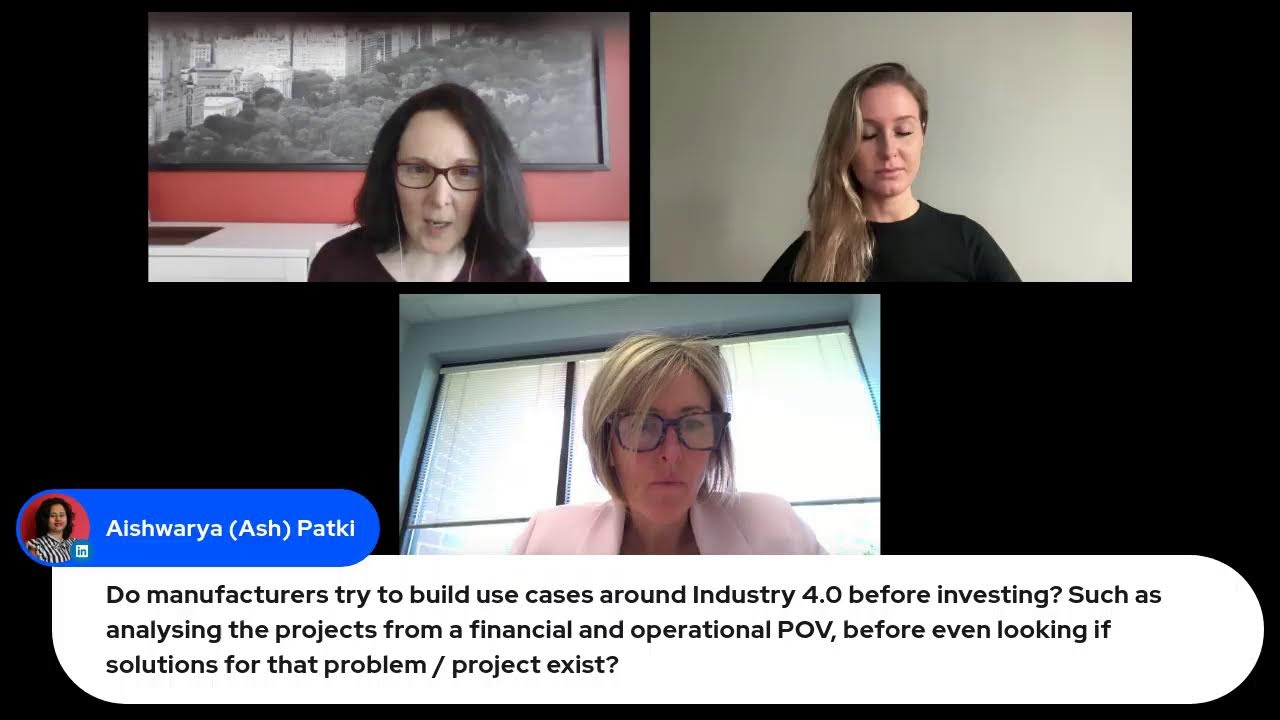
From the advanced manufacturing stage. And if you can't attend this one, there's more Tuesday, Wednesday, Thursday. There's a link in the comments with the full agenda, so if you'd like to plan out your day, it's there. And we have a question here. Let's see if— I think, yes, I think we have a question here. We have a few minutes extra and I'm going to show the questions. It's kind of putting you on the spot today. Let's see. Do manufacturers try and build use cases around I-40 before investing? Such as analyzing projects from financial operations before even looking if solutions for that problem project exists?
I love this question. I'll let Katherine go first.
Okay, go ahead.
No, go ahead since you— since you— I love it too.
Go ahead, Kate.
Well, I mean, it's— it's— I think that I love the question because I'm like, it's almost like a what my best practice recommendation, so to speak, would be, would be exactly that, starting with the value first. And then like the goal, the objective, the value, and then looking at potential use cases based on where you stand in your digital transformation journey. Because if you are collecting, you know, a certain amount of data and your goals are to get something done quickly, you know, that'll influence your use cases. The way I typically will have this brainstorm process, so to speak, with the manufacturer is talking through impact and feasibility when it comes to use cases. So figuring out the impact towards their goal, mostly from the bottom line, the ROI perspective, and then the feasibility component has to do with that digital readiness. So we'll go through an experiment like that, we'll rank them from the most impactful and the most feasible, And that's typically a starting point as far as their overall journey. But like Katherine was saying, it's iterative, it's a transformation. So it really is meant to be a continuous process, but starting with a quick win can really help build some steam around and momentum around the transformation, especially on that organizational level as well.
Yeah, Carol, I don't know how much time we have left, but I guess—
Go ahead.
In my experience, it's been yes, yes, use cases all around. I mean, you know, we don't need to do these things just for, you know, for no reason, right? I mean, there's got to be that problem. There's got to be that, you know, that problem to solve. But for us, it's been a combination of trying to come up with that return. But then there's been some cases where we need to do this thing and deploy this technology or this tool or whatever M4.0 thing because it just makes sense. And we can't necessarily say, oh, it's going to give us this specifically. So, there's There's been those 2 ways that we approach. It's things that just make sense. And then because we need to get out of the old days of writing things down on paper all the time, right? And then there's things where, okay, we're going to invest this amount of money in AI because we want to get our OEE raised by 5%. That's what we expect to gain. So, it's For us, it's been a combination.
Excellent. Thank you so much for your contribution today. And Ash, thanks for that question. It's very, very last minute at the end, but that's okay. We were able to fit it in. So I'm going to close for today, and we'll see— we'll see you next week. Thanks very much.
Thank you, Carol.
Thank you so much.
Look forward to meeting you guys.
See you, Kate.
Bye. Bye.










