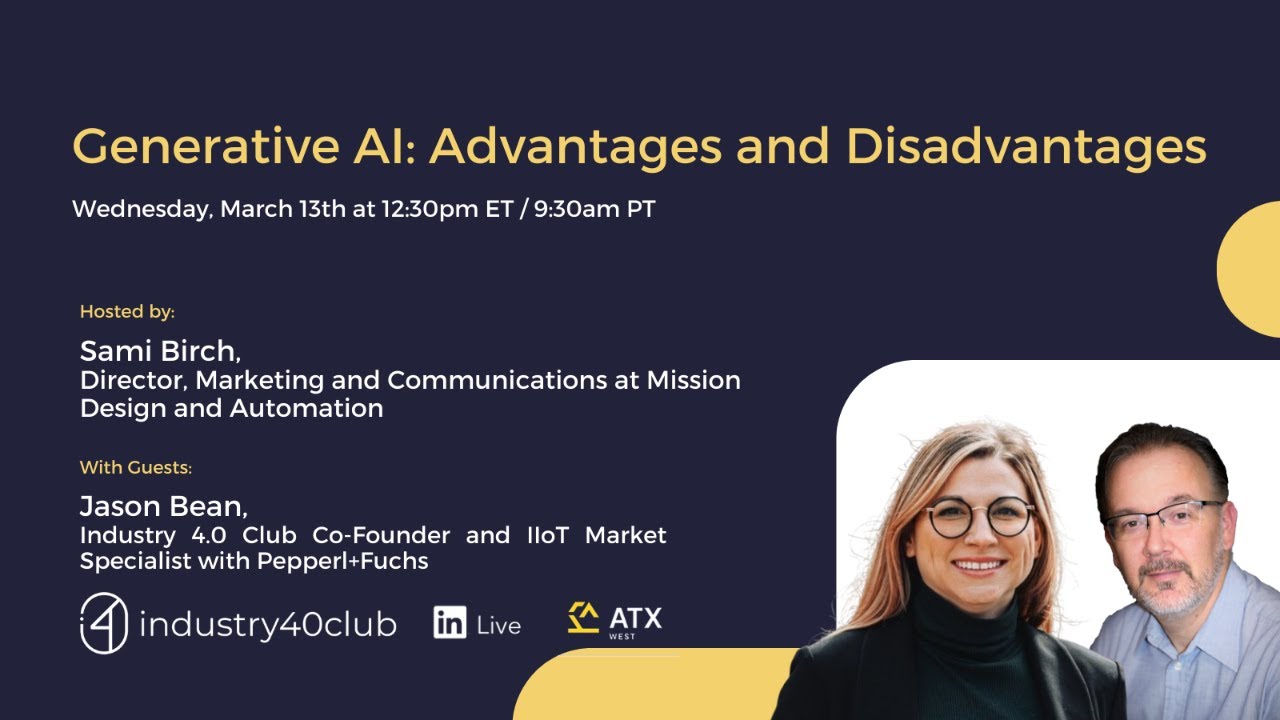
In this IME West News & Brews interview, industry 4.0 specialist Jason Bean discusses the practical deployment of generative AI in manufacturing. He explains his role evaluating ethical use of ChatGPT for his employer, Pepperell and Fuchs, and outlines key use cases such as worker augmentation and legacy‑knowledge transfer, describing how a custom GPT can act as a virtual trainer. Bean highlights major risks: inadvertent data leakage when employees use public ChatGPT, intellectual‑property exposure, prompt‑injection attacks, and copyright pitfalls. He reviews mitigation strategies, including enterprise policies, turning off model training, and OpenAI’s new Teams plan that disables data collection. Bean advises that ChatGPT and custom GPTs are best suited for proof‑of‑concept projects, emphasizing that enterprises must retain full ownership of any solution built on ChatGPT Plus due to security concerns, while secure, encrypted API‑based back‑ends are preferable for production. He notes the market is still early, with some firms already using enterprise‑level OpenAI API integrations, but stresses continuous testing and retraining as models evolve. The interview concludes with Bean’s preferred contact method (LinkedIn).
Chapters
Are you looking to uncover how design ideas are brought to life and talk to leading engineers who drive product innovation? It's time for D&M West correspondent Sammy Birch.
Well, thanks. We're here today with Jason Bean. Jason is a brilliant mind in the AI generative space. Jason, can you tell a little bit about yourself and your story?
Okay, so when ChatGPT released, one of the tasks I was assigned from my employer was to look at the ethical use of ChatGPT and how we could deploy it within our organization. So I work primarily as the Industry 4.0 market specialist for Pepperell and Fuchs, and along with that, part of what I do in my job is also work with our customers who provide generative AI solutions into the marketplace. So I'm not only seeing it from the perspective of how you can deploy it within your own organization and where and how to properly use it. I'm also seeing how the industry is actually looking at deploying this within manufacturing. So that's kind of the basics there.
Fascinating. So are there certain areas that you think are more I guess, plugged into it now? Are there, I guess, what is the maybe lower-hanging fruit to apply these technologies and use them? And then I think we'll get into some of the advantages and then maybe some of the risks. But is there an area in manufacturing that it makes sense to, like, let's get started using generative, or people have been, or maybe people are using it now?
One of the main areas where I'm really seeing it is in worker augmentation on line-side monitoring and transferring legacy knowledge from the older employees down to the new employees. Because the generative AI actually works really well as that knowledge transfer point because it can be trained on the existing knowledge of your workforce. And then rather having to use a trainer, the employee can go through and learn by themselves and acquire those skills. And if they need additional assistance, they then know who in the organization to go to to get those deeper questions answered.
For sure. That's so important. I feel like in a lot of organizations, at least in my experience and from talking to others in the space, there's so much tribal knowledge that exists And making sure we build systems to transfer that knowledge is critically important to keep the health of your business. And so if we can use these tools to help make that lift easier to transfer that knowledge, we'll all be better for it.
Yeah. So like in testing it, I kind of went and tested my own personal GPT and I built a trainer myself. I took a training course that I developed, I trained it on that document, I trained it on relevant information, and just did some initial testing. And the GPT was able to actually take on different roles within that process and interact with the individual and help guide them through the steps. So it could have— it was able to act as, say, a manager teaching what the responsibilities were expected from that point, or whether it was a line lead or whatever position it was. You could, as the user, you could say, this is what I— this is my position, this is what I need to learn. And then it would look at its knowledge base and go, okay, well, who do I need to be to teach this?
Wow, that's incredible. Do you— so it sounds like training is really one of the areas that you— we should be focusing on employing GPT. Are there areas that bring you concern? You know, AI has blown up in the last couple of years while manufacturing has been using it in different ways for, you know, for quite a long time. But I think with the enablement that we're seeing, more people have more access to using these tools. Are there risks involved that we should be aware of, and how can companies mitigate some of the risks that maybe pose a security issue?
So, there are a number of risks associated with this, especially with ChatGPT itself. This is the way most employees are going to be using generative AI right now, because to build a Custom enterprise-level generative AI solution has some price barriers to it and has, you know, some knowledge barriers. You need to hire, you know, the proper coders to build your particular large language model trained on your stuff. But it's very difficult to control whether or not your employee is logging on to ChatGPT and putting information in there. So, Employers need to be aware and they need to be having these ethical discussions at every level from right up at the top to the departmental level, down to the team level. And they have to come up with, you know, policy and procedures that the employees are aware of as how they're allowed to use these technologies within their jobs. Because if you've got a basic ChatGPT account, Any information you put in there is being used to train OpenAI's models.
Sure.
If you have a ChatGPT Plus account, which is the paid one which allows you to make custom GPTs and stuff of that nature, you have the option to turn off that training. But most people don't even think to do it. So again, you're still loading your data in there, and the data you're loading into ChatGPT This is, as an enterprise, this is your intellectual property. This is what makes your organization your organization. It's your standard operating procedures, it's your policies, so you don't want to risk that getting out because if it does get out, now somebody can start to emulate you. They can start doing the things the way you do it. So you have to have a very solid policy on how you're going to allow this tool to be used. Now, 2 weeks ago, it's about 2 weeks ago, OpenAI released a Teams plan. This is from my initial tests with it. This is geared more towards enterprise-level organizations because when you're in the Teams plan, it is the The training is automatically turned off. You can't turn the training on for OpenAI, so your data is in that Teams plan. It's not being used for OpenAI. But there's still a level of security you need to look at because it's very easy to trick a generative AI into divulging information. I ran this test with an engineer that he's 2 daughters that love Frozen, and copyright is a very big issue with these generative AIs. So, we asked it to create an image of Anna and Elsa from Frozen, and it says it can't do it, it's copyrighted.
Okay.
In 4 prompts, we had an image of Anna, Elsa, and Olaf.
Wow.
Looked identical to Disney. So, you can trick these systems because they're language-based, and somebody that rather articulate and knows how to use language can use it to divulge information.
Wow, can you say that a little bit louder for the people in the back? Um, yeah, put the mic right up to your mouth and let's hear it. The security and the access to people that people have.
Oh, so the— so we're gonna restate about the security, about the fact that you can actually trick ChatGPT into divulging information. There is a company up on the floor upstairs. Um, I, I know their individual who's been looking at ChatGPT from their perspective, and he tested with a custom GPT that he built, and he was able to get it to divulge the conversations other users were having with it.
Yeah, that seems a little— yeah, that's definitely risky, especially if you're Putting information in that is your competitive advantage. We certainly don't want our entire IP being loaded into a system that's regurgitating it out to others. Yeah.
So, now, all those— there's these concerns. ChatGPT still has a place in your organization and with these custom GPTs and all that, but they're not at developing enterprise generative solutions. They're at proof of concept. You have an idea for a generative AI solution you might want to deploy in your organization. Building a custom GPT is a good way to test whether or not it's actually possible. And once you've validated that, it can actually help you develop that criteria that you need to, to provide to any integrator that's out there that folks focuses on developing these. But when it comes to ChatGPT and ChatGPT Plus, you can't rely on an external company to come and develop these things for you. You have to, as an enterprise, 100% own that because of the security risks involved in it. If you build on the proper enterprise with the proper API where you get the benefit of a secure encrypted server, You can trust that out more to an external party to build. But when it comes to ChatGPT Plus, you must take 100% ownership of that. You can bring in people to help you, guide you through it, but I would not trust having somebody build it for you.
Okay, that's really good advice. Do you know any, like, are there companies that you know that are doing this really well right now that have kind of figured it out, what the secret to it all is? Or is it still just a little too early?
I think it's still a little too early. There are companies that I know that are using enterprise-level OpenAI API integrations in the backend of their softwares already, and people are already buying them, and it's already providing, you know, benefit to them, but this is still relatively new, right? So you have to constantly be testing, you have to constantly be training, and you have to constantly be adjusting because as the tool gets better, what you had it doing before may no longer be relevant.
Oh, sure. Well, thank you, Jason, so much. This is really fascinating. You are a powerhouse of knowledge when it comes to AI and GPT, and we really appreciate you being here. How can people get a hold of you if they have questions?
The best way to get in touch with me is through LinkedIn. That's my primary form of communication. I check that more often than I check my email or my phone. So—
Awesome. Well, thanks again so much, and I'm excited to talk more and learn more from you.