IME West Preview: Let's Talk about the Upcoming Smart Manufacturing Workshop
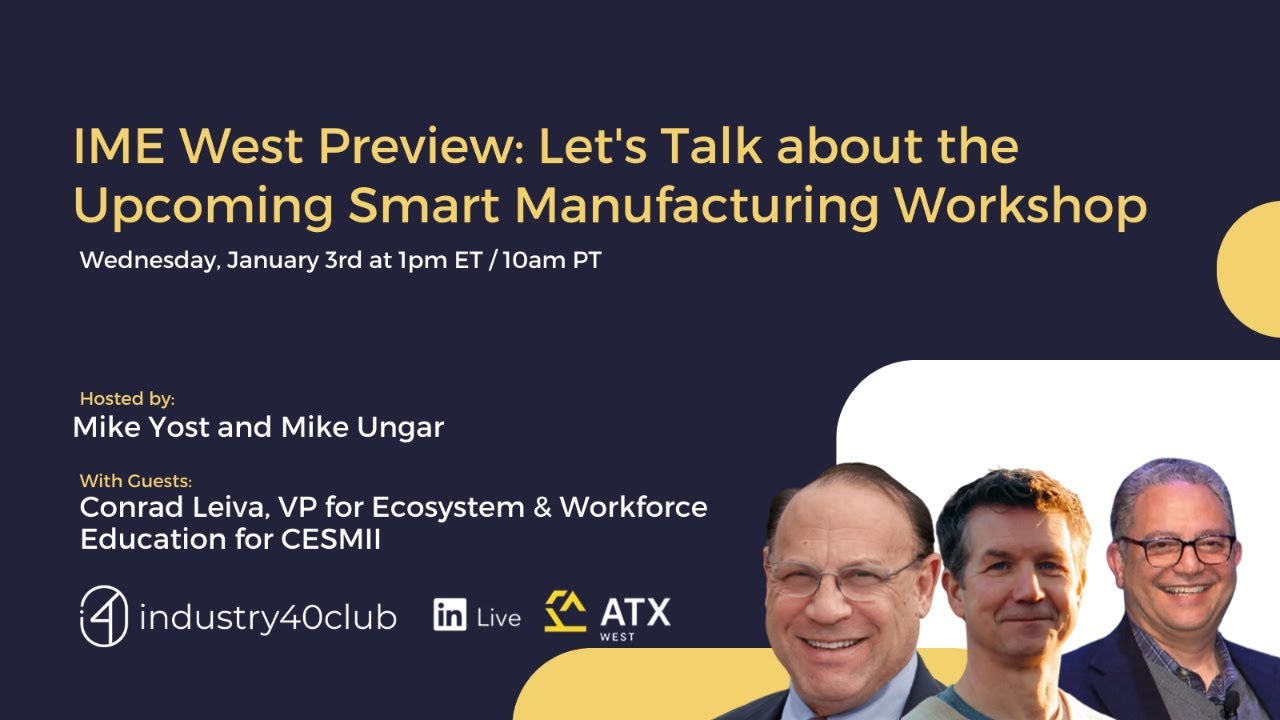
Conrad Leyva from SESAME, a Manufacturing USA institute, previews a Smart Manufacturing Workshop at IME West on February 5. The workshop teaches manufacturers how to avoid pilot purgatory by using a six-dimension framework covering strategy, culture, processes, systems, workforce, and supply chain. Registration is open to anyone.
Chapters
Good afternoon. I'm Mike Ungar. I'm one of the Industry 4.0 Club co-founders, and we're excited today to host our fireside chat. Uh, this is one of the first fireside chats in the series focused on introducing some of the events and some of the speakers that will be happening at IME West, which will be taking place in Anaheim, California from February 5th to the 8th. The Industry 4.0 Club's been busy putting together a fantastic group of speakers for the advanced manufacturing track and for center stage, and we're going to be highlighting some of those during the month of January. So our guest today is Conrad Leyva. So Conrad is the Vice President of Ecosystem and Workforce Development for SESAME, the Smart Manufacturing Institute. In his role, Conrad is accelerating smart manufacturing adoption and education programs through a national ecosystem of regional centers, technology partners, and educational institutions. A recognized industry authority, he engages manufacturing business leaders, educators and practitioners across all dimensions of industry to develop and share knowledge on both the how and why to leverage information technology in manufacturing. Before we get to Konrad, I would like to also introduce our co-host, Mike Yost. Mike, would you introduce yourself please for a moment?
Sure. Thank you, Mike. Welcome, Konrad, and Happy New Year, everybody. Mike Yost here, one of the co-founders of the club, and Mike's co-host here on the Fireside Chats. Been part of this industry for about 3 decades and spent a lot of time working with Conrad over the years trying to help drive awareness and education on this space. So really excited to be partnering up with him for the event in Anaheim next month, and hopefully you'll have plenty of questions here and some people will be able to actually join us at the event next month as well. So welcome, Conrad.
Hi, great, yeah, great way to start the year, I think, at that conference.
Yeah, so, so Conrad, uh, and Mike are going to be facilitating the Smart Manufacturing Workshop, which is going to take place on February 5th from 1 to 5 PM at the Anaheim Convention Center. So before we, we get to explore the, the workshop, can you talk a few minutes about SESAME, Conrad, and the mission at SESAME?
Sure. SESAME is one of 17 Manufacturing USA institutes that are funded by the US government to help manufacturers adopt advanced manufacturing technologies. I mean, each one is dedicated to different technologies, and SESAME is the one dedicated to accelerating adoption of smart manufacturing technologies. By the average manufacturer, which is a small-medium manufacturer. So SESAME does that through building an ecosystem of members, and that includes manufacturers and a lot of the stakeholders that support them, like machine builders, software vendors, system integrators, academia. And we're all Working together to make technology more accessible to manufacturers, and to develop workforce skills, education needed to implement and sustain these new methods and technologies.
Very good. Thanks. And so SESAME has been around for how long?
It's been around for around 5 years. We just had an extension to another 5 years by funding by the Department of Energy. We're very excited about this second stage of the institute, which is going to be more focused on scaling and deploying nationwide a lot of the things we've been working on the last 5 years.
The organization itself obviously has many different components to it, right? So SESAME invests in projects, right? Is working to drive investments and research in specific technologies and obviously on the workforce side. So what we're talking about next month and what you lead up is the work on the the workforce side, the education side, right? So maybe talk a little bit about how, how the pieces work together or what your focus is. I'm a big proponent of certainly all the work that Sesame is doing, but I think that the work that you're doing on the education side to help drive awareness and understanding is critically important. So maybe talk a little bit about your fit within the organization in in that area in complement to the other areas.
Yeah. And so this, this workshop, for example, is part of what we consider education. So we're, we're providing broad education from informal ways to through events in the ecosystem and regional events. And like this one is in California. And we're educating the leaders, the champions, on the why and how of smart manufacturing. We're educating the practitioners that need to implement the technologies. So we go a little deeper on, on creating a new foundation, a better foundation for smart manufacturing. And that's from data acquisitions to all the way to organizing the data, information models, getting it to AI methods, AI bots, and semi-autonomous methods to optimize the operation in the factory, but also all the way into the supply chain. So, so the education umbrella covers a lot. But This particular workshop is focused on what do the leaders in our manufacturing organizations need to know to really help them get started.
It sounds like then you mentioned at the end that the ideal participant for the workshop would be a leader, or is it really open? It'd be also ideal for champions and others who are involved in the actual deployment.
I mean, yeah, yeah. And when I use the term leader loosely, so it doesn't need to be a manager. It can be an engineer, it could be the, the IT guy in a smaller company, you know, but, and or that citizen IT/OT. So we, it's really anybody that's going to be involved in shaping the agenda for smart manufacturing and how these technologies are all threaded together in the organization.
Yeah, and Mike, if I could just add on to that, one of the things that makes me most excited about the framework that SESAME has put together is the fact that it helps organizations understand what smart manufacturing means for them in particular. So there are multiple areas that SESAME will drive people through that we'll go through in the workshop, and that people will get an understanding that smart manufacturing is not just a technology discussion, right? There is a component about technology. It can go very, very deep. Konrad already brought up all sorts of things about data modeling and information models and AI bots and all that other kind of stuff. There's plenty of depth of knowledge to dig into in that area, but that's only one piece of the puzzle. They also dig into areas about your role within your supply chain, how you treat your people, right, what you expect out of your people, how you empower your people. Do you have a data-driven culture, right? What is your strategy and leadership? And do you have a commitment to continuous improvement, manufacturing excellence? And so what I've seen with this and watching Conrad and his team deliver these workshops is people can internalize it for them. And they can really break away from having to know all the buzzwords and the technical stuff and really get into understanding where they are, what their leadership team thinks about where they're going as a business, and then work to align technologies to support the initiatives that they're driving.
And Mike, that really goes to the heart of why we developed this workshop in the first place. We really saw that a lot of companies were diving into technology as a tactic and jumping. There was a lot— there's in the last few years, there's been efforts to, okay, jump in fast, look for the low-hanging fruit, get a pilot or 2 going, get the ball rolling, right. But we've also seen that many of those efforts have ended up stalled in what is called pilot purgatory. But, and because there wasn't enough forethought about how, how it all fits together. So we believe that the best way to avoid that, that stalling of the initiatives is by an integrated business and technology strategy. So this is a big focus of this workshop. to make sure we start with the business strategy first, and then talk about how technology supports that business goal. So it goes back to your question, Mike, of who, who is this targeted to? Well, we want the technical team and the people leading these initiatives to really understand that connection between business strategy and technology, and to have that lead their thinking and their prioritizing of projects, that we not just drive these technology projects looking at continuous improvement, but that we are also looking, keeping an eye towards business growth strategies, towards new opportunities for revenue that might be enabled through these data strategies in the organization.
Just to confirm though, I don't have to be a member of SESAME to participate. Anybody can sign up for this particular workshop, is that correct?
That's correct. This is done through the conference, through IME West. Just have to sign up. I believe you do have to register for the workshop, so make sure you take that extra step. But it's open to everybody. And it's a very practical way that we're going to spend about 4 hours with, with the audience. We like to shape the agenda a little bit to the audience attending. But yeah, everybody can attend.
And one thing I would add to that is that this is similar content that's being taught all around the country. Right. So this has been taught in the Northeast and the Southeast and the Midwest. It's been taught in Texas and California. So, you know, SESAME's efforts are really around defining a framework, a— I'm trying not to use the word playbook because that has a definite meaning, but really it's just sort of the language for people across the country and across the entire ecosystem to understand how we're talking about these things. And so it is part of a broader national strategy that people will get access to.
Yeah, you know, but if you're in the West Coast, this is definitely a conference to try to attend. If you didn't get it on your radar because of the holidays or something, I sure hope people are still trying to get the— get this event on their agenda.
So, you know, what Mike mentioned, that you've done this now in many, many locations around the country. What have you heard back from participants in terms of what they've taken away? Anything in particular that strikes you that you'd like to share?
Oh, yeah. There's so much. This is a very interactive workshop and we use examples from the— we pull information out of the audience and use their own examples back. on them so that they can really relate to the discussion. We do some polls during these workshops to seed the discussions with participants, and we encourage them to share their activities, their goals, their challenges. Part of the benefits you get is that you're working with peers there and exchanging ideas, and we're driving that conversation. We, we have confirmed all kinds of things, for example, that projects are generally being driven by, by improvement, performance improvement, you know, kind of initiatives, and in that there has been a general link to company business goals. And many instances, the folks running these initiatives don't even have a good understanding or their business goals. Now, I'm generalizing. I mean, some, some companies that is stronger than another. So we're going to talk about the general patterns that we see. That doesn't mean that these are—
Yes.
Right? The absolutes. We've also seen that there's a range there. Maybe larger companies tend to be a little more advanced than the small-medium. But that's very important. But in general, we see that many don't feel that they have a good foundation of systems to support the smart manufacturing initiatives, for example, that, that's been a laggard in general, in a lot of these efforts, they all have plans and goals to work in those areas this year, in the next following few years, but But we've seen that, that tend— the tendency, which also reflects a mindset change that's happening, where, for example, the, the lean champions have traditionally not embraced technology solutions. But we're seeing a dent in that attitude, and seeing a change and a starting of embracing of digital lean. As an initiative also. So a more understanding of how technology and lean comes together. And that's all part of how this new mindset of smart manufacturing and their initiatives is starting to permeate the whole, the whole area.
And, Conrad, if I can share a couple anecdotes from my personal experience.
Yeah.
I'd done a precursor or an earlier version of this workshop. I think it was in Greenville, actually, Mike, 2 years ago.
Yeah.
And at the end, one of the things that is stressed in the discussions is the fact that a lot of companies will appoint a person and say, you go figure this thing out, you're the smart manufacturing person. And somebody came up to me afterwards and said their biggest takeaway was that It does take the entire company's commitment to doing this. And they were going back to their business leaders to say, it's not fair what you've put on me to solve all of this, right? And they did that. And then they've worked closely with Sesame. We're actually the first company to go through Sesame's roadmapping process, right? And so they continue to educate the organization, learn together, and there are actionable steps coming out of these workshops. that Sesame can help facilitate and get people to get in their organizations to build out actual roadmaps. And then just one other anecdote in that process, plugged in with another company that's doing one of the roadmaps for themselves right now. And what they uncovered was they didn't think they were ready for the smart manufacturing stuff. They're doing plant expansion, they're doing some business systems upgrades, and they're like, we're just not ready yet. We're gonna wait. You know, until, you know, give us 6 months and then we'll do it. And the conversation around the table turned to the work that they're doing now in the business systems side, they're doing in isolation of what they need their future plant expansion to understand and communicate.
Mm-hmm.
So they're going to build the system potentially in isolation of what's happening in the plants and then build a system in the plant in isolation of what happening in the business systems. And, and the light bulb went off for them. They were like, no, we need to be talking about this now. So it's not a matter of wait until we're ready. It's really look at how we frame this for ourselves and understand information flows and how the business works. And that really was a light bulb moment for everybody around the table when they got that message.
Yeah, that, that's Both of those points, you— I'm going to add a little to those points. But those are great points. Because there's other myths that we really work on to dispel during these workshops. And some of the myths are like, are you ready or not? And then myths about how much it costs, or the infrastructure needed, the network needed, the time needed, the skills needed. And we really spend time dispelling a lot of those myths and, and telling people, no, it's okay to get started now. But going back to your first point, I think it's important to say this workshop, we're really laying a foundation for a systematic way. SASME has been working with a network of consultants and developing a systematic way to get your team grounded, on a common ground and prioritizing strategically. So it's a method to look into 6 dimensions of business practices, not 16, not 20. So we've simplified this method compared to other methods that are out there. But we really look at strategy, culture, processes, systems, workforce, And supply chain. And through bringing in and stress the importance of bringing all those stakeholders into this process. So you can't just throw it to the IT guy, like you said.
Yeah.
Or you have to empower them to work with a stakeholder, a key stakeholder team across all of these functions to make sure that you're not missing part of the puzzle. These Things are cross-functional projects and initiatives if we're going to do it right. Smart manufacturing is not just about implementing a robot here, a, a new data collection system over there. It's about how all this data is threaded together in the organization to really elevate the game of the whole enterprise. So, so looking at these 6 dimensions, we've had Great conversations and eye-opening conversations like I said, where people said, oh no, this tool and these methodologies enable me or make me feel more comfortable having these conversations in the wider organization.
As you've talked about the workshop, 4 hours probably doesn't create the strategy or the plan. It gets one more aware that they can get started, as you alluded to. How does one go about getting more resources once they're done with this workshop?
Oh, well, we have— so we have formal education programs too for these skills. So this gets you— gets your mind thinking and enables you to start that conversation within your organization. get you comfortable with what's needed. But Sesame, part of what we're doing in the ecosystem is that we have demonstration centers around the country where you can see all this coming together. We, we run events of our own. So on top of industry events like IMA West, we also run smaller regional events. Keep your eyes open for that. But we have a formal education catalog. Smart Manufacturing Education Catalog on our website. And in, there are, there's a new— we'll talk about at the workshop, but we're in the next month going to be releasing a new training certification for consultants and champions. And there's already a class for manufacturers that Rensselaer at Work is putting out, and that we've worked jointly together on these courses that, yeah, the manufacturer— we're preparing the manufacturer, that takes like a 6-week course, and preparing a network of consultants that we're enabling to mentor and help manufacturers. And that's like an 8— more intense 8-week course. So these, these courses, there's formal training to really systematically approach this. But there's also these, these workshops that get you acquainted and, and with the general methodology.
Fantastic. Yeah. So basically, come to the workshop, and then you'll leave the workshop not only with clarity on how to move forward, but there'll be some additional resources available to you afterwards to continue that journey, if I understand correctly then. Yeah, super. Well, I mean, we've been talking for about the last 25 minutes or so about the workshop. And I think it's, it's, it's exciting. I can't wait to be part of it in California. Any last thoughts, Mike, before we wrap up here today?
Um, well, other than, you know, This is a great way to kick off the new year, like Conrad said. You know, I think what I oftentimes encourage people to consider is Conrad mentioned earlier about people try things with tech and it ends up in a pilot and then the pilot stalls and people are like, yeah, we tried that digital thing, it didn't work. And we really need to change that mindset. And SESAME's really doing a lot, and this workshop is one element of helping to drive awareness and drive understanding that leads into the more formal things, you know, processes and tools and training and technologies and integrations and all that kind of stuff. So I always encourage people that your journey doesn't start on, you know, Industry 4.0 or smart manufacturing. when you decide or you start to deploy your first system, right? It's really when you're getting your people opened up to communities like the Industry 4.0 Club, ecosystems like SESAME has, taking these kinds of workshops, meeting peers, you know, and starting to raise an awareness inside your organization and personally about what this means or what this could mean for you and your business. So I would encourage people that This is part of the early steps. If you don't feel you're ready, like that other manufacturer I mentioned a minute ago, you know, this is how you get ready. You start to surround yourself with people like SESAME and the ecosystem that they're building.
Thank you, Mike. Conrad, any final thoughts as we—
Yeah, I want to encourage the smaller manufacturers also to participate because Manufacturing is becoming an, you know, ecosystem play. The larger manufacturers and OEMs are really interested in creating a highly connected digital supplier network. And you're going to increase your value in that supply chain if you're a digitally ready organization. So don't Don't wait. This is going to become a competitive differentiator if you're ready with these smart manufacturing technologies, if you're ready to share real-time data, not data that's a week old, with your partners in that supply chain, with your customers. So really join in, and the methodologies are available, and smaller manufacturers might actually be able to move faster in some ways with less of a legacy than the larger manufacturers. So I really encourage the smaller manufacturers to really think about joining us and learning about how they can move faster.
Yeah, thank you for that. So just as we wrap up, I wanted to, I wanted to share the— go to the— if you want to sign up for the workshop, which we would hope you will, again, Anaheim, California, February the fifth in the afternoon from one to five. Go to www.imengineeringwest.com. If you'll go there, you'll click on the events and education dropdown menu. Click on the workshops tab, and you'll sign up for the SESME workshop. Okay, so we really hope we see all of you there, Mike and. And I and Conrad will be there ourselves, and we look forward to, um, to a wonderful conference. So thanks, thanks, Mike. Thanks, Commodore, for the, for the, for the discussion today.
Excellent.
Thanks for having me on the show. Looking forward to the conference.
All right, thanks, guys. Bye-bye.










