Industry 4.0 in Action: Connecting ERP, AI, Supply Chain & Smart Manufacturing
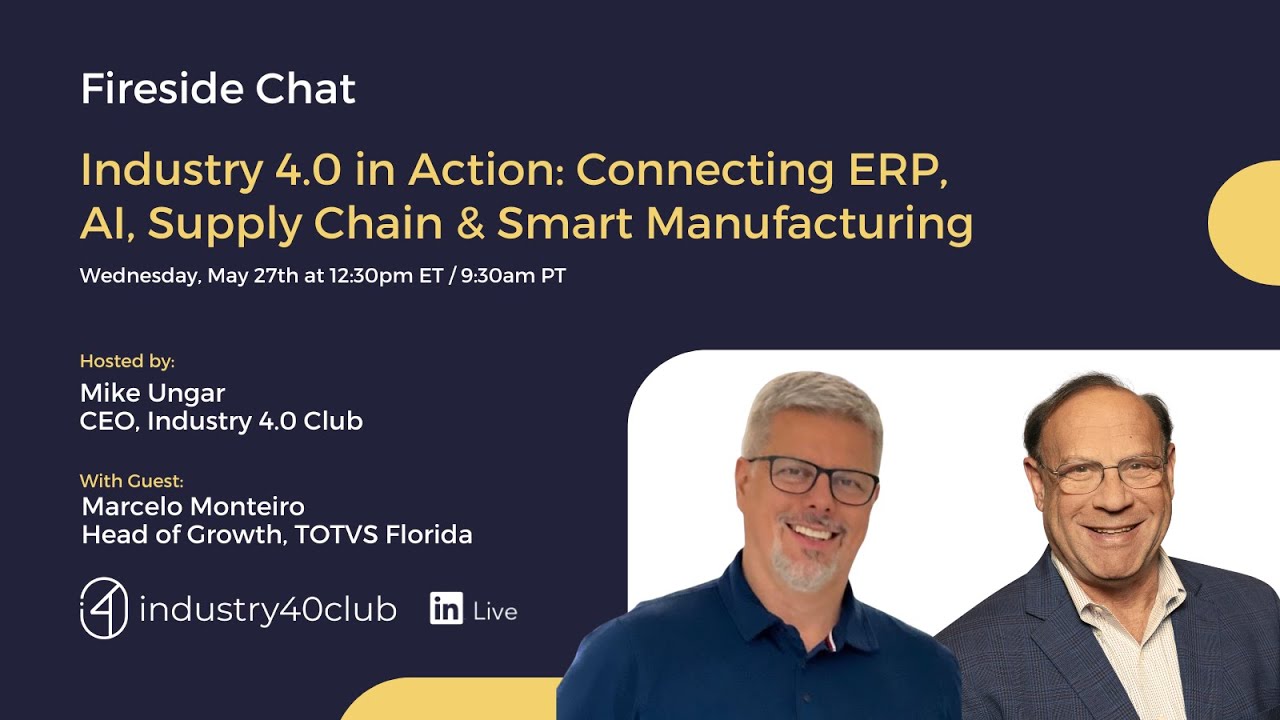
In this 28‑minute fireside chat, Industry 4.0 Club CEO Michael Ungar interviews Marcelo Monteiro, Head of Growth for TOTUS Florida, about the practical realities of implementing Industry 4.0 in manufacturing. The conversation covers the democratization and cost‑reduction of AI and sensor technology, the pervasive problem of siloed ERP, shop‑floor, and supply‑chain systems, and the need for a single trusted data source. Marcelo shares concrete AI use cases—predictive maintenance, AI‑driven quality inspection, and demand‑forecasting—that deliver measurable ROI when backed by clean data. They discuss the challenges of integrating legacy data across 25 plants in 22 countries (Jabil project) and contrast cultural/market differences between North America (maturity, cybersecurity, automation) and Latin America (economic volatility, need for rapid problem‑solving). The pair outlines a pragmatic transformation strategy: start with clear business problems, build a common data platform, adopt AI incrementally, and empower shop‑floor champions. The chat ends with a call to action for listeners to pick a problem, develop a strategy, and engage with the Industry 4.0 Club.
Chapters
Welcome to the NIST 4.0 Club's fireside chat. The club's purpose is to engage the power of diverse worldwide talent to accelerate the global evolution to Industry 4.0. We accomplish this by hosting and supporting respectful, thoughtful, and interdisciplinary open conversations and creating quality content on wide-ranging Industry 4.0 topics to expand the reach of our community. My name is Mike Ungar, and I'm the CEO of the Industry 4.0 Club. I have over 40 years of experience in management and leadership, most of that in manufacturing at Michelin. Our fireside chat this afternoon is titled Industry 4.0 in Action: Connecting ERP, AI, Supply Chain, and Smart Manufacturing. To help us discuss this topic, I'm joined today by Marcelo Monteiro. He's Head of Growth for Totus Florida. Just a bit more about Marcelo. He's a senior business development and growth executive with over 20 years of experience in the software and technology industry across the Americas. Based in Florida, he leads expansion initiatives connecting North and Latin America through enterprise solutions focused on ERP, supply chain, fintech, and digital transformation. As head of growth for TOTUS Florida, in collaboration with Venturus R&D, he specializes in strategic partnerships, cross-border programs, and innovation-driven growth that deliver scalable and measurable business outcomes. So welcome, Marcello, we're glad that you could join us.
Thanks a lot, Mikey. It's really a pleasure to be here with Industry 4.0 Club. I'm sure a lot of conversations.
Yeah, so before we get started, just a reminder for those listening live on LinkedIn, if you've got a question for Marcello during our time together, please put it in the comment box And we'll make sure to give it to Marcello during our broadcast so that he can respond and share his insights. So maybe we'll just jump right in and, and just start this conversation. So you spent over 20 years helping organizations grow through technology. When you think about Industry 4.0 today, what changes do you believe are having the biggest impact on manufacturers' business models and competitiveness?
Great question, Mike. And, uh, I like sometimes to start just again sharing a little bit the history, you know.
Yes.
Industry 4.0, I think we have more than 12, 15 years in this process. So, uh, definitely one of the points that nobody sometimes realized, AI is part of this history for many, many years within IoTs, machine learning. I mean, so many experiences that we are deploying in the industry, but now it became much more democratic. Everybody has access to AI tools and AI accessible. This is really one of the main changes, and we have to integrate all of this together. So The business model is changing a lot, and that's one of the points that everybody has to be trying to get their priorities on that, no?
Yeah, no, you're right about that. The— I think technology is changing faster and faster, you know. You're right, it's been around for a while, but the things we thought about 10 and 15 years ago, um, as what I'll say leading-edge technology, it's evolved already now, and there are new things, you know. Even as simple as, or what's driven that, I think, to some degree is the cost of the technology that has come down quite dramatically over the last decade as well. Have you seen the same?
Have you—
what do you think that impact has been on how we move forward? Absolutely.
I fully agree. And I go a little bit further. It will continue reducing a lot. Because again, I'm sure that the new features and the new agentics, AIs, and solutions, they are here exactly to promote a better cost reduction on that. No doubt. I like one example very much that AI brought the entire humanity back to classroom. All of us. It doesn't depend on the level we are. The CEO, the C-levels, supervisors, and the shop floor. All of us, we have to understand how to bring AI to our productivity base. And that's how we can be more efficient. And definitely, if we are efficient, we need more cost reduction. That's a consequence.
Yeah, I think the thing that's interesting is that, like, even the cost of sensors today, right, they've come down dramatically. And so our ability to collect data on the factory floor is dramatically less expensive than it used to be. How are we seeing companies taking advantage of that from your experience so far?
One of the points is bringing more connectivity within all the areas. The ERP, for example, as we worked for many, many years with TOTUS, is not in the past just a system of records. We have to integrate ERP with your supply chain, with your shop floor solutions, your MES manufacturing. All of these integrated, that's the real efficiency that you're gonna have in your areas. And once you go into this direction I have no doubt, again, you have to be more efficient, you have to be more predictable in your analysis, and this will bring your cost reduction at the end of the day.
You know, you bring up a good point about the integration of systems. A lot of companies began their deployment of Industry 4.0 by focusing on one of those systems, right? I need a new— an ERP system, or I need better data on the shop floor, or my— I need to connect my supply chain. So the problem, I think one of the challenges that a lot of manufacturers face today is they started with the siloing those systems.
Yeah.
And now they're stuck. So how does one go about integrating them when you've already started, let's say, with a, with a bunch of silos?
Do you—
what do you— how do people go about it? Solving that problem?
That's one of the challenges because we usually— I usually put one of the main areas that is integrating all of this together. Sometimes it's not simple because, as you said, throughout the history they took different solutions and different approaches. But at the end, at the other side, AI agentics can help now to get better solutions. Obviously, again, which everybody says, the main— the first lesson is you need good data sources. So if you don't have these on the ERP, on your supply chain analysis, or you don't have good IoT solutions implemented, then you don't have a good result at the end. So what we usually do when we approach any solution any customer is, let me see how is your architecture implemented, and then let's work on this. Let's see what is the problem, because everybody comes together. Bring me one of the solutions. The main question is, what is your problem? Where exactly are you suffering? What do you want to implement better? And then we will see how to solve this analysis.
Yeah, it's interesting you speak about that. I think that's one of— if we're not careful though, that's one of the ways that people begin to silo is that they solve one problem at a time, right?
Yeah.
One of the areas that you advocate for, I think, is developing a broader strategy around the deployment of all of those technologies together. How do companies go about establishing or developing a strategy when they've got these silos already?
We have to see again, starting from the main point is problems, solutions, where they can be solved. Maybe some of the solutions is already implemented either in the ERP areas or in the supply chain solutions, but most of the cases now the challenge is really to have reliable data, reliable solutions. How can we see if they really have reliable? Oh, if I go to ERP and I have one data, and if I go to the shop floor and I have the same data, oh, okay, now I have trustful databases implemented. If they don't have, and most of the cases they don't have, then we have to start working in these integrations. Where are the problems? In the shop floor? They don't have good tools in the shop floor and I have to go there and implement a better solution on a MES or on IoT areas and then integrate them. So again, starting from the main point, what are problems going on in your manufacturing areas?
Yeah, that's good. You hit on something also that you said that I think is really important. You know, we talk about strategy. I think the first step in any good— or one key element of a good strategy that you alluded to as a common set of data that's robust so that we're using the same data for all of our solutions. Is that— I think that's one of the things I heard you say.
Yes. Yeah. But that's not the reality in many cases because as you said, you have many— I mean, the American market a long tradition implementing technologies, but we do have very old solutions in the market. In many cases, they never updated those databases, and then they implemented a warehouse solution, and then they implemented that supply chain area, but they didn't take care on the databases. So they have 2, 3, 4 different sources of data in the manufacturing area. That's the main issue, Mikey. If we don't start from the beginning getting integrated area, problem.
Well, I think that you have to, you know, so you mentioned the beginning, you know, the doing that as a greenfield or someone who's starting relatively early in their journey, you know, that's obviously easier if I've got systems already in place. That might not be integrated well, you know, that requires a different sort of approach to harmonize the data sources, make sure that we have the same, and incrementally go through and do that. And that, that sort of change can be very challenging for a manufacturer who's used to looking things up, at things a certain way in terms of the data, and now have to look at it differently because the data is now maybe a slightly different source than they had before.
It is. But again, there's no magic solution. And when, when we start talking, remember a couple of years ago, data is the new gold, data is the new that, because we understood that if we have to start talking about AI agentic solutions, AI implementations, if you don't have a good databases Forget about. Don't think about that. Just give you an example. You you you have participated. We have been present on the MX Zero Manufacturing Show in in Greenville, and I had the privilege to present together with a digital provider from JBU. JBU is one of our customers and projects. We did exactly this: a global manufacturing plant like JBU. 25 different countries, almost 100 different manufacturing plants. Do you think they have one single database at that moment? No. We spent one year and a half with Venturus team, first of all integrating one single data sources in all these 25 countries. It took a long time. Some of them in Excel, some of them in other files, some of them in the ERP. None of them talking in the same language. Now they have one single solution implementing and deploying on all those manufacturers, which is amazing project. But again, after 1 year and a half, now they can have one single implementation running in all of them.
Exactly. That makes a lot of sense. Makes a lot of sense. So since we've got this baseline now of a common data platform, it's a good place for us to start talking a bit about AI. Okay. So, so many manufacturers are really excited about AI, of course. But they often struggle to move beyond pilots and experimentation. So where are you seeing AI create practical, measurable value today? Inside manufacturing and supply chain operations?
Oh, we can stay 1 hour talking about AI examples here. Yeah, no doubt about it, but it's a very good point. As I mentioned quickly in the beginning, within TOTUS we have more than 6,000 ERP projects only in manufacturing. And Venturus, we have so many global projects like this one I just mentioned with Venturus. So with Jabil, there are very important areas where AI is already in place. Predictive maintenance. Many plants are already working in a lot of implementations on predictive maintenance, and AI is helping a lot on this. Getting the benefits on the machines on that. Quality inspection. Quality inspection is one of the great projects we are implementing. And again, AI can help you to really get better and better and better quality on that. Production planning and demanding forecast. We have amazing results now based on your history. Based on the market inputs and market analysis, now we can have a much more reliable demand planning in place for our customers. So these are a lot of examples that if you do have good data implemented, AI can bring a lot of resources and analysis on that.
Yeah, that, that I think that's a great reflection on where you have to start, you know, and rather than jumping right into experimenting with AI, step back and think about your data and making sure that it's robust first. I think it's a good takeaway from that. I want to just remind our audience that we're speaking with Marcelo Monteiro from TOTUS about really the integration of ERP, AI, and supply chain and smart manufacturing So it's great to have this conversation. For those listening to us on LinkedIn, if you've got a question for Marcelo during our discussion, please put it in the comments box and we'll make sure we share with Marcelo so that he can answer it during our time together. So Marcelo, the other thing I think it's interesting to kind of tap on is different cultures have different strengths, and you've worked across North America and Latin America. in, in these implementations. Are there differences in how companies in these different regions are approaching digital transformation, and are there any lessons that we can learn from, from one another cross-culturally?
Yes, there is, and no doubt about that. North America is a much more mature market, but they are very complementary lessons from both scenarios. North America scalability, a lot of them cybersecurity programs and projections on that because it's a much more mature market on that. We do have obviously the best advanced automation in place in manufacturing industry, no doubt about. And obviously all of this brings a lot of ROI, ROI in terms of how is the profitability in any, any projects, any implementations in place. On the other side, you see Latin America with all of our difficulties and challenges in terms of economy, tax, and control. So when we have projects in place implemented in Latin America, all our executives, they need a lot of problem solving quickly, flexibility in terms of economy implementations and tax analysis, and this brings a lot of versatile studies and analysis in the— during this implementation. So when we combine both areas, and I'm handling this business for 20 years, there is a lot of projects we start implementing in Latin America, in Mexico, in Brazil, in Argentina, and then we go to America, USA and Canada, and on the opposite side. So taking the advantage on both cultural approaches is— that's the best of all for one of the markets and the other market as well.
No, that's a great point. You know, in my history at Michelin, one of the things that was very exciting about the way the company worked globally was it really would attempt to take the best from each culture in terms of approach, whether that was Asian or European or American, and bring it together on a team and allow each culture to add their expertise to the team, their experience, in order to bring out the best solution. And I think your point about complementary experiences and how they can help one another, it really is truly the best approach for getting the best solution. I appreciate the example.
Yeah, again, the challenge with the JBuild that I just mentioned was involving 22 countries from Asia, Europe, Americas, and Latin America. So the complexity to bring one single database's resources for all of it was the main one.
Yeah, you mentioned, you mentioned the data earlier, and when you become more connected digitally, operational visibility becomes even more and more important. So I wanted to ask you, how are modern ERP and supply chain platforms helping leaders make faster and better decisions from the plant floor all the way up to the executive level? How is this bringing everybody together for this agility for decision-making?
You took the right, the right word on that, visibility, and how to bring better visibility on top of all of this. So the ERP guys that are managing the results, financial areas and administrative areas, they need the best, the right resources than the guys that are in the manufacturing, the supply chain area. So how we can really combine those solutions together? Again, that's the main challenge we face in many of our implementations nowadays. And I'm sure there are a lot of— we are doing this on the ERP area with all the AI implementations. We don't just open the implementations and our customers to get 1, 2, 3, 4, because that's what happens on the beginning. You heard many times, I have to bring AI to my company, I have to bring AI to the shop floor. What exactly you need to bring? What type of information you have to handle it? So based on this, then we bring the right approach and the right solution because we saw some cases. Doesn't mean the names, but customers with a very robust manufacturing and bringing a GPT to work in some areas, a Gemini in some other areas, and say, guys, what are the policy? What is your internal controls of data? And this was— you will start losing completely your sources of information. So again, bringing the right visibility internally is the main challenge in my team. I have no doubt about it.
Yeah, that's a great, that's a great point. Um, I think the, the interesting thing is giving the the person running the machine the right data to make the decisions they need to make at their level and have that same common data be integrated up so that the executive can see the bigger picture as well based upon the truth, the same truth, if you will, is— and then having it be framed differently, obviously, because the decisions the executive is making are different. The needs are different than the person on the machine, but the common data gives us expectations or hope that we'll have consistency in how we react at both levels.
Yes. And that's why the challenge comes again to all the manufacturing staff and teams. And as I mentioned on the beginning, AI is a challenge for the entire organization. 10 years ago, we have the supervisor taking the IoT results or the shop floor analysis. He took that in a weekly meeting with the supervisors and the teams and take that solution. Now, most of the cases, everybody in the implementation, in the shop floor area, they have their results on top of it. on their analysis. So, and you have a challenge to bring more for all the teams and all the staff is how to handle those information on a daily business. And I usually say in most of the cases they have to start again pushing and pushing your operational teams in the shop floor to be using AIs for your reports, even if it's just a single solution, but your reports, your analysis, and understand that AI is there to help you to be more productive and to have a better solution. The entire operational areas will benefit from that, no?
Yeah, excellent. Thank you for that. You know, we talk a lot about AI. It's really on everybody's mind today, but you have all the other elements of Industry 4.0. We talked about ERP, Other smart manufacturing devices. We didn't get into digital twins. And anyway, there's a lot of technology available today. So for, for, for a manufacturing leader who's listening to, to us talk about this and feels overwhelmed by the pace of technology change, what advice would you give that person or that, those individuals on where to start and then how to build momentum towards a successful Industry 4.0 transformation?
Wow, again, very complex because it changed a lot from one industry to the other industry, but it always starts again in— besides, I bring 20 years in technology and implementations, but I always start discussion and don't start looking for the technology. Start looking for your business plan and your main problems to solve. When you go through it and then you see the visibility or what exactly you have to really implement better— is this a production delays that you are suffering? Is this lack of visibility that you have in your production areas? Do you have quality losses that you have to Work through it. So throughout this, there will be a solution to be implemented. There will be an agentic AI that we have in part of it to solve it. So go step by step. Don't bring an entire solution to your shop floor area. Go on the main areas that you are really struggling, suffering, and you have to get better solutions in.
Yeah, that's good. I think we had one comment I wanted just to share from one of our listeners. Robson says, first identify the problem. You've said this already, then select the tool. I think that's perfect, you know, for what you've just said as well.
You touched it in the right way. I remember you have seen, you mentioned Michelin and Jeffy during the manufacturing. He made a very good example. How he is bringing the AI in the shop floor teams, no? Bringing the champions. Oh, identify 2, 3 good champions in your shop floor teams. Great. Promote them internally. Let them— everybody follow him on that. And then you will see that step by step, the entire culture will be spread inside your teams.
Yeah, that's, that's true. You take advantage of your Your leaders, those that are willing to, to be in front first and try things.
Yeah.
That's very good. Well, we've, we've been talking together, uh, for about the last 28 minutes or so with, uh, Marcelo Monteiro. You know, as we get ready to wrap up, Marcelo, would you mind sharing maybe a final thought with our audience from just our conversation today that you'd like to leave everybody with?
I think it was very rich, good points to bring to the table, Mike. And if I can summarize a little bit on that, Industry 4.0 nowadays is not only technology, is again ability to connect your business, integrate all the areas together And make sure you have good sources of data and information on that. We handle this every day in all the projects, even with very old customers that implemented solutions 15, 20 years ago. They still have now the challenge to bring all these data updated and prepared for all these integrations. So the challenge continues. Start from the main points, go to the second, then go to the third, and make your projections on all of these.
Thank you. No, that's wonderful. I appreciate your, your thoughts on that, and thank you again for taking the time out of your schedule to, to join us today. This, this has, uh, been a very rich conversation about Industry 4.0 and, uh, and, and some really great thoughts on how that how to implement it in manufacturing. So thank you for that.
No, thank you again for the opportunity for TOTUS and for Venturus to share a little bit some of our experiences on that. This is just the beginning of a long journey for a new chapter on Industry 4.0. I have no doubt about it.
Yeah, thank you very much. So just want to just kind of wrap up as we wrap up today, talk about the club. The Industry 4.0 Club would like to encourage you to take action. You've heard some insights today. You know, individually read an article, attend a workshop, choose a problem to solve and apply Industry 4.0 technology to that problem level. Develop a strategy. We'd love to hear what you're doing. Drop us a note on our website at www.industry4oclub.com or on a link to the AIM page and let us know what you're doing to advance the deployment of Industry 4.0. We also host conversations like, like this weekly. If you'd like to be a guest on one of our future broadcasts, drop us a note on our website or our LinkedIn page and let us know. We'll reach out to you and see if we get something scheduled. With that, again, thank you, Marcello, for your time, and we wish everybody a good rest of the day and the rest of the good week.
Thank you, Mike. Thanks to all. Bye-bye.










