Labor 4.0: Rebuilding Today's Workforce for Tomorrow's Manufacturing
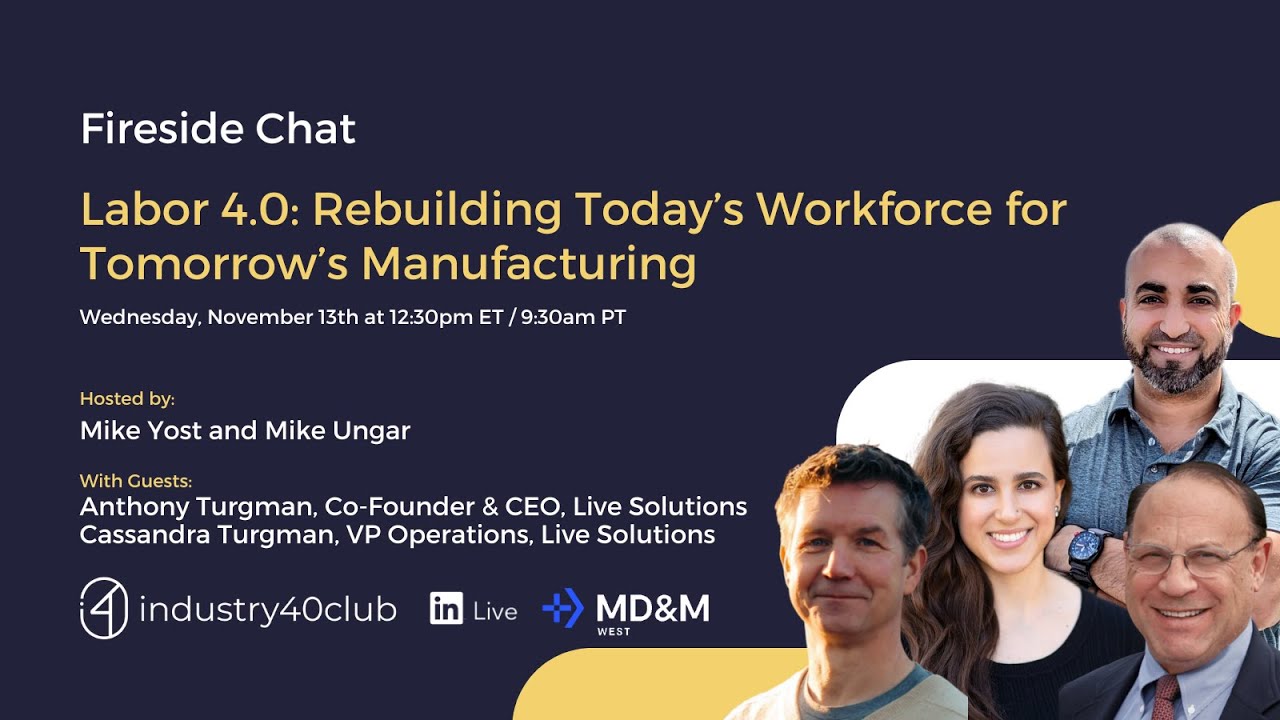
In this Industry 4.0 Club fireside chat, host Michael Ungar (CEO) and co‑host Mike Yost introduce guests Anthony Tergman (Co‑founder & CEO) and Cassandra Tergman (VP Operations) of Live Solutions. The conversation centers on the widening manufacturing skills gap as Industry 4.0 technologies accelerate. Anthony explains that hype around automation and buzzwords often obscures the real need to upskill floor workers, maintenance staff, and engineers, and that many companies lack clear pathways to bridge the gap. He contrasts large manufacturers, which have funding but no systematic methodology, with small‑to‑mid‑size firms that are stuck in inaction and adopt disparate technologies. Cassandra adds that cultural resistance, fear of the unknown, and a weak perception of manufacturing as a career hinder progress. Both stress the importance of up‑skilling, reskilling, and building a learning culture, citing educational partnerships, apprenticeships, and university‑industry bridges as effective levers. They discuss how technology can be a barrier when leaders are uncomfortable with capital costs and unclear ROI, and they highlight the need for ecosystem collaboration with vendors, OEMs, and groups like the Industry 4.0 Club. The guests preview their upcoming MD+M West presentation (Feb 5 2025, Anaheim) where they will argue that manufacturing is “sexy,” growing, and capable of creating rewarding, tech‑centered jobs if companies invest in culture, pathways, and collaborative ecosystems. The session closes with a call to action for listeners to engage with Industry 4.0 resources, attend events, and develop smart‑manufacturing roadmaps.
Chapters
Welcome to the Industry 4.0 Club's fireside chat. The club's purpose is to engage the power of diverse worldwide talent to accelerate the global evolution to Industry 4.0. We accomplish this by hosting and supporting respectful, thoughtful, interdisciplinary, open conversations and creating quality content on wide-ranging Industry 4.0 topics to expand the reach of our community. My name is Mike Ungar, and I am the CEO of the Industry 4.0 Club. I have over 40 years of leadership experience, with most of that time being spent in manufacturing at Michelin. I'm joined today by my co-host, Mike Yost. who's chairman of the club. Mike, could you introduce yourself further, please?
Sure. Thanks, Mike. Welcome, everybody. My name is Mike Yost. I am the volunteer chairman of the Industry 4.0 Club, one of the founders. I've been in industry for about 35 years, with the last 15 or so being focused primarily in the industrial nonprofit space. So enjoy engaging with people and talking about relevant topics. to industry, and that's certainly the case today. So looking forward to today's conversation.
Thanks, Mike. So today we have the pleasure of speaking with Anthony Tergman, who's co-founder and CEO of Live Solutions, and Cassandra Tergman, who's Vice President for Operations of Live Solutions. Also, Anthony and Cassandra will be presenting at MD+M West in Anaheim, California on February 5th, 2025. The title of their presentation is Labor 4.0: Rebuilding Today's Workforce for Tomorrow's Manufacturing. A quick introduction to both of them. Anthony has 15 years of experience in consumer packaged goods. As co-founder and CEO of Live Solutions, he's focused on building teams of manufacturing experts dedicated to assisting their clients in designing the factories of the future. He enjoys tapping into his vast network of manufacturing professionals to foster collaboration among leaders and encourage the proliferation of industry knowledge. Cassandra's passion for smart manufacturing, automation, and Industry 4.0 principles drives her approach to client solutions. Her unique blend of technical knowledge, strategic thinking, and people-focused solutions enables clients to navigate the complexities of modern manufacturing successfully. Also, as a co-founder of Live Solutions, Cassandra leverages her extensive background to guide companies through digital transformation, ensuring they remain competitive in an increasingly technology-driven landscape. So welcome to you both. We're really glad you could join us this morning.
Thanks for having me. Thank you.
So Mike, you want to start off with the first question?
Yeah, absolutely. So Anthony, excited for the work you guys are doing and the the role you're going to play at the event. And just, there's a growing skills gap for manufacturing workers. So can you give us your perspective, give some more details on that gap?
Yeah, I think the current landscape lends itself to getting lost in the hype. And a lot of people are of the mindset where I guess the technological gap is going to provide some real challenges and difficulties for us to understand how labor is going to play a role in our future. And because of that, I don't think people are able to really wrap their heads around what is needed for their current workforce to progress through into the next era of these technological advances that we're making in industry. Everyone's so busy about— worried about the buzzwords automation, Industry 4.0, what does that mean? But they're often forgetting the fact that people are going to play an integral part in this. And the divide is, what about the people on the floor? What role are they going to play in terms of operational experts with the new equipment should the new equipment come in? What role are the maintenance personnel and the engineers going to play if they're constantly unaware of the new technology or unable to achieve the knowledge or obtain the knowledge that they need to become experts in the system? subject matter and help the company advance that narrative. I feel like from what we've been hearing out there, there's a huge gap in companies understanding what they need to do to provide that foundation for their employees, their, their workforce. And the fact— and the fight becomes then companies want to advance and progress their technology, they just don't really understand how they're going to Do that. So it's kind of a parallel of, hey, we want to advance, we want to put in new equipment, we want to put in more advanced technology. How do we get there and what do we do in order to advance? And that gap right now is really putting companies in a bind where a lot of inaction is happening rather than action because there aren't clear pathways to help them form these to help them bridge these gaps and help them understand what is needed for them to succeed in industry.
Yeah, and so there's certainly a difference depending on the outlook. Like, if you're trying to, you know, go lights out and go completely automate facilities and you're, you know, trying to not rely on workers versus if you're trying to empower your workers, And have workers that today are covering one area, give them tools and resources to support 2 or 3 or 4 areas at the same time and extend their skills and capabilities. And so are you seeing a push toward one direction versus the other, or are people trying to figure out what the best path forward is for them?
I think there's going to be a constant pull between the size of manufacturers. I sense, and I've been hearing in industry, that the larger manufacturers are putting funds behind getting things done the right way. They're just kind of— but they don't really— they don't have a methodology behind it. A lot of manufacturers are just throwing things at the wall, trying to see what sticks, and ultimately trying to figure out which one wins out. The smaller to medium manufacturers, on the other hand, they're kind of stuck. They're in a position where, again, it goes back to that inaction where they don't know what to do, so they don't do anything at all and they just kind of keep things the way they are. And then when they come to and they realize that they need to do something, they often implement disparate technologies that don't really interact well together because of that lack of knowledge. And the skills gap isn't just at the manufacturing floor level, right? It's That's what the leadership do well. So their lack of understanding kind of the direction of where to go leads them to just make poor decisions oftentimes that aren't constructive in a way, in a manner that present themselves well to their future kind of like capital spend or even for like training programs and your employees programs. It's often found that They struggled to put together cohesive packages to help front-load employees and oftentimes work from behind to get employees upskilled. What this does is it kind of creates a gap where now you have less knowledge within the company and they have to go outside to find this knowledge. And companies don't really feel comfortable with that sometimes. No.
Thanks, Anthony. That's an interesting perspective. So, Cassandra, you know, I think Anthony talked about the awareness that manufacturers have of this sort of issue. Why do you think that they're not more aggressive or intent in addressing it?
Yeah, I mean, to kind of touch on what Anthony said, it's very much that they're playing from behind a lot of times. And so, The larger manufacturers do have a leg up with the funding and just existing workforce that they have. But at the same time, they are very much sort of stuck in their ways of doing things. And so challenging that and coming in as an outsider, as we've done many times, and saying, hey, you can do things differently. What about this? it challenges their existing comfort zone. And so when you challenge that comfort zone, people are less, you know, they're, they're scared. They don't know what to do, and they don't know what they don't know. So I think there are— there is a big push for upskilling. It's, it's becoming more popular now, and more, more articles are being written about it. But I do think that manufacturers just don't know what to do. A lot of manufacturers are turning towards educational partnerships, which is great, apprenticeships for their employees. And statistics show that if you, you know, train your employees and give them a reason to continue coming to work every day, they'll keep coming back. And so there's this constant push Between corporations and employees, it's like, okay, well, there's this loyalty thing. Well, we have turnover, we have constant turnover. There's, there's no loyalty in the employee workforce. But then you have to look back at what you're doing to maintain that loyalty and how you're getting people to feel like their jobs are secure and that they're actually working towards new skills and learning things that can progress. the industry and their careers.
Yeah, you're really describing, I think, what makes a strong culture.
Exactly.
In a company and a manufacturer. And it's so true.
Yeah, definitely.
And I'm just curious, do you see the technological age that we're in being a barrier to business owners, leaders, Because it's funny, I've been in the tech space for a long time, and I never talk about technology ever. Oftentimes when I get introduced to talk to people, they say, you know, Mike's here with all his fancy talk about technology. And I'm not talking about technology. So I think there's this barrier where people perceive the fact that, you know, there is a a tidal wave of technology coming at us, and they just get afraid of having the conversation. So do you see that creeping into part of the mindset?
Definitely. And with increased technologies, you have increased scope of work for your projects. You know, many people internally that need to support that, whether it's upfront and maintenance, right? And so they just don't— they're not— well, a lot of companies are not well equipped for that, and they also don't want to spend the large capital costs upfront when they can't tangibly see what they're going to get for it. You know, we've seen case studies, we've seen the statistics saying that smart manufacturing is improving companies' revenues and overall efficiency. But companies are still reluctant to really go all in on it, I think. And especially if they don't have the people that they know can continue it and sustain it, then you have a problem, right?
Right. And I mean, to piggyback off that, there was a stat thrown out by Deloitte a few years ago, I think it was '22, where they polled a bunch of industry professionals and they said, hey, what out there is an appealing career path for you. And so they rank all these career paths, and manufacturing obviously was one of them. And while manufacturing improved overall, I think it was like a period of 2 years that they do these surveys, it was still lagging behind general industry. And the reasons behind that lag was primarily driven by the fact that people perceived manufacturing to be antiquated, to be Kind of your, your old man's job and not the new up-and-coming, like, hey, this is vibrant, this is the place for—
Exciting.
Yeah, this is a place for nurturing ideas and technology and advancements. It's more like, yeah, yeah, it's cool, it's not sexy, right? People want sex, they want appealing, they want something that's vibrant and that's going to give them knowledge and skills that they can take to their next job or their next career path and help them grow. And that's the thing that manufacturing really, as a whole, in the US at least, struggles with bringing to the forefront those new innovative technologies. Because, Michalos, to your point, it's hard to drive that appeal because of the apprehension that these manufacturing leaders have because of the unknown, because that foreign element that they don't really understand what this technology is and how to implement it. So again, it's that hurry up and wait mindset where we want to learn, but we don't want to take action.
Right.
Yeah.
I think, Mike, we have a new tagline for our fireside chat here. People want sexy, so that's why they— So just wondering, Anthony, what are some of the strategies that manufacturers can pursue as they address this gap you just mentioned?
I mean, there are a number of things. Let's start at the floor, right, which is the easiest thing to start with. There are ways to send operators to training programs that help enable their leadership capability to help them grasp the knowledge and the advanced methodologies required for them to take on these newer technologies and to feel more comfortable with it. I think Cassandra mentioned the fact that there is a big apprehension all throughout the organization. Why not start there first and foremost? Let's go to the maintenance guys, right? There are several online training programs now that provide metrics that help companies understand where their maintenance team is, right, from an initial assessment standpoint, and help cater that training program to address those knowledge gaps. And if there's something that you want to tailor it specifically toward, like robotics, automation, advanced technologies, they can help you curtail that training to help provide that supplement to your team. And from the leadership standpoint, it's really just getting engaged with your vendor partners, with OEMs, and helping and understanding what the new technologies are all about. But finding someone like Live Solutions, for example— I hate to plug us, and I rarely do, which is my own fault— but we help companies understand how to get this done, right? In our partnership with SESAME and the partnership with the Industry 4.0 Club, our philosophical missions are aligned in that we help educate leadership and people in manufacturing to understand where these technologies are, what they mean, and how they can properly structure implementations and deployments so that they will succeed ultimately, because that's As a collective, we only succeed if we work together, and that's something that I think, you know, you brought to the table.
Yeah, and we were at the CESME annual meeting together, and big topic of conversation was ecosystem, right? So exactly to your point about people expanding and drawing on others with skills.
So yeah, and I just want to add to that, manufacturing in general is not— you know, Anthony and I both went to the same university. We studied engineering. I had no idea that manufacturing was really a viable career path. I kind of just landed in it. And so educational systems aren't really pushing that narrative from the get-go. They're not saying, hey, you know, our manufacturing jobs are going to increase. We're slated to have 2.1 million manufacturing jobs by 2030.
Right.
And a lot of those are going to be unfilled, and we need people to have more tech-centered jobs. So we need— and career expertise. So we need people like, um, uh, who can maintain automation equipment, who can do data analysis, who can do predictive, um, analysis, and so forth. So, uh, there's just A growing need for that, and manufacturing is not really good at selling itself, I guess. It's not a good salesman.
That's so true. It's a good way to think about it. We— I chuckle when you talk about manufacturing not being good salespersons about that, or sales themselves. It's really something we have to get better at. Otherwise, like you said, we might have this gap for quite some time.
Yeah, and I mean, we've had the opportunity to compete with China for a long time now, and we've just struggled. The gap is well over, what, 15%, 17% in terms of gross product produced. So it's just, you know, combined with— so not just education, but the workforce currently. A lot of people that have this knowledge that they're taking with them and retiring, that's not being replaced. That's valuable. A lot of people coming into industry are missing out on some good mentorship potentially with the workforce that's retiring.
Sorry, Mike, go ahead.
I was just going to ask Cassandra to take that a little bit further. I know we mentioned culture earlier. In our discussion. What role can culture play in really reducing this gap and creating an attractive place for people to work?
Everything. Culture is everything. I don't like to sound like a typical— I'm from the Bay Area. I've worked in Silicon Valley startups and they all say the same thing. Our culture is so great. We have pizza parties and ping pong tables and whatever. That's not what I'm talking about. I'm talking about really engaging with your people. I mean, people are at the center of everything, and that's really what our business focuses on the most. You can have the most fancy technology, but if you don't have the right people, your company's going nowhere. So, so with, with that, you know, you really have to develop the people from within, and if you do that, you'll see a good return on your investment.
What is the old adage? Culture eats strategy for breakfast. It's very important to cultivate a collective mindset within companies that really embraces change and embraces learning. And that's where manufacturing is really lagging. I mean, to go back to the whole bridge between manufacturing and education, to echo Cassandra's point, we did go to the same university, and guess what? I mean, Joost and I had this discussion after leaving university. You have no idea what you want to do. I fell into manufacturing by accident. I really didn't know what I wanted to do.
Me too.
Because there was no guidance from within. What we're trying to do is we're trying to build inroads with universities and create professional liaisons, essentially bridges that help connect manufacturing professionals that Cassandra mentioned that have that knowledge that really want to bestow it upon someone else, but they don't know where to go with it.
Yes.
Trying to find a home for that, right? We're trying to find people to take that and, and say, hey, I want to run with this. And how do you do that, right? Well, you pay people, you incentivize people, you bribe them essentially, you give them scholarships, you create foundations, you create educational partnerships and pathways to help broker this. And that's another thing that is really About the central focus about rebuilding today's workforce. Today's workforce is already here. We just need to go and find them. Where are they? Where are they hiding? We need to turn over these stones that help us identify where these people are so we can plug them into the system and get them going now. Because if we wait any longer, it's going to be too late.
Most people I talk to don't even know that manufacturing is as big as it is. And then when they think about it, they're like, oh yeah, that makes sense. You know, it's like, yeah, we're a very consumer-heavy country and, you know, not everything's coming from China. We do a lot of innovation here. And so when I talk to people about what we do, they're just amazed by it and they're like, wow, you guys must be doing well because there's so many companies out there that you can help and not many people do what you do. And while that's true, There's also a big gap, right, in what needs to be done and their appetite for that. And so that's what we're trying to figure out.
I'm sure it doesn't help too that most of the press that you see about manufacturing is when there's a recall or when there's something bad that happens and all that kind of stuff.
Yeah. And I really do hope that one day we can work with our alma mater and really work on building out manufacturing workforce, especially where we went is in the Inland Empire in Riverside, California. And so there is a lot of manufacturing there in that area and in Ontario. And if we, you know, I think we can make a big difference by engaging with those schools in those areas with heavy manufacturing. And that's what manufacturers need to do.
Yeah, so I know you're speaking at the MD&M West event here in February. Just wondering what you want people to take away from your session, anybody that comes to the event.
Yeah, so for me, I think what I want people to take away is that manufacturing is growing. And you don't have to be behind the curve. And we are creating more jobs. Automation is not removing jobs. And you just need to figure out how to use the people you have and make them want to come into work every day feeling fulfilled and happy and growing their skills. And I think that if we work towards that, we can have a workforce that is empowered and Smart and can take us into the new technological age.
Without that, we really don't succeed as a collective. We don't bring back American manufacturing. We don't strengthen the foundation that built this nation. And I rhymed on purpose, by the way. I'm kidding. But the main takeaway that I want to see people leave with at this is that manufacturing is sexy. Let's use it. Let's go with it. Let's push it out there, right? Let's make it something that people want to leave college and they say, I want to hang my hat on a manufacturing role and I know exactly where I'm going to go. But in order to do that, we need to build structure within manufacturing to allow for these jobs, to allow for these growth pathways, because a lot of these manufacturing organizations as well, they're kind of flat unless you're working for like one of the big names, right? You're working in a pretty flat organization that doesn't afford itself much growth opportunity. So a lot of these companies need to get in and get moving toward a viable and sustainable growth pathway for a lot of their, uh, for a lot of their employee base. And the way that they can do that is really upskill, reskill, and collaborate. And that's really the, the main point here.
Fantastic. Well, um, just to wrap us up, so thank you guys, um, Anthony and Cassandra. We're really glad you guys could join us for the short time just to give us a preview of your presentation at MDM West. It's going to be happening on February 5th at the Anaheim Convention Center in California. So we hope you're going to decide to— you'll— we hope that all of you listening in will decide to join us at the conference. To register for the conference, go to the website mdmwest.com and register for the design, engineer, and build element of the conference. We know that you, you won't be disappointed and that you'll enjoy Anthony and Cassandra's presentation and other presentations as well. Just to kind of wrap us up, the Industry 4.0 Club would like to encourage you to take action. To advance the deployment of Industry 4.0, read an article, attend the workshop, attend this workshop, develop a smart manufacturing roadmap for your plant or company, or challenge your organization to move forward with Industry 4.0. We'd like to know your actions, we'd like to hear from what you're doing, so please drop us a note on our website or through our LinkedIn page. The Industry 4.0 Club routinely hosts conversations like these on LinkedIn and YouTube. If you'd like to join us for a future conversation, please let us know. Our website is www.energy4oclub.com or follow our LinkedIn page. And on behalf of everybody, and thank you, Cassandra, Anthony, and Mike.
Thank you.
Everybody has a great rest of the week and a good day.
Thanks for having us.
Thanks.










