Leadership and Change Management in the Age of Industry 4.0
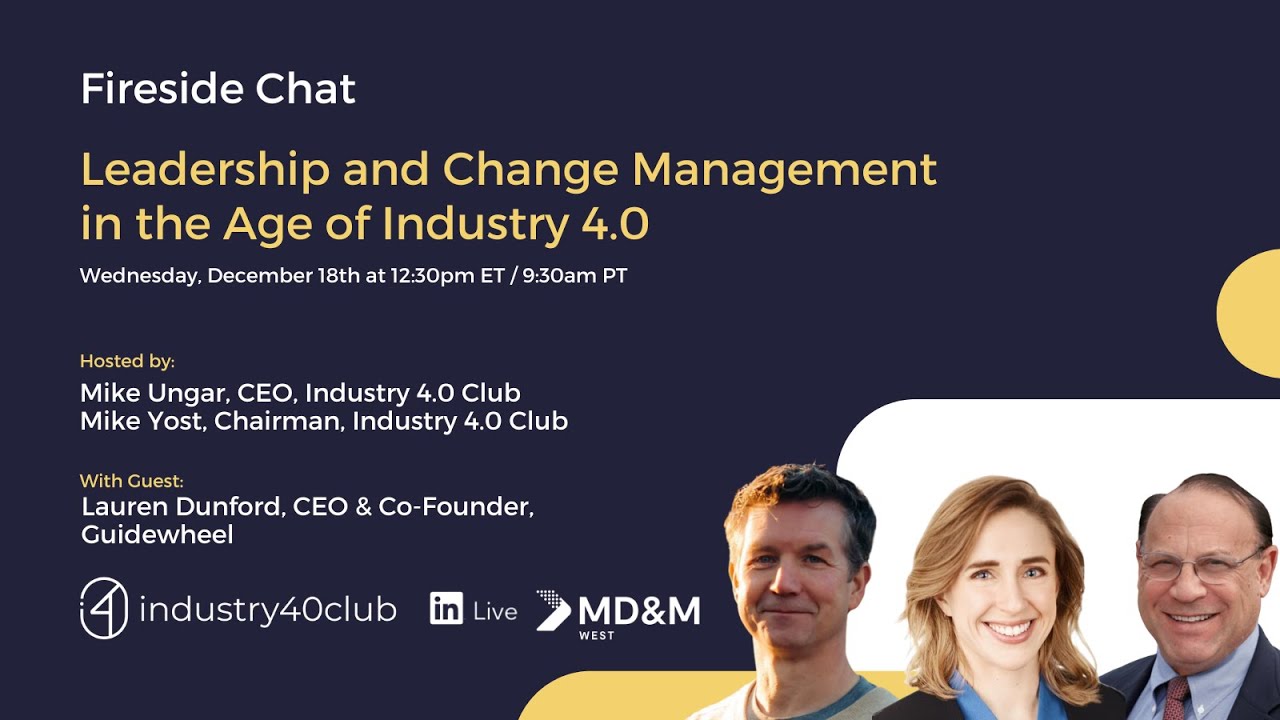
In this Industry 4.0 Club fireside chat, CEO Michael Ungar interviews Lauren Dunford, co‑founder and CEO of GuideWheel, about the origins, strategy, and impact of their real‑time factory‑floor platform. Lauren explains how a painful experience with paper‑based production tracking at Revolution Foods sparked the creation of GuideWheel, a flexible, visual, and data‑rich solution that replaces manual whiteboards while preserving engagement. She describes the ideal mid‑market, multi‑plant client, and outlines a change‑management methodology that starts with a single, high‑impact focus (controllable downtime), uses a crawl‑walk‑run cadence, and leverages gamified scoreboards to generate quick wins. The conversation delves into GuideWheel’s customer‑success model—playbooks, on‑site coaching, champion development, and a community of mentors—emphasizing that tools only succeed when people use them. Lauren discusses the challenges of building a data‑driven culture, the need for leaders who “want the truth,” and the importance of speaking the plant’s language. Technical interoperability is addressed through an open‑API architecture that can ingest data from legacy and future IoT‑enabled equipment. Finally, Lauren previews her upcoming MD&M West presentation, highlighting real‑world case studies (e.g., Premium Packaging) and the vision of a collaborative ecosystem where customers extend the platform themselves.
Chapters
Welcome to the Industry 4.0 Club's fireside chat. The club's purpose is to engage the power of diverse worldwide talent to accelerate the global evolution to Industry 4.0. We accomplish this by hosting and supporting respectful, thoughtful, and interdisciplinary conversations and creating quality content on wide-ranging Industry 4.0 topics to expand the reach of our community. My name is Mike Ungar, and I am the CEO of the Industry 4.0 Club. I have over 40 years of leadership experience, with most of that experience in manufacturing while working at Michelin. Today we have the pleasure of speaking with Lauren Dunford, She is the CEO and co-founder of GuideWheel. Lauren will be presenting at MD&M West in Anaheim, California on February 4th, 2025. Her presentation will be titled Leadership and Change Management in the Age of Industry 4.0: Strategies for Leading a Digital Transformation Journey in Manufacturing and Overcoming Resistance to Change and Fostering a Culture of Innovation. Just a little bit about Lauren. Lauren's the Chief Executive Officer and co-founder of Guidewheel. She's on a mission to empower the world's 10 million factories to reach sustainable peak performance. She was inspired to start Guidewheel by experiences in climate change and manufacturing, including a Fulbright Scholarship focused on supply chain and work at the Hewlett Foundation, Environmental Defense Fund, and Revolution Foods. She's lived and worked in India, Kenya, Nicaragua, and Mexico. Lauren holds a BA and MBA from Stanford and is a Udall Scholar and Truman Scholar. Welcome, Lauren. Thanks for taking the time out of your busy schedule to join us.
Oh my gosh, Mike, thank you for having me. I've been excited for this.
Anyway, I just want to start because your background is really interesting to me. I was looking at your background and goodness, what a diverse set of experiences. What motivated you to transition from a leadership role, operational role at Revolution Foods to start a technology company like GuideWheel?
Yeah, you're being kind with diverse. It might, might first seem random, but it's not. It's not random when you see the method behind the madness. So actually, the kind of formative experience for me that got me starting GuideWheel and really finding this mission so compelling was spending 5 years working out of a fresh food manufacturing plant with Revolution Foods. So, I was in their East Oakland facility. I was the one who got the call when we messed things up and a customer didn't get their delivery on time or something with production had gone wrong. And so, I felt the pain of how problems with production can play out quite personally. I wasn't working on the plant floor, but got a tremendous respect for the people who were and the day-to-day challenge that that posed. And I also walked through the plant every morning and many times throughout the day to get to and from my desk. So I saw the paper and clipboards and whiteboards that we were using to manage production, which, I mean, this was in the heart of Silicon Valley. So it kind of blew my mind. Wow. Paper is paper. Can paper still be the right choice? And I realized, I mean, it is the right choice because there aren't great tools for plants that aren't the world's most massive.
Right.
So many manufacturers are still making a choice to track manually because great tools haven't existed that are flexible and, you know, the right size. So that kind of kicked me into this search for how to solve that problem in an elegant and scalable way, which then led to GuideWheel.
Well, that's really cool. So, yeah, you know, truth be known, I'm a lean practitioner from way back. Okay. And I have to be honest with you, some lean folks are really scared of getting rid of the paper and the whiteboards and stuff. And the reason why is because they think that, and to some degree it may be true, that you lose engagement, you lose involvement in data. So when people bring that up to you, how do you respond?
Yeah, I actually think that's coming from a really good place. Engagement is critical. If you're not inclusive of and engaging the plant floor, nothing is ever going to change. Things only change when action is taken by someone on the plant floor. So When I think about the contrast between technology like it used to be, legacy cumbersome systems that can be used by a couple of people in the back of the plant who have the expertise and training to use those systems versus pen and paper or whiteboards, I actually see, I see the argument for pen and paper and whiteboards. Everyone can see it. It's transparent. It's something no one needs training to use and update and see red, yellow, green. How did I do? And I think what's changed is not how important it is that things are visual and inclusive and easy to use, but technology has caught up. So now having options that are able to keep the engagement, keep the visual transparent nature that is so wonderful about whiteboards and pen and paper, but bring it into a place where people don't have to be spending so many cycles and time updating data manually. Yeah, spend that time solving problems together.
Well, thank you for saying that. That's really a great— that's exactly— I think that's really the right answer. I mean, from my experience as well at Michelin, we would take a tire manufacturer, someone who's making tires, and we would ask them to write down information. And of course, when they're running information, they're not making tires.
Exactly.
So we would lose that productivity. And so you're exactly right, turning that time into productive time or Getting rid of the waste of data recording and turning it into problem-solving time, which is really the value-add for the factory, is really a home run. So that's really well said.
I think it's also interesting. I could not agree more. It's that time being used for the productive, either making or problem-solving. There's also an element of when you think about what's possible now with connected devices and sensors, we can get a richness of data that becomes even more visual and engaging than an hour-by-hour board on a whiteboard.
Right.
Where we can see the heartbeat of the equipment, how is it doing, and engage around using the visuals to solve problems together in a way that is more powerful than just the data points that are possible to be tracked by hand. And that's where it starts to get really exciting is both replacing the manual tracking so people can be focusing their time on higher value add, having accurate data they trust, et cetera, but then also getting a richness and granularity of information that unlocks a whole new treasure trove of leading indicators, predictive, you know, that type of thing.
Yeah, the other thing I think that happens as well is when it's digitized like that, you eliminate the silos. You can eliminate the silos of it being at one place, and the only way you can see it is to go over there. Now the subsequent post or the work area The preceding, even your entire supply chain can be connected. And so, and you can get a lot more folks to be engaged when there's an issue or something that needs to change than in the past when it was too hard to get to because the data was silent.
Yeah, totally. The way I've heard someone say that is a source of truth that is the truth that everybody can see. There is having it Actually shared allows people to see not just their area and problem solve in their area, but see the connections, like you said, among equipment, among areas. Those boundaries are often the really interesting spots.
Yeah, that's neat. Just a quick comment before we go further. For those of you listening on LinkedIn, if you'd like to ask a question of Lauren during today's conversation, please put it into the comment box. and we'll try to share it with Lauren and have her engage with you as well, as well as our conversation as we go forward. Thanks for that. Lauren, you've been leading Guidewell now for several years. What are some of the key lessons you've learned as a leader moving this technology company forward?
The first and most important one is learn and listen from especially our customers. That goes for the whole market, it goes for teammates, it goes for partners, but boy, the listen and learn from our customers is one that has just played out so wonderfully. So, the original idea for GuideWheel, I started working with these customers, listening to what they said, preparing an initial prototype, and they ended up using it actually very differently than I had thought they would. And it was listening and seeing what they actually did with it that brought the kind of unlock and unique elegance of the solution. So that, I think, has been something where it's not just the original insight that came from our customers' creativity.
Right.
It's now all the ways where we've tried to make it easy for them to do different things with it. And the engineers and production managers and VPs of Ops have then ended up using GuideWheel in ways where we never would've thought of it, but it's so much better than anything we would've thought of. And our job is to then make that really easy for them and others to do.
Naturally, I guess. And I guess it doesn't stop, right? Every time you probably add a new client or a current client adds another work area to their use of the technology, something comes out of that, I'm sure.
Yeah, it doesn't stop ever because the people are so creative and the people closest to the problem will have different perspectives. And then also it doesn't stop because technology is improving every day. And so it's exciting to see as we make new technology available, people use it in different ways. And that kind of coming together of what's possible now and what are these super smart humans doing to solve their problems at a smaller level, how can we then break that out into being something that people can use on a larger scale is just a blast.
That's really cool. So describe Can you describe for me your ideal client, your ideal factory? I mean, obviously, we met, you mentioned, I mentioned in the intro, 10 million factories, but there's probably a subset of that that fits best in your, no pun intended, wheelhouse.
Yes. Oh, too good. Definitely. So we tend to start with the mid-market first. So if you've got, you know, 5 machines and 1 facility, that's probably not going to be a spot where you'll get the most value from GuideWheels. It's too small. At the same, in the same way, if you have, you know, 200 factories and already have real-time visibility telling you everything you need to know across all of them, let's not go duplicate or rip and replace. Let's focus where folks don't have visibility yet. So where they're going from pen and paper or whiteboards to getting their first real-time pulse on their machines, that's where GuideWheels is most valuable. that tends to be a VP of Ops or manufacturing leader with more than one plant, because then they can't physically be in the same location as all those machines at once.
Yes.
And it becomes so much more valuable to be able to see where they're losing time and capacity on that equipment, get a pulse on where those spots are and why, and then equip their teams with great tools to solve them. So, manufacturing or operations leaders across multiple plants And discrete or continuous or both? Both, because what we find is there are so many plant floors where they'll have pieces of the operation that are continuous and then pieces that are discrete. An extruder might be, you know, producing all the things it is, and then they're palletized at the end, that type of thing. So, okay, we tend to work with folks where, um, it really does span both discrete and continuous. What's, what's really important is that we're able to Really typical though about the customer we work with is going from not having real-time visibility to having it.
Yeah, that's really neat. That's pretty cool. I want to talk for a second, and then we touched on this earlier about change management. Because when you introduce the— I'm used to, again, I've seen it happen more than once where we spent 10 or 15 years putting in our lean system. We're really good at that whiteboard and those hour-by-hour charts. You by hand. I mean, and oh my gosh, you know, I've been— we've been talking to the operators, and every day the supervisor goes out and he, he coaches the operator on how to fill out that chart. And boy, it's really part of the culture. And now all of a sudden, here comes technology. Okay. And, you know, obviously it's there to help them improve their business results. We know that most often these sorts of technology implementations fail not because of the technology, but because of the people.
Yes.
So how do you, how do you overcome that? How do you help your clients integrate your technology and manage that change management?
Yeah, so I will say just right off the bat, we don't have a perfect answer for this. The answer is the same of we learn and see what the great customers do. So we have some customers that take Guidewheel, grab it, run with it, integrate it very fully and easily, and achieve tremendous results. We have others where they need more support from us. So what we try to do is look at the ones that are great examples and then templatize that. What we've seen as a pattern in the ones that do really well is that they, they tend to not try to do everything at once. The do 100 different things all at once tends to result in a very slow set of progress and lots of setbacks. The ones that are really successful try and usually succeed in employing a crawl, walk, run of starting with something that is one thing that they focus their entire team around and drive that impact, recognize it, and get that momentum going. Usually what we tend to do is work with folks to have that first thing be controllable downtime. And there are a couple of reasons. for that. First is we try to talk with folks early before we work with them and say, if controllable downtime is the biggest bang for your buck on your plant floor, Right. we're going to be a great solution for you. There are some folks for whom that's not true, but many for whom it is. I think it's an average of 30% of margin is typically being lost to controllable downtime alone, that being shift handovers, changeovers, that type of human thing.
Right.
Because it's so controllable, if we start with controllable downtime, it's something that is important. 30% of margin is a huge amount, and it's sitting there because it's hard to get at. But it's also something that can be moved quite quickly with everyone participating. Friendly competition, we'll often put up scoreboards and see green, yellow, red. So, operators are going from no visibility into how they're doing to having that friendly competition, going home at the end of the day and, you know, Partner says, hey, honey, how are you? Well, fine. To, oh man, I'm great. Like, I crushed my previous best. My night shift, you know, won against the day shift, the pizza party at the end of the week. There can be some really fast wins.
Yeah.
We'll often see a 10 to 15% improvement from the scoreboard alone. And that tends to kickstart everything. Fast wins, momentum built on something that is really meaningful at a board and executive level tends to get the crawl transitioning to walk, transitioning to run. But the big lesson I think is, Crawl, walk, run, and starting with the most important thing.
That's really cool. You mentioned this idea of gamifying the process, and that makes a lot of sense. We used to try to improve our throughput. I had one person ask me one time, and we would buy— in our world, we work 24/7, and we would end up— the night shift always seemed to manage to get the most production because they weren't bothered by day shift.
Yep.
And so we would always, when they hit a record, we knew they're coming in and we'd always bring biscuits in for the night shift before they went home.
Yes.
And I remember somebody asked me one time, so what happens if they do this every day? I said, is that— that would be wonderful because we're always buying biscuits, you know. So, but you're right, creating opportunities, gamifying it in a way that, and recognizing that result is one way to overcome and help advance the changes that need to be made in the environment. Yeah.
And everything I just said is just some pieces of it. It's a very hard challenge and ultimately one where it depends on the leader of the organization to really set the tone as well.
And so do you have a guide? Do you have people that help with this integration that go to the client as well, or are you primarily just the software? What's the balance for you?
We invest really heavily in the success of our customers. What we found is a tool is only as good, like you said, as the people using it. No tool can be the greatest tool on the planet and it doesn't do a thing. If people aren't using it and taking action on it. So, we actually have a whole customer success team in addition to our solution engineer and technical implementation team where they provide the coaching and playbooks and training and go on-site to whatever degree the customer wants. We don't want to impose ourselves.
Sure.
We hold ourselves to success being more dollars back in the P&L of that customer. And the dollars don't get back in the P&L if someone isn't taking action based on that data. So, we know we're never going to be successful if they're not using it. Well, we can do a lot of monitoring from afar, providing playbooks. Ultimately, what we try to do is early on in the relationship, invest pretty heavily in identifying the meetings and metrics that are being tracked today.
Mm-hmm.
Customers are tracking production in some way, shape, or form, even if they don't have GuideWheel yet. So what are they talking about in their daily production meeting? What are they saying at shift handoffs, day shift to night shift? How do we make sure that we make GuideWheel speak the same language that they're already speaking? So it's built to be very flexible in that sense. And then pay attention and attend some of those meetings so that we get them pulling in GuideWheel to the meetings they're already having in the language they're already speaking so that it can be informing those decisions.
So I think some of the things that I've heard you say in terms of change management is one, this crawl, walk, run mentality. So, you know, we used to say eat the elephant one bite at a time, so to speak. You know, get started slow.
Yes.
The other thing I hear what you're saying is make sure you speak the language. Make sure you're— in other words, you really get to know their culture so that you're not— it doesn't sound foreign. to them, I guess. Yeah. And then what about this issue? There are always some people that are, you know, we have the early adopters, we have the middle followers, and then we have a few that are like, that's never going to work for me. How do you— what do you advise folks for that group that's maybe a little bit less interested in taking the trip with you?
Yeah, totally. So a couple of things. First of all, on the governance side, when we roll out with customers with many plants, we try to think about What's the cadence and way that we roll out that set us up for success? So, having the teams who want it, I think one customer said it so well. He said, we want people who want it and who know what they'll do with it first. Let's give it to those teams. Then let's progressively add on more and more. And let's finish with the folks who might not actually want it quite so much. And that cadencing together, we'll never know. So, we have to work with our customer to—
Sure.
coach and support them to set their organization up for success with those many, many plant rollouts. Within each plant or department, what we also do is lean on the expertise of the customer and equip them with best practices for GuideWheels. So typically, the VP of manufacturing or VP of ops that we work with is not going to be the right person to be managing all the details of the implementation.
Right.
That person's plate is completely overloaded. And success for that person is always about their team. It's about the people on their team being able to take and own results. So, what we do is we say to that VP of Ops, who's the person on your team where you really want to retain and have them grow with the organization? Where they're maybe up and coming a little bit in their career? Where their eager for meaningful projects that will move the needle on the bottom line, honestly, is probably the person that already has a lot of projects. So, that's what we mostly need to talk about with the VP of Ops.
Yes.
But can we work with that person and be the best possible partner and win beneath that person's wings, where we give them the amazing playbooks that we have? I think we have like a 24-page playbook of change management, building champions for that person on the plant floor to apply all those best practices, change story, finding the right people, identifying wins. But the VP of Ops is never going to have time to read a 24-page manual.
No, of course not.
That champion will often dive into it, grab those materials, totally make them better and better for their environment. And they'll be the person who's connected and respected by the folks on the plant floor who are the key ones to engage. And then what we do is we say to that champion, here's what we would normally do to support you. Here are the playbooks we would normally give you. Here's the community of other champions in other companies that we'll loop you in with. And here's the community of mentors we have available. Because there are these amazing folks kind of retiring and, you know, leaving the industry who want to stay connected with those incredible rising stars. And we say, what pieces of this would you like? Would you like the community, the mentorship, the playbooks? Folks will often be pretty excited about that full package.
Yes.
And then how can we support you in taking advantage of all of those resources and celebrate the success? So we've got a time then where we've got you presenting to the VP of Ops who then brings it to the board. And this person's success is then on our success, where we're measuring it together in terms of dollars driven for the bottom line.
Wow, that's great. So I wanted to kind of transition and ask you, you know, we working with other companies today on this journey to engage with Industry 4.0 and smart manufacturing, we come across a lot of, you know, you mentioned already that, you know, the companies are— got whiteboards and Power BI charts, but we find a lot of companies aren't that data-driven. They don't Even they don't even have those silos of data. Why do you think so many companies today aren't? Or maybe say it differently, how do you help a company develop a strong data-driven culture?
Yeah, I mean, it's been hard to get that data. I will say having someone track it manually, it's a challenge. It's an additional ask. It's also something where no one ever quite trusts it. So it's like this catch-22 where When we've come in and clipped GuideWheels on the assets of a given plant, we typically see that the manual collection of data, sometimes we'll do a side-by-side, is typically around 50 to 75% accurate, which is just not that accurate. So, you know, it's hard to be data-driven when you don't have good data to base it on.
Mm-hmm.
What we try to bring to support that data-driven culture is, first of all, we try to be really picky about who we work with and find the leaders. One of our customers put it this way, he said, You should work with people who want the truth. If they don't want to know the truth about how their machines are running, that's not a good fit and it's never going to be.
So I'm guessing you walk away from some clients sometimes?
Yes.
Potential clients?
Well, for us, it's about the long-term success. And if someone is not in it to improve and know the truth and lean in, that's not going to be a good long-term relationship.
Interesting.
And a bad choice for us to try to make that work and push a string. We want people who are pulling. So we look and try to be clear upfront about what it is that we do and what it is that we don't. And so one of the things that we try to talk with folks about is, what will you do with the data? What will the impact be? What problem are we solving for you? And if we can't identify that, we should not work. with that company. So find— and I have to believe there are a lot of people that do really want to improve.
Yeah.
There are so many leaders out there, definitely more than enough for us to have our entire work cut out for us, who want to figure out how to reach their full potential as a team, as a leader, how to have their leaders actually be leaders versus micromanaging and wondering always, you know, what the details are. And so we try to be picky and work with them and focus all our effort on supporting them. Versus pushing a strain with folks that don't want it at this moment.
That's really cool. Hey, I want to share a question that we have. It's specific to Geiger, but I think it might be interesting to address it. This comes from— I hope I don't mispronounce your name— Hyo Lin Liu. This sounds like an amazing tool for non-connected devices. Is there an opportunity for this to work or integrate with brand new machines built in 2025? which may already have IoT built in.
Absolutely.
Yeah.
So the way we've built GuideWheel is it all has to be interoperable. No manufacturer wants a bunch of different systems. And the new machines being built today have tons of bells and whistles and information, which is fantastic. So we've built GuideWheel to be a layer that fills in the blind spots and then can take in information from those newer machines, from other systems. It's got this open API structure from the start. That makes that easy to interconnect and layer on more and more information. What we also really want is not just customers laying more— layering more and more information into GuideWheel, but having the tools to build their own things on top. We'll provide out-of-the-box value that meets people with the common solutions to common problems, controllable downtime, overall equipment effectiveness, all of that. We want out-of-the-box easy for them to get value. We also want customers to be able to innovate and be creative and develop and build on top, and eventually an ecosystem of developers to be building on top of that real-time layer for the factory floor, which brings us back to how wonderful it is to see the creativity and to be able to learn and iterate with our customers.
Yeah, let's see. So it sounds like what you're trying to do is actually enhance the The client's innovation as well. That's really cool.
Exactly. And we try not to start with, oh, here's just a bunch of tools, build whatever you want, because that isn't that effective. That's a catch-22. We've got, you know, a cold start problem. What we tend to do is say, hey, let's start by solving a few really important problems with out-of-the-box solutions. But from the start, be thinking about how you'll be able to integrate these into your existing systems, build on top really easily over time.
Yeah, we have another question. I think it might be interesting to kind of speak with or speak to from Yaseen. Thank you for the insightful discussion. What are the best ways to guide teams in embracing digital transformation, especially in industries with strong traditional processes?
Yeah, there are— this is such an important question, and there are so many really incredible leaders on this topic and thought leaders and all sorts of information. So I'm just going to caveat that whatever I'm going to share is going to be one tiny, tiny slice of how we think about it. What we tend to think about is how can we be driving towards a result that's meaningful at the business level, having folks see what that looks like, and then also see and connect to how that digital transformation solves a problem for them in their day-to-day and makes their life better. I'll give an example here that's a pretty fun one. We have a A customer that makes cookies. And this CEO of the company had used GuideWheel before at a previous company. So he came in and automatically it was one of the first things that he did when he joined this new company. And he aligned the whole team there around 2 things. First is if we increase our shift productivity, we don't have to work Saturdays anymore. And so for them, that was the thing that everyone was—
Pretty cool.
Exactly. Like they could take Saturdays off. They could still meet all their customers' demands, et cetera. And so he aligned everyone around that big goal of we're going to be able to stop working Saturdays and spend them with our families. And then the second thing he did was he actually quantified what that additional productivity would mean for the business after Saturdays were taken out of the equation. And he gave people a raise that incentivized their own salaries as the business got more successful. So he was, of course, benefiting net from the additional productivity. But each teammate got to see, hey, how does this affect my day-to-day? A team goal and an individual translating. People might not want to go that far with, you know, with every single rollout, but thinking about what is it that becomes better in someone's day-to-day life?
Yeah. Yeah, creating line of sight. You know, that's a lot of times what we're talking about. I think you're just you're sharing is creating a line of sight between what the individual on the shop floor does and the company's success. And that's a huge— when you can connect that, that's huge.
Yeah. And they'll often be the ones to connect it once they can see how things fit together, because that CEO is probably not going to be the one who knows how to run the most efficient changeover for a certain type of cookie-making machine. It's going to be the operator on the plant floor where once they can see how their work connects to that larger team goal, hey, we're going to get our Saturdays back for our families, And we're all going to get raises as we deliver more and more profit to the business. Suddenly all the innovation starts coming from the plant floor as well. And so it's recognizing and having a voice for the plant floor in the how we do this, plus the goals and alignment that we've seen be most successful.
That's great. So I want to kind of turn our attention— we've been talking for 30 minutes already— I want to turn our attention to your talk at MD and MWest, if you don't mind, for a little bit. So you're inviting one of your clients, which I think is fantastic, Lisa Hewitt from Premium Packaging. Why did you ask Lisa? What is she— what is her experience and why did you ask her to join you in your presentation?
Yeah, so Premium is an incredible company and has the kind of leadership mindset that we really appreciate. GuideWheel. They also took a bet on us very early. I think we had just launched in the US when the CEO at the time of Pretium basically was like, oh, I see this thing could be amazing. Fitbit for factories. Let's get started. So he saw the vision and started with us before we had a lot of the functionality built out. So I have a very personal just gratitude for Pretium for taking that early bet. They then deployed us across all their 25 plants. So it's also a nice example of someone who's been using GuideWheel a long time across this, you know, 25 plants is not the biggest company in the world. It is, it is a significant operation and they're across 3 different continents. So being able to see the diversity within the operation. And then Lisa plays a really unique role where she's at the corporate level, looking over all of the plants and seeing the amazing bright spots where we've got one of the plants that tracks every single detail of everything maintenance-related with GuideWheel, and then another plant that focuses in on energy and how they can get their energy bill from being, you know, a surcharge to getting money back from the utility. We've seen so many different success stories. Wow. Lisa's ability to speak to that, I think, will be a blast for anyone who's there.
That's fantastic. And maybe, maybe one last question. So What do you hope, you know, those that come to your presentation, what do you hope they walk away with if they attend your presentation at NBM West?
Yeah, I mean, I think that the big thing for me is it— not everyone knows yet that it's possible to have technology that isn't monolithic and cumbersome and used by a couple experts in the back of the plant. I mean, it's kind of ridiculous now that our homes have, you know, doorbells we can control from our phone.
Yes.
And I don't even want to know what my refrigerator is doing, but I could. Like, it's all this stuff from, you know, intuitive, usable, press a button and you can see everything. And that type of technology has not come. I think it's actually deeply unfair that there hasn't been that great intuitive, useful innovation on which others can build yet for the plant floor. And I want people knowing that it's here and we can all build together towards what we want this platform to look like, both as let's drive a ton of value with the quick wins, crawl, walk, run, but also that the most exciting stuff happening on the plant floor is not going to come from just the platform that GuideWheels provides. It's going to be the things our customers build and being able to be part of that mission together is just a real blast.
Oh, that's neat. Well, thank you for that. So we've been talking here at the Industrial 4.0 Club, we've been talking with Lauren Dunford, who's one of the founders and CEO of Guidewheel. Lauren, any final thoughts for our audience as we wrap up today's conversation?
Just, you rock. I appreciate so much all of the incredible manufacturing teams that we get to work with that I get to work with, and I appreciate just manufacturing as the backbone of everything we do every single day. And thank you all for the incredible hard work and leadership and dedication I see you putting in every single day.
Thank you, Lauren. So I want to thank you for joining us to give us a preview of your presentation at MD&M West. This will be happening on February 4th at the Anaheim Convention Center in California. We hope that you decide to come to the event, to join us at the conference and hear Lauren And other speakers that'll be there. To register for the event, here's the website that you need to go to. It's mdmwest.com, and look for the Design, Engineering, and Build Conference. That's where Lauren will be speaking. So please join us there. The Industry 4.0 Club would like to encourage you also to take action. I think that's one of the things that's really important to advance the deployment of Industry 4.0. You know, read an article, attend a workshop, develop a smart manufacturing roadmap for your plant or your company, or challenge your organization to move forward in the deployment of Industry 4.0. And please let us know what you're, what you're doing. We'd love to hear from you either through our LinkedIn page or at our website, which is www.industry4oclub.com. We host conversations like this on LinkedIn and YouTube. Weekly or every other week. And if you'd like to also join us on a conversation, please reach out again to our website or LinkedIn page and let us know. We'd love to see if we can host you on a future conversation. Again, Lauren, thank you so much for taking the time out of your busy schedule to join us, and we look forward to seeing everybody hopefully in California in February. Thanks again.
Thank you.










