Leading Digital Change: Why Initiatives Fail and What Successful Leaders Do Differently
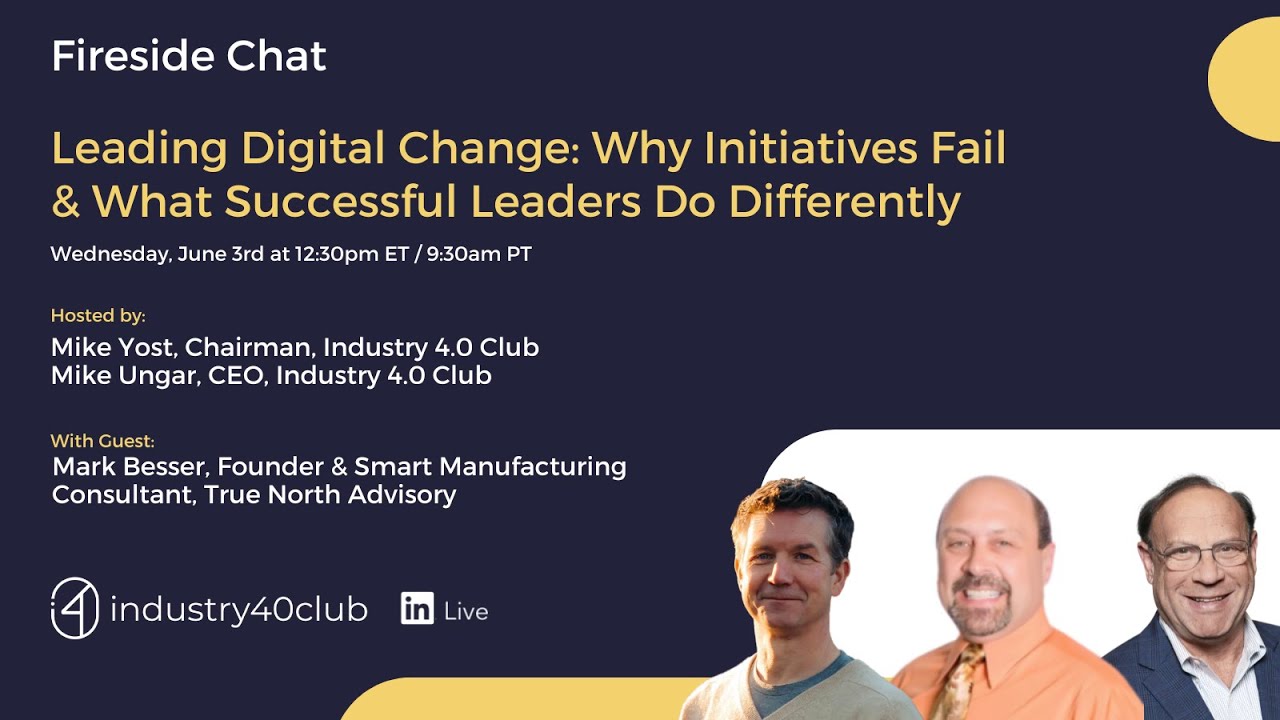
In this 25‑minute Industry 4.0 Club fireside chat, host Michael Ungar (CEO) and co‑host Mike Yost interview Mark Besser, founder of True North Advisory, about why digital‑manufacturing initiatives in plants often flop and what leaders can do to make them succeed. Besser argues that failure is rarely the technology itself; it stems from mis‑alignment of vision, strategy, KPIs, and stakeholder buy‑in. He stresses the need for a clear “North Star,” measurable outcomes, and a realistic, bite‑sized 60‑day pilot that proves value before scaling. The conversation covers cultural resistance, the danger of “pilot purgatory,” the importance of identifying and engaging all relevant functions (operations, quality, maintenance, finance, IT), and the challenge of building foundational data infrastructure versus delivering quick wins. Besser also offers practical advice on vendor selection—finding a trusted internal champion at the software vendor—and on AI adoption, highlighting the need for discrete problem statements, relevant data, digital literacy, and guardrails. The discussion concludes with the key takeaway that winning organizations align leadership, leverage their workforce, and only declare success when measurable value appears.
Chapters
Welcome to the Industry 4.0 Club fireside chat. The club's purpose is to engage the power of diverse worldwide talent to accelerate the global evolution to Industry 4.0. We accomplish this by hosting and supporting respectful, thoughtful, and interdisciplinary open conversations and creating quality content on wide-ranging Industry 4.0 topics to expand the reach of our community. My name is Mike Ungar, and I am the CEO of the Industry 4.0 Club. I have over 40 years of management and leadership experience, most of that in manufacturing at Michelin. I'm joined today by my co-host and chairman of the club, Mike Yost. Mike, would you please introduce yourself further?
Sure, absolutely.
Welcome everybody.
As Mike said, my name is Mike Yost. I'm one of the co-founders of the club and Mike's co-host here on these fireside chats. I've been in industry almost 40 years myself, uh, on the industrial solution provider side, and, uh, the last 16 years with industrial nonprofits. Uh, so, um, enjoy getting together and talking with domain experts, experienced professionals in our space. So we're really super excited that we have Mark Besser here with us today. He's going to be talking about leading digital change, why initiatives fail, and what successful leaders do differently. Mark is the founder and smart manufacturing consultant at True North Advisory and a longtime friend of mine, and hard to find anybody I trust in industry more than Mark. But for— by way of biography, Mark has spent his 40-year career helping manufacturers cut through the sales and technology marketing noise to turn digital ambition into operational results that align strategy, operations, and technology. Mark's got experience spanning manufacturing and enterprise software and has led smart manufacturing in 37 countries and over 500 plants. Deploying ERP, MES, industrial IoT, analytics, and AI. So from plant floor to industry leadership, Mark brings practical execution experience to actively help shape the future of smart manufacturing through thought leadership, education, and national manufacturing initiatives. So for those of you that are listening in on LinkedIn, if you have a question for Mark, and we sure hope you do, Please go ahead and submit it into the comments section, and we will do our best to ask Mark and integrate it into our conversation. So with that, I want to say welcome, Mr. Besser.
Yeah, thank you very much, guys. Looking forward to, to the next half hour together, and those 120 years of experience between us explains why 2 of us don't have any hair. Yep.
Yep, there we go. Anyway, well, Mark, thanks, and we're glad you could join us. So let's just jump right in. So you've worked with manufacturers in, in really many, many plants in many countries, as Mike alluded to. So let's just dig in and sort of talk about why digital initiatives fail and what are some of the most common root causes for those, those failures, if you will, across organizations.
Sure. You know, this digital manufacturing, digital transformation is certainly one of the biggest opportunities facing the manufacturing industry today. And I gotta say, it's probably also one of the most reliably mismanaged of those opportunities. So I'm pretty sure we could spend half an hour just on that question, but let me pick a, you know, let me pick a couple of nuggets. First, I'm going to make maybe a bold statement and say generally I would say failure is never about the technology itself. We— it's much more likely that we asked that technology to do something that it wasn't equipped to do, and I would look towards failure happening in either how we lead that process, the alignment of our leadership team, the people, the processes themselves, but rarely it's the technology. And kind of to that point, you know, did we ask it to do something that it probably shouldn't have? You know, can we put machine configuration master data in SAP? Yeah, we can. Should it be there? Probably not.
Probably not.
Right? Probably not the most quickest way to, you know, access and make change. So, great, you know, kind of a great example of, you know, we got great technology, we just asked it to do something wrong. I'll point to what I'll say is misalignment as really the primary cause, in my opinion, of why these projects fail.
Mm-hmm.
It really starts with, we don't have a clear vision, a clear strategy. We're not tied to business outcomes. We haven't set a baseline of KPIs to actually measure against. All of those are going to contribute to the fact that we have a very difficult equation and definition for success, how do we know, you know, that we've even accomplished it? So this, this misalignment challenge fundamentally, where I think most of these go wrong before we even get them off the ground.
And do you see, Marc, along with that, that Like, without having that vision and strategy and outcomes defined, um, are the— is there a failure of the people not being bought into what it is that's being built?
Right.
I see this all the time in day-to-day stuff, even the, the app that my school uses to track my kids, like, in school and their progress. Um, it doesn't seem to work well. I'm not invested in making it work well, so I basically just give up on it. Do you see that kind of challenge as well, not engaging people effectively?
Oh, 100%. We tend to shove these things down to the, to the guys on the shop floor, and we don't, we don't tend to rally the support, their participation in that process. And, and then on top of that, we never really offer reasoning or understanding of You know, why are we doing this? What are we trying to accomplish? It's not just about, you know, it's not just about change or trying to make somebody's job easier. There's a reason behind what we're doing this. So we're not really buying in; we're not getting that cultural buy-in. And then I'll also add to that—
Yeah.
This, you know, kind of passive cultural resistance that gets created. As a result of that, right? We'll all smile and nod our heads and go, okay, yeah, this is what we're gonna do. And then to your point, Mike, the last thing you wanna have happen is, all right, I go back to what I was doing yesterday and, you know, we just killed adoption of what we were trying to accomplish. Right.
Well, and I think too, with the speed with which technology is evolving, right, how powerful the tech is becoming, and this is not a new phenomenon, right? But you got companies that are investing heavily, maybe from a corporate level, they have ERP initiatives or MES initiatives or, you know, AI initiatives for sure, but they're not creating an impact, right? And you still see organizations that are stuck in, you know, pilot purgatory, pilot mode, you know, sampling, dabbling in things. So what separates the organizations that do get results from those that just keep dabbling?
Well, the biggest one I'm going to point to is, you know, what problem or opportunity are we trying to solve with these technologies, right? So I know I'm— it sounds like I may be beating on that alignment drum here a little bit, but if I can't point towards our North Star of what we're actually trying to accomplish, How do we know we got there? How do we know, like, how did we know we invested in the right place? How do we even measure ourselves from a, you know, from a success standpoint? But kind of specific maybe to this kind of pilot purgatory that, you know, you referenced, I think we're not particularly honest with ourselves when we approach these projects. We, almost every investment today is made with some definition or some ROI attached to it that's calculated, right?
Mm-hmm.
We all, as the, as the team who's going to execute, want to win, right? So we come up with these kind of bold statements and these bold ROIs of what we're going to accomplish. Scope gets big, the opportunity gets big, right? The attention gets big. The investment gets big. The risk of failure gets big. The cost gets big. Right? I think we need to ratchet that back down a little bit. Right? I— it's hard to keep our attention for more than 60 days, especially when you got 2 or 3 jobs that you're trying to do inside the plant. So from a scope perspective, create this box, if you will, that is achievable. We can get to it. It's not going to overextend the capabilities of our organization. We're already fairly skilled to actually be able to accomplish this. So, I don't need to go bring in a bunch of talent that we don't have today. We can do it within 60 days or so, so that we can actually see results and get excited about them. And then we got to be careful that we don't plant the flag of success too early. Right. So make sure we actually achieve those results.
So, so Mark, you're talking about though, it makes a lot of sense what you're saying. However, a lot of plants have to really put in some, I'll call it foundational work before they start. In other words, you know, think that they may not have a, a, a direct ROI. So, so how do you see that kind of blending together what you're describing? Because I agree with you about the idea of a quick, of 60 days getting results, but sometimes you've got to lay the foundation and there's not any immediate results from doing that. How do you suggest plants, you know, make that happen while respecting what you just described?
I'll challenge that a little bit, Mike. Maybe we're measuring the wrong thing then, right? Are we trying to make life easier? Are we trying to improve efficiency? Are we trying to, improve output? Are we trying to reduce the amount of overhead we use? Are we trying to reduce the amount of labor we use? Are we trying to reduce the amount of materials that we use to get something done? I mean, if you challenge that metric a bit, you should be able to come up with something quantifiably that we can actually measure as part of that process. Now, the challenge is we want to make sure we're still tying that back to a business outcome. But fundamentally, I think our bigger challenge is we just don't measure it today. It's hard to improve and manage something that you can't and you don't measure. Go ahead, Michael.
No, go ahead.
No, Mark, what I'm thinking about is, let's suppose I want to really use more robust data. Right now I don't have consistent gathering of that data. Alright? So I've gotta put in the sensors. I've gotta put in the— I may need the system to, to make it transparent across the plant. In other words, I may not be ready to, to actually execute the, the, the top end of that.
Sure.
Well, I've gotta put the whole infrastructure in place first, you know? So that's kinda what I was alluding to because people tend to wanna break these down like you just described into small pieces. But there's a piece there that maybe doesn't have a direct ROI to start. It just gets me in, be able to get me into the game. It's like practice before you play, you know?
Yeah, for sure. And we can't underestimate the level of technical debt that we run into as part of this process, right? And whether that infrastructure or cybersecurity, or it's the skills of the people that we have on the team, or, or, or, or, right? Those are all hurdles and obstacles we're going to have to work through as part of that process. But that said, I don't have to have a full DataOps platform to test out a solution on a new line with 2 new machines.
Right.
I do have to have some requirements in place and I do have to understand what the implications of those things are going to be as we start thinking about scale later. But I should be able to fundamentally prove out that solution without having to put all that baseline in place. Yeah, that is all really when we start talking about scale though. Yeah.
So you're— what I hear you describing is the real challenge is still to find that— I'm going to use that word— that bite-sized piece that you can grab a hold of and see results in 60 days.
The sweet spot. Yep.
I just want to jump in here real quick and reset us and remind everybody that we're talking with Mark Besser, founder of True North Advisory, talking about leading digital change. Why Initiative Fails and Leaders Succeed. So if you have questions for Marc or want to throw in your thoughts, please go ahead and put them in the comments. I wanted to stick with that topic for just a second, Marc, and add a layer of complexity or a challenge that I think, again, bubbles this up to a leadership level. And that is, if you're having a value-centric conversation, how is the business defining value, like, across departments? Right? So the quality department has an area that they want to— problem they want to solve, and maintenance has an area that they want to solve, etc., etc., etc. Somebody's got to be able to help prioritize if, you know, there's a certain number of resources or priorities that get set in one versus the other. So how do you see companies managing that?
Yeah, some good program management capability, but you— it really starts with the identification of who are all the potential stakeholders as part of that process. And I don't think many times we go through the due diligence of that. It's easy to say, you know, who are my IT guys, who are my quality guys, who are my operations guys? But to your point, did we think about maintenance? Did we think about finance, right?
Mm-hmm.
Do we think about— right? There are other people, other organizations and groups that are gonna be impacted by that solution. I think that Stakeholder identification is pretty critical up front. But specifically, you're going to have to have at least some reporting structure and some weight inside the organization that someone's got to be able to pull all those teams together and have them participate and play.
That's— we talk a lot, obviously, we all here are trying to help the smaller organizations that don't have as many resources, or maybe they're not as mature. This kind of discussion for me is really gold because those are the kind of things that translate between companies, and you can learn from some of the bigger companies that have gone before and, and, you know, identify the stakeholders and identify the, uh, the North Star and those sorts of things like you're talking about, Mark. So I think those are fantastic insights.
Yeah, and just because those companies are bigger doesn't mean they've done it well. They just have more money.
Yeah, if I can change gears just for a second as well, you know, there are an awful lot of vendors out there today selling their wares, okay? In fact, goodness, if every— I watch LinkedIn every other day, there's a new company selling something with AI, for example, you know, it's like, please stop. But how does a small to mid-sized manufacturer who may not have the internal resources to actually sort through the noise. How do you suggest that they deal with, one, staying abreast of what's going on, and 2, really bring on board the right partner?
That's a great question, Mike, and this one is going to be pretty close to my heart, spending most of my 40-year career in, in the software side of this business, right? So I You know, first of all, have you ever met a software company who said, no, that's not what we do? I— this is part of the problem with sales and marketing, right? I— the answer is always yes. So, uh, or, or, uh, yes with some kind of caveat, but—
It's only software. How hard can it be?
Um, here, here's my answer to this, guys. I, first of all, I don't think most organizations understand the dynamics of a relationship between a vendor company and the software company and the actual manufacturing company. And what I mean by that is the real work, the real work for a software company doesn't stop, you know, the day that you guys sign that contract, actually just begins.
Right.
And as a, as a consumer of that, I need to have somebody inside that organization that I trust, that is my advocate, that's looking out for me, looking out for the interests of my organization, looking out for how we do business.
Mm-hmm.
That person inside the software company, if they're good, is going to battle for you every day. And what they're battling is the software companies making decisions every day about, where am I spending my dollars on the next investments and capabilities or, or directions? Or, or I have a list, a wish list of things that Mike Ungar wants for his company, right? How do I prioritize that against the 37,000 other lists of things that are happening? or support tickets and priority and resources. And right, there's a battle that happens every day inside the software companies that I don't think people realize, right? So my, my, my first recommendation is forget about what you hear in the demo, forget about what you read in the marketing materials, because those are always going to be fluff and flowers and answer the question that says, yeah, we can do it. What you need to do is find somebody that you trust to go take the hill with, who you think is gonna actually watch your back and look out for you.
Yeah.
And secondarily, isolate yourself to what your real competitive advantage is. What are the 2 or 3 or 5 things that actually make your company what it is today? Those are the things you should be focusing on. Because those are the things you're not going to want to change, right? This is what makes you successful. If I have to force fit those things into Mike Yost's definition of what software is, I got a problem, right? So we should be able to match up capabilities against and isolate those to make sure that I'm being actually looked out for. That's probably my biggest recommendation in that space.
I think that's really, really powerful stuff. You know, I'm the last person on the planet that wants to ring the bell for AI. But I think we'd be remiss here if we didn't bring it up. It's on everybody's lips, in everybody's ears. We get it constantly. So, you know, as AI becomes more embedded in what we do in manufacturing operations, what advice would you give to leaders who want to understand it and want to marry, you know, this digital ambition into, you know, practical guidance and execution within their organization without overwhelming everybody?
Great question, and another one that's close to my heart, having spent the last, you know, 6, 7 years in AI.
Exactly.
First of all, guys, you don't need a masterclass in AI, but go learn what it is. I can tell you what it's not. It's not the sentient thinking being from the Terminator movies from the '80s, right?
Oh.
AI has actually been around since the '50s, right? And it fundamentally, when you get down to the core, hasn't really changed that much. Because it still is pattern matching at the end of the day. What has changed in the last couple of years? First of all, the scale providers made it easy for us to get access to it now.
Right.
I don't have to have a souped-up machine to actually make it work. A bunch of really smart people changed how we interact with it. I don't have to be a Fortran programmer to write assembler or to make it work. We can speak to it now.
Right.
Yeah. That actually creates a lot of challenges. What does AI need to be successful? Well, I got to have a fairly discrete problem that I'm trying to solve, and then I actually have to have the related data, relevant data, to point the engine at to help me solve it. If I don't have those, now you're really just doing a Google search.
Right.
Right? So to answer that maybe more specifically, Mike, I first of all recognize AI is going to create— you're going to have to create some digital literacy inside your organization. It's not that I need a bunch of data scientists, but I do need to have some guys who understand how do I go procure and retrieve data, and how do I get it in a state that I actually can do something meaningful to it, and how do I make sure that it's actually relevant to the problem I'm solving, and help me build the guardrails around that so when I fire this cannon, Right, it's at least going in directionally correct to what I'm, you know, what I'm trying to accomplish.
Yeah, I think that, I think that's really interesting, especially your last point about the guardrails. I mean, I see the access of AI nowadays is really unleashing innovation in like every corner of a business. My son is a new employee for a small company, and there's no formal AI strategy or anything. And his, his, uh, leadership team thinks that he's a superhuman because he's got this AI companion. They ask him to do something and he does it at this, at this level of expertise that's, you know, exceeding expectations. And they ask him to do more and he does more. So it's really powerful for him, but there are absolutely no guardrails. Like, he is not getting any guidance whatsoever. And I think that's a really slippery slope for folks. Managing that innovation.
And you can't— I mean, is it going to be valuable? Yes. Is it going to help? Yes. Do you trust it? I don't. Not yet. Yeah. I mean, I laugh about this little cartoon that I saw a while ago. The guy says— he asks his AI engine on his phone, can I eat this mushroom? AI says yes. Right. Well, do you trust that?
Right.
I'm not sure I'm ready for that level of trust yet.
That's pretty good. Well, we've been talking for the last 25 minutes or so with Mark Besser, Mike Yost, looking at what it takes to create a successful digital transformation. As we wrap up here, Mark, Mike, maybe we could share a final thought with our audience. So Mike, maybe you'll start and Mark, you'll wrap us up. Mike?
Yeah, sure. As I mentioned at the top, there are very few voices in industry I trust more than Mark Besser with his experience and knowing him as a human being. And you probably see me writing frantically here. I have about 12 different takeaways that I've written down throughout the course of things, but the one that really jumps out at me the most was the focus on, you know, manufacturers having a true north and really focusing on what are the real competitive advantages that you have, and then aligning the digital transformation and the tools and the tech and the AI and all of those things in support of that. I think that's really sage advice, and I think that it helps cut through the clutter oftentimes of, you know, you're not chasing tech, rather you're focused on your business and then aligning tech to support where it is that you're going to go. So I think that that gem of, you know, focusing on your real competitive advantages is a great takeaway, Mark.
Yeah, and from my perspective, guys, the organizations that are winning at this digital manufacturing game They aren't winning because they have better technology. They're using the same technology that all of us have access to. They're winning because they have leaders who are aligned and engaged with what they're trying to accomplish. They're building trust with the people that they have. Their workforce is the most underleveraged asset in the organization. Right. And they refuse to declare victory until the value shows up. That, that's the flag they're planting.
Yeah, very good. Well, Mark, thank you so much. Mike, for your time as well. Just been great as we've talked about digital transformation and what makes a successful result for a company. So just to kind of wrap up, the Industry 4.0 Club would like to encourage you to take action. Read a book, attend a workshop, maybe even establish a smart manufacturing roadmap for your factory, or encourage your plant to do so. It's really important that you take some, take some action. Let us know what you're doing. Drop us a note on our website at www.industry4oclub.com or on our LinkedIn page. We'd love to hear from you and understand what you're doing to advance the deployment of Industry 4.0. We also hold conversations like this weekly. If you'd like to be a guest on one of our future broadcasts, we'd love to have you as well. Again, reach out on our website at www.industry4oclub.com or our LinkedIn page. We look forward to talking with you and learning about what you're doing. With that, Mike, thank you. Mark, thanks as well.
Excellent. Thanks, everybody.
Yeah, have a great day.










