Lessons Learned Through the CESMII Smart Manufacturing Roadmap Process
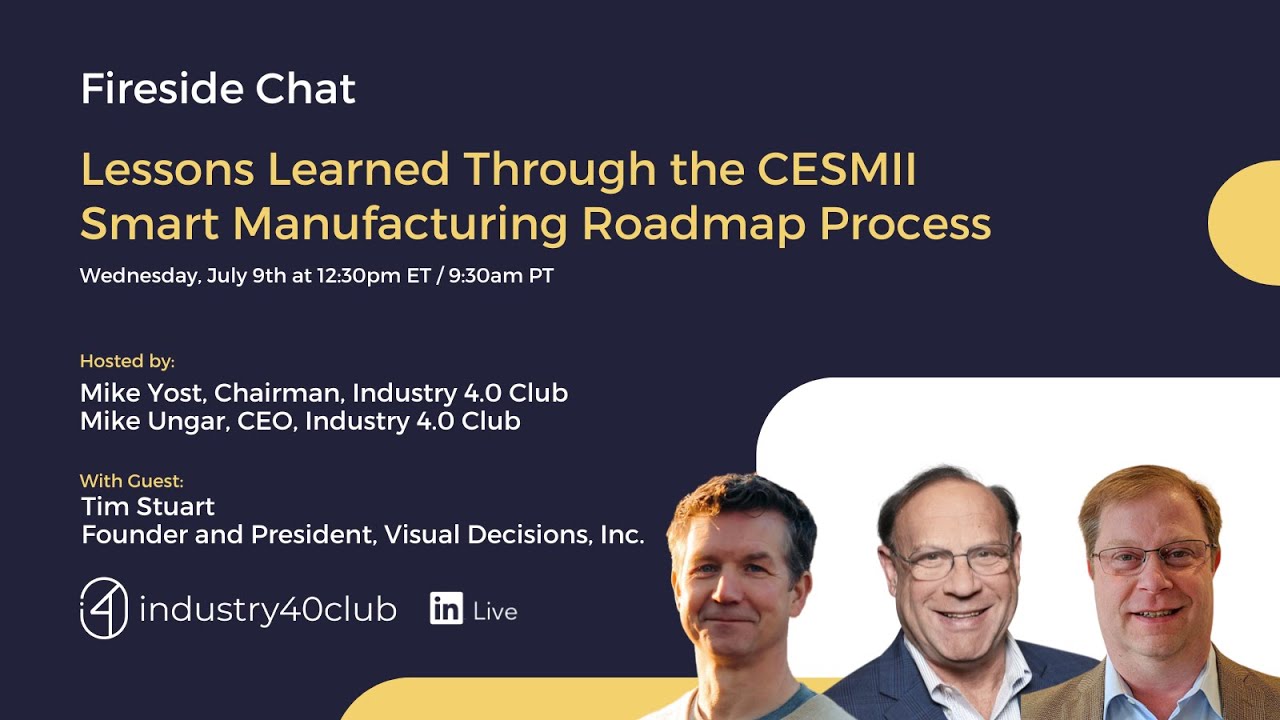
Tim Stewart, president of Visual Decisions, walks through the CESMII Smart Manufacturing Roadmap process: a structured assessment that takes 20 questions, interviews, and gap analysis to build a phased technology plan. It works for shops of 18 people up to 10,000-employee companies across any manufacturing type. The facilitator guides but the manufacturer owns the roadmap.
Chapters
Welcome to the Industry 4.0 Club's fireside chat. The club's purpose is to engage the power of diverse worldwide talent to accelerate the global evolution to Industry 4.0. We accomplish this by hosting and supporting respectful, thoughtful, and interdisciplinary open conversations and creating quality content on wide-ranging Industry 4.0 topics to expand the reach of our community. My name is Mike Ungar, and I'm the CEO of the Industry 4.0 Club. I have over 40 years of leadership and manufacturing experience Most of that with Michelin. I'm joined today by my co-host, Mike Yost. Mike is the chairman of the club. And Mike, would you introduce yourself, please?
Sure. Welcome, everybody, and thanks for the intro, Mike. My name is Mike Yost. I'm the volunteer chairman of the Industry 4.0 Club. Been in industry about 35 years, first half of that on the industrial solution provider side, and the last 15 years on the industrial nonprofit side. So really excited to have both a subject matter and a subject matter expert that are close to my heart. We'll be talking today with Tim Stewart about smart manufacturing roadmapping. If you haven't met Tim before, he is the president and founder of Visual Decisions, Inc. He's been working with companies across industries for more than 25 years. to help optimize manufacturing and other business operations, leveraging both Lean, Six Sigma, and digital or smart manufacturing tools. He's been at the forefront of solving problems for companies by helping them apply new capabilities to fundamentally improve their overall business process. Today, we're going to be talking with him about the SESAME Smart Manufacturing Roadmap process. He is a certified roadmap professional. He's also an executive mentor for roadmap professionals and some of them I work with closely. And so, Tim, we are very happy to have you here today.
Happy to be here.
And before we— just want to say also that for those of you that are on LinkedIn Live, if you have questions, please go ahead and add them at any time, and we will do our best to get to them if and as they fit with the flow of the conversation.
It occurs to me that one of these days I'm going to have to update that bio to say say, working for— with customers for 30-plus years now. So, yeah.
Yeah, time keeps moving.
That happens quickly, unfortunately.
It does.
So if we jump into our topic, Tim, I was curious, you know, how did you get— so the SESAME Smart Manufacturer Roadmap process has been around for a couple of years now. How— what motivated you to get involved in that? What was the trigger for you?
It aligns very closely with how I've been doing business for those 30 years now. Yeah, I strongly believe in beginning with the end in mind, starting with the big picture, and working my way backwards from what are the overall goals of the business to, you know, what should we be doing from a smart manufacturing perspective?
and so forth.
And so I've been working with my own process that I developed decades ago of how to do that analysis and help companies get started on that journey. Mike is actually the one— that was ambiguous. Mike Yost is the one that introduced me to the SESAME process. And it aligned very, very well with how I've done things in the past. And so it seemed a very natural fit to get involved with that process and really adopt an industry standard that has been developed by SESAME and other experts in the field and approach that from that industry standard point of view, utilizing common tools and helping to develop a common language across industry.
So, Tim, you and I work together closely on a number of different projects, especially leveraging the roadmap process. And I guess just for others' sakes who may not know, SESMI is the Collaborative Ecosystem for Smart Manufacturing Innovation Institute, which is basically the National Institute on Smart Manufacturing. And so they have this toolset, and 3 of us here are familiar with it and advocates for it. And I guess, Tim, for those who are not as familiar with it, can you talk about the companies you're engaging with and, you know, sort of where it fits? Are there places where it doesn't fit? Is this a big company thing? Where are you seeing the toolset apply?
So I've seen the toolset applied to companies that have 18 people, and I've seen the roadmap applied to companies with 10,000 people. So it really applies across that entire spectrum, and it also applies well because the toolset is focused on those business outcomes first. It really applies across industries as well. So anywhere in discrete manufacturing, anywhere in process, batch, etc. I strongly believe in it for pretty much every company, I guess. And that even applies, you know, no matter where you are in that journey currently as well.
Yeah, and I think— so we are working in Northeast Ohio where I live to try to build A community of practice, essentially, for companies that are learning this language, as Tim talked about. And we have seen folks that are not sure why they're getting into it and sort of stumble and fall, and then other people just grab it and run with it. Maybe one other point to touch on is the fact that while I am in Northeast Ohio and Tim happens to be a Cubs fan living in Chicago, Yeah. The toolset is designed to be light touch and to be supported remotely as well. So maybe talk a little bit about sort of the engagement methodology, and if there isn't a Roadmap Professional right around the corner from you, that this is still a potential option for folks. Sure.
So the toolset was developed actually right before COVID happened. And then once COVID happened, the toolset was adjusted So that can actually be done completely remotely. And I, when I perform the roadmaps, I'd like to get out to the customer. I'd like to be able to see the process and talk to the people in person and so forth. But that's not a required part of that process, and I've done some that were completely remote as well. What was the other part of the question? Oh, the overview of the process. So what we're trying to do is to fundamentally understand the current state of the business. And we do that through a couple of different tools, one of which is a survey tool. It's got 20 questions. It's not a huge investment of time, but we try to crowdsource the results from within the company. So we want really broad participation and get that input. from the different teams. And then we take that output and that helps us to determine what are the questions that we really want to dig into to understand the reasons behind where the business is, where it is today. And so we go through that interview process to get a more robust picture of the current state of the business. From there, we're trying to look at the future state and where do they want to be 3 years from then? And that's going to help us do a gap analysis between where they are today, where they want to be. And it also helps us to inform the business case process where we're looking at what is the potential value from addressing their current challenges and so forth with what is that worth to the business to make the decisions on investments and so forth. With all of those different things put together, the current state, the interview process, the future state, the business case, now we're looking to actually build out the roadmap itself. And so we look at defining programs across different business dimensions, define initiatives within those programs, and, you know, an estimate of the value, and then we put those into a now, next, or a future category. For when we want to time phase those different initiatives. So that's the, what, 3-minute overview of the process.
So that you've talked about what the process is. I think one of the things, if I could step back a half step, I'm curious, why would a company need this? You know, why don't they just like take the phone call from the next great vendor that comes in and That can solve one of their problems. No, that can solve one of their major problems and just go do that. Why would I want to go through this process if I'm a manufacturer?
So the next great vendor is not only calling the company as a whole, they're actually calling one specific person within that company. And so they may be calling the plant manager for, you know, your Spokane plant. Meanwhile, you have a different great vendor that's calling, you know, the plant manager for your Indianapolis plant. And it's different vendors, they're talking different things, but the same general area. And so if you don't approach this with that holistic picture of where you want to be in, you know, in your mind, you have the potential of ending up with A mess. Lots of different systems doing lots of different things that don't talk to one another, that are on different platforms, that are implemented in different ways, different data architectures. And you end up with— I had one customer that I worked with a few years ago that in 9 plants had 57 different systems for quality alone. And That's not where you want to be. So you don't want to just pick up the phone, talk to the latest greatest vendor, and do your own thing. You want to do it within that overall framework.
And so the process that, that you have, the assessment process, allows you to address those kind of issues and find those types of challenges?
Absolutely. And so one of the good things about the process is That you start with that end in mind, but you're not defining what vendor you're going to look at for a particular thing. You're looking at the capabilities that you're trying to add to the business. And so one of the key things is that you're building that overall picture first, and you're determining what are the capabilities that you need to add, and then that puts you in a position where you can start to execute and pick what are the solution vendors that I want to put in place for those different capabilities. But essentially you've got a good map in place to go and look for those solutions, making sure that you're handling the needs of the different parts of the business.
So I've heard it said instead of, you know, ready, fire, aim, which happens a lot of time with these types of solutions and burning need, Right, they're realities we're faced daily, right? And so people need to solve a problem, they grab a solution, they solve the problem. And what the roadmap does is more of the ready, aim, fire, make sure that you're, you know, considering implications like some of the points that you already mentioned.
Yep, absolutely.
I guess one of the things that always occurs to me, especially now in Being in the nonprofit world as long as I have, I've been fortunate that I get a lot of vendors that come to me and share what they have and what they're doing. And there are times when I literally think, wow, this is great, they got it right. And here's another one, like, this is just phenomenal stuff. And I start to think, boy, is our approach outdated, right? Should people just grab it and go? And then the next day there's another, and the next day there's another. And now it's AI, and now it's everything's AI, and it's moving so fast. And the more those technologies come at us, the more it reaffirms to me that having the language as a company to talk about where those things fit in the context of your business priorities makes more and more and more sense. So how are you seeing the response Like, how's that resonate with the people that you're working with? Are they recognizing a value that they— that they're in a better position to figure out where technology can support them?
Are we talking about before they do the roadmap or after they've completed it? After. So after they've completed it, they're absolutely— I can't think of any company that's gone through the roadmap and gone, that wasn't waste of time. They've all been extremely positive afterwards, setting, you know, their strategic plan for the next 12 months, looking at how they're going to approach technology upgrades and so forth, even, you know, how they're going to approach something like lean manufacturing and whether that should be a part of the roadmap and so forth. Because I should have emphasized earlier, what we're looking at isn't just the technology. When we talk about capabilities that we want to add to the business, technology is definitely a part of that, but we're trying to look at that capability holistically and looking at that to say, are we good at problem solving? You know, do we have a consistent process by which people can identify root causes and put solutions in place? Do we have a way of identifying waste within the operations and eliminating that over time? And so the roadmap is looking at those aspects of things as well as the technologies to put in place. And so while the latest and greatest, you know, mousetrap is wonderful, what we're really trying to look at is how can we help people work more effectively over time? And coming at it from that point of view, certainly we want to look at what is available from a technology perspective to assist with that, but we also want to look at the processes of business and so forth to really put a whole solution in place.
Yeah, I'll add a commentary from one of our co-founders of the club who taught— who is a solution provider. And he talks about the fact that the companies he sells to are, as an example, a chocolate chip— well, if from an analogy perspective, the company itself was a chocolate chip cookie manufacturer, that his solution represents a chocolate chip. And there are so many broader things that need to be considered within the context of a company that if a solution provider is not taking the broader context into play, they're probably doing you a disservice.
Tim, I would like to just— we got a question from our audience, which I think would be interesting to share up on the screen from Kurt. Kurt asks, how do roadmaps address the need for adaptability and resiliency?
What we're looking at when we put the roadmap together is, again, we're starting from the end. If adaptability and resiliency is important to an organization, then those— that's part of what we look at as we look at, you know, how do we define the current state? What are the challenges that they currently see in terms of adaptability and resiliency? We're trying to uncover, you know, what are the opportunities? So if you become more adaptable and resilient, what is that going to help you do as an organization? And if we determine that that's, you know, part of that North Star, if that's part of what the organization is really trying to achieve, then we can look at things like how do we, from an adaptability point of view, how do we minimize setups for the organization so that we can move from one product to another much more easily, so we can be more agile and capture perishable demand and things like that, so that if we have supply chain issues, we can turn on a dime and, you know, make a different product that we're capable of making based on the materials that are available to us and so forth. And so if we understand that as part of the drivers for the business, then we can align the roadmap to achieving those goals.
Yeah, I think too, I'm going to— I would just add, thank you for that. I think I would just add to Kurt's question, your response. You know what, I think about the roadmap a little bit like a standard. Okay, we're putting in place a plan, and when we have a plan in place that we're following, If the assumptions we made for the plan require a change, well, then we know what we're trying to do. We see that maybe there's a disconnect now because something's changed in the environment. Well, now we're respecting that plan as a standard and we're able to adjust. I think it creates a bit more— we talk about resiliency, it creates a bit more rigor around Hey, we had this plan, something's changed, what do we need to change to? And of course, we also talked about the roadmap's meant to be a 12 to 18 month roadmap, typically, if I'm correct in the timing. And so it's not meant to be a once-off over time, you keep refreshing it. Yeah, your thoughts on that?
The roadmap is meant to be essentially a 3-year horizon, but you refresh it on an annual basis. Because business conditions change, the people within the organization turn over, you have different technologies that are available and so forth. And so you do want to refresh that on, you know, a 12 or 18-month basis. And interpreting the question more along those lines in terms of adaptability and resiliency of the plan itself, you know, I'll liken it to an actual roadmap. So— When you're traveling from Chicago to, I don't know, Miami, I'm thinking wintertime. I want to go someplace warm.
Okay, not Cleveland.
You know, you're going to start off with a certain plan in mind. There's a certain path that's going to be the shortest and most reliable path to get from Chicago to Miami, but You know, there could be accidents on the road, there could be construction, there could be any number of different things, and you want to have that adaptability so that as you're driving, Google Maps will now say, hey, there's a problem up ahead, let's, you know, divert and take this path instead. And I think that you still want to start with that roadmap. You still want to make sure that you Head off from your home in the right direction and you're going in, in the general path you want to go in.
Yeah.
But yes, you want to have that adaptability so that you can divert when you need to. And I think that the roadmap gets you heading in the right direction, and then taking that periodic look at things helps you make those adjustments as you go. As you're executing against that plan.
Yeah.
Well, and if I could jump in for just a second, Mike, the, you know, what I've seen primarily through the work that Tim has done is that when you have something like an objective of being more resilient, right, or being more adaptive, then that gives the company the opportunity to talk with everybody that's dealing with their problems in their departments and the solutions that they're looking at. And so now you have sort of a North Star where you can point to and say, how does it help us reach this goal that we know at a higher level is important to all of us and have some level of understanding that it fits or it doesn't fit? And if it doesn't fit, what do we need to do about it? So I'm wondering, Tim, if you could talk a little bit about What it takes to succeed, right? Like, because, um, I'll state this doubly emphatically, and, and then, um, like, this is not a consulting gig, right? Like, Tim does not come in and write a roadmap for a company, right? You come in to help them learn the tools and use it themselves. So it is work on their side. Can you talk a little bit about that, um, the fact that it's theirs and, and what it takes to succeed and the kind of work it takes for the manufacturer themselves?
Sure. So I outlined the process earlier, and I'll say that at the beginning of the process, there's a lot of work from whoever's facilitating. And I want to use facilitator as opposed to consultant as I do this explanation. So the person that's facilitating the process up front does a lot of work because you're running the survey, you're Collecting the results, you're, you know, building out the analysis of that survey coming from the different people in the organization, you're conducting the upfront interviews and so forth and gathering that current state of the business information. But from that point forward in the process, you want to make it more and more the customer's actually building that plan, the manufacturer is building the pieces together. As a facilitator, we're contributing our knowledge, we're contributing what is the current state, what's the art of the possible, but it's really up to the manufacturer to say, here are the things that are important to us, here's how it ties into that overall objective or North Star, and this is the plan that we want to run with. And it's important to have them build that and have that ownership of that plan Because the next step is actually going out and executing it. And I don't know about anybody else, but when I develop a plan, I'm much more likely to actually execute it than when somebody hands it to me and says, here, go do this.
So, you know, it's, uh, they're just touching on something that, um, going back to Mike's question about sort of the things needed to succeed. You know, I grew up in plants with big plants with, and we had structures in place to project managers and people that could manage roadmaps and the execution and that kind of thing. You described earlier that you've done this for plants the size of 18 people, and I don't imagine that there's a dedicated—
No.
necessarily project manager or engineer or industrial engineer that can lead this roadmap. So For those smaller plants that don't have the, the continuous improvement sort of infrastructure in place, how do they manage the execution of this roadmap?
The roadmap or the execution of the roadmap?
Well, development first, but then execution, obviously, because, you know, when you say 18 people, I can imagine all 18 are involved in executing it. I don't know.
Yeah, so I'll talk to development first. On that side of things, you know, work— I'll just take that small company as an example. They had a younger engineer that was pretty much straight out of college that was part of this, and essentially the owner of the business and that young engineer were the people that were essentially the core team for the project.
Mm-hmm.
And they coordinated with the other people to get them involved in the surveys and to, you know, run— help me run the different interviews and schedule those and so forth. But after we did that process and we educated ourselves on the current state of the business and we understood where they want to be in 3 years from now and so forth, it was really me working with the 2 of them to put that plan together. And they relied on me for that art of the possible and, you know, bouncing ideas off on different initiatives and so forth, but it was really them putting that plan in place. From an execution point of view, we finished up that roadmap in December of '24, and the owner basically took that strategic plan. Took that roadmap and used it as his strategic plan for 2025. So he's taking the roadmap that we built and he's using that now to execute for his company this year. So the things that we talked about in terms of building up the lean practice, he has really run that himself internally in terms of helping his management team Learn lean practices and so forth, getting them educated kind of on the side and so forth, and laying the groundwork for that transition. In terms of executing with the software, you know, he ran a vendor selection based on the criteria that we had discussed as we were going through, and that looked at addressing the challenges that we documented as part of the process. And once that vendor was selected, the vendor came in and helped get this solution up and running. And then he's done a really good job understanding the fact that it doesn't actually improve the process itself and that they have to now use those results coming from the software, the data and information coming from there. In, you know, shift handoff meetings, in, you know, the standup meetings and so forth, looking at that as integral into the problem solving they do.
So, well, and Tim, I would say too, to an earlier point about vendors showing up with solutions, if I'm thinking we're talking— I'm thinking I know the company you're talking about. They're not a company that likely had vendors knocking on their door.
Right.
So you talk about isolated and alone, right, with nothing but a computer and Google to go find out what the heck is going on in this space. I think it's pretty powerful to think about actually having a toolset that you can work through that process now, have your teams aligned, and, you know, prioritize and justify doing projects that then bring the vendors in to support. Yeah, I guess just one another question that comes to my mind that I'm thinking folks might have is you mentioned it's teaching them to learn the tools, not doing it for them. There is education available, right? Manufacturers could go take classes themselves. So maybe talk about that for a second. But then secondly, what's the typical timeframe? You said that it's up to the manufacturer to own it and drive it. Is this a 2-year project? Is it a 2-month project? Somewhere in between?
Okay, so the education part first, please. And if I forget the other part, remind me.
I get you.
So on the education piece, there's a class available through Rensselaer Polytechnic Institute, RPI. That certifies roadmap professionals. And so you end up with a certificate from RPI, from SESAME, that says that you have completed that process. It's an 8-week class. You meet once a week and do a fair bit of homework in between. So that process is out there. There's cost associated with it. It's not very much. I think it's about about $2,500. And I'm also an instructor for that class. So happy to see anybody there.
In terms of the second half of my question—
Second half of the question?
No.
How long does the process typically last?
There you go. That has varied wildly in my experience. I've had someone get it done in essentially a few weeks once the initial survey was complete. They had 73 people take the survey and it took them almost as long to get all the people to take the survey as it took them to finish the rest of the steps afterwards. But I've also had a customer that is now on their 7th month of the process.
Yeah.
So, but they're almost done. They should wrap up by the end of July, so they won't go any further than that, I don't think. But it's really up to the customer. It's, you know, it's meant to be about 40 hours of actual time, work time for the person facilitating the process and significantly less than that for the core team and even less than that for the people that are just participating in surveys. It's a relatively light lift for the organization.
I just want to add though, I would say when I've been talking to folks, I'm trying to say, let's target trying to do this in 3 months. From start to finish. So including taking the assessment, getting like you did those, that crowdsourcing, because that takes a little bit of herding cats sometimes.
Yep.
But, you know, I think, I think it's important for companies interested in doing this that they go into it with a target to do that in relatively short order, in a few months like that, in 3 months, because it creates momentum too, right, for the For getting the project launched and getting— or getting the projects launched, getting the work done. So, you know, there's the risk in the longer period of time as you lose some of that momentum that you gained initially with the crowdsourcing and the questionnaire. So I just share that as another way to think about it, or at least when I try to talk to folks about it.
Well, touching on something that you just said there, when you start this process and we go through that process of crowdsourcing the results from the survey. As a management team, you're kind of setting expectations that, hey, this is something that we're going to be looking at, something that we might be embarking upon.
Yeah.
And people are going to want to know more, and they're not going to want to wait 6, 12 months to find out more. And so once you embark on that process and you ask people to participate in that survey and so forth, you owe them some response and follow-up of, here's what we're actually going to be doing.
Yeah, no, thank you for that. Just for our audience, we've been talking for the last 30 minutes or so with Tim Stewart, who's the founder and president of Visual Decisions. We're going to call him one of the gurus now of the SESAME Smart Manufacturing Roadmap process. As Tim has mentioned, he's an instructor and an executive coach or mentor for those doing these roadmaps and has done several himself. Tim, as we get ready to wrap up our time together, do you have any final thoughts for the audience about what we've talked about, about the roadmap process?
Fundamentally, it is tremendously valuable for your organization. I think at one point I Started talking about the fact that no matter where you are in your smart manufacturing journey, that it's a good thing to look at, and I haven't really touched on that anymore. Even if you've implemented some different things within your company, I had a conversation with a wonderful woman that runs a company up in the Northeast. And she looks at this as always knowing what comes next. So even after you, you know, implement a system, even after you, you know, start your lean journey and so forth, understanding what comes next and how that process is going to flow so you can start prepping for that next step as you're executing against this one. is very important. So whether you have done absolutely nothing or whether you're already, you know, taking some steps along that path, I think that it's a really good idea to create this overall picture to understand where you want to end up so that you can take the appropriate steps and you always have that idea of what comes next as you go along.
Thank you. That's great. Thank you for that. So as we wrap up today, I want to thank Tim for joining us to share his experience with companies implementing the SESAME Smart Manufacturing Roadmap process. And thank you to Kurt also for his question. That's been very helpful. The Industry 4.0 Club would like to encourage you to take action to advance the deployment of Industry 4.0. So read an article, attend a workshop, or even, gosh, shall I say, develop a smart manufacturing roadmap, right? for your platform company, or challenge your leadership to do that as well. We, we think that that can only help support the advancement of Industry 4.0. We'd like to know what you're doing, so please drop us a note, um, on our webpage at, uh, www.industry4oclub.com or our LinkedIn page. The club also hosts conversations like these on LinkedIn and, and YouTube weekly. Thanks for these conversations. I think you have something to offer our audience. We'd love to hear from you as well. Please drop us a note and offer your expertise. And with that, thank you, Tim. Thank you, Mike. Go ahead.
I think Tim had something to add.
Yeah, I had one last thought pop into my head. If you are a small or mid-sized manufacturer and you are thinking about a roadmap, please Keep in mind that wherever you are in the country, there can be some funds available to help actually pay for the roadmap and pay for a facilitator to help you with the roadmap. And if you have questions about that, please reach out and, you know, I can help you with it.
And I think, Tim, also you, you do have resources, frequently asked questions, and other things posted under your profile on LinkedIn, right?
Yeah.
Okay. Yeah.
So check out Tim on LinkedIn as well.
Perfect.
Thank you, guys.
Thank you so much for taking the time to join us today, Tim and Mike. And we wish everybody a good, a good day and a good rest of the week. Thank you.
Thanks, everybody.
Bye.










