Leveraging Digital Technologies & Leading Cross-Functional Collaboration to Optimize Supply Chain
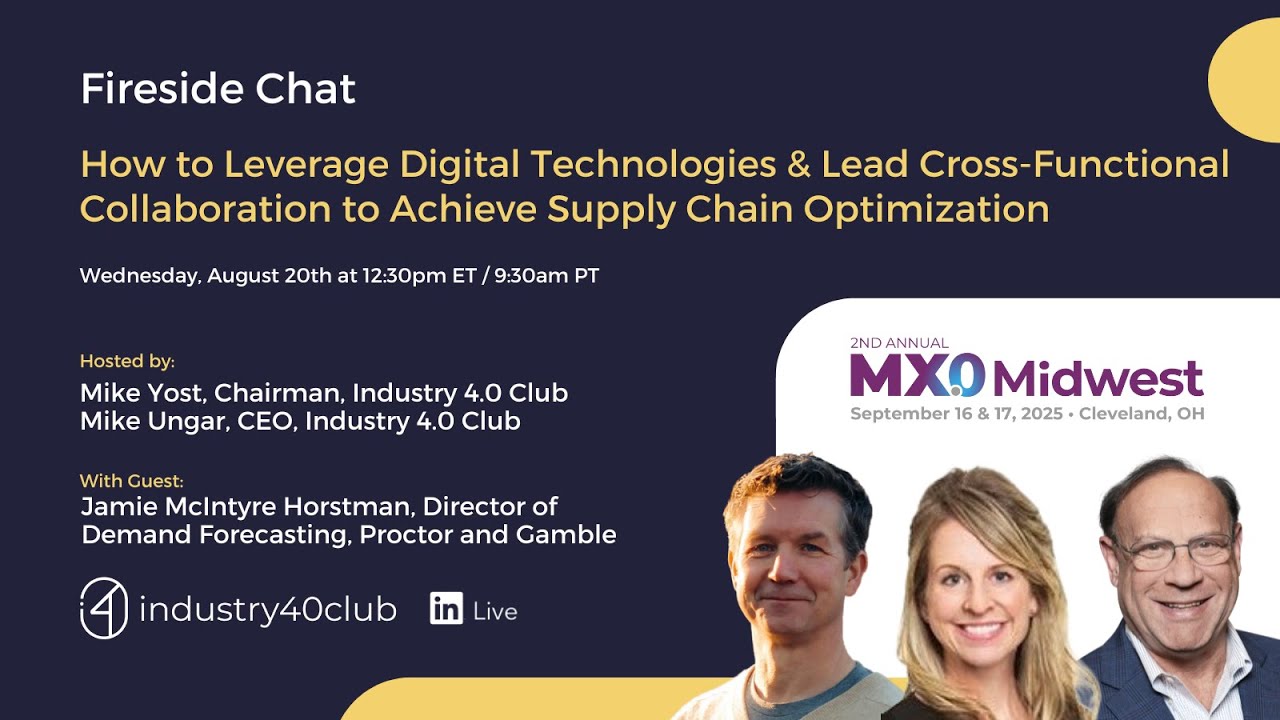
Jamie McIntyre-Horstman, Director of Demand Forecasting at Procter & Gamble, shares how she uses Tableau and Power BI to anticipate Amazon pricing spikes and build out-of-stock dashboards for Kroger. She built predictive models that account for panic-buying and port strikes, but stresses that technology only works when sales, brand, and supply partners meet weekly to align on forecasts.
Chapters
Welcome to the Industry 4.0 Club's fireside chat. The club's purpose is to engage the power of diverse worldwide talent to accelerate the global evolution to Industry 4.0. We accomplish this by hosting and supporting respectful, thoughtful, and interdisciplinary open conversations and creating quality content on wide-ranging Industry 4.0 topics to engage the reach of our community. My name is Mike Ungar, and I am the CEO of the Industry 4.0 Club. I have over 40 years of leadership and management most of that with Michelin in manufacturing. I'm joined today by my co-host, Mike Yost, who's chairman of the club. Mike, would you mind introducing yourself, please?
Not at all, Mike. Thank you. Welcome, everybody. My name is Mike Yost. I, as Mike said, I'm the volunteer chairman of the organization, one of the co-founders, and Mike's co-host here on the fireside chats. I've been in industry for 35-plus years. With the last 15 being on the industrial nonprofit side. And our work here is, as Mike said, to share voices about Industry 4.0 and the value that can be realized by understanding and adopting the practices and technologies. So we're really excited that today we have with us Jamie McIntyre-Horstman, who's the Director of Demand Forecasting at Procter& Gamble. Jamie will be at the MX.O Midwest event being held in Cleveland, Ohio on September 17th, participating in a panel discussion entitled How to Leverage Digital Technologies and Lead Cross-Functional Collaboration to Achieve Supply Chain Optimization. Jamie's a supply chain leader helping Procter& Gamble companies grow both the top and bottom lines through improved service, lower cost, and efficient delivery of innovation. She currently leads supply chain for Procter& Gamble's Febreze business, managing over 575 SKUs and 300 customers across North America, using her personal grit, talent development, and data analytics to solve problems at every node. So forward to the conversation here with Jamie.
Thank you. Thanks so much. It's Nice to be here.
Yeah, before we get into the, uh, talking with Jamie, I just want to just talk about a bit about MXL Midwest. It's really become the go-to gathering for manufacturers in the region to connect, collaborate, and learn from real-world examples of successful digital transformation shared straight from the horse's, or if you will, the manufacturer's mouth. Beginning in 2024, the event has empowered local manufacturers to advance their careers and businesses through valuable knowledge exchange and impactful networking opportunities. We're excited that Jamie is going to be there. For those of us listening today on LinkedIn, if you have a question for Jamie, please put it in the comment box and we'll do our best to get it to her during our broadcast for her to be able to respond to that. Again, Jamie, welcome. Just to get us started, being the Industry 4.0 Club, A real quick question for you. How does industry— how has Industry 4.0 changed supply chain management from your perspective?
Well, Industry 4.0 to me is all about machines improving productivity and improving the visibility of our supply chain and doing it at a very accelerated pace. If I think about productivity, it's taking repetitive actions, predictive tasks, And automating them so they can be done without humans intervening. I think about this as physical tasks. I think about this as mental tasks. So it can be a robot that's stacking pallets, but it also can be an automation that is creating and publishing a daily report and frees up 45 minutes of time of a person every single day. I don't think of this as replacing humans. I think of this as being able to elevate the work that we get to work on. So what we get to focus on now is much more strategic versus being extremely tactical in nature. I also think from that standpoint, it has a bearing to say that it has impacted how we think about our organizations. So a lot of some of the mundane or menial or repetitive tasks have now been automated, and we now need more and more people in the data science and in the data engineering space to help keep up with the pace of the need for that. So we might have shifted some resources now that used to be doing tasks over here and either given them the skills that they need to be data scientists, or we've had to kind of reorganize and hire more data engineers and data scientists. And I think we're still on a path, like we're not there, like we still need to be adjusting the organization to meet these kinds of needs.
I think that's really insightful. And I think, you know, oftentimes a lot of the work that we do, we engage with smaller companies that, you know, not the size of a Procter& Gamble. But one of the things that I always point to that I think is impressive is that point that you're making about organization and how things like this impact the organization. I think there's a lot of things that companies can learn because you are thinking this way and your company is making changes. I'm sure a lot of the smaller manufacturers are scared to hear about data analysts and data scientists and things like that. So what would you recommend for folks when they start to think about applying digital technologies for their supply chain?
Yeah, I mean, this makes me think back to maybe 10 years ago. And a big theme for the culture of the organization I was leading at the time was that we all have to improve our skills in this space. So, trying to go out and hire a whole new team of data engineers is not where you need to start.
Hmm.
But you need to take on some of the tools that exist today and that have existed. I think of— these even seem like very dated tools at this point, but at the time it was Tableau, it was Power BI, etc. And I basically taught my entire team how to use both of those tools. And it improved their lives and their productivity instantaneously. And so I think you can take it off, you can take small bites like that and just introduce some of these legacy tools that can, that can at least help improve the productivity. And once people get comfortable with that, then taking the next step doesn't feel like quite the leap that maybe looking at these platforms and these solutions that exist today could cause you to feel like.
Yeah, you know, it's— that's interesting you mentioned that. It's, you know, having— you're in a large company, and I know my background's in a large company, and a large company can afford to, to be forward-thinking in that, can hire, can have resources to help, you know, have people that have been with them for a long time. But these smaller companies, it's funny when you mention the tools you just did, that could be for them their, their step now.
Yeah.
And they go, wow. You know, you know, it's so much— it's not so much why they didn't do it 10 years ago. It's let's get started now, you know, because it could be a huge difference like you alluded to. I'm sure at that time the steps that you made even with that were pretty significant.
Yes, absolutely. I completely agree with what you just said. I do think that the smaller companies can take advantage of some of these legacy platforms that have existed now for 10 or 15 years. And now they're very affordable and they're very achievable and they're very within reach of almost anyone in supply chain of being able to figure out how to use quickly and how to make their lives easier and how to improve their productivity.
I guess just a quick question on not the technology side, but from a business practice perspective, how much of your time or the company's time is spent in working with supply chain partners You know, to bring them along, be part of the process, you know, whether it's learning these types of technologies or best practices or things like that.
Yeah.
Are you speaking of internally or externally?
Well, I guess, yeah, I mean, it depends on— you may have a lot of the, you know, the capabilities internally as well. But yeah, maybe even that as an example, if it's internal teams that are, you know, different, what have you.
So at P&G, we tend to homegrow a lot of our platforms and solutions. We will go out benchmarking and we will even tap into external sources like MIT. But a lot of times, whether it's, you know, a new demand algorithm or machine learning platform that we're building, we tend to kind of like grow that from within. Now the exception to that are big things like ERP systems. So utilizing SAP or a warehouse management tool or, you know, TMS, those are some of the big external platforms that we will definitely collaborate with folks on.
That's neat. Going back to the thought on those initial tools and kind of stemming off what Mike was asking, when you, when you did that, was that an initiative that you said, look, I need to take my team forward? Or did you get that direction from corporate? How did that get started? Because that's, that's pretty cool stuff, you know, that you actually yourself helped your team learn those tools.
No, it was— it really stemmed from, um, we had to be very lean and mean. Uh, we were a very— I was working at the time on one of our sales teams working with one of our large grocery customers, and we had a total of 4 people working the supply chain that was handling a $900 million business to Kroger. And it was— we were drowning. And so I was just looking for ways to make the work that we had to get done, be able to get it done faster and more efficiently. And so, yeah, I took the initiative to go teach myself Tableau and Power BI, and then I took the initiative to teach my team how to do it too, because I was seeing the benefits.
And I think what's really important about that, why I'm glad you shared the story, is that it wasn't somebody else telling you you should do that. It was— and a lot of small, mid-sized businesses are in exactly the same place, right? It was that, hey, as a leader, I'm working either— I've got a couple people I can work with, you know, I don't have to wait for someone to tell me, or Procter Gamble doesn't give me— you know, the company's not going to give me a bunch of resources. I can go do this and do it and succeed. And I think it's a really great takeaway and story to share. And I think the— I guess I wanted to bring that out because some of our listeners might think of P&G, well, I'm not P&G, but What you did is you thought like a small business owner, an entrepreneur, and said, I can take the leadership role and do this. And you did. That's great.
Right.
Yeah.
And being in that sales team environment, again, we were small but mighty, but it was the most entrepreneurial space that I have worked in in my career here at P&G. So I think it also was an enabling space for us to think that way.
That's cool.
I just want to remind everybody, if you've just joined us, we are talking today with Jamie McIntyre-Horseman, who is the Director of Demand Forecasting for Procter& Gamble. And if you would like to ask any questions or join the conversation, please do so by putting comments or questions into the comment field, and we would love to get Jamie's take on those things. Jamie, I'm wondering, We talk about Industry 4.0 and such, and are there data, supply chain data that you can capture today that wasn't possible before that are having a major impact that you're able to share about?
Yeah, I have a pretty unique example there from my last role when I was working on the facilities business. It has to do with our ability now can scrape the internet for unformatted data and compile that and format it in a way that can be extremely insightful to our business. And the example I'm thinking of that I can share is— and we're still working on this solution, but I know we will solve it— is that we had significant issues, and I'm sure a lot of companies do, with understanding Amazon's algorithm. Amazon's one of our biggest customers. And they— their algorithm for how they order our products can be very sporadic. And even the folks that sit with the customer directly can't really explain why the algorithm did what it did. So like, for instance, one day we could be cruising along, and the next day we could have them order 3 months of supply of one specific item. Right. And then we're out. I mean, because we typically in that business, we're sitting on, I don't know, max of 6 weeks of supply. So we're out and the supply chain's so long, it's going to take us months to recover from that item. So we just don't have any more of that to sell for 2 months. Well, nobody likes that because you're losing sales, you're just, you're disappointing customers, etc. But what we wanted to do, so clearly we would scramble and we'd make more and we'd get it there as soon as possible. But we wanted to prevent those outages. We needed to figure out why Amazon ordered so much of that. And it turns out that a lot of those instances were related to their algorithm scraping the internet and finding price comparisons. And if there was any type of deal out there that was, that was on an item similar or exactly like this particular item, it would automatically reduce the price on their website to match. And not even like their team would understand that that's happening. It's all happening behind the— in their algorithm behind the scenes. And so now we've been kind of on a mission to replicate what they're doing so that we can be triggered immediately if there is a potential pricing change that may take place. And we will immediately trigger additional orders of materials, additional production, et cetera, and adjust our demand profile to show this, that what we were expecting to come And then we'll be prepared and we won't run out and we'll get more sales.
That's fantastic. So I grew up in the MES space and just used to tell everybody that, you know, we used to get very traditional triggers of, you know, an order or a warranty recall or what have you. And, you know, now things have changed where you can get different signals from different places. make a product perfectly, but it gets out into the marketplace and social media picks up that people don't like it, well, then you better go back to the drawing board and fix that. So I guess a perfect illustration of, you know, how powerful these tools and these insights that you can gain are. So that's fantastic.
Yeah, that's really neat. It also reminds me, you know, at the end of the day, What you're trying to do is know your customer as well as or better than they know themselves, and that's understanding the market. And that's really— I think you're highlighting that today's tools can really help you do that. That's really cool. That's neat. So you've just shared one, at least potential success story from Improvency. Is there something else that you'd be willing to share that's kind of an example of a of a success you've had? Sure.
While I was on that sales team working with Kroger, I would say that was where I had my biggest S-curve to date on understanding the power of data analytics and utilizing the data to solve problems faster. And we did create something from scratch, basically, that took Kroger's— the focus was on out-of-stocks. Right?
Mm-hmm.
And how was supply chain causing out-of-stocks, whether it was on promotion for Kroger or whether it was, you know, just everyday available items? Because that was one of the biggest drivers of lost sales that we were seeing. And we built a tool that would actually take all of Kroger's out-of-stock data. But not only that, it would take our, our P&G internal cut data. So case fill rate data to Kroger, our on-time delivery data to Kroger, and several other inputs and combine it all together. And it would not only create a list of exception messages to us to say, hey, here are your biggest items that have been out of stock. It would tell us where. So what regions, what stores. It would tell us whether it was promotion-driven or just everyday-driven. And it would also offer solutions. So based on criteria that we kind of built into it, It would say, hey, you know, this appears to be a promotion-driven outage and the shelf holding power is not large enough to match the velocity during promotion. So you will either need to change the reorder point during promotions or offer a secondary location that you can hold more product, right? Like, so it would literally go to that level and suggest a solution. And this is where I think there's tons of power because I think right now, with all the acceleration of the data and even just getting to places where there's dashboards with data, it gets to the so what, right? Like, some of it doesn't get to the so what. Sometimes you're overwhelmed with the number of exception messages. You don't even know which one to act on. And then if you do try to act on them, you're like, okay, well, what do I do with this? How do I solve this? So I think that's the power of some of the acceleration we've seen in these tools.
Well, you know, it sounds like— I mean, I'm listening to you, I'm thinking AI, predictive AI. It's, you're using the data and now creating predictive models so you can anticipate what's going to happen and react to it before it happens.
Yeah, I mean, that actually triggered another example. We have not solved this one yet, but we are working on it. So recall COVID. So I now work mostly on our family care business, which is Bounty and Charmin, right? So toilet paper. And recall during COVID the spikes that we saw, the out-of-stocks that we saw, and the demand was just insane because people were pantry loading and afraid to run out of toilet paper. Well, we have now trained our consumers that any little supply chain blip that they hear of, they need to go buy toilet paper. And so even when we may not have anything going that would be impacted by that supply chain outage, doesn't matter. Doesn't matter. There is fear, there's panic buying. And so this has now happened at least 4 times since COVID So one of the biggest ones was during the port strikes of October last year. The surge was insane. We had an entire month of orders come on the books in like 2 to 3 days in October. We had a recent one. I'd call it a mini panic buy with the tariffs back in May when the tariffs were going back and forth and back and forth and there was so much uncertainty. And so now we're trying to build those examples into a model such that we can be more predictive of geopolitical, you know, occurrences that are being talked about in the news. And will we see some sort of panic buy associated with this? And if so, will it be more like a COVID or will it be more like a tariff? And so that we can be more proactive with that kind of a thing.
I'm wondering, again, I I mentioned earlier, I'm an old MES guy, so I'm on the plant floor side. And, you know, all of the signals that you're talking about harnessing and gathering can tell you, you know, now we need to go. Can you talk a little bit about, like, how much you have to work across the organization so that if you find that there's this new demand spike or something's coming, you know, you have a whole bunch of the organization that still needs to figure out how to go and deliver and deliver it? quality products at the right price points, all those sorts of things. So how much collaboration across the business do you get into?
It's all collaboration, and that will not go away. You can't replace collaboration with machines. The machines will make us smarter and more productive, but we still have to have the inputs from our customers, from our sales team, from our commercial team, like our brand team on what their plans are. All of those things have to go into it. But then there's also the downstream communication and collaboration that has to take place, like you said, as far as making sure our supply partners understand that we're putting these demand changes into the system so they're not surprised by it. And honestly, so that they can even be more proactive. I mean, our systems are still, I'd say, a little slow. We still operate on a weekly cycle of being able to really make demand, like significant demand changes. So if I hear today that a customer is going to add a big promotional event in October, and we're going to have to start building for that now, I can't wait until that signal to show up next Tuesday morning. So we have daily and weekly management processes that we use to have everybody in the same room to be talking about changes and to be coming up with solutions.
Well, and I can imagine Along with that, thinking back to at least my experiences, you have to have enough credibility because you may be asking people to do things that are like, Jamie, are you sure this is hard? You know, and that you're gonna have to be able to say, no, we're not sure, but I need you to do it because statistically it makes sense to do it, right?
Correct. Yeah.
Yeah. Not so easy sometimes.
Definitely not. It takes a while to build credibility. But I think that's why I love data so much, right? I mean, I use data in everything that I do, and that's how I present the situation, whether I'm talking to my sales team or my brand team or I'm talking to my supply chain partners. It's all about the data. And especially if you can go back to points in time in history that said, hey, last time they did this event, they did X, Y, or Z. This is what I'm planning to pass. It matches almost exactly. People kind of nod their heads and get on board and say, okay. Let's do it.
Well, it's a good thing you're talking about data because there's a question that just came in, Mike, if you see that, from Brian, saying, have you expanded your data insights to other parts of the business, or is that ingestion siloed? For example, has your sales demand insights impacted manufacturing operations or supply chain? Thank you, Brian.
Yes, we have a couple of different functions within P&G. One is called consumer market knowledge, so CMK. The other is our analytics and insights groups. And we work very closely together to take anything they're learning about our consumers and our consumers' habits and behaviors that might impact our forecast, as well as we— the A&I group does a consumption model forecast. So if we think about supply chain, we're typically thinking about what are we going to ship to our customers. But The A&I group takes it to the next level and actually forecasts what we think our consumers, our shoppers, are going to do at our retailers and how much they're going to consume. And then we have to come up— we have to do the mass balance of shipments, consumption, and trade inventory, the inventory that our retailers are all sitting on, and do predictive modeling to understand each month what do we think we're actually going to ship. So yeah, there's a ton of collaboration and insights that are gained from other organizations that we work on every single month as we can work towards our consensus of the forecast.
Sounds like so much work. I'm surprised you could take time to be here with us.
So as we're thinking about your being— the panel you're going to be on at MXO Midwest, what do you hope that folks take away from, from that session that you're going to be a part of?
Yeah, I mean, I think there's a couple things. One, we've touched on this a little bit. You've got to step outside your comfort zone to remain competitive. So you've got to, you've got to go out there and you've got to try something new. So the world is accelerating the space of digital technologies, automation, AI, machine learning, all those things. If it seems too hard to leap to AI and machine learning, like we said, Start small and start with something like Power BI that can make a huge difference right now and get comfortable with it and then move to the next thing. So I think the other thing I think I would say is if you're also kind of like hesitant to get into this space, start small with things like podcasts. There are so many supply chain podcasts out there. The 2 that I subscribe to the most are Let's Talk Supply Chain and Supply Chain Now. And their focus is on bringing in industry partners that can help introduce you to new technologies and platforms and solutions that are out there. And it's a very simple way to just broaden your horizon and learn more and kind of put your toes in the water of Industry 4.0.
That's really great. We advocate A lot of people, when they talk about Industry 4.0, they define adoption, so implementation of a solution as the point, the start of your journey. But I think the point you just raised as far as being on podcasts, sharing information like you're doing right here is an integral part of people getting started. I think that's really valuable insight that you're sharing there.
Thank you. We're reaching the end of our time together and to help us wrap up, Mike, maybe you'd share a final thought that you've picked up from today. And then, Jamie, maybe one last chance for you to share your final thoughts before we wrap up.
Yeah, I mean, a number of things. I've feverishly been taking notes, so I'm really looking forward to your panel, Jamie, and hearing you speak. Jamie talked about visibility and productivity and the organizational impact that The organization is learning how to be digital, for lack of a better term. I think that's really, really powerful. But probably the biggest takeaway is Jamie's passion around data and the value of having access to data, and then how you can turn the data into something of value. So really appreciate you sharing all of those insights, Jamie.
Awesome. Thank you.
Jamie, how about yourself? What would be some final thoughts as we wrap up for the audience today?
Yeah, I mean, I think we just all need to think about our organization and what is the organization of the future. Not just about staffing adequately in the data space, but where do we think we can actually shift roles from and to? And change the seats on the bus. We all need to embrace this in order to remain competitive. And so start small and, and grow as quickly as you can.
Well, that's fantastic. Thank you. Thank you for that. So thanks for taking time out of your schedule to share your insights, Jamie, in terms of digitalization and also supply chain improvements, and also for giving us a preview of your participation at MXO Midwest, which will be happening on September 16th and 17th in Cleveland, Ohio. We hope you decide to sit in for Jamie's presentation and join the club at the conference. If you haven't signed up already, here's the website. Please go there and register. We'd love to see you there. As you've heard some from Jamie, Jamie's one of many remarkable speakers that will be there, and I think you'll learn a lot. Anyway, just as we wrap up the club, as Jamie mentioned earlier, we want you to take some action. She shared a couple: listen to a podcast, for example, and read an article, attend a workshop, develop a smart manufacturing roadmap for your plant or company, or ask your team to do so. Either way, move forward, and we'd love to hear what you're doing. So drop us a note on our website at www. industry4oclub.com or on our LinkedIn page. We also host these conversations weekly, and so if you'd like to join us on a conversation, um, please, uh, drop us a note at either our website or LinkedIn page. We'll see if we can't organize that and have you on as part one of our guests. With that, Mike, thank you very much for the time. Jamie, um, sounds like you're doing some great stuff at P&G, so thanks for that. Thank you.
Wonderful. Thanks for having me. Thanks.
Have a great week, everybody. Thank you.










