Leveraging Kaizen for Future Centric I40 Advancements: A Paradigm Shift - Collaboration & Innovation
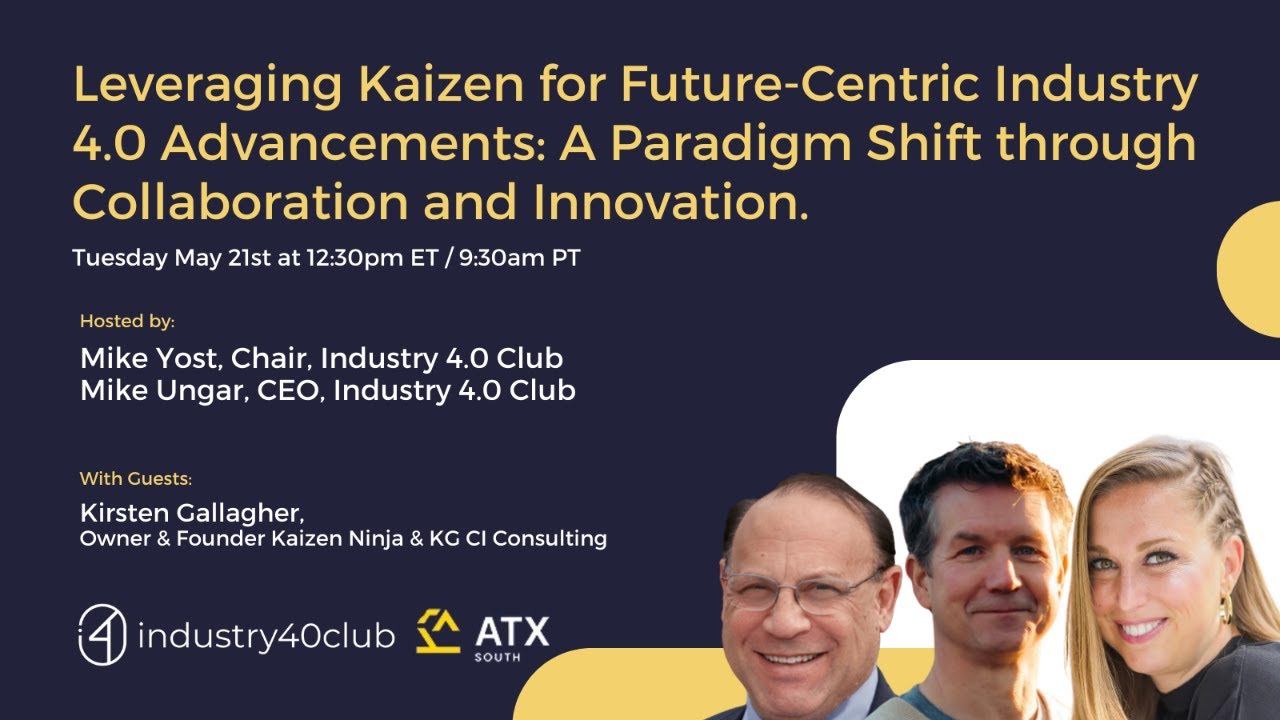
Kirsten Gallagher, CEO of Kaizen Ninja, discusses how Kaizen events are evolving with Industry 4.0 technology. Modern Kaizen targets 25-30% improvement in five days by combining process expertise with real-time data and AI, shifting from incremental tweaks to bold, team-wide transformation. She emphasizes that technology should support good process design, not replace the people and culture that drive change.
Chapters
Welcome to the Industry 4.0 Club's fireside chat. The Industry 4.0 Club's purpose is to help advance the deployment of Industry 4.0. We do this because we want companies in the US and abroad to be more competitive, to really sustain themselves and help our communities grow and flourish. Today's fireside chat is one of our broadcasts leading up to Informa Markets IME South event, which will take place in Charlotte, North Carolina from June 4th to June 6th. The Industry 4.0 Club has been busy putting together a fantastic group of speakers for the advanced manufacturing stage, and we're highlighting some of those individuals during the month of May. Our guest today is Kirsten Gallagher. Kirsten is the CEO of 2 rapidly growing organizations, Kaizen Ninja and KJCI Consulting— KG, excuse me. She's known for her passion and enthusiasm that she brings to process improvement. With a strong foundation in Lean and Six Sigma, Kirsten has spent most of her professional career leading high-impact process improvements, Kaizen events that streamline organizations, improve team morale, and lead to significant annual cost savings. Kirsten has a Bachelor of Science in Industrial and Systems Engineering from Rochester Institute of Technology and is currently pursuing her MBA from the University of Maryland. So welcome, Kirsten.
Thank you.
I'm joined today by my co-host, Mike Yost. Mike, would you mind introducing yourself?
Sure. Thank you. Welcome, Kirsten. Thanks for joining us here today.
Thank you.
My name is Mike Yost. I'm one of the co-founders of the club and Mike's co-host here on the fireside chats. I've been in industry about 35 years with the last 15 focused on the nonprofit side of things, and primarily the goal has always been to get folks like Kirsten engaging with manufacturers so that they can get answers to the questions they have about how they drive Thanks, Mike.
And I'm Mike Ungar. I'm one of the— also one of the co-founders of the Industry 4.0 Club. Today I'm a business coach and executive coach with Focal Point. I spent nearly 35 years with Michelin in a variety of continuous improvement, operations, finance, and HR roles. And like Mike, I'm really glad to be here to talk about Kirsten and what she'll be doing at IME South. For those that aren't aware, she's speaking on June 4th at 1:00 PM, and the title of her presentation is Leveraging Kaizen for Future-Centered— Future-Centric Industry 4.0 Advancements, talking about this being a paradigm shift through collaboration and innovation. Kirsten, we're glad to have you here to talk about that. You've been leading Kaizen events for several years. What are some of the things you do when leading an event to achieve the event's goal? Can you talk a bit about that?
Yeah, so, so much of the Kaizen events really start with the pre-planning phase in order to achieve goals. And so I spend a lot of team with leadership and the subject matter experts actually prior to an event to align on those goals and where we're headed for that future state. And we talk about incremental improvements, but we also talk about those giant advancements that are going to make a difference. And so when I go into an event, we already have in mind what some of the future of that organization is leading towards. And as we're working as a team, leading the team through each of the stages of Kaizen Event, we work on going back to those goals and identifying each day how we're going to actually implement the future state, design it with those goals in mind, and then align the improvements so that way we're successful towards those goals.
One of the things from my experience with Lean that we used to always talk about was really how important the actual goal setting is itself. We talked about it, I'm assuming it's the same thing for you. We don't want to just say improve by 5%, we want to improve by 50%. Do you run into leaders who get scared by those goals, and how do you handle that?
I do, especially because your Kaizen event typically is 5 days or less. And so when you put out this huge number, they're sometimes, they get really nervous and they're like, well, what if we don't hit that? Because a lot of times they're used to being held to the metrics strictly. But when you're in a Kaizen event, it's almost like no-risk opportunity. You're using 1 week of time, so the worst-case scenario you walk away with improvements that you weren't anticipating a week ago. And so I really work with the leaders to set goals that are challenging enough where their teams will actually think outside of the box. And that's what takes us into the future state in a much better way than if you set a 5% improvement goal. I would say on average, I coach my leaders in particular to set goals of 25 to 30%. For that 5-week period— I mean, excuse me, 5-day period. And we tend to blow that out of the water, actually. It's so neat to see the leadership change their mindset through that process as well as the team, because the team is there like making a difference instantly. And so they are— their mind is blown as they can actually make things happen that sometimes they've dreamed about for months or years. So it's really neat to see that shift.
And where does Industry 4.0 fit into your events and your projects?
Yeah, there are so many ways that it incorporates. So I've been in the industry for 20 years, and my background really is from medical manufacturing. I had 15 years of that in medical manufacturing, and so it is really neat to see how Industry 4.0 has shifted in that 20-year time period. and how it's focused in all continuous improvement that I've been a part of, essentially. The data that is available now compared to 15 or 20 years ago is just tremendously different. And so I feel like the foundation that I think is so valuable from Industry 4.0 is that access to tons and tons of data in a way that we used to have to manually do things like time studies. That paradigm has shifted, honestly. The second thing that I would say is coming from medical manufacturing, there's so much advancement in automation, and the high-volume automation is tremendously, like, unbelievable to experience. And so as I go into Kaizen events, for especially in that industry, it has been something that really drives that futuristic, how do we, like, philosophy with how do we actually support the human and automated interaction better? How do we actually progress to the future state with stronger automation? And how do we get ahead of the scale with regards to our innovation? Because we're not just trying, especially when it comes to manufacturing that takes months or years to develop, we don't want to just take one step in the future. We want to go multiple steps in the future. And so when we're able to innovate as a team through kaizen or continuous improvement in general, that industry advancement for 4.0 is just— it takes us to 2 or 3 levels further than what we were doing 20 years ago.
You know what I mean?
Oh yeah, absolutely. Yeah, been around a while and can relate to what you're saying about— I think one of the things that's powerful is the art of what's possible now. People are able to see that because, you know, you do have less infrastructure required, less time, less costs to start pulling information and using that for, you know, decision-making and Kaizen events and lean practices and things like that. So, and I think what's important, we stress here all the time, and it sounds like it aligns perfectly with your approach, is that you got to focus on the processes and put the technology in the proper place, right? You're not leading with a technology discussion.
Right. I 100% align with that. In fact, when you're able to streamline the processes to the future state, and then that's the foundation of your technology improvements, then you actually have the optimum opportunity to make a difference and advance within the industry or within your process across the board. If you're making the improvements for today's process or if you're automating for today's process, then you're essentially handicapping yourself for the future development.
And are you typically going in and complementing existing teams? Are you filling a gap that an organization does not have?
Actually, it's a mix. There are several organizations who I work with today who have a lean team, but they don't have the capacity or they don't have expertise in kaizen events specifically. And so I do a lot of support in that way. But then I also have some several clients who don't even have a lean team or process improvement team, and so I go in and I support them in a little bit more of a mixed bag. Sometimes it's a Kaizen event that I run, but then sometimes I'll run projects for them that help them develop throughout the process rather than just only one instance.
Well, that's really cool. It's, um, yeah, I get excited. Your enthusiasm is hard to Hard to contain, I can just tell. That's wonderful. So in your pre— I briefly shared the title of your presentation. I'll just say it again for our audience: Leveraging Kaizen for Future-Centric Industry 4.0 Advancements: A Paradigm Shift Through Collaboration and Innovation. You use the word a paradigm shift in the title there. What is the paradigm shift, and what makes it so significant from your perspective?
Yeah, so we actually started to talk about this a little bit, but I think the paradigm shift is now rather than making incremental smaller improvements, it's getting your entire team into a future state mindset, developing what that larger future state process is, and then automating and advancing from there. And I think it takes a tremendous skill set and a right mix of team members to be able to step outside of what today's challenges are and envision what that true future state is that will make a difference for 2 to 5 years down the line, maybe even more. And so that paradigm shift is really taking the leadership within the organization to construct a team that has that innovation, as a foundation already. They already are subject matter experts for the process. They're the engineers, they're the people who run the assembly line or the process that they're working on. They're also the leaders, and they're coming together and they're actually creating that space where they can think about the process from a totally new standpoint and then add a layer on top of that. That's the automation and the innovation and the data collection And all of that. And so that is a big shift because a lot of times, especially when manufacturing is up and coming and the smaller manufacturers are growing, a lot of times it's really hard to step out of today's problems that we're troubleshooting in order to get into that mindset. And so that is that paradigm shift where that's the ultimate innovation for the future and being able to utilize your team in a way that highlights their expertise and then also allows them to envision that next phase is just like the magic of where we're headed.
I just wanted to piggyback on that and tell you, anybody who's watching this, you need to get to Kirsten's event because you're aligning perfectly with some of the thinking that we have here at the club. And we're We're partnered up with the National Institute on Smart Manufacturing, which is called SESAME, and actually co-host an event with them, which is called the Smart Manufacturing Mindset. And so it is 100% aligned with what you're talking about. And we talk to business leaders who have figured out that they need to be involved in, you know, where they're taking the company and where technology fits and have an answer for for Industry 4.0 or smart manufacturing. And so it's a really, really important point that you're highlighting. One, it's engaging the leadership. Two, it's focusing on processes. And the thing I see, I don't know if you see this as well, but it's a lot, it should be a lot more welcoming conversation for manufacturers to have about where's your business going and how are you from a process perspective as opposed to saying, what's your AI strategy? Or where are you going with generative this? Or, you know what I'm saying? So do you find— I don't know, I guess it's lowering the bar to those types of conversations as I see them, or it should be able to do that. Are you seeing folks that are receptive to the technology conversation if you're leading the way that you are leading?
I am actually. It's been really neat to see that shift and people who are taking that step in that direction, especially as a leadership team. One of the things that actually has been a shift for me in my 20 years of running Kaizen events, early on in my experience, I would actually often do the pre-planning with leadership, and then I would chop leadership out of the conversation and focus on only the people who are doing the process in the room. And That there was a reason for that at the time. However, what I've found to be more powerful over the last 10 years in, in like that development of my Kaizen career is that I've really opened up the door to have key leadership people in the Kaizen with me because that actually sets the stage for that future vision for the company as a whole, and it shifts their mindset into that next version of what that advancement looks like. And so that has been a tremendous partnership that breaks down those boundaries. It changes the culture for the company, and it creates the possibility for the innovation from the top all the way through the people who are doing the work on a daily basis, whether it's assembly or production.
That's cool. Have you, have you run into, um, a scenario yet with folks that you're working with where the leaders have said to you, here's our goal, and We want you to find a way to integrate Industry 4.0 into the solutions as well. Has that been a criteria that anybody's given to you yet as a condition of achieving the target or a boundary?
They haven't phrased it in that exact way, but usually they have some, especially in the last year and a half where AI is a lot more current in our language. They have come forth and said, hey, how do we advance in this way? Or this is something that we're already playing with, can you make sure that comes up in the discussion in the Kaizen event? It's actually weaved into that, but it's not quite as blunt as the way you described it. Well, no.
I guess in some respects that's good because again, as we've talked about, we don't want it to be a goal to do technology.
Exactly.
Our goal is to solve the problem and use technology Appropriately to do that.
So, and I would also say through my Kaizen pre-planning process, we really focus on the metrics and the benchmarking, and then what will it look like when we hit these goals. And so we customize with the team, we customize what that solution will be based on what will really help achieve those goals in the future. And so I think That naturally weeds out some of the discussion of like pre-coordinating what the solution is or asking for that technology first, like without any questions.
You know, we used to call that— so when we get those sort of a we know the solution thing, you know, that when we were doing a Lean event, we would— or a Kaizen or a Lean Six Sigma event, we would say that's not really an event, that's called a go-do.
Yes, take action day is what I call it.
Just go do. Don't— if you don't need to, if you know what you want, go do it. Don't— let's not put a problem-solving or Kaizen event together to justify it. No, if you really think that, go do it then. Don't— let's not spend the time on this.
Exactly. We're totally aligned there.
Yeah, it's been for some time, there's been pushback oftentimes between sort of the lean community and sort of being anti-technology. So have you seen, or is that changing at all, or are you still getting pushback or hesitation from lean practitioners to even discussing or considering Industry 4.0 type technologies?
Yeah, I think this is such a hot topic right now, and I don't want to make anybody uncomfortable because I definitely see this difference. There's lean practitioners who are just really old school, and I think that the foundation that we have is fantastic, Lean, so one of the things that I think the beauty of lean practitioners is you can see the process, you can see it from a large scale, and you can also see the detail in a way that most people don't have access to. And we also are able to see the flow through the process, which is that, you know, pacemaker for the entire process across the board. Well, I think that when, when you have lean practitioners, who come in with that knowledge, mostly if they are 20, if they've been practicing for 20 years or more, they grew up where it was that manual time studies, it was the do not use any technology because we're going to write everything out, we're going to have the daily huddles that are surrounding the whiteboard every day. And those skills worked, they were great. However, I kind of think of it sort of like learning arithmetic So you can actually calculate in Diffie-Hellman when you're older, you know, 20 years down the line. So I think that that foundation that those lean practitioners have, it is invaluable expertise. But I think actually the way of the future is when we have those lean practitioners partnering with individuals who are younger and more on the technology side, because we actually can chop out waste from what we've done. And like the data that we talked about a few minutes ago, that's a perfect example. We have so much access to data across every single, you know, manufacturing process that never existed 10, even 10 years ago.
Yeah.
And so I really believe that a lot of times the lean practitioners who are stuck in the old-school methodology and hesitant to embrace Industry 4.0, they're really intimidated by scrubbing that data or integrating with the individuals who are in process of designing all of that. I think that I really want to challenge them. Like, this is what I— this is what I envision, and I've had discussions quite often outside of this forum, but I want to challenge them to say, like, can you use your expertise and in partnership with someone who has that complementary expertise, and then that is the most powerful combination that we can create moving into this next, you know, decade of the movement, ultimately.
Yeah, I heard an automotive business leader a number of years ago make the comment that we can absolutely do lean without technology, there's no doubt about it. Oh yeah, he said, however, When we use it, we tend to build a foundation of trusted data we can make decisions off of, and we tend to have the results last longer. There isn't backsliding once we put the processes in place and automate them and have the data structures.
Yeah. Well, you have your checks and balances that are real-time as opposed to what they used to be, where you'd have to check in every 4 hours or whatever that frequency was. But now you have your team that can support with that real-time data that you're actually collecting on the fly.
Yeah, it's really, really interesting. One of the things that I'm going through, so I think the idea of being able to manage with that level of granularity and that amount of data is something that we have to learn and it has to be taught as well. And one of the analogies that I use exactly to your point is like, as a parent, I have an app that shows my kids' real-time status of their homework assignments and whether they're late for class and all their due dates and grades and things like that. And I have so much information about what they're doing that I don't know how to parent with it, right? My parents used to get a report card once, you know, you know, every, every quarter, and that was their check-in unless they got a call from the principal. Right. So now I have all that information, but do I know how to even, you know, use that effectively to get the points across that I want to get across? I have too much information.
Maybe we need to run a parenting Kaizen event. But actually, to that point, I think depending on where you are in business, you actually need different levels of that data. So it's not a one, like, clear answer across the board anyway. And so there is some, like, discernment that needs to happen in order to say, hey, we have this startup organization that's using this one system that has access to all of this data, and then we have this established manufacturer who has the same system and access to all of the data. We're going to use the data differently in both environments.
Yeah.
And so I think that's key is having Truthfully, those old-school Lean practitioners are the individuals who are amazing at that discernment, because they know, they've been through multiple different environments, they've worked with different clients, and they've been able to understand what level of information they need to analyze the system. But sometimes they're intimidated to actually sort through that data or figure out how to, right, how to navigate that, because it's more data than they might have had in the past sometimes. I think that next phase of lean development and also just industry development is identifying what the difference in data looks like and how we're going to use it to the specific situation that you're in right now.
In fact, what you're describing is really, as you learn how to use data, it's really evolutionary for you. You're learning. Don't try to get overwhelmed with everything. pick a few things and learn how to use it and then expand. And otherwise, otherwise, like we're just talking about, too much data could be waste. So it's about understanding what you need to run the business. And then as you use it, you're going to find you need other things. And it's quite neat to watch that evolution occur over time.
Absolutely. And have that fed to you in a way that it's not overwhelming. Because I think that's some of the other beauty, like, you You don't have to wait for Thursday morning to run a report anymore. I mean, that data is always available. So how do we make sure that it's visible in the way that we can see it and actually use it right then?
So Kirsten, just to kind of— we're gonna— we've been talking for a little over almost 25 minutes now about your upcoming talk, so it's been really, really great. So what do you hope people will take away from your presentation on June the Um, 6th? 4th.
Yeah, so my belief is that across the board, no matter what, our people are our most valuable resources. And so I really hope that as people come to my talk, they're able to just show up with an eagerness to grow and learn how to use those individuals who are the experts across the system and the innovators across the system to come together and then create that vision for the future and exceed what they already thought was possible through that collaboration. And so moving forward, that collaboration and innovation is what will progress us and advance us into that next development anyway. So that's what I hope someone comes and looks forward to seeing.
That's fantastic. That's fantastic. No, I'm looking forward to it a lot as well. So we're getting ready to wrap up. Mike, any final thoughts for our audience today?
Yeah, I mean, I am always looking for ways for people to digest and understand what in the heck we're talking about when it's, you know, we're talking about Industry 4.0, and I know it can be overwhelming and intimidating. You just, you can never catch up with the speed of technology, period, right? But we haven't talked about technology here, right? And so I really hope that people will come and hear Kirsten and continue down this path, that this is what you've done, right? This is about your process, right? This is about continuous improvement. This is about leadership. And so if people look at it from that perspective and follow the kind of principles that Kirsten's espousing, you don't have to be intimidated. You can put technology in the proper place. So I'm Really excited for you, Kirsten, and hope you have a great event.
Thank you.
Kirsten, any other final thoughts for the audience today?
Yes. I would just love to say that when it comes to each level of interaction in the organization, you can approach it as a leader yourself, no matter where you stand in an organization. You have this knowledge that nobody else has. So being able to share that and collaborate is the very foundation of what helps us advance across the board, no matter where you are in the organization. And so as we're thinking about Industry 4.0 and envisioning where we're headed, whatever level you're at, that is the exact right level to bring your value and expertise to the process and that discussion.
That's fantastic. Thank you for that. Well, So as we wrap up, I wanted just to remind everybody that Kirsten is speaking on June 4th at 1 PM, and again, the title of her presentation is Leveraging Kaizen for Future-Centric Industry 4.0 Advancements: A Paradigm Shift Through Collaboration and Innovation. And if you're interested in registering, which we hope you do, to come to the conference, I've got up here on the screen the website. Go there and, and Get your pass and join us at the event. We hope to see all of you there. So this has been the Industry 4.0 Fireside Chat. If you like these sort of conversations, we, we have Women in Manufacturing, the Future of Manufacturing, which deals with the technical topic around manufacturing, Fireside Chat with interesting individuals like Kirsten, as we've done today, and also People, Process, and Culture.
Thank you.
We air those broadcasts on Tuesdays and Wednesdays, typically at 12:30 PM on LinkedIn, YouTube, and X. And as you know, as we've talked about already today, we also do some live programming, and I'll be at IME South from June 4th through June 6th at the Advanced Manufacturing Stage. So with that, thank you, Kirsten. Thank you, Mike, for joining us today. And we wish everybody a wonderful week and see you in Charlotte. Thank you, Kirsten.
Take care.
Thank you so much.
Bye-bye.










