Managing the Human Side of Digital Transformation
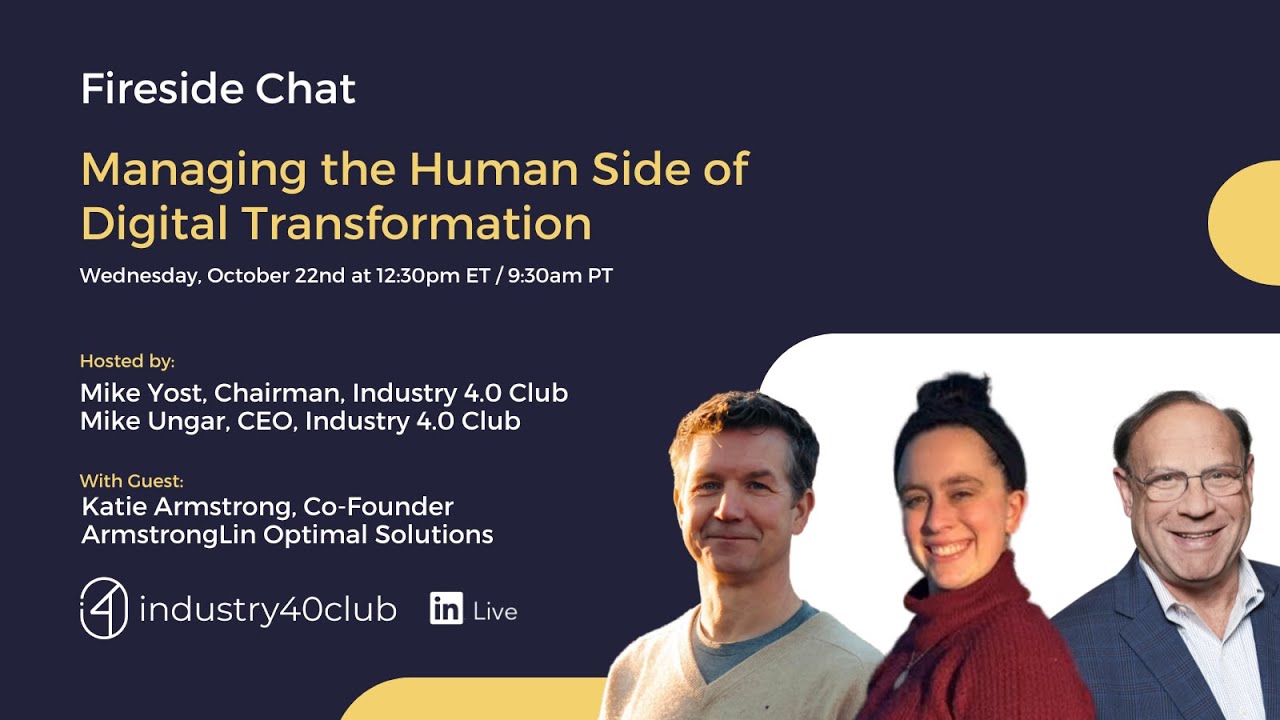
In this Industry 4.0 Club fireside chat, host Michael Ungar (CEO) and co‑host Mike Yost interview Katie Armstrong, co‑founder of ArmstrongLynn Optimal Solutions, about the human side of digital transformation in manufacturing. Katie explains why she started her consultancy – to provide external project‑based improvement leadership that frees frontline staff from firefighting. The conversation covers how to involve employees early (evaluation round, bottleneck interviews), change‑management tactics (buy‑in, skill‑level assessment, tailored training, user‑friendly system design), and the balance between large, project‑driven step changes (ERP, ML) versus incremental low‑hanging‑fruit tweaks. They discuss managing cross‑functional silos, communicating with different stakeholder groups, and avoiding “solution fatigue” by re‑using existing tools when possible. Leadership responsibilities are highlighted: allocating time and resources, leading by example, and removing roadblocks. Vendor roles are differentiated between out‑of‑the‑box software (minimal involvement) and highly customizable systems (deep partnership). Cost, usability, and clear capability definitions drive project selection. A success story illustrates digitising a material‑review‑board process, replacing paper with a simple software template, achieving seamless adoption and “no‑news‑is‑good‑news” outcomes. The session ends with final advice: understand individual motivations and ensure sufficient resources for transformation.
Chapters
Welcome to the Liberty Club's fireside chat. The club's purpose is to engage the power of diverse worldwide talent to accelerate the global evolution to Industry 4.0. We accomplish this by hosting and supporting respectful, thoughtful, and interdisciplinary open conversations and creating quality content on wide-ranging Industry 4.0 topics to expand the reach of our community. My name is Mike Ungar, and I am the CEO of the Industry 4.0 Club. I have over 40 years of leadership and manufacturing experience Most of that at Michelin. I'm joined today by my co-host, Mike Yost. Mike is the chairman of the club. And Mike, would you please introduce yourself a bit further?
Sure, absolutely. Appreciate that, Mike. Welcome, everybody. As Mike said, my name is Mike Yost. I am the volunteer chairman of the Industry 4.0 Club, one of the club co-founders along with Mike, as well as his co-host here on, on these fireside chats. So I've got 35 years of experience in industry, with the last 15 on the industrial nonprofit side, primarily helping facilitate conversations like we're going to have here today about the role and the value and the fit of digital technologies in manufacturing operations. So really excited today to have a conversation around managing the human side of digital transformation, and joining us to have that conversation is Katie Armstrong, who's co-founder of ArmstrongLynn Optimal Solutions. Katie's experience in chemical, automotive, and semiconductor manufacturing industries gives her a solid background for implementing creative solutions to complex problems. Her goal is to help companies grow by engaging all employees in an organization and removing roadblocks, driving positive change, and translating a big-picture goal into actionable steps. are her strengths. So I'm sure we're gonna get a lot out of the conversation today. If you are listening on LinkedIn, please go ahead. If you have questions, put them into, into the comments box. We will do our best to get to them. And with that, welcome, Katie.
Hello. Thank you, guys. That was, that was the perfect intro. So thank you for that. Excited to have a chat with you guys.
Appreciate it.
Yeah, that's fantastic. So Katie, if we can just kind of help us get a little bit about— get to know you a bit better. So you've got a really broad experience. I looked at your profile with a lot of high-profile companies. What motivated you to go out on your own and start Armstrong Lin?
Yeah, that's a great question. I would say myself and my business partner, well, first of all, we met in business school. So that was, you know, the first step towards building the company. We met in our MBA program. And one thing that we kind of noticed through talking with each other, and also from my experience working in manufacturing, is that we saw that there was a need at a lot of companies for somebody to come in and manage these kind of large-scale improvement projects. A lot of times they are related to an Industry 4.0 technology implementation, but it can also be manufacturing efficiency improvements or quality system improvements. And what I've noticed kind of throughout my career in manufacturing, which might resonate with you guys as well, is that a lot of times when a company is not functioning to its highest ability, people are just drowning in the firefighting, right? Like their day-to-day is just completely taken over. And it's really hard to get out of that yourself because you're so bogged down with the firefighting, you don't have any time in your schedule. To actually change the system that's not working. And so we really saw a need for someone like ourselves, an external consultant, to come in and manage projects on a certain project basis so that we could actually make an improvement without taking time out of people's day as they're trying to keep the company running. And so a lot of times companies struggle with this because you have to be a really large company to justify having a full-time employee doing that. And there's just not that many companies that are big enough. And so that's kind of really where we saw the need in the market for our own company. And that's kind of why we started it, because that work was very interesting to us.
Well, that's excellent. And we know here that technology solves everybody's problems, right? Kidding. But if we get back to the title of the show here today and your experience about the human side of digital transformation, can we talk a little bit about that? Like when you see organizations or when you help I guess, do you get involved with organizations at the planning phase, or have they already decided that they're going to go and execute? And if you are involved at the planning side, what actions do you advise they take, or what considerations need to be made when you're thinking about people, thinking about the workforce?
Yeah, that's a great question. I do a lot of times get involved in the planning phase just because I think a lot of companies look at technology implementation and are very overwhelmed. And so one thing we can go in is kind of break it down for people into bite-sized chunks so that it seems a bit more manageable. And so one thing that we definitely ask people to plan for during that time is to have actually an evaluation round. So choose the technology solution that you want to use. What you should do first is actually talk to every one of your employees. Obviously, if you're a huge company, maybe not every single person, but You know, one representative at least from each department and understand what everyone's priorities are. Because sometimes an issue I see is that a company will just kind of decide like, okay, we need something to be more efficient. We're going to pick this solution and we're going to implement it and train everyone. And then, and then that process is going to be more efficient. But a lot of times that doesn't always happen if you don't take into account what people's needs actually are. And so if you take the time to go sit down with every department and ask them, okay, what is your bottleneck? Because they'll tell you, like, if you go ask them, they know what the bottleneck is. And so take a moment to actually understand what is actually slowing you down. The chances are it might be a solution that's different than what you maybe originally thought as a leader.
And especially under the context of the digital age that we're in, do you see people typically leading with technology and then trying to pull pull in the workers, or are they thinking people first and then how does technology support them?
I think a lot of companies sometimes will get excited about all of the new kind of solutions out there and lead a little bit technology first, which isn't a bad thing. It's a great thing to adopt these new, you know, systems that we have available. But going to your people first to really understand what problem is, I think, can just lead to a more effective technology implementation.
You know, you mentioned going to our people first and getting some feedback. I hear you're— I mean, between the lines, I'm hearing change management, change management, change management, right? So what are some of the other principles you think about when you're looking at, you know, talking to the folks about what their problems are, their needs are?
Yeah.
So with talking to change. Yeah.
Change. Yep. Yeah. So with change management, like you mentioned, getting buy-in from people is very important, which is another reason why it's a good idea to go to people first and say like, okay, it's not that we're just implementing this technological solution and you're gonna learn how to do it. You're saying what is annoying to you, right? Like what is taking up a lot of your day that you don't wanna spend time doing? Okay, I'm going to bring in a technology that solves that problem. That's going to get a lot more buy-in from the people that are trying to adopt the system. Another thing that's really important with change management, especially with technology, is understanding what everyone's technological capability is. Because at a company, there's going to be a lot of different skill levels when it comes to technology. There's going to be some people that pick up the new technology right away. and they're used to— maybe they have like software engineering background and they just are used to using platforms like that. And then there's going to be some people that, that struggle, that it's not intuitive to them. Um, and so another consideration kind of on the change management side is understanding, okay, what's everyone's level of capability? Um, what are they likely to struggle with with the new system or excel at? And then how can you shape the system to accommodate those skills, right? So there's a couple ways you can go at it. You can obviously train people, right? Um, training people is going to have different levels of effectiveness. Some people just like, it's not going to click with them, and that's, that's okay. And so if you are kind of at a point where it's like, okay, this is not really going to click with this person, then the next question is, how can I adjust the system to make it more user-friendly for someone, right? So like making a system for someone that's really well-versed in using Excel and dashboarding and all of these things, it's going to be a very different than trying to make a system that is useful for someone that has never used Excel before, right? And so you want to make sure that you're accommodating everyone's levels when you are creating a system. At the end of the day, if someone's too confused by it, they're just not going to use it.
Yeah, so I'm wondering— a lot of thoughts going through my head. Maybe I'll just first of all remind everybody that if you have questions or comments that you want to add to the conversation, please go ahead and put it in the comments. session here, we're talking about the human side of digital transformation. And just wondering, Katie, if you have any success stories that you could share around some of the principles that you were just discussing, where things worked out a positive way for you?
Yeah, yeah, definitely. I think the best one I can think of is an implementation that's now in use And, you know, it's a successful implementation when people forget that it happened and they just don't ask you about it anymore and they just use it. And, you know, it's like, that's perfect. It's like no news is good news, right?
Right.
I had even a leader say at one point, like, oh, when was this implemented? Like, I thought this had been in here for a while. And I was like, no, it's like 7 months ago. It was a completely different system just a few months ago. So that was definitely a success. And I think with what this one was, it was actually just kind of a basic project management software that we used, and it was to help manage a company's material review board process. So previously they were using paper. Every time they had some sort of excursion with their batch, they had to record the information on paper and get, you know, in-person paper signatures for it. And then they were scanning it and storing it in digital. folders. So obviously there's a lot to be improved with that, right? Like no searchable database. What if someone's on vacation and you can't get to them in person? And what if you want to add notes or comments and track tasks, right? Like there's a lot of things that could be improved from a paper system. And so we switched over to a software that the company actually already had and just utilized it and made a new template for this process. And so now you can do electronic signatures, add notes, track the progress, and you have a searchable database. And so just to kind of tie this to what I was saying previously, different groups at the company interact with this process differently. So there's some groups that really manage the whole thing from start to finish. And so for that group, I did much more intensive training, making sure everyone knew how to use it. Thankfully, it was a very— it's an engineering group, so it was like a very technology-forward group. So they picked it up really quickly. But then there were some groups that— what?
You mentioned technology forward doesn't mean willing to change sometimes, you know.
Well, that's true. Yeah. Thankfully, in this case, one thing I had going to my advantage is that people did not like the paper system. They felt that it was too cumbersome, you know, it took too much time. And so it was relatively easy to get people on board again, because I came to them saying, like, I'm gonna make your life easier with this. We're gonna make it so that you don't have to print things out, walk around with them, all of this stuff. And so I was able to train them that way.
You mentioned a moment ago about working with people from different departments and such. I'm wondering, the implementations or the projects you take on, are they typically across organizations, or are they within, you know, particular different functional parts of the organization? And if they do go across the different organizational, you know, silos sometimes, how do you manage that?
Yeah, so a lot of times I would say the implementations that I do focus on a few different groups. So kind of like the example, some groups are much more heavily involved, but it does typically touch a lot of different groups at the company, or it affects a lot of different groups. And so the way I kind of handle that is I talk to each group separately in a somewhat different way. So for the groups that are heavily involved in it, I'm asking them, okay, what functionality about this makes sense to you? What functionality doesn't make sense? If there's something that's cumbersome, not helpful, whatever, I do whatever I can to change that, update it, make it usable for them. And then for the parties that are somewhat less involved, so like for this example, since it was a kind of manufacturing quality-focused project, One of the tangential groups was R&D or customer service, where they would get certain notifications for things. So like if R&D was being asked to consult on a certain issue, or if customer service had to be notified of something because it might lead to a late shipment, that would be kind of their level of involvement. And so for them, I just kind of explained where they would be a part of it. So for example, for customer service, I'm like, okay, so There is this capability to notify you if something's going to be late. How would you like to receive that notification? What is going to be a useful piece of information for you? Then I do whatever I can to try to make that information accessible and usable to them.
Thank you.
That's really neat. We're talking a lot about digital transformation and you've shared a couple of projects. Do you see digital transformation generally as a project or really an ongoing evolution of a company's way of working out? What have you experienced so far? And when people ask you that question, what do you advise?
Yeah, it's a good question. I think in some ways it is both. And so I think with any sort of big step change in a digital transformation, so for example, updating your ERP system, or implementing some sort of machine learning software for your material resource planning, for example, if you want to implement a step change that's going from old system to new system, then you need to have that be a project. Because I think with that, there's just too much going on to try to do it incrementally. People will miss trainings, people will sort of see new data points and not know what to do with them. So I think if you want a big step change to be successful, the best way to do it is to have a project and have a project team and a kickoff and a well-thought-out timeline and action items and everything. But I also think that digital transformation, it can happen incrementally in a low-hanging fruit style. So like, let's say for example that there's something that— some certain piece of data that one team wants, like let's say material resource planning wants better visibility on their late shipments. If there's a way that you can tweak your existing system to accommodate that, then I say just go do, right? Like, go train people really quickly, show them what you did, and then update your system that way. So I think it's important to continuously look at your system and say, like, are people working outside of this? Are people working inside? Is there a way it can be improved? And kind of work on it incrementally that way. But if you want to do a big step change, then project management is the best way to go.
I'm wondering a couple of things. I'm wondering, under the umbrella of change management, project management, digital transformation, do you care what the technology is? You yourself? I mean, does it, does it really matter what the technology is? Or is it the same principles that apply that you're managing?
I think for Me, it's, it's all the same principles, right? Because at the end of the day, have a group of— have a process that could be more efficient than it currently is. You have a lot of people that are going to be resistant to change if they feel like the technology is going to make their lives harder, right? I think that's fairly universal. And you have probably the same group of people that would be much more excited and engaged about the change if they felt it was going to make their lives and their jobs easier, more interesting. And then everyone will have to get trained depending on what, like, regardless of what the technology is. So I think the only thing that's sort of technology dependent is that some software's technology are easier to use than others. So that's kind of the only difference there. But even then, that's more of a— that's more something you would think in the evaluation stage when you're deciding which one to go, which one to go with.
And then what— it's good to hear. I'm in the smart manufacturing world and I'm pretty much the same way. I don't really care what the specific technologies are because there are general principles of flow and losses and, you know, those sorts of things. In the management of the transformation itself, what role does the vendor play? Do you find yourself typically working with the technology vendor in a partnering type of relationship? Or do they just sell their stuff and get out of the way and you and the manufacturers you're working with take it from there?
I think, well, I guess it depends on the— this is something where it does depend on the type of technology, I suppose. But if it's something simple like a project management software that's kind of out of the box, then yes, the vendor would just kind of sell it and you collaborate with them in some ways, like if you're experiencing issues or errors or, you know, like various different software issues, then yeah, reach out to them. But typically the company just kind of runs with the implementation there. But if it's something a lot more involved or customizable, like I know a lot of manufacturing execution systems are very customizable, something like an ERP system, then the vendor would be a lot more involved. I think you still need to have a project lead in that case, either external consultant like myself or someone at your company that's taking the lead on that. to just translate everyone's needs of the company to the vendor. Because I don't think it's the vendor's responsibility to go to the lengths of understanding your needs and change managing your people and everything like that. But you should have one point person that is sort of the translator in that case.
Excellent. Appreciate that.
Have you, have you been fortunate enough to do multiple projects with the same company?
Yes, yes, I have, actually. Yeah, thankfully.
So what was— yeah, what was that experience like? So I mean, have you— because I imagine if we're not careful in this world of technology, that— and how long you've been with them. So at some point, you're replacing stuff you put in, you know, if you're not— the way things move these days. What have you experienced? Anything quite like that or not yet?
I have not yet got to the point where I've replaced my own implementation. Thankfully, those still hold, they're still effective. But yeah, I think when you're completely changing or updating a system, it kind of goes back to the same principles, right? I think we're kind of probably in a 5-year cycle right now when it comes to technology. Like, you implement something and 5 years later it's probably going to be outdated depending on what it is. And so I think you just kind of come back to the same principles, right? Like, what was working before that's inefficient now? Or what's something that is inefficient and could be made better with new technology? And just kind of start the process over again with the change management principles.
Do you, do you have some insights into how the company is choosing these projects?
That's a good question. I think cost is A very big factor for a lot of people, especially now with a lot of uncertainty in the market. I know people are kind of looking for low-cost solutions, especially because it can be difficult to demonstrate the value of like a manufacturing execution system to a company, especially if they've been functioning a certain way. It's usually a situation where all the engineers are saying like, no, we really need this. And finance is saying, why do we need to spend all this money on like something that's already being managed? Right.
Yeah.
So I think people are definitely looking for cost, and usability is another big one.
Yeah, you mentioned— it's interesting now going back to the human side for a second. I'm sorry, I didn't mean to interrupt you. Going back to the human side, when you're doing multiple projects in the same company, after a while, this kind of change is normal. It becomes sort of the status quo. Is that what you're seeing as well?
Yes, definitely. I see a lot of change. I would say the one thing I would caution against is like solution fatigue, I guess. By that I mean some companies will go a little bit overboard with getting a bunch of different softwares to create solutions to very specific problems. And so one thing that I always encourage companies to do is use what you have. So in some situations, yes, you do need a new implementation and a new technology where there wasn't one before. But in a lot of cases, you can use something you already have and customize it or adjust it or tweak it in some way to fit the need. So, you know, for example, like I know a lot of ERP systems have some quality management capabilities. So then, but then some companies will say, oh, we need, you know, quality management software, so let me go find one of those. And sometimes, you know, using, using what you have in that ERP system might be enough. So I think, again, that's where you can kind of like come back to your people. But typically, if something's not being used, your people aren't going to know about it. So you want to come to your people to understand like, okay, what do you actually need? Like, what capabilities do you need? Not just I need a quality management software, but like, do you want signatures? Or to track actions, like specifically what do you need? And then you can go back to your existing softwares and evaluate and say, okay, does this have this capability or does it not? And if not, yes, let's get the new software. But if it does, then maybe we make some adjustments.
Makes sense.
Yeah, that's an interesting dynamic there too, because an old plant floor guy like myself, there have been many times where we were selling something like a quality solution for the plant floor and then the ERP system had a quality module and corporate was saying, just go ahead and use this, we already have the licenses. And we're in the plants going, well, even though they're using the same language, they're not doing the same things. And so we need, you know, a better definition of, like you said, what capabilities do we need before we just sign off and say, all right, well, we can definitely go ahead and take that easier path or perceived easier path.
Mm-hmm. Exactly. Yeah, I think just having a better understanding of like what capabilities are you actually going to use and what's going to be helpful to you, it's helpful for everyone, including the people that will ultimately end up using the system. And then, like you said, useful to justify to management as well.
Well, speaking of management, let's talk a little bit about the role of leaders. What role do the leaders play in digital transformation, in your experience?
Yeah, that's a great question. So I think the best thing that leaders can do in the face of a digital transformation is provide the resources necessary. And when I say resources, I'm not just talking about money to pay for the software, right? About people's time, like having an understanding of, okay, one person's gonna have to lead this project. What percentage of their normal day job is this going to take? And if it's 20%, What are we going to move away from them to someone else or to other people so that they have the appropriate time to manage this project? I think that's something that leadership sometimes really struggles with that leads to failed implementations is when they don't allocate the proper time for everyone and on everyone's schedule and provide the resources necessary to actually make sure that people have the bandwidth to execute a transformation like that. So that's one big one. And then another one too is honestly leading by example. I've had some experiences where leaders are saying, okay, we need to implement this, and they're not willing to learn it themselves. And so that is something where I think it's actually really, really critical for leaders to almost be not super users, but they should be some of the most capable users at the company of the new technology, especially if they're the ones spearheading it. Just so that they can show by example. And if someone comes and asks them like, hey, I don't know how to do this, what's this functionality? You can answer their question. You can't just like, oh, I don't know, I'd ask so-and-so, right? So I think that those 2 things are very important.
Yeah, I think so too. And I think oftentimes my experience from engaging people at the plant level on the broad umbrella of Industry 4.0, smart manufacturing, digital manufacturing, and such, oftentimes the organization assigns a person to go own it and figure it out. And that's really an unfair position for people to take. And I think my counsel to people that I talk to that are in that spot is, we need to engage the rest of the organization, right? The senior leadership needs to be involved—
Yeah.
To do the things that you talked about, but then also to To make sure that, you know, their fingerprints are on it, they have the long-term sustained support, etc., because it's way too easy to give somebody the responsibility, not take into account the points you mentioned about the work that has to come off their plate.
Mm-hmm.
And then when things don't go quite right, just say, oh, well, that didn't work out, and, you know, move on to something else, which is not Really transformative.
Yes, that can be very demoralizing. You can lose some buy-in from your employees if you go that route, for sure.
And I can imagine that that alone sometimes can sink a project versus having it sail away, you know?
Yeah, it definitely can. It's very critical to, especially for leaders, because you kind of mentioned it, Mike, too, when people run into roadblocks, It's leadership's job to remove those roadblocks, especially if you want the project to succeed. So there has to be that open line of communication.
Yeah, that's great. Well, we've been talking with Katie Armstrong from Armstrong Lin for the last 30 minutes or so. And as we reach the end of our conversation, Katie, it's been great so far. Maybe we'll ask Mike first, but then go to you. Maybe some final thoughts on this discussion today for our audience, Mike?
Yeah, yeah, for sure. Obviously, we were going to talk about people, given the title of the topic and Katie's background. So certainly the focus on people first and, you know, the culture, I think, is really critical. But also the point that Katie talked about as far as solution fatigue. I think that's really insightful, that it's not hard to find the next greatest thing. And we're getting bombarded constantly in our personal and professional lives with a, you know, a better gadget or a, you know, a new way to approach things. And so I think it is really a challenge to not just go chasing these new shiny objects that are out there. And if they're grounded in a, you know, in a process and a justification based on the needs of the business, then I think you can avoid that. But that would be the— Yeah, thank you, Mike.
Katie, how about your final thoughts for our audience today?
Yeah, my final thoughts is I think I would just say main priorities for a successful transformation are understanding everyone's motivations, because everyone's going to have different motivations and you want to have a good handle on what everyone needs from the system. And yeah, giving, giving everyone enough resources for the transformation. to be successful. That's— those are the, the 2 main things I'd say. If you, if you take away nothing else, um, that's, that's what I would recommend.
Thank you very much. That's perfect. Well, I want to thank you, Katie, for, um, taking the time to join us and share your thoughts on really engaging the workforce in digital transformation. It's been, it's been really quite interesting to talk with you, um, this afternoon. The club, the Industry 4.0 Club, would like to encourage you to take action. To advance the deployment of Industry 4.0. That could be by attending a workshop, reading an article, or encouraging your plant or your factory to start a smart manufacturing roadmap. We'd like to know what you're trying to do, how you're trying to help advance the deployment. So drop us a note at our LinkedIn page or at our website at www.industry4oclub.com and just let us know What actions you're taking. We also host broadcasts like this every week with interesting people like Katie, and we'd love to, to host you if it's something you've got something to share with our audience that would be interesting. Please also drop us a note at Arlington Paint or our website, and we'd be happy to connect with you. With that, thank you, Katie, again. Thanks, Mike, and I want to wish everybody a wonderful rest of the day and week.
Thank you.
Thank you.
Bye-bye.










