Manufacturing Greatness: Leading the Human Side of Industry 4.0
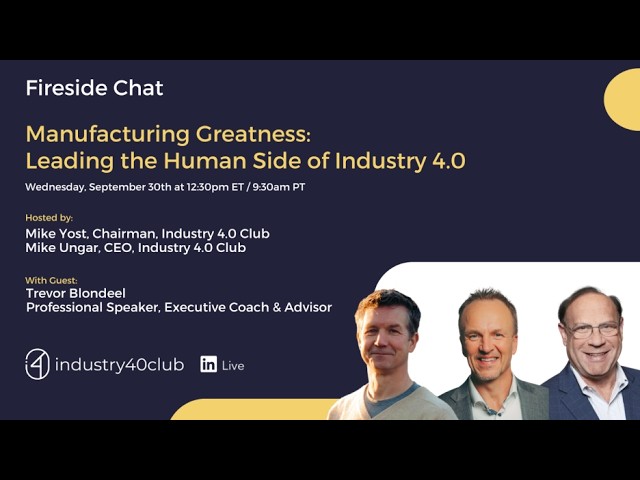
In this Industry 4.0 Club fireside chat, host Michael Ungar (CEO) and co‑host Mike Yost interview Trevor Blondiel, an author, speaker and executive coach with 25 years of manufacturing experience. The conversation centers on the human side of Industry 4.0, arguing that new technologies such as AI, robotics and cobots only deliver value when frontline employees are actively engaged. Blondiel shares findings from a national survey of 1,250 working‑age adults in the US and Canada: about 80 % are willing to work in manufacturing or transportation logistics, but perceived unsafe conditions, transportation challenges, and fear of job loss due to automation rank as top barriers. The dialogue highlights common leadership missteps – over‑communicating directives, confusing clear expectations with detailed instructions, and failing to create space for questions. Both hosts stress the need to treat digital adoption as a core pillar alongside safety and quality, to involve workers early, and to build transparent, accountable cultures. Practical recommendations include: hold genuine two‑way conversations, set clear expectations (not step‑by‑step instructions), improve orientation and the first‑90‑day experience, address transportation logistics, and let top leadership model curiosity and accountability. The session closes with a call to action for manufacturers to read Blondiel’s upcoming book, run workshops, and develop smart‑manufacturing roadmaps.
Chapters
Welcome to the Industry 4.0 Club's fireside chat. The club's purpose is to engage the power of diverse worldwide talent to accelerate the global evolution to Industry 4.0. We accomplish this by hosting and supporting respectful, thoughtful, and interdisciplinary open conversations and creating quality content on wide-ranging Industry 4.0 topics to expand the reach of our community. My name is Mike Ungar, and I'm the CEO of the Industry 4.0 Club. I have over 40 years of management and leadership experience Most of that in manufacturing at Michelin. I'm joined today by the club's chairman, Mike Yost. Mike, would you introduce yourself further, please?
Sure, absolutely. Thank you, Mike, and welcome, Trevor. Welcome, everybody. As Mike said, my name is Mike Yost. I'm the volunteer chairman of the organization and Mike's co-host here on these fireside chats. I've been in industry a little over 35 years myself, about half the time on the industrial solution provider side and the Second half of my career on the industrial nonprofit side. So really excited to get to meet new people and hear their experiences and their perspectives. So really excited that this afternoon we have the opportunity to speak with Trevor Blondiel, who's an author, speaker, and executive coach. And the topic for today's session is going to be Manufacturing Greatness: Leading the Human Side of Industry 4.0. So by way of background, Trevor has spent 25 years in manufacturing, 18 years of them with Magna International. And while at Magna, he learned that new technology only pays off when people on the floor are engaged behind it. So he's the author of a forthcoming book called Manufacturing Greatness and is grounded in first-of-its-kind national study that he commissioned of 1,250 working-age adults across the United States and Canada who are willing to work in manufacturing, and his podcast of the same name ranks in the top 1% globally. Trevor's a certified speaking professional, an ICF-certified executive coach. He works with manufacturing leaders to build teams that work to get results and to stick around. Super critical topic, super excited to hear about the research. Love to hear what you think, how you can share with us, Trevor. So Welcome to the club.
Thanks for having me, guys, and thanks for creating this platform to have this conversation.
Absolutely.
Yeah, it's great to have you, Trevor. Thanks. So let's just jump right in if we can. So you've talked to— you— I think one of the things that you talk about is that new technology only pays off when people on the floor are engaged behind it. And so as manufacturers, you know, we hear a lot today about AI and automation and robotics. As manufacturers invest in these and other Industry 4.0 technologies, what are leaders most likely to get wrong about the human side of transformation?
I think a lot of my conversations is there seems to be less resistance to the technology. I was just talking to someone at a plant last week and it was about some of the change that was happening. And they were OK with where they were going and with the changes. But it was the— it was more along the lines of like, let's execute it together. So it's just having more of those conversations about, OK, we're going here with these changes. But then how we get here, how we're involved in that conversation. And, you know, my whole core message comes down to, you know, results come from deeper conversations. So the more that we can kind of involve at those points, and it's kind of a cliché, but it's not because we're still getting that feedback that's important.
So from that perspective, if the workers are not afraid of the tech, they're willing to have the conversations, they're asking to be engaged in conversations, do you think leaders by and large are prepared to have those conversations?
Hmm, it's a good question. Is it prepared or is it disciplined? Right? Because I think that I'll definitely say if I look back of me running manufacturing plants, maybe sometimes I skipped that conversation because I was afraid of some of the questions that were going to be asked.
Right?
And maybe I should have had a few more of those. And because sometimes, you know, we just want to push it through. 'Cause it's gonna happen regardless. But how we get there can be so different, right? Like, one morning I got a call from corporate and they wanted some cycle times information, some engineering project going on. So we were having a great day, production's about 9 in the morning. So I bring my team in, I got supervisor, engineers, I tell 'em what we need, how we need to get it, why it's important. And so I go back to my office, my executive assistant comes in, she says, you really pissed those people off. I'm like, wait a minute, I got all this leadership experience, we're hitting numbers. And she says, I don't know, but they were good when they came in. They weren't when they left. And I could see that you didn't notice.
Wow.
Oh, so I go talk to the supervisor. And I'm like, how's it going? He's like, fine. I'm like, oh, okay, how's it really going? He says, well, it was going great until you came in, you did all your talking, sent us in different directions, and now we're probably gonna lose 10% production.
Geez.
So that's, you know, you know, that supervisor was confused, right? Because I, I give great messages. Right, it couldn't have been your fault. We found out I was the one that was confused, and I had to bring everybody back in and let them talk through it. And it was a very humbling moment.
Wow.
So when you— is it that you, you didn't think about them when you shared the message? Or tell me, what was it? What was the root cause of that confusion?
I did all the talking. I didn't leave space for like questions and kind of going back to the— like, all I had to do is tell them the vision, right? Like, this was what— this is what good looks like. And people at that level, they don't want to be told what to do. They want to be told where we're going, you know, with some confidence. And I think as leaders, we get excited about the technology and the changes, and we just want to drive it. But we need to stop telling and start asking.
It's a fantastic insight.
No, I think it's something that is important about learning how to empower your teams. One of the things we used to say, and I would still say, is leaders are responsible for defining what and why, but you've got to give room for the folks that have to do it to come up with the how. And I think it's setting some boundaries. Really, it's listening. And then if there are some boundaries, obviously, but normally those they know the boundaries already. So thinking about as a leader what and why, and then letting the team figure out how, is really a kind of a short way of thinking about the best way to go about doing that. Is that what you saw as well in your experience?
Yeah, and it's not— this is the part I want to ask you guys, because like, this is not new. Like, right, you already, you already saw this, Mike. But when, when we look at different plants that are struggling, like, usually it can still come down to this. So like, our technology It's doing great, I think, right? Like, I think manufacturing is, is doing fantastic. Like, we're, we're finding all these different areas, but it's like, is it just the pressure not to slow down and have the conversation that drives a lot of us not to have more of these conversations?
Yeah, yeah. One of the things that we talk about, we hear people, um, talk about a lot, and, and there isn't a, uh, sort of a straight-line path to what I'm about to say, but, you know, we hear people talking about the way that safety, you know, and quality have been ingrained as a core pillar of manufacturing for decades and decades, right? And now we've got to get to a point where digital is that same sort of pillar for us, so we all know how to handle these kind of things, right? To lead and to follow and to advocate and And those sorts of things. So I think we see broadly that people see the value of it, but not necessarily prepared there yet.
Yeah. So Trevor, stop.
Go ahead, Mike.
No, go ahead. I was going to move on to the survey. So go ahead. Go ahead.
Yeah. So I was going to ask the same question, Mike. So I wanted to learn more about the survey that you— or the study you conducted About working-age adults who are willing to work in manufacturing or work in manufacturing, what did you learn about what people actually want from manufacturing careers? I think, and what is it, how does it differ from what manufacturing leaders often assume that those folks want?
Well, the most inspiring part that I wasn't even thinking about getting this information until after I got all the results. And so, you know, it goes out randomly to people, 500 people in Canada, 750 people in the US, and there's a pre-questionnaire. And you have to say, are you willing to work in technology, healthcare, manufacturing, construction, transportation? And so we narrowed it down to say that if you were willing to work in manufacturing or transportation logistics, then you could proceed in the survey.
Mm-hmm.
80% of the general population was willing to work in manufacturing or transportation and logistics. So I was like, that was— that manufacturing was number one ahead of technology and healthcare. So, and even the people that run the survey are kind of like, this is pretty good. Like, you know, they only had to go to 20% extra people, you know, to get that information. So that tells me that We got an industry that people want to work in. And then I think the one that kind of surprised me still was, you know, one of the questions was, you know, what's one of the number one barriers for you to, like, consider working in manufacturing? And what do you guys think that was?
Transportation.
Getting there. Any other guesses? Why people might not want—
I mean, the perception of kind of the dirty, dull, dark perception of manufacturing?
I didn't think that was still out there as much, but it was unsafe conditions. That was a concern still. So there's still, you know, I think that's what surprised me a little bit was the general population not seeing that, you know, we're not putting our hands inside presses, you know, dropping parts. You know, we're in an age of 2026 with a lot of technology here. And, you know, when we follow our procedures and the technology on safety has gotten incredibly better, and I don't know how well we share that with everybody.
Right, right. Do you work at all in sort of how manufacturers So I guess what's the outcome of the work? You've done the research, you're out talking about it, you're speaking publicly, you're writing the book about it. Is there a call to action in there for the manufacturers themselves? Are you advocating that manufacturers either recognize what you've uncovered and learned there and respond to it or change the way they try to attract people? Or what's the main outcome?
Yeah, I think the main area, kind of going back to your point earlier, right, when you're asking, Mike, about, you know, what holds us back from having those conversations. And maybe some of it's pressure, maybe some of it's I'm just not used to having this. I know I sometimes struggled having just a transparent performance conversation. And I believe that the whole accountability, if we're transparent with it, that actually builds trust in our industry. And so really, that call to action is just have a conversation.
Right?
That, that is really the kind— I think that's what I'm seeing for that is, is the research is backing that up, is that people want to have clear expectations. People want to do a good job.
Yeah.
Um, and they want to understand that. So just talking to someone this morning and they're like, well, this person, uh, didn't care about this. And I'm like, How do you know that? You the fact is they didn't do it. You're you're judging now, saying they don't care because yet we haven't even talked to them. So I think you know even from the research just finding out that you know expectations one of the stats was one of the fair ones: 86% expect clear expectations in their first year. And it was different answer for different generations.
Well, that's interesting.
And there's a clear trend.
You know, I think sometimes, as you mentioned, expect clear expectations. I think sometimes people get clear expectations confused with clear instructions. So what do I mean by that? What I mean by that, going back earlier about what and why, let the folks figure out how. So they'll think, well, if they want clear expectations, let me tell them how. And no, that's not— those two are not equivalent. So I think a lot of times people get— young leaders get confused between clear expectations and telling people what to do, if you will. Have you seen the same thing?
Oh, every day. And in the data, it's the whole aspect of Oh, they didn't get it, so I'm going to tell them again. And like, how is that working for you? You know, like, and it's— and okay, well, I'll get them to repeat it back to me. Well, that you're just trying to force a language. But like, how is the other person thinking about the problem or the expectation? Like, what do you think about that, Mike? And so what does good look like to you, like in your job? It's just like we are right now, just creating conversation about what do we expect from each other. I think that is going to be what's going to shift our industry. That's what's going to continue to excel our technology as well.
I just want to take a second and reset us here, let everybody know that, remind you we're speaking to Trevor Blondiel, author, speaker, and executive coach. Topic is Manufacturing Greatness. leading the human side of Industry 4.0. And Trevor, based on your experience and your research, what do you see? Is it really— I guess when I go out and talk with people, the first words out of their mouth about the challenges they face oftentimes is labor, that we don't have enough, we have a labor shortage. How much of Based on what the research uncovered and what you've experienced, how much is the labor shortage the issue versus how the way manufacturing organizations are leading and engaging and developing their people is more of the problem?
Yeah, I think they said when people are considering working in manufacturing, 56% of the people have been influenced by somebody that's already working in manufacturing.
Okay.
Okay, so then, so now all of a sudden, like, how we're leading internally is impacting our recruitment pipeline. So yeah, how we're doing it day to day is going to affect, like, you know, doesn't matter what marketing campaign you have to hire someone from the outside, it's going to be those internal daily behaviors. And then are you creating that environment that's that's attractive, you know, that's going to have those conversations internally that I do want to keep. I like to say, like, you know, it's, it's our job to make sure that when people leave the parking lot, they don't have to come back the next day. You know, like, they could go work someplace else. So what are we doing to kind of create that conversation to keep them coming back in?
It's maybe a follow-on question, because there's— so I live in Northeast Ohio in the Cleveland area, and there's a lot of work we do in the region talking with people about technology adoption and performance and such, and talent is always part of every conversation. Finding and retaining and upskilling is always part of the conversation. A lot of times what we find is that there are, I guess, who owns this problem? I guess is the question. We find oftentimes HR leaders are put on point to go hire workers, as an example, or have training plans or whatever. And oftentimes what we see, to be quite frank, is that they're set up for failure. I mentioned earlier when you asked about the biggest deterrent, the number one question or challenge that we often hear our manufacturers talking about is the transportation challenge, especially in rural areas. Like, well, I don't have a way to get to work. So I often find that I guess my question is, can we say definitively where this challenge of managing the human side and the talent side lives within a manufacturing organization, or is it too dispersed, touches on all parts of the organization?
That's a great point on the transportation. There's going to be so many elements that's going to tie into it. Man, I remember Magna launching this huge frame plant in Mexico. And one of the most important aspects they were managing was bus transportation, right? That was a launch strategy. I remember going there to help them launch. And when the soccer game was on, they shut the plant down.
Yeah.
You know, it's just little things like that as far as like, you know, what are we doing there? But here's where I see the biggest lever. So just on a LinkedIn post, there was an HR professional that commented that— very, very proud on, like, because one of some of the survey information that came back was like the importance of orientation the first week, having someone to ask questions. We talk about that recruitment in that first 90 days, because I hear a lot, we get 10 in the door on Monday, and, you know, 3 months later, there's only 4 left. You know, those types of conversations. So, you know, the, the example was, hey, we've done a lot. And our first 90 days are getting better. But then after 90, then they're having some disconnect. So how do we keep— how are we keeping those conversations going and leveraging the resources we already have? We're out there trying to recruit more. And I don't think this is an HR problem. I think this is more of a— I like to say, like, we want to connect the top to the shop.
Mm-hmm.
And I think we have great leaders out there, great owners of manufacturing plants, great intelligent you know, engineers that are now running plants. And I think they have great intentions. And then somehow we kind of get disconnected from those conversations of engagement, because how we show up impacts on how people feel.
Yeah.
And how we make people feel determines the extent to which they can engage with us. So I'd like to start with the fact of, are we really tapping into the people that we already have? The best people that could work for you today are the ones that are in the door, you know, already through the door. So, like, you know, how are we utilizing them? So I think, like, Chocolate fountains. Like, I go to— you go to an event and they have the fondue fountain and they got the nice chocolate coming out of the bottom. But if you grab your piece of pineapple, whether you dip it in the bottom or the top, does it taste any better as we go down? It's only as good as what's coming out of the top. So it is important of who is representing your top leadership, and are we creating— are we creating the space that people are engaged at work there, and then more people want to come to work?
Well, it's a really good point. You know, thinking about where we are today on the South Floor, this idea about creating a place where people want to come to work. We talk, you know, AI's in the news every other day. I mean, oh my goodness, can we not? I mean, it really is prevalent in terms of conversation. And this accelerating change, there's really a lot of positive things coming from that. But it scares people. Let's just face it, it can scare a lot of folks. So how should leaders involve frontline employees in technology adoption in AI so they see that AI and other tools, robotics and cobots, help them succeed rather than something that really replaces them? How would you go about doing that? What advice do you have for leaders?
Yeah, one stat I'll just share kind of related to that is that the people in the survey, most of them weren't working in manufacturing or the field, right? So this is a smaller percentage of the survey, but the majority of the people said 32.6% ranked perceived of lack of job security due to automation, AI, or outsourcing in their top 3 barriers from working in manufacturing.
Mm-hmm.
If the people were working in manufacturing already, the barrier was 20.2%. So this— if you're actually in manufacturing, it sounds like we're involving people more so that they know that the AI is actually not going to take away jobs. It's going to create a different form of jobs, and it's going to engage us more of like, we don't— you know, it's less, less touch points. Right, for safety, right, which again ties into our recruiting aspect. So I think that the, you know, just having them, going back to having them involved, knowing, you know, what's the vision on the technology, right? That it's just changing, it's changing how we work. And we already have, like you said, Mike, about the shortage. So it isn't a job security issue. So just having those conversations. So for those frontline employees, Again, it's like, have we shared that overall vision? Are we bringing them along the way, or are we pushing them towards this?
Right. So, you know, we've— what we hear all the time, and I think it aligns with what you're telling us about here today, is that this is really a leadership opportunity, right? Like, this is a big deal from a leadership perspective and managing all of these things. So if a, if a manufacturing leader walked up to you today and said, hey, I'm all in, right? Like, this all makes sense to me, this Industry 4.0, and, you know, whatever level of AI and automation and whatever else is important. But I understand, I, you know, I gotta create the right culture, you know, people working together, embracing change, getting results, sticking around for the long term. Like, that's what I wanna build here culturally. What are the first couple of things that you would tell them to do differently than they're doing today?
Well, if that's your vision and you believe in it, when you see pockets where there's gaps, how is that just a curiosity situation, right? Like, it seems like we're hardwired to kind of like, oh, you know, this person here doesn't like any change, right? And you're always going to have the negative people. Well, what can we learn from them? Instead of how can we be less judgmental on the ones that aren't excited maybe about some of our technological changes and understand what's the resistance? If we have some negativity, then let's not try to hide it. Let's just be okay, what am I missing? Because I think this AI that we're going to implement is really going to get rid of some redundant work and we'll be able to focus over here, but I could be missing something. Let's talk about that and we might be missing something. We're going fast. We want to know. I think that's what I'd say to that leader because I love to find those leaders that are excited about this and want to do it and we can do it. We just got to bring the people along with it.
Very good. I think that's a great point. I think really allowing folks to make sure that You open the door and you're asking questions and listening is a huge— it sounds like a simple thing, you know, and maybe there's a theme here, um, because I've heard you talk about, you know, sometimes we want to go too fast and we don't bring people along with us. I used to think about this, and sometimes it's, you know, you go slow to go fast. By that I mean giving people time to get on board so that once they are, then you can move very quickly. So I think it's a— Interesting way to look at things. We've been talking together, Trevor, for the last almost 30 minutes now. As we begin to wrap up, I wanted to maybe get a final thought from Mike and from you that you might want to share with our audience. Mike, you want to start us off and share what you've heard from today's conversation?
Yeah, absolutely. Probably off the top, the fact that you can survey over 1,000 people across the US and Canada, and 80% of them say they're open to working in manufacturing, I think is a big takeaway. And I would just probably marry up the conversation we've had here with the conversations that I have week to week as well, that we don't have any technology conversations without having talent conversations.
Mm-hmm.
And we're constantly seeing where leadership has to lead. And so I think I'm really excited to see Trevor's book when it comes out and follow him and learn more about that. But I do think it's a good body of knowledge for us to share and a lot of reinforcing points about how important bringing the people along with you is if you have a vision for adopting Industry 4.0 or any sort of digital future. So appreciate you sharing, Trevor.
Thank you.
Trevor, how about a final thought from you for our audience today?
Yeah, I think sometimes the message gets construed of, you know, we're going to have all these conversations, we're going to bring people along, we got to have consensus. It's not about that. You know, it's just about, can we be a little bit more curious with each other? And can we be transparent and bring accountability with it? Because I think that, you know, if we're mindful and how we're showing up, how we're making other people feel, we've got those clear expectations and we're kind of unpacking where we might disagree. Then let's, and let's hold each other accountable for that. Because it is a tough industry and there is a lot of great change coming. And we also need that accountability. But when we have that out in the open and we can talk about that, just like that woman that came in the office and told me that, hey, I upset these people. If we have more of that going on, because I'm going to make mistakes, I did, and that wasn't my last one. But I started surrounding myself with people that got curious when I wasn't showing up the way that I committed to. I think just curiosity about each other, hold each other accountable, and we're in this together, so let's do it together.
Thank you. That's a great way for us to end the discussion today. Trevor, thanks for joining us. to really share your perspective on the impact that people can have on really successful Industry 4.0 implementation and really overall technology advancement. So thank you for that. The Industry 4.0 Club, we'd love to encourage you to take some action. Read a book, read Trevor's book when it comes out, attend a workshop, or even encourage your facilities to establish a smart manufacturing roadmap. We want to know what you're doing. We want to hear from you. Drop us a note on our website at www.industry4o.club or on our LinkedIn page and share with us what you're doing. We'd love to hear from you. Also, we host conversations like this weekly, so if you'd love to be a future guest with us, we'd love to hear that from you as well. Again, drop us a note on our LinkedIn page or website and let us know if you'd like to be a guest or share what you're doing. With that, Trevor, thank you again. Mike, thank you. And we want to wish everybody a great rest of the day and the rest of the week.
Thanks, guys, for having me on. Thanks, everybody.
Thank you.










