Mastering Complexity in the Age of AI: Takeaways from Configit's CLM Summit
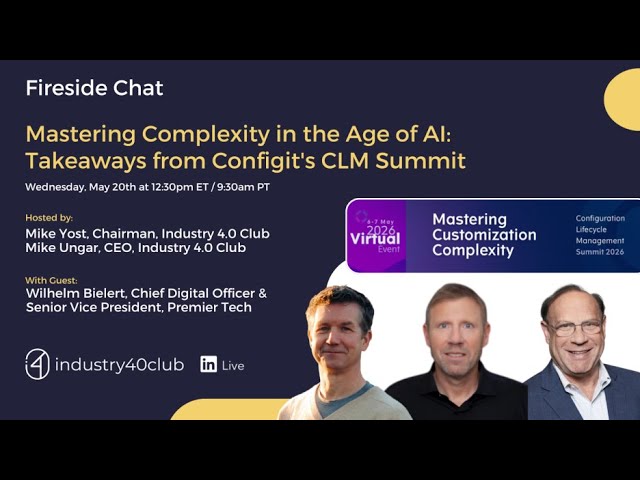
In this Industry 4.0 Club fireside chat, host Michael Ungar (CEO) and co‑host Mike Yost interview Dr. Wilhelm Bielert, Chief Digital Officer & SVP at Premier Tech, about practical lessons from ConfigIt’s 11th Configuration Lifecycle Management (CLM) Summit (May 6‑7). Bielert emphasizes that today’s geopolitical and market volatility should be seen as an opportunity, and that Configuration Lifecycle Management can act as a “brain” linking engineering, sales and manufacturing silos. He explains how AI’s creative, probabilistic capabilities complement the deterministic logic of CLM, enabling engineers to explore new designs that are then validated against configuration rules. The conversation repeatedly stresses that technology alone is insufficient; successful adoption hinges on change‑management, leadership buy‑in, and upskilling the workforce. A solid, trusted data foundation across PLM, ERP and sales systems is portrayed as the boring but essential prerequisite for AI and digital twins. Bielert advocates “standardize the logic, not the product,” promoting controlled flexibility over unlimited customization. He recommends starting with small lighthouse projects, leveraging ecosystems such as NVIDIA’s Omniverse/USD for digital twins, and iteratively scaling. Upskilling tactics include hands‑on exposure to AI‑enhanced PLM tools, robotic virtual twins, and aligning new features with daily work. Finally, he warns that AI will soon extend beyond corporate borders, with agents communicating across companies and large‑scale AI‑driven “digital factories” becoming commonplace, making early experimentation critical. The discussion concludes with a call to action for the Industry 4.0 community to adopt these practices.
Chapters
Welcome to the Industry 4.0 Club's fireside chat. The club's purpose is to engage the power of diverse worldwide talent to accelerate the global evolution to Industry 4.0. We do this by hosting supporting and supporting respectful, thoughtful, and interdisciplinary open conversations to expand the reach of our community. Today, we're going to be speaking with Will, and I'm going to let Mike introduce him in a minute. Just a little bit more, my name is Mike Ungar, and I'm the CEO of the Industry 4.0 Club.
Hi, Mike.
I have over 40 years of leadership and management experience, most of that in manufacturing at Michelin. I'm joined today by my co-host, Mike Yost. Mike, would you please introduce yourself?
Absolutely, appreciate it, Mike. As Mike said, my name is Mike Yost. I'm the volunteer chairman of the Industry 4.0 Club. Welcome you all here today. And also one of the co-founders of the club and Mike's co-host here on our fireside chats. I've been in industry almost 40 years myself on both the solution provider side and the last 16 years on the nonprofit side. And as Mike mentioned, our work here is to engage people in discussions about relevant topics to Industry 4.0 and how to find value. So we are really excited today that we're speaking with Dr. Wilhelm Bielert, who's the Chief Digital Officer and Senior Vice President for Premier Tech. We're going to be talking to Will about mastering complexity in the age of AI and takeaways from the recent ConfigIt CLM Summit, which we've been talking about lately. So just quickly, by way of introduction, Will leads the digital transformation initiatives focused on AI-driven manufacturing, business process integration, and scalable industrial platforms. With a background spanning industrial automation, industrial technology transfer, enterprise transformation, and digital strategy, Will works at the intersection of CLM, PLM, AI, and digital twin technologies to help industrial companies manage complexity at scale. We'll also note that Will is the co-author of a book published in 2024 called The Secrets of AI Value Creation, and he regularly speaks on digital transformation, industrial AI, and the future of connected manufacturing ecosystems. So welcome, Will.
Thank you very much. Thank you for having me. Really a pleasure.
Yeah, thank you. So before we jump in, uh, to some questions for Will, I just want to mention that Will was one of the speakers at ConfigIt's 11th Configuration Lifecycle Management Summit, which occurred back on May 6th and 7th. The event focused on how manufacturers can master customization complexity by establishing a strong data foundation for future growth. Summit brought together B2B manufacturing leaders to explore how connected systems, data, and logic enables organizations to manage complexity more effectively. AI was, was certainly a major discussion during the conference, and again, as Mike mentioned, we'll speak to Willow about that during our conversation today, as well as some of the other key points from the summit. So with that, well, maybe we'll just jump right in and ask you a question about the summit. So from your perspective, what were some of the most important practical takeaways for manufacturers? And by that, I mean not just ideas, but things that leaders can actually act on to do right now to better manage complexity in their company.
Absolutely. So there's been really a lot of learnings at this event. And I think what I took away as a very practical thing is that we have to live in a world of uncertainty. I mean, as everyone can read from the news, this is really happening. And this means for manufacturers who are active in different geographic regions, I think they need to change their perspective of seeing this as a threat to see this really as an opportunity. And, and one, one, one logic from, from this, from this fact is that CLM, if properly deployed, can really act as a, as a brain, as, as your DNA to manage this different complexity, to really allow you to transfer products from A to B, to search for new clients, to maybe establish in new regions plants. And these plants can then work on the proper configuration lifecycle management practices and can use the products. So that's, I think, a very, very practical element. A lot of— I was astonished, and it's always good to refresh our brain that very often we see topics and we work on topics, but it's relatively clear that we need to continue even more. And one thing was, for me, was also very clear is that CLM can really act as the interface between different knowledge silos, which typically still exist: engineering, sales, manufacturing. So we often work with clients to get offers or to get sales and to engage with their proper counterparts of our sales team. But often products are developed in certain teams, let's say in engineering for example, and then it's really tough to collaborate. So now CLM, and that was really clear at the summit, sits in the middle and it can really help you to overcome, to overcome these silos. That being said, it is not a technology topic typically, it's more a transformation topic. So, uh, CLM leads to the reflection to ask yourself, do we have everything which is needed? Like, for example, I think to really use and to deploy a CLM practice, you need to have product management. You need to have people who are responsible for your different products, for the modules, to really take this to the next level. And I think a very practical element is also to ask yourself, what's my North Star. Where shall I— where do I want to go? Where can I unlock the opportunities? And what do I need? And there's a lot of organizational and skills which are needed to deploy CLM.
Well, that's a, that's a great point. And I, I would just say, for any of you that are not familiar with CLM as a, as a, as a concept or as an application layer, um, you can, um, certainly check out the ConfigIt site and, and some of our previous, uh, webcasts that we've done that have gone into the topic more in depth. And I think, Will, you bring up a good point about, you know, managing complexity of products across different departmental boundaries, you know, the engineering and the sales and the manufacturing, et cetera, and the value that discipline provides. So I would encourage everybody to go check that out and learn more about CLM if you're not familiar with it. But we wanted to sort of jump in a little bit, given your background and expertise on the AI side of things and getting value from AI. And, you know, there's, you know, an understanding of the probabilistic nature of AI. And in a manufacturing environment, it's very deterministic, right, that the requirements are not on probabilities, but on what's actually happening. So, you know, given your perspective at Premier Tech, how should organizations try to strike the right balance between the speed that AI offers versus the deterministic structured certainty that's in configuration logic?
Yeah, that's a very good question. And I think that's really important for everyone to understand because I think what's very powerful is, and I've been very long in the AI space even before it was called AI, is that AI can really add to your team's creativity. So AI is able to find new solutions, to be really creative. Imagine AI, the different algorithms, like an external party which gives you maybe solutions you never thought about. And some of these solutions are really for sure interesting, and you maybe discover they are not feasible. Now, The AI versus the deterministic manufacturing practice, or also the deterministic configuration lifecycle management application you have, are like 2 coins which are working together in a complementary manner. What I, let's say, learned was that it's very powerful to use AI, for example, to find a new design, to make a digital twin, and so forth. And the CLM can act like a type system in software application, like an instance which validates whether the new design you generated with the creativity of AI is feasible or not, and what does it take if it's right now not in the solution space to expand it. So it's a little bit like AI gives you the power of creativity, the power of finding new things, and then the CLM can give you the deterministic understanding. Will this really work? Can this work within our existing solution space or not? And these 2 together, I think, are really powerful. If one is alone, if CLM is just alone, you miss the creativity of AI. If AI is alone, you— and you may remember at the beginning when we were all creating funny images, sometimes you created hands with 6 fingers. So you figured out, oh, that's not feasible. Now imagine a machine is much more complex than a picture of a hand with 5 fingers, and right now you typically learn it only once you build it. Now together, AI and CLM can validate the solution before you build it so that you can really see, okay, in the virtual space it works, which means you can transfer it to the reality And have a lot of, let's say, advantages doing this.
I think it's a powerful point that I hadn't considered before. Sorry, Mike, just that notion of creativity and also, you know, to the point of allowing or being empowered by the AI to be creative, but then also having sort of the guide rails of the CLM to say what is actually possible. That's a really powerful combination.
Well, and to tag on to that, Will, I don't know if you've seen this application. I'm sort of curious. So that's the first answer, right? The first answer from CLM is that, well, no, this is outside our boundaries. Have you seen where then you take that and you ask the question either of AI, well, if it's outside the boundaries, what would we have to change in order to put it inside the boundaries? Is that a normal, in some cases, the normal next question?
Yeah, that's the next question. So, so, so it's, it's, uh, I mean, if I would explain it at a very high level, it's like a collaboration. Like, you give AI the freedom to deliver new, let's say, new designs, new design variation, and CLM gives you back the feedback, okay, that's within our boundaries, or this is not within the boundaries. And that provokes discussion with engineering to answer the question, so if there's a value to this new product which is outside our boundaries, what do we need to do, what costs will we have to do so, and, and what are different paths to do it. I think it's a, it's a very valid, valid point, Mike, and I think it's also a good example that right now I personally think for the next foreseeable future, um, we'll not replace engineers. It's more that we give them much more time to think about solutions and increase solutions with the support of AI and CLM. so that AI and CLM together can give new options to the engineers. And then the engineers can really start a thought process saying, okay, that makes sense, that doesn't make sense, okay, that new configuration makes sense, but it's out of the space currently. So what does it really take to, to bring it into the space?
Right.
And I think that's, that's kind of the power which where we are now, where we can augment the creativity of engineers with power of AI and then with the governance of CLM.
That's really powerful, I think. My brain goes a little bit to the concerns as we— I love the notion that the AI unlocks the freedom, provides the creativity and challenges the normal thinking, and that the CLM provides some of the boundaries, etc. I'm wondering on the people side of things, like your experience, because I know from my experience years gone by, different departments are so busy working in their silos and doing their, their tasks that working across the different departments is often an organizational challenge or just a people challenge. So do you find in the space that you're in, working across those, those different organizations, that we're getting beyond that? People are better at collaborating across departmental boundaries?
Well, I think, I think the challenge remains the same. As I said before, the implementation of CLM, which is often not there, especially not in the United States for whatever reason, it takes a lot of organizational effort to really bring it into an organization. And this is like, uh, this is very similar to a lot of other organizational challenges. You need to change the behavior. Uh, team members have worked a long time in their silos for good reasons. They've been very successful. They created successful products. But now you have a new world, you have uncertainty, you have much more demand for configuration. So there's a lot of different challenges which are typical, which are very typical for, for an organizational development task to do this challenge. And what you also see is that while in the past we had a lot of technology restrictions on the technology side. Nowadays it's really more on, on the skills side, on the organizational side. So that's, so that's the big challenge. The technology, whether it's, let's say, algorithms for really using AI engineering, whether it's platforms such as Configured, whether it's other platforms like, like the PLM platforms, I would say they are relatively mature and relatively stable.
Right.
But as in every software project, to bring people to really use these features, to work on a daily basis, to use the full potential, that's a different challenge, and that you see here as well. So I think, as always in my career, the big effort is not in technology. The big effort is even more here in the upskill, explanation, and so forth. And I truly believe that it's the augmentation of human brain and AI and other systems such as CLM which creates the value. But still, in AI, there's still a lot of confusion, a lot of fears that AI will replace us all, which I have my— at least for the foreseeable future, I have my doubts. Uh, I think it's really an augmentation, uh, which creates a lot of opportunities. But, but to move away from this more a very cautious view on AI. I think, I think a lot of change management has to be put in place to really get across, get across the opportunities which are coming with AI and with new applications such as CLM.
Appreciate that.
Yeah, that's a, that's a really great perspective. I'd like to, to maybe, uh, dive into something we haven't talked much about yet, and that's data. So one of the consistent themes we saw at the summit was how important it is to have trusted connected data across all of our systems like PLM, ERP, and sales. So what do you see most manufacturers struggling with today, and what separates them from those who are successful building the connected data foundation?
So I think that's a, that's a very valid point, and that exactly reflects my my observation that AI is seen as very cool, as very sexy. Everyone, everyone would like to do something with AI. But if you talk about, oh, we need to have a good data foundation, that's not cool, that's not sexy at all, that's a little bit boring. But that's really the foundation. So, um, so to really unlock the power of AI and also CLM, you need to have a proper data foundation. at least you need to start somewhere. I mean, as always, start small and scale up. Pick a machine, pick a module, pick something and fix the data and then show the power of AI. There's a lot of confusion that AI will fix the underlying foundation, which will just not happen. I think you're totally right. I think we focus too much on technology, AI, Often we are not aware that AI is only as good as the data I use. If I don't have proper models of my machines and if I don't have a proper configuration logic in my application, AI cannot describe, cannot augment my team because the underlying foundation is just not a correct representation of of my, of my products. So, so you're totally right. Um, once again, we often forget about the boring foundation and, and step right away to, to artificial intelligence. But if we don't have the data, or we have broken processes, or knowledge gets lost, or there's no, not, not a feedback, let's say, from construction sites what problems there are, then we'll just not be able to use the full power of AI.
So I'm curious, Will, and actually let me just back up for one second and remind everybody that we're talking with Dr. Will Bealert, who's the Chief Digital Officer and Senior Vice President for Premier Tech, talking about mastering complexity in the age of AI and talking about recent experience from the Configuration Lifecycle Management Summit that he attended with ConfigIt. And yeah, I'm wondering to that point about data and systems and architectures and things like that, you know, obviously as product customization increases, the complexity grows, but that's also a competitive differentiator for manufacturers.
Yeah.
So what strategies or architectural approaches, we've talked about mindset, we've talked about sort of the, not a lot on the technology side, but from an architectural perspective, What have you seen work best to manage this as folks try to scale their ability to customize but still maintain control, you know, over the core operations of their business?
I think, I mean, there's a lot of these practices start with the mindset. So I think there's a lot of confusion. You should really standardize the logic, not the product. So CLM is not about standardization of the product at all. We often mix this. We think, oh, we have standardized products, so our customers, they don't get the product they had in the past and we can't differentiate. That's, I think, that's, that's totally misunderstanding. What, what we should do is we should, we should standardize the logic how to derive a, a final configuration for a product, not the product itself. So it's really So I think if you summarize it, it's like controlled flexibility really beats unlimited flexibility. We often think, oh, a customer has a specification, I just go for it. No, you have to— if you want to simplify your product configuration, it does not need, or it does not mean you need to have a simple product. It only means you have to apply a consistent logic so that you have control flexibility and you can really reuse these rules in a way that you can deliver a highly differentiated product to your client, ideally with a better cost position compared to someone who does not have this logic in place. I think that's a major major misunderstanding. And then if you want to use simulation, digital twin, and similar technology, then you need to have exactly this proper logic in place so that the AI can understand this is the logic for my products and then can really tell you, okay, this offer, this combination we've never built, but very high probability, a very high security, if you will, that it will finally work. But if you, if you don't have this in place and you do it more in an unstructured classical customization approach, at one point you create a complexity which you're not able to handle.
That's interesting. You know, earlier you talked a little bit about Workforce. I want to kind of come back to the workforce conversation for a second because, you know, we know that most technical projects or projects about technology and manufacturing fail not because of the technology or the process, but because of the people, right? So, I wanted to kind of talk about what, or get your feedback on what mindset shifts are required to move from managing complexity So leveraging it as a competitive advantage, you've talked about that a little bit as well, using an AI-enabled environment. And think about, if you can, when you talk about it, there's also, there's a leadership and then there's also on the shop floor, the lower levels.
Very, very valid point. I think, I think, and by the way, that was one reason to write the book. And when in my statement I explained that often We have a new technology, but the issues and the challenges we have, but also opportunities, have been often seen in the past. That's a classical change management topic. First of all, you need to have a proper buy-in from the C-leadership team. If there's no discipline and no effort to bring into the corporation proper data foundation and then to really start small, try things, and then promote things, that's classical in change management. nothing will happen. So I think everyone who is now standing up and saying, okay, these are the concrete steps, let's select one product module, let's select maybe one product in our manufacturing division, let's try to really use standard formats and standard approaches such as CLM, such as digital twin, and let's create a little lighthouse project to really show that we can create value and show the advantages in concrete KPIs, That with the proper communication will bring us to an open situation where people want to try it out and will basically use AI and see how their work, how their daily life can be easier. But often we just don't follow these standards, things we've seen so long, and then nothing will happen. I mean, sorry, it's very Often the things which create the success are very basic. So technology is here, but if you don't do the proper change management, you can have the best technology in the world, it will just not work. This is trivial and long known, but if we just forget about it, nothing will happen. So I think also sometimes we overestimate the complexity. If you start, if you select a proper vendor, if you go with an ecosystem which is somehow advanced and which is already mature. Like, I think especially the NVIDIA ecosystem with USD and Omniverse fulfills this criteria. If you start relatively small, you have one or two subject matter experts to really show the value. I think it's not too complicated, and you will be able to create a common dynamic which brings you, brings you there, which is well known for decades. But as I said, if we just believe in technology and don't don't, don't put the right organizational, um, surroundings that it can really create value, um, then that's a problem. That's why we call the book Secrets of AI Value Creation, because often it's not a technology issue, it's really the different elements to bring the organization to a level that it can really move is the, is the secret, which I think is true here for CLM and AI as well.
That's a great point. Now, we talk a lot about how important it is for people to have the right mindset and really to become comfortable. And I think, you know, that involves sometimes upskilling as well.
For sure.
So when you think about upskilling, did you— what kind of upskilling did you find you did at Premier Tech to help people begin to embrace things like AI and CLM?
I think, I think first of all, all the major application vendors are currently integrating AI features into their classical functional capabilities. I mean, CLM vendors are doing this, Configured as an example, PLM vendors are doing the same. So first is really to discover and to see how can we, how can we really, really use this and, and what is the value. And also Most vendors, at least I know, are moving into an ecosystem. I think USD/Omiverse/NVIDIA is one of the most important ecosystems to really show the value of digital twins. To understand how this can really relate to your daily work, let's take, for example, digital twin technology. Now major PLM vendors have now integrated NVIDIA products into their own PLM products. So then the next, the natural next step is understand what's in the product and try to apply to your work environment. So I think the, the most, I think the, the biggest challenge or the, the, the, the most fruitful way to doing this is to do something which is really close to your existing daily work. And especially this comes true if you're talking about an application, let's say PLM, which now all of a sudden is offering, uh, AI features. So just to understand these features, understand how you can apply it, understand, uh, what's— what you can do will really do a significant upscaling. Another good example is there I mean, we are using a lot of, or we are creating a lot of robotic automation solutions. All the suppliers of robotic arms such as ABB, Fanuc, or KUKA, they are now delivering also virtual twins of the robot to their clients. So that's very natural. So then you can all of a sudden experience what it what does it really mean and what are the possibilities for me? And you may learn that all of a sudden, let's say the digital twin of the robot can at least take some part of the code you've done in the past on your own without support. So these are, I think, very concrete steps which are relatively easy, which are close to your daily work, which helps you to understand the value of AI and which also reduces the fear because very often I'm convinced you see also the weaknesses of an AI-generated code, which gives you again optimism that you're not completely useless, but there needs to be someone with a brain to oversee AI and to really create value.
That's very good. Thank you for going a little bit deeper on the issues with respect to people. I really appreciate that. We've been talking for the last 30 minutes or so. about lessons learned from the ConfigIt CLM Summit. We've been talking with Dr. Wilhelm Bieler. So as we get ready to wrap up the conversation today, maybe, Mike, a last thought for our audience, and then maybe Will will give you that opportunity as well.
Sure, appreciate that, Mike. Yeah, actually a couple of things, if I may. The idea of AI enabling creativity and providing the freedom to think differently is a concept I had not heard of before, and I think it's fantastic, especially when married with the boundaries or the guardrails of a CLM type of environment. So that is something that I think is powerful. Also, the notion of standardizing the process, not the product, is another way of thinking things I think is very, very powerful. And then just one other thing I would go back to is, as we've as we've gotten to know ConfigIt and this space around complexity management, configuration lifecycle management. You know, this is the 11th year of their summit. And so I think as people are looking at the opportunity for, you know, product customization and how do they manage that, there are certainly experts that are available, solutions that have been tested, and now they're AI-enabled, et cetera, et cetera. And so folks, like Will and the Configa team and stuff. It's inspiring to me to see, you know, the experience and expertise that people have in this space. So appreciate you sharing with us.
Thanks, Mike.
Absolutely.
Will, how about your final thoughts for our audience today?
So I think there's now— there's a very dynamic environment. We have uncertainty, we have AI, But for everyone right now, I think there's an opportunity if you really combine the logic of your, of your products, the data with the proper foundation, and AI into, into one system that can really accelerate you, that will really create new opportunities, whether it's the different geographic regions, whether it's really a significant gain in your, in your corporation. You, you really should see this as an opportunity and, and proceed and combining these different these different elements together. There's a lot of reference architectures, a lot of knowledge, but start now because if you don't start, it's not a question about will it happen, it's just the question when will it happen. If it happens and you are not on the experimenting side, on the side of the companies with the corresponding maturity, then you can maybe run into a very difficult situation. The other topic is what we see now is AI, will not stay within the inside, within the boundaries of your company. The ecosystems which are now really, uh, currently, uh, which have been created, they are more also to connect different companies together. You will see agent talking to agent in some industries. Uh, if you do business with specific companies, you're already requested to deliver digital twins so that then the company requesting digital twin can can build a big digital twin of the company. A good example are AI factories. They are very expensive. We're talking typically about $1 billion plus. So everything is simulated before. This will go to a lot of different industries, so you need to have an experience how to do this. And the whole topic right now is really not about technology, it's more about adoption Uh, investing into people, upskilling people, putting a proper meaningful governance— not in the sense of standardization and simplification and worse products for clients, but more creating a logic which allows you to differentiate even more. I think if you start now and have this focus and have eyes on all these elements we talked about I think you're in pretty good shape for the AI age, and you'll, you'll see a lot of gains and a lot of wins and a lot of success.
Well, thank you very much. That's wonderful. So as we wrap up, I just want to thank you, Will, for taking the time out of your busy schedules to join us to discuss the role of AI and how it can play to help companies to master complexity, and also for sharing your insights from the CLM Summit that occurred Just a couple weeks ago, May 6th and 7th. Um, the summit was the 11th summit held by ConfigIt, and, uh, gosh, I hope number 12 isn't—
uh, is—
it'll seem like a year away, and then we'll be there to learn even more, um, than what we picked up this year. So thank you for your time.
Absolutely.
Just before we wrap up, a little, a little bit more about the Industry 4.0 Club. We'd like to encourage you to take action. We've talked today, you know, some wonderful ideas about confection, configuration, lifecycle management. We talked about AI, we talked about upskilling your folks. Take some action to advance the deployment of Industry 4.0. Either— and read it, you can read an article, attend a workshop, but take some action. We'd love to hear what you're thinking about and what you're doing. So please drop us a note at our website at www.industry40club.com. Or on our LinkedIn page. By the same token, if you'd like to join us on a future conversation on one of our fireside chats, we'd love to hear from you again. Reach out to us on either our website or our LinkedIn page and let us know of your interest. And with that, we'll again thanks so much for taking the time out of your busy schedule, Mike, as well. And we wish everybody a good day and a good. rest of the week.
Excellent.
Thank you.
Thank you.
Thanks.
Thank you.










