Navigating AI Disruption in Manufacturing: The Path to Success
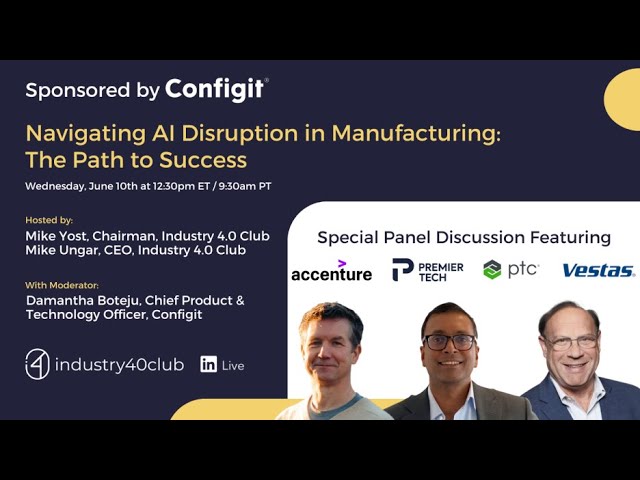
The Industry 4.0 Club hosts a recorded panel from ConfigIt’s Configuration Lifecycle Management Summit, moderated by Damantha Bateju and featuring Dr. Will Beelerd (Premier Tech), Peter Apporta (Vestas), Rüdiger Stern (Accenture Industry X), and René Zollfühl (PTC). The discussion explores the current state of AI in manufacturing and configuration, emphasizing that AI is still in an early evolutionary phase with modest gains (e.g., digital twins, code generation). Participants stress that data quality and trustworthy configuration are foundational; without curated, governed data, AI initiatives stall. A talent shortage is identified as a major catalyst for rapid AI adoption, while also posing workforce disruption risks. Governance models are debated, with a consensus toward a hybrid approach: central oversight for security, cost, sovereignty, and regulatory compliance, combined with decentralized empowerment for experimentation. The panel highlights common pitfalls—unfocused “random acts of AI,” POC‑itis without business cases, and neglect of change‑management—leading to failed pilots. Successful scaling requires clear business value, dynamic use‑cases that can leverage external data, robust data pipelines, and executive sponsorship. Organizational changes include assigning data ownership, building AI roadmaps, and re‑thinking legacy processes to be end‑to‑end rather than point solutions. The conversation concludes with quickfire recommendations: build AI experimentation capability, qualify and kill projects that lack value, connect legacy systems, and never treat AI as a universal shortcut. The hosts encourage listeners to act on these insights to advance Industry 4.0.
Chapters
Welcome to the Initiative 4.0 Club's fireside chat. The club's purpose is to engage the power of diverse worldwide talent to accelerate the global evolution to Industry 4.0. We accomplish this by hosting and supporting respectful, thoughtful, and interdisciplinary open conversations and creating quality content on wide-ranging Industry 4.0 topics to expand the reach of our community. My name is Mike Ungar, and I'm the CEO of the Industry 4.0 Club. I have over 40 years of leadership and management experience. Most of that in manufacturing at Michelin. I'm joined today by my co-host, Mike Yost. Mike, would you mind introducing yourself, please?
Wouldn't mind at all. Thank you, Mike.
Welcome, everybody.
As Mike said, my name is Mike Yost. I am the volunteer chairman of the Industry 4.0 Club, Mike's co-host and one of the co-founders of the club. And I've been in industry almost 40 years myself, a good chunk of that on the technology solution provider side. And about the last 16 years on the industrial nonprofit side. So I look forward to these types of conversations and moving the mission forward, as Mike talked about. And today we're going to do something a little different. We are actually going to share a panel discussion that occurred during the Configuration Lifecycle Management, or CLM, Summit for ConfigIt on May 6th. The panel was a discussion about navigating AI disruption in manufacturing and the path to success. And the panel was moderated by Damantha Bateju, who's the Chief Products and Technology Officer at ConfigIt. Damantha was on with us in one of our previous episodes, and he's been with the company since 2023, has over 25 years of experience with software development, enterprise class-level products. And he leads the products and technology strategy for ConfigIt and also did a fantastic job of moderating this panel. So we thought it was valuable enough that we would share that with all of you and that we will circle back with you after the end and share our perspectives on it as well.
Yeah, thanks, Mike. Just a quick comment before we get to the recording. Or to the panel. ConfigIt hosted its 11th Configuration Lifecycle Management Summit back on May 6th and 7th. The event focused on how manufacturers can master customization complexity by establishing a strong data foundation for future growth. The summit brought together B2B manufacturing leaders to explore how connecting systems, data, and logic enables many organizations to manage complexity more effectively. A key element of this summit was the discussion of AI's impact on manufacturing, which I think led to the creation of this panel. So we hope you gain something from listening. Hope you really find this interesting as we have. And with that, let's get to the panel.
Dive deeper into some of the topics that we went through in today's presentations. We're going to look at the state of AI today. We want to see whether AI is delivering the value that it's been promising and see how AI and digital threads work together. We also want to explore how configuration lifecycle management plays into all of this. So I'd like to introduce our panelists for today. First of all, I'm joined by Dr. Will Beelerd, CDO and Senior VP at Premier Tech.
Hi.
Peter Apporta, Product Owner Configuration Management Systems at Vestas. Rüdiger Stern, Managing Director at Accenture Industry X. And René Zollfühl, Senior Director Global Industry MedTech at PTC. Thank you for joining me today, and I'm looking forward to hearing your perspectives. So, Will, AI is everywhere, but what is the current state of AI in manufacturing, in configuration? Where is it genuinely delivering value today? And what are the expectations that really we can expect in reality?
So first I have to say it's really an evolution. So what we see right now are the first steps of a bigger transformation. So we see a lot of, so we in particular see a lot of suppliers stepping into different ecosystems, especially stepping into Omniverse, creating digital twins of existing equipment, having first clients asking for it. And we see already relatively small gains, like for example, we can now create code which we needed to do by, by hand or programmers in a virtual environment, and then really can, can validate the code. That's a good example. But I think we all have to have to admit that it's an ongoing transformation. And then, as I showed in my presentation, it will go step by step over the next years, really aligning a lot of different elements. So right now, already a lot of different signs, especially in coding, especially in taking control or patent detection. And step by step, everything will be an evolution about, I would say, 4 to 5 years.
Sounds good. Peter, what about you in configuration? what your perspective is, especially around configuration. How do you see AI playing there?
Well, we're not applying it yet, but of course we are looking into how we could apply it. And configuration, as I also alluded to in my presentation, is very much about trust. So we don't want to jeopardize that. So having Agentic AI in the core process of handling configuration, I think that lies very far ahead, and because it would be too risky to do. That said, there can be a lot of use cases of analyzing existing configuration data to identify patterns or other things that would be relevant that cannot be found today. It would be relevant to, to, to apply AI on that. Absolutely. So, yeah.
Do you have any perspective on when it will be ready? Also, any of the other panelists, what would be a criteria for, okay, now it's actually ready?
Will it ever be ready? Through our discussion, we'll probably touch upon the data foundation that has to fuel all of this. And so, and I know from many years in the industry that data quality doesn't come overnight. Sure, lack of quality can come overnight, but the quality—
And I think we've all heard that before.
Yeah, so yeah, very good. I will not make any promises.
Rüdiger, what's your perspective?
So as Peter said, so data quality and trust is definitely a thing. What I see and I believe will give it a push is the talent shortage. Yeah, so that may drive adoption quicker than we think. Yeah, so pushback or resistance is less of a topic than the talent shortage, and make sure that that has been overcome.
So it's interesting you say that in terms of the pushback. I mean, isn't that just a normal human reaction to pushback, and why would it be different now versus Anything else, I think?
It is a human aspect and it's not unusual. So as we said with regards to overall configuration lifecycle management, it is a people topic. So it's a change aspect, it needs proper education, communication, and the people need to be brought along.
Sounds good.
René, what's your perspective?
I mean, just to add to this, right, I think that worker shortage, skill shortage will be a driver for adopting AI. But also to your point earlier, I think we also need to be careful when we talk about AI because there are so many buzzwords and so many things. What is AI? You know, it's machine learning. Is it agentic AI? Is it generative AI? And we need to distinguish where each of those tools, which are in the end, they're just tools, right? And we need to make sure that they can be applied But this requires data, right? It also requires that the people are willing to adopt. And to your question about the impact, I think the important part is that this technology, I think, has the potential to disrupt more people in the workforce than other technologies we had in the past, right? Because it's also now affecting— you mentioned programmers, right? Programmers were people that always thought, hey, we are on the safe side because we are doing what is needed to drive transformation. Nowadays we can create code much faster. So, and this, you know, the— I think that the effect on the people and the workforce is much bigger than it has with other technologies.
Yeah, and you might even have it on a societal level, an effect. Yes, because resistance is one thing if you're just asked to do things differently or have an agentic AI helping you. But if it turns out, well, you can leave because now you're substituted by AI, I think the—
Or 1,000 AIs, as I promised.
Yeah, exactly. So yeah, it's a very different—
it's a very— you brought up 2 very interesting points. And the question is, will we stay in the future like we've been in the past? And you managed to mention it in your presentation as well. So now imagine And you made a very valid point that AI is really hallucinating. Wouldn't it be our obligation to really create restrictions so that it's properly governed, like with CLM? So we can use agentic AI to create a wonderful fancy wind chill. But at the end of the day, CLM would tell us, oh no, that's not possible, or it's only possible if you extend the solution space. So I think it's more the collaboration between different systems which we have to learn. And then we have also to imagine a lot of the A lot of the topics we have, like data. Data is the biggest AI problem. Synthesization of data is a big, big story. And also there's now a lot of technology to make the data clean up. So maybe we should also ask ourselves to have a different perspective and to find ways to overcome the bottlenecks which are right now the bottlenecks for AI, like having proper data, having to do the cleanup, or the wonderful—
AI.
topic about processes. There's, there are tools now, a lot of tools mapping the, the processes, matching these processes, and then AI agents are helping to improve the processes. So I think we'll see step by step, we, we discover problems and then, and then also we use different sorts of artificial intelligence to solve them.
So, Rüdiger, I mean, in your experience, where do initiatives like this stall? What are the problems, or what are the causes of some of the friction that happens in these types of rollouts?
I'm not sure if I ever want to answer the where. It's more the why. An observation I would like to share is when it all started, there were budgets available, and companies started POCs, proof of concepts, and there's a— my clients call it a POC-eritis. So everyone who had a few dollars left started a POC with no business cases associated to that, and at the end it was, from a technology perspective, it might have been successful, but the so what question was not answered, and that's why many of these initiatives failed.
Right, sure. René, do you see the same thing?
I see actually absolutely right. And it is maybe it's also a kind of maturity that we are, that we are seeing now that's coming. And I remember having discussions with clients that say, hey, can you help us and tell us what we can do with AI? And I said, what do you want to achieve? What do you— what is the business outcome that you want? They say, well, for now it's my management that tells me I need to apply AI in my processes. They also don't have a clue on what to do. But they need to report to the street. They need to report to their stakeholders, say, we are on the forefront. We are doing something with AI. But everyone was questioning. And it came to my mind, we had a similar situation when everyone talked about IoT a couple of years ago. You know, we had this private purgatory.
Blockchain also.
Exactly, blockchain, the same topic where everyone was You know, this pilot purgatory that was defined as something from the— I think from the World Economic Forum, where they said, you know, to Rüdiger's point, we need to have a business case. We need to understand what the real business impact of applying AI in a certain process would be for the organization. And that's really the critical point where also some initiatives die today as people realize, well, just putting AI on the problem doesn't solve the problem.
Maybe it's good that those things die if they are not viable.
Exactly.
Because it can never be the goal itself to have AI. It serves a purpose. And if the purpose is not clear and aligned, it makes no sense to spend resources on it.
Absolutely. On the other hand, I think conferences like this one are really helpful to understand what's possible and what's not possible. Because what I also see is we often repeat the same mistakes. So we often don't just read what is successful and what's not successful. And very often in a domain which is evolving, we try to apply the new technology to our current legacy, which is really difficult because we just don't know what is possible. And then if we try to run a POC repairing, like you said before, a legacy process, that doesn't make any sense. Then we should really educate ourselves and really move on to maybe redesign a little bit more so that it's finally working. But often we, exactly like you said, we ask, oh, what can we do with AI? I learned about ChatGPT, so why don't we apply ChatGPT? And then it doesn't make any sense. But it's not to blame on AI, it's to blame on ourself because we have to educate ourself.
Yeah. But I feel like this has been said like 100 times before, as you said, with IoT, with SaaS, probably with personal computers. And on the one hand you say we never learn, but I would also postulate that you kind of need to explore your way anyways. It's that same pattern of like trying and failing and doing what you did before, and then somebody comes and thinks a little bit radically, and then you need to move on from there.
But, but, you know, with 2 other people, I wrote exactly a book about this topic because we were really frustrated that the same mistakes are done over and over again, like we heard today. So if there's no change management, there will be no change. It's as simple as that. So if you, if you buy a piece of software and you think it will change your organization on its own, it will fail. It's simple, but I don't know, for whatever reason, these mistakes are repeated since decades. It seems to be no evolution.
And it's in most cases not only a financial waste, it is only a waste of focus. So in a time where the organization is jumping on the latest and greatest, Maybe not qualified good enough, so it will fail. They take time away from the stuff that would be really value-adding.
And that's a very valid point because the question for us is, for example, shall we maybe create a business enablement team? So we have people in the business really trying to keep the lights on. And if we have major disruptions like AI, it's maybe better to give it to teams who have more room to breathe, who can really understand it, than to try to just Sure, makes sense.
So let's switch gears a little bit. Peter, lately we've seen a lot of PLM experts and other commentators stressing the need for product memory.
Oh yeah.
Data foundation for building end-to-end digital threads. What's your take on that?
That is very important, but not only for AI. At Vestas, we have a clear strategy on on making curated datasets available to the business. So data reside in many, many different business systems, and often what you need is a combination of data points, maybe some extracted intel from that, forming a dataset on which the business can operate. And we have a clear strategy on that. The data, they are owned by line of business, And if we should make the switch to AI, that would be a very, very nice starting point to start training AI, because you don't get anywhere without quality datasets that are governed and curated, because they represent what good looks like. So I think that can go hand in hand. And I would dare to say that when you start up a an initiative on an AI, you should have that consideration at the same time. So maybe you want to build up a curated dataset, not only— basically, you can, you can have benefit of it if the AI fails, yes or no, but you still have benefit. But it would also be a prerequisite for, for scaling up and, and making that AI a success. So that's, that's really important, I think.
Sure, sure. So What kind of organizational changes needed to be in place to make that work?
You need to assign ownership of it. Of course, the data points, they reside in the various business systems wherever these data points are owned, but the curation and sometimes the work with the dataset, you need these data points. If that's true, then we need to set this data point like this. This kind of work needs to to live somewhere and someone needs to be accountable for it. Yeah, sure.
It's very valid and it's a profession. So very often in engineering-driven companies, you have very good knowledge in, let's say, civil engineering or electrical engineering, but data science is a different subject. So you have to have— if you have a very professional knowledge on the product, you need to have the same professional knowledge on the handling of data. Yes, because what you say is exactly right, but if you just don't have— if you have a blind spot, nothing will happen.
Yeah, sure. How about you, Rüdiger? Do you have any thoughts on that in terms of things you've seen with respect to organizational change and friction in getting that happening? Because one thing is to say it needs to be owned by somebody, but how do you figure out who that should be, where that should be, especially if some general Ownership is decentralized. How are you going to do that? And what kind of process would you think would be a good way to approach this?
I think the ownership is twofold. One is the data itself. So that's been generated by engineering operations, by the product itself. So they need ownership. And then the AI roadmap or the AI governance needs to be owned as well. So there needs to be an organization, if not yet that owns the AI roadmap and facilitates the AI adoption.
Okay, all right. So I'm going to ask you guys a very quick gut reaction question, right? Should AI governance be centralized or educate people enough and spread it out? What do you say, Will?
Spread it out.
Yeah, what do you say?
Well, the— you need the rules of the game, you need to define centralized. Otherwise you will face the next problem around the corner. So you might want to engage everyone decentralized, but not on their own. That will lead to disaster.
So you prefer the center of excellence approach?
Well, not for defining them, but, you know, like, just imagine if everyone makes up their own way of defining a business case. And none of these business cases making it to the same decision makers. They would be quite frustrated that, oh, this team comes with a proposal, they describe it in one way, the others, and have different metrics of evaluating if it's feasible or not.
Sure. What do you say, Rüdiger?
Centralized governance, but then spread out the enabled capabilities and govern that. So, use the swarm intelligence in the teams to come up with ideas, but curated.
Sure. What do you say? Absolutely hybrid. Hybrid, right? Hybrid, yeah.
Having a hybrid approach, having central governance, especially, I mean, working a lot with medtech companies, especially in industries where you have regulated processes, you need to have that governance body that's looking into what is also the impact of applying AI in regulated processes. It's a different thing if you just do maybe apply AI on a kind of procurement process. compared to a process that has an impact on the quality or on patient safety. But you also need to empower the people that work in the process to apply AI and come up with ideas. There must be a central governance body.
Yeah. Because I think— sorry, I was going to say, in my experience, what could happen with centralized governance is stifling of innovation. Because the governance body has determined that this is the right way to do it. And they tend to be a little bit less open for innovation, or you need to have some very, very open-minded people sitting there to be able to say, my purview lies here in terms of setting guardrails, but everything else is in there. So this is just my take on it.
But maybe it's in some cases it could actually be the opposite, because if you imagine you could— like scaling up AI really takes takes place when you can start reusing things. So now if you would build up a library of agents that you make available to the organization, so you basically centralize, you govern it, make sure that they work, they're curated, and now you say to your business, okay guys, you have all these standard building blocks, go ahead, combine them.
Use them.
Then you can have both. And I think there are also topics that call for central governance. And I would, just to mention a few, I would say stuff like security.
Yeah.
Cost.
Yeah.
Because you don't want to just let everyone hook up with some vendor. And the third one I would say is sovereignty. Because if we become more and more reliant on AI, The models, who owns those models? And if you can't take them and put them somewhere else, you don't own them. And then you're locked in. And then the problem is around the corner, cost-wise, politically, whoever. I mean, you're just, you're living on the grace of others. And that puts you in a tight spot.
Yeah, that's so.
So my comment was, I think, yeah, Rüdiger, what were you gonna say? Thanks. So my comment was more really on the first step because what at least we discovered was that AI is still a topic of big fears. So people have a lot of asymmetric knowledge. And then the question is, shall I expose my knowledge? Because my knowledge is maybe the guarantee of me having a job.
Yes.
So then the first step, and we've done a kind of hybrid model. So we basically selected different models and said, okay, don't use the normal ChatGPT version to create an example. Here's a landing page. All the models on the landing page are safe. You don't run into a kind of a cost risk. So you just can try it out for your work and you see how they will help you. And we were really astonished after now, let's say about 1.5 years, 30% of the team members have adopted to it.
Right.
They're trying it for different things. They know it's safe. And now the culture really has changed. So now we perceive a much higher openness to go the next step and have a curiosity to try try this out instead of the past where we saw a huge, huge fear and no, I don't want to do it, AI will replace my job. Now we are more like, okay, if we grow, we are more safe and then AI will support the growth. So finally it will secure my job. So that's a totally different perspective.
Yeah, sure.
I do agree with the 3 points Peter mentioned. I would like to add 2. It depends a bit on the business model and the type of company you are, but It's IP protection, especially if you work in an ecosystem. And the other one is commercialization. I mean, there is— so if you're used to, let's say, hours by times dollar, then how do you deal with that in a business context? So these 2 topics I would add. That need to be centrally governed.
Yeah, exactly. Sounds very good.
Specifically with all of the regulation that is also coming, like the Cyber Resilience Act or the AI Act or the regulations in other regions, right? You need to have that governance, that governing body in an organization.
Sure.
And of course, these are boring topics because, oh, they're holding me back. Why can't we just—
yeah, but You need to have them.
Yeah, exactly.
You need to succeed in the long run as well.
So René, how do companies balance the focus on near-term versus mid to long-term AI opportunities when it comes to spending and how they sort of allocate their portfolio? Do you have any thoughts on that?
Well, you know, I mean, we may have a little— well, I have maybe a very specific view on that because coming from a software vendor, right?
Yeah.
We are currently also investigating on what the typical and the good use cases are. And we are also doing it step by step as every organization is trying to apply AI. We also apply AI with the domain knowledge that we have and based on the solutions that we are providing to our clients, right? So, and I think there will be, there are already use cases implemented leveraging AI that are more easier to implement, but also generating value already. But then we're also thinking about use cases, especially when you think about the complete architecture process or IT architecture use cases that span multiple systems. When we think about agentic, right? I mean, it's easy from a solutions provider to say, hey, let's apply some agentic AI use cases on the solutions that you are providing. But what if you need to integrate with an ERP system or with a CRM system? or with a CPQ system, right? So there are different domains. And I think to start with, and I think that's also maybe a bit of the advice, is to start with the steps that you really can completely influence and then think, but thinking in the long run on what this would mean when you think about the holistic picture.
Yeah, do you see it as being any different than any other type of technology investment? It's kind of the same, right? Start small. Think big is the usual.
Again, for me, I think AI is a tool. It is a technology, right? And we need to see how we can implement that into our processes, into our organizations. And I think it all goes back, and we touched it a bit earlier, people, process, technology. That triangle needs to be somehow in balance, and you need to think about all the 3 dimensions, even with that technology.
And data.
And data.
And data, yes, yeah, that underpins everything.
That's the fuel.
Yeah, that's correct. Good. Do we need to change processes to work more effectively with this strategy? Rüdiger, do you have any comments on that?
Yes, I think so, yes, definitely. So it's, I mean, the processes these days are either driven by IT systems or by common practices. And if we want to adopt AI to its value, then I think processes need to be rethought. And another one to me is looking at processes as they exist today. Look at it from an artifact perspective, from a result perspective rather than a process perspective, and look at end-to-end integration rather than Point solutions for AI, that's where I see the value. So it's, I mean, enabling an engineer saving 10 minutes a day, that's good. Yeah, but, you know, if you think of, you know, engaging procurement, yeah, engineering, manufacturing, and look at the entire value chain and take out time and frustration there, that's the real value of automation and AI.
Do you guys disagree?
I think just to add, I mean, the other way to look at it is that maybe it's one of the first biggest use cases of AI because there are a lot of startups helping companies to align their processes to, as you said in your presentation, to the standard software. What we often see is an evolution. So a company exists for 100 years, no one ever thought about a specific process, it just works since decades, and all of a sudden we discover Oh, it's really legacy. What we do does not represent, let's say, our standard ERP plain vanilla process. So there's a lot of AI solutions really discovering the gap between the supported process and the reality and helping them through agents to really adapt it. Because I mean, I think it's obvious if you have legacy processes where no one ever thought about it, it doesn't make any sense. So, but this is normally, you know, In the old times, a big project, a lot of resistance, a lot of whiteboards around the world, but now you can monitor processes in real time. So I think that's maybe a good use case just.
Okay, makes sense. So I think last, one of our last questions. Many initiatives, AI initiatives start strong but fail to scale. What does it really take to move from pilots to enterprise-wide adoption? Anybody have any thoughts on that or any experiences with that?
So I think the first thing that really sticks, so that it's a use case which can get a dynamic on its own where the AI can really provide the pathway. So if, let's say, the typical frustration comes, okay, we have now this little pilot, now we need to find 20,000 man-hours to clean the data to make it happen. And then just nothing will happen. So if you have something, you should, you should be aware that there should be some angle that the AI can scale. That can be with external data. Maybe you can— you need weather data, or you do pattern recognition, or you need market potential. You buy the data for the whole globe and you can just use it very easy. But, but if you had a block that, that humans need to do a big amount of work just to make it happen, in my experience, it will always fail. So find something which has a dynamic on its own. That would be my advice.
Yeah, sure.
Any other perspectives? It is kind of that start small, think big approach, right?
Maybe it's also that we don't have that— I mean, I started my career by implementing SAP systems, right? And maybe it's also a completely different approach to this. And maybe also the lifecycle of an agent, right, or an AI application is much, much shorter than like an ERP system, for instance. Maybe that's also something we need to consider when we think about applying AI. But again, it goes back to start small, but then also make a decision and monitor the performance of the agent and have maybe also a governing process in place that says, hey, if the performance of that agent is degrading, What can we do? Do we need to update it? Do we need to improve the performance? Or is there maybe another solution that we should apply to that? So there's maybe a much more agile way of thinking within the organization on how we use the technology.
Exactly.
But think about this form of agents where the agents put each other under pressure. There's a lot of change now.
Exactly. Great. Yeah, maybe a follow-up question for you. AI provides a lot of opportunities. A lot of ideas are going to come and go. What's going to decide the winners and the losers in the next 15 to 20 years? Who's going to be the disruptors? Who's going to be disrupted? Doesn't need to be specific companies, but areas, industries. Where do you see the big winners and losers?
I think from a company perspective, I would say those companies that really start now by experimenting and giving also their employees, empower their employees to do so, to play around with it, you know, put away the anxiety that is there in the society and giving them a playground to experiment and really start now with applying AI in the processes and then continue and evolve but having a governance framework in place and an orchestration in place that helps them to really steer the development of the AI into the right direction for the benefit of the organization.
Rüdiger, who are the big winners and losers?
I'm not sure. I mean, 10, 20 years is a long time. Yeah, so it's those who adopt quickly, but are nimble enough to rethink and readjust. I think that is, I mean, as you pointed out, right? It's overrated for what happens in 1 year, but underrated what can happen in 10 years. So I think the nimble organizations will be the winners.
Yeah, sure. How about you?
Yeah, I would say the, I think the organizations that avoid wasting time on what I would call like random acts of AI. Like, because experimenting is good, but if you, if you spend too much time on just playing around without having a clear strategy or purpose of what you're doing and why and how, I think you, you will, you will lose a lot of time. So, um, so the companies that, that approach it diligently and, and find the right balance between a framework that makes sure that the direction and the approach is correct, but still gives enough of freedom to, to let loose the creative forces. I think they will, they will have a good chance.
How about you, Wilm?
Well, I think that's all perfectly correct. I would just add something. What I feel always very comfortable with is a kind of no-regrets approach. So there's things we heard them today completely Which are a must. You need to have good data. You need to put different things in place in the organization to be ready for AI. If you only experiment and you don't do data governance, for example, you're losing the AI edge. That's obvious. There's no discussion. There's no doubt that regardless how the development will be, you always need good data. And you need people who, let's say, as you said, experiments and And then also, you need to have a way, and I think that's relatively new for an organization, you need to have top management's input to really say, okay, that's a good use case, that's good, so now let's really scale it up. Because experimentation is good, you may have good people, you may have good data, but if no one at your management level is taking it and really scales it up with the discipline needed to do so, it's a failure anyway.
Yeah.
And I totally agree, it's this kind of combination, putting things in place to be ready, discovering new things, and as you said, not wasting too much time, having a culture of saying, no problem, it's not your personal mistake we failed, it's good, so let's do the next one. And then really say, okay, now these are the 2 bets we take, let's roll it out.
And maybe I'd like to add also the the management also needs to acknowledge that scaling up, going from experimental stage to rollout in a company, it requires a lot of funding, focus, attention, and—
Leadership.
Leadership. And it costs, it costs really. And the business case, that better be good because it's not only the wins of the AI, it comes with a huge It's a cost and a necessary cost because you are running business.
That's very true. And also accept the obvious, like it's very tough to get an ROI on the first steps of data governance. That's impossible. So there's no point discussing it endlessly.
Sounds good. So let's wrap it up.
Maybe data quality will get sexy again.
That's great. Yeah, for sure. Was it ever not? Let's wrap it up with a quickfire round. So, um, in a short, short response, one capability companies must build in the next 12 months and one mistake to avoid. What would you say?
Capability is really innovation experimentation with AI. That's really important. And avoid is, is a kind of hectic experimentation without without reflecting and without purpose.
Yeah, sure. How about you, Peter?
Yeah, I would say that one thing they should build up is the capability of, of, of qualifying the, the right projects, funding them, but also being willing to kill them. Yeah, if they are not delivering business value. And so that would be a good capability to have. The other one to avoid, I would say, is to, to treat AI as a shortcut So if your processes do not align or if your quality is poor of your data, it's not a shortcut to solve these kind of things.
That's very good. So, yeah, very nice. Rüdiger, what do you say?
So I think the capability to build is connecting legacy systems and data sources. So it does not necessarily require a a new IT system, but how to connect, how to make data available. And the mistake to avoid is to forget about the people.
Yeah, very good.
Yeah, exactly. I mean, it's, it's, um, success is empower your people, uh, but also have your, your digital data in order, right? And I think things to avoid is Don't treat it as the tool for everything, right? You cannot use AI for some problems. You need to be very cautious and careful on where to apply AI. It's like, you know, you won't use a screwdriver to remove a nail from the wall. So that's—
You had a good example in your presentation where the, the calculation was handed over to a calculator because that's the right tool for doing a calculation. And sometimes an RPA bot is better, or a machine learning thing is better to solve the problem.
Yeah, good. On that note, I will thank you for some very insightful comments. It was a pleasure to hear your perspectives. Thank you for participating.
Thank you.
Thank you.
And with that, I'll say back to you, Danjo.
Well, that was certainly, um, uh, an interesting conversation for sure. I hope that— yeah, I hope you got— everybody's listening got something from that. The topics that were covered were quite broad. Maybe, Mike, I'll start off and share a couple of takeaways and then hand it to you to, to share yours as well.
You know, the—
what I appreciated the conversation about A couple things. One is the companies need to have good governance, centralized governance about AI, but also then allowing folks to, to, to learn and try different things and then be ready to say, well, this didn't work and let's cut it and not continue to go down the road. I mean, that's interesting because that's the basic principle for, for any technology that you're considering doing, but I picked up on that. And then the second thing I just wanted to share that I thought was really important was this conversation around talent. The talent shortage will really drive AI adoption, and then it's really going to be disruptive for folks, disruptive for the workforce. And so you've got to get your workforce ready to understand that it's going to change how people work. So those are a couple of things that I took away. about the conversation. Mike, how about yourself? What did you take away that you thought—
Yeah, those were both key points for me as well. You know, having those standard business blocks through a centralized governance structure that could then empower people to innovate. I noted as well that conversation around the acceleration of adoption due to the talent shortage, the workforce shortage. was the same conversation. They were talking about the importance of data quality and that having a foundation of trust and being accelerated by that talent shortage need. So, you know, they did talk. One of the things I wrote down was AI as a people topic. And I came back to this point about a couple of things from a leadership perspective and then also from a talent perspective and innovation perspective. I thought those were all great. And probably the main, bumper sticker that I got out of it was to avoid random acts of AI. So I thought that was a good one.
Yeah.
No. Appreciate the thought. So hopefully, you've enjoyed this panel from— on AI coming out of the ConfigIt PLM Summit. I know that we thought it was worthwhile to share it with you, that the insights were pretty deep. And what a group of experts to hear from, each of them having a different perspective on their own, based on their own experiences in their own companies. So with that, the Industry 4.0 Club would like to encourage you to take action to advance the deployment of Industry 4.0. Read an article, attend a workshop, or develop even a smart manufacturing roadmap, or encourage your company to do the same. We'd love to hear from you. We'd love to hear what you're doing. Drop us a note on our, on our webpage at www.industry4oclub.com or our LinkedIn page and let us know what you're doing to advance the deployment of Industry 4.0. We hold conversations like this weekly, so if you'd love to be a future guest on one of our broadcasts, again, drop us a note at our website or LinkedIn page and let us know. And with that, Mike, thanks again for taking the time to join us for this panel discussion today, and we wish everybody a wonderful Rest of the day and rest of the week.
Take care.
Bye-bye.










