New update to ChatGPT: Develop personal and customer GPTs for Manufacturing
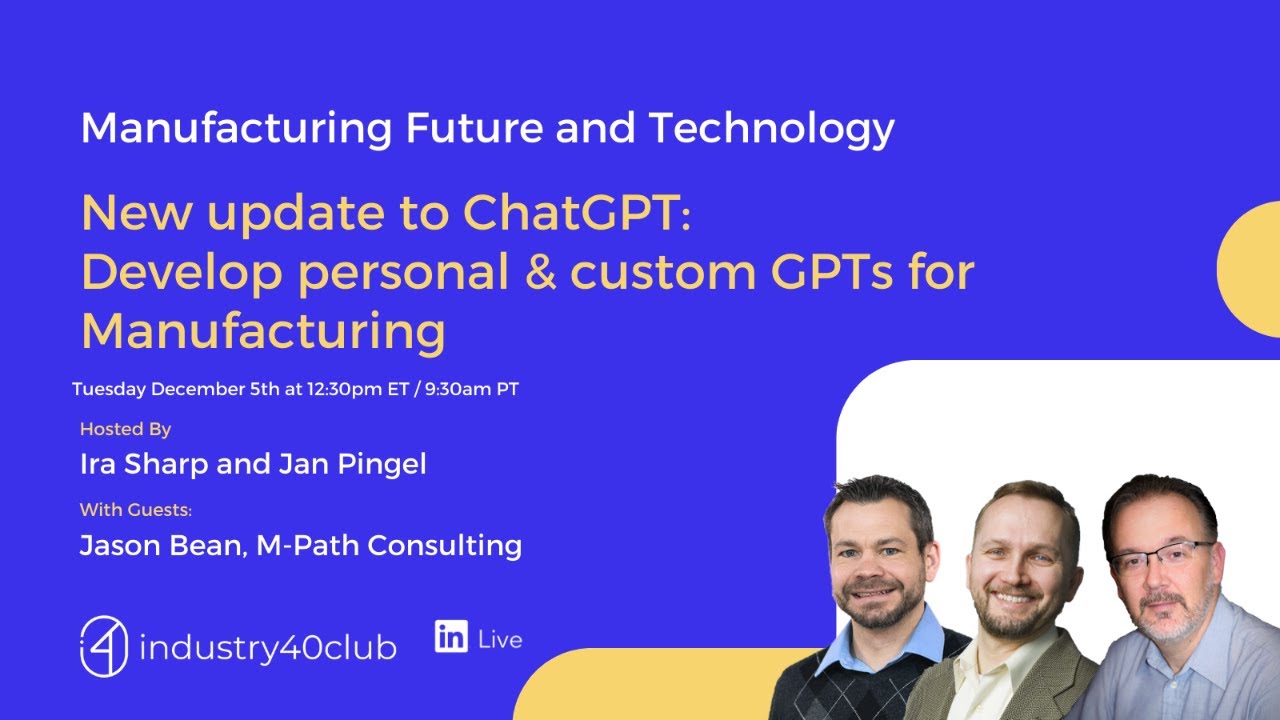
Jason Bean and Ira Sharp demo OpenAI's custom GPT feature for manufacturing use cases like employee training, customer support, and capturing knowledge from retiring operators. They warn that current security is weak: custom GPTs shared via link lack access controls, and the model can be tricked into revealing training data, so sensitive work needs on-premise or secured cloud deployments.
Chapters
Hello everyone, we are here back again on Industry 4.0 Club with our Manufacturing Future. Um, we're today going to talk a little bit about ChatGPT, and I'm here joined with, uh, Jason Bean from my Industry 4.0 Club, and again also joined by my co-host Ira Sharp. We are not going to focus so much on Sam Altman's little trip he had a couple of weeks ago, etc., but we're going to look at something that came out of the OpenAI Developer Conference that I have had very little time to play with, but I know Jason had spent some time on this, which is custom GPTs, personal GPTs. So that's an interesting topic and something that we think once it fully matures could be very interesting for manufacturing to look at as well, but it probably needs a little bit of maturing. But yeah, just quick here, just as introduction, when I'm not here with these great people presenting and talking about Industry 4.0 Club, My name is Jan Pingel, and I am a product leader for digital solutions at Ingus Oran, an equipment manufacturer where we utilize IoT to make our equipment smart and connected. Jason, do you want to quickly introduce yourself?
Yeah, I'm Jason Bean. So when I'm not engaged with the people at this club, I am the Industry 4 specialist for Pepperell and Fuchs, and I am also the founder of Empath Consulting, my own business, which focuses on educating employers on neurodiverse employees and how to bring them into their organizations.
And Ira?
Yep.
Hello, everyone. My name is Ira Sharp. And yeah, so outside of the club here, I'm actually the Director of Marketing at Phoenix Contact. And specifically today, what I've been doing when I'm not on this livestream here, as you can see with my Very festive PLCnext sweater is right on the other side of this office wall here. We're having our Christmas potluck, so we're enjoying a little bit of the holiday season here in the Phoenix Contact offices. But otherwise, I'm on the club here co-hosting with Jan and the Future of Manufacturing and talking about all things that are forward-looking in the manufacturing space. So I think it's a great topic today, and I really look forward to it.
Yeah, absolutely. And when you say forward-looking, that's definitely what this topic is all about. We've seen here over the pretty much a year now. I think the first, uh, official, uh, public useful version of, uh, OpenAI ChatGPT was about November, uh, last year. So we're talking about close to a year now where we've been talking about this topic, trying to see where it all goes, and various different companies have developed solutions that we kind of play with both for Uh, creating documents, uh, marketing, uh, conversations, graphics, images, video, etc. All kinds of different stuff in this particular arena here that, uh, I think it's, uh, proven itself. I think at this point that it's not just a short-term fad, but, uh, but something that's gonna be staying with us for a while and, uh, and just needs to mature a little bit more. Um, but that's what it is. But again, this session here today, uh, is I think Jason reached out a couple of weeks ago and said, hey, we should talk about this topic because it is showing some interesting aspects that I think we could show here. Just as a main introduction, I think the idea that was introduced over a month ago right now at the OpenAI Developer Conference was the idea of personal GPTs or custom GPTs. And really what it means is that everybody is in the thought process of, can I create something like a bot or something with some specific knowledge that I can then use as a part of my application or my customer interaction or whatever it is, or my employee interaction, whatever that is, right? But the tools were not really there. to do it. And so now what OpenAI has introduced— but the tools from OpenAI, I guess there was APIs, there was developers could develop something. But OpenAI has now introduced the idea of anybody can go in if they're using the latest version of OpenAI's ChatGPT. They can now go in and create what's called a GPT. So really a custom definition with some specific learning that can then respond in a specific way that you have defined with it to be a tool to help out. We're going to talk a little bit about different aspects of it and also some examples of thinking through how could this be used. But I just want to put a disclaimer in here right away. I think we talked about it between the 3 of us a couple of times is that This is a technology that's evolving. I think Jason has seen specific companies that have started to introduce this type of product into the market. And I just want to make sure that, especially from a manufacturing perspective, that we're aware that there are still significant issues around IP, around security, around other things that I want to make sure that we're showing some ideas that could be used in the future. But as a company, as a manufacturer, you still got to be a little bit careful of what it is that you're going to introduce into your environment and make sure that you fully understand what the impact could be. So if it's something not nefarious information that can provide some information to users, maybe you can use it more or less as it is today. But if you're thinking about, I'm going to put my equipment drawings or something into a system or whatever in then maybe the time is not yet. We're going to talk a little bit about that. But I want to hand it over to Jason here. Jason, if you can give us a little bit of an introduction to how you got started with this after that developer conference and what you have seen so far. Then I think you're going to show an actual example so we can see how it's actually used.
One of the main reasons I wanted to reach this topic was since the developer conference, I've actually now encountered 3 companies in the field that have— that are built offering to build custom GPTs for manufacturers and actually trying to sell it to them. One of the problems is, is there are security issues, you can actually trick the GPT into divulging The custom instruction set. You can get it to divulge which documents it's been trained on. You can actually even get it to down. You can even get it to provide you a download link for those documents. So manufacturers need to be aware, like if especially if they don't have an IT department where they have security compliance already in place and where their software goes through an assessment, that they need to really vet. Some of these newer AI companies that are coming out to ensure that they're not going to be exposing any sensitive material. Because when you create the GPT, you have one once you go to save it. You have three options: personal use, anyone with the link, or public. If you most companies would probably be picking anyone with the link expecting that it for their employees. Now anybody with that link, it's just a URL link that anybody can share. There's no security on it whatsoever. So anybody that's using it can easily start asking to divulge that information. Now, I've been working alongside some AI companies now for the past couple of years. So I've seen legitimate generative AI solutions for manufacturing that have all the security compliances in place. The manufacturer gets a secured server, their data is locked in. It's— you can get 2-factor authentication for individuals to get in. But with ChatGPT, there's been this increase in companies that are building solutions based off what's available in the general marketplace for ChatGPT.
Yeah, I think it highlights specifically around the maturity, right, that I'm very confident that, that this technology is going to be put into the OpenAI solutions that are secure, the enterprise versions, etc. And also Uh, there are going to be ways to identify within the GPT what you are allowed to disclose, uh, yeah, etc., etc., right? But right now, I think it's an interesting playground to, to be in and see what it can be utilized for and maybe prepare for. And I think I, I can see a lot of people that have access to GPT because a lot of companies are now blocking all these, uh, all these generative AI systems right now to make sure that they're not unintentionally disclosing any information just because the maturity is not really fully there yet. But the ones that have access to it might be at least looking at generating maybe some personal GPTs that they're going to be able to play with and just learn more and be able to utilize that as a part of their daily improvements and etc. But, but there's still some maturity things that needs to be in place before this becomes mainstream for sure. So good points there, Jason. And again, also the warning around if somebody out there is saying that they can generate or they can help develop a GPT within ChatGPT for you, then it will be in the same environment that Jason's been playing with. That means that all the, the areas of issues that you've identified is still going to be there as well.
And, you know, with all this, it's interesting to me because, you know, when I think about AI as a whole, you know, AI isn't new. It's become— it's been thrust into the mainstream and a lot of it has been through this generative AI, you know, whether it be the ChatGPT and then there's of course the other types of platforms that you mentioned like image generation and these kind of things. But when I think of manufacturing, it's— I'm curious, Jason, where you're gonna go with this because Typically with manufacturing, we wanna have a closed box and it's not so much generative. You know, you wanna be within, you wanna play within your playground. So, you know, be curious to see where you see manufacturing actually using more of this generative side of the AI versus using ML, which is kind of like a fixed application that you're just refining over and over and over again to get a better yield or get a better result of a defined process. So, Yeah, some of the things I'm looking forward to.
Yeah, one of the areas I think manufacturers can really benefit from generative AI is in employee training. That's one of the reasons I started playing with the GPTs was for my personal business, was to how do I take the training courses that I deliver to my clients and create them so they're more, they're more accessible, and that they actually adapt to the individual learner versus being a closed one-box-fits-all training system. Right. So yeah. Currently, the way I— if somebody wanted me to go in and train, I have to go in, I— we take a boardroom, we go Sessions and stuff like that. And I was looking, okay, how do I take my training online and make it more accessible? And the GPT seemed like a very natural progression for that. I've not fully developed a GPT I would say I would release to people yet, but I do have one that is in development for training, and I can show a little bit of how that works and how that was built. So people are aware, but basically anything in your business that is language-based, whether it's written documents or whether it's verbal communication, generative AI and large language models have a place there to augment and enhance that, that area.
Yeah, well, well, if you can have a Jason Dean GPT and I can ping your brain and everything that you got going on with the book and everything else you've done, Sign me up. So I'm sure I can learn quite a bit.
So— Well, I haven't been able to emulate my brain yet, but—
You gotta go to Elon Musk with that. With that question. Hey, I just want to maybe level set here, just so everybody is on the same page here. When we're talking about a custom GPT, what do we really mean? And so with ChatGPT today, and most of the other generative AI systems, if that's graphics, image generation, whatever it is, it's typically based on a conversation. So you go in and you start talking to that, to the AI on the other end, identifying what it is you're looking for, providing all the different content that you wanted to evaluate, and then it comes back with a result. And the difference here between like search, I mean, that's one of the main things that came out when it originally came out, With search, you'll get a list of different references and links. Here you get a response, you get an actual physical response you can then utilize and use to something. And it could be, if you could ask to generate a report, it would generate a report. If you ask it to generate an image, it will generate an image, etc. So that's how this whole generative AI works. You go online, you have a conversation, and you can have follow-up questions and comments that then improves the output of that. specific conversation. The thing that happens then is that you then close it down and then you open up again and you start a new conversation. You're back to square one, and that new conversation doesn't know all the other content you already put into it. You're starting with, here's a new request, new content, give me another response back on that particular thing. And then that conversation can go on and on for a while as well. The idea of the custom GPT is, as Jason mentioned before, if you have some existing content, that you feel can be utilized to provide answers to somebody that's on the other end asking a question. You can now generate or define a custom GPT within ChatGPT Plus, I think it's called, or OpenAI Plus. Um, you can then, uh, um, first of all, tell what it is that GPT is to you, what it's supposed to do, how it's going to respond, what it's going to respond to. Then you can provide that content to say, base your responses on that particular content that I'm then going to provide. You're then going to upload that content, and then that GPT has that learning that you now provided that you can then hand to somebody else. For example, if I have a conversation with ChatGPT and I get to a great result and I say, hey, Jason, can you continue that conversation? That's not how it works. It's my conversation, it's not Jason's. But with the ChatGPT, if I create a GPT, and I put all this stuff in it and say, here's all the content you can use to be able to respond to it. I can now give that GPT to Jason, and he can now use that with what I put into it. And so that's where the difference between using standard ChatGPT today by going on to OpenAI and having a conversation compared to now generating a GPT you can share with others, or you can use it yourself. Whenever you go back in and say, open that particular GPT, you're basing all the results based on what it is you learned. Even if it's a personal one, you still have it preloaded with all the content you put into it and your conversation starts there as opposed to starting from scratch as it would do when you go into a standard ChatGPT dialogue and converse with it. I don't know, Jason, if you want to maybe Kind of give us a little bit example of what is— what, what you've been doing while you're playing with it so people can get a feel for how you would go in and generate your personal GPT.
Let's see if this share screen works.
Yep.
It looks like it's up.
There we go.
So, uh, Jan mentioned to actually create GPTs, you have for to even use them right now, you have to be a GPT Plus subscriber. So if you haven't seen ChatGPT's interface, which I would doubt many have, uh, not seen it, uh, this is your standard chat window in which you can talk to. But if you want to create a GPT, you have to jump over to Explore and it'll come up. So these are a number of different GPTs I've been playing with, some will be deleted because it's just all test. Then you get a list of a bunch that were created by OpenAI. But most recently I've been working on this, which is my, which is my training one. So if I go— sorry, they've changed the interface. If I go into edit, when you want to create, you just communicate through the create here. By asking questions to ChatGPT, stating what you wanted to do. You can ask it to help you actually create the instructions. And then in the configure tab, so what it's doing when you're communicating with it is it's filling in, it's generating this instruction that appears right here. So when It's doing that through that interaction of use. It— every interaction, it will update and change this. So I like the interface when you're first brainstorming an idea, but when you're trying to really fine-tune it, it actually works better if you actually move away from the interface and actually start fine-tuning this instruction yourself.
Um, yeah, and that's another interesting aspect I think too, is that so people that have started using ChatGPT and OpenAI from a like industry perspective have been able to utilize the enterprise version of it, and they've been able to use that like the APIs to generate a bot, for example, whatever it is. So, so you're going to have programmers that's been coding this, they've been generating some code in order to interact with the API, generate a specific structure there, load it with some content, and now get the right responses back. But this interface here is similar to all the other interfaces. It's a conversation. You are instructing the system what it is you want it to do by having a conversation with it as well. This is basically democratizing the idea of generating these type of systems as opposed to as it is today or before this, that you still had to get a programmer to develop an application that would interface with the API and then come back with the right responses. Is that a good analogy, Jason?
Yeah, that's a good analogy. So if you notice when you're creating the instructions though, what you wanna start with is a role and goal of what the GPT is gonna be. So it's What it's going to behave like, what knowledge base constraints, guidelines, clarification, personalization. The more you structure this and actually give it headings, the easier it is for the GPT to perform. Now, the other thing is, is here under knowledge, this is where you can load your personal knowledge base, whatever that be, whether it be machine operating instructions, employee onboarding, whatever you, you want. So I've loaded in Word documents that I used in my training. So I've got, you know, autism awareness training, neurodiversity in the workforce. I've got an instructor's manual in here and a participant's manual. Um, the thing that OpenAI just added was this: conversations with your GPT may include file contents. Files can be downloaded when Code Interpreter is enabled. So they have realized that through the people, the community playing with the GPTs, that, um, people were able to access this information that is behind the scene of the GPT. So they're putting in that little caveat saying, giving you that warning. And the other thing is that they've added recently is the following files are only available for code interpreter. So depending on your file type, it depends on what, how GPT interacts with it. So these top 4 are Word documents. This bottom one is a PDF.
Okay, and, and also when I look at it here, you can kind of see that you can add different components to it. So for example, like, uh, traditional with the GPT before, it was— it would have been trained up until sometime last year, I think, and now they updated it. So it's like, I think October of this year that the new GPT is trained to. But you can now add web browsing, which means that you can actually go have it go out and find current information. You can, you can add DALL-E, uh, image generation. So if you wanted this to generate an image, you can do that. And then of course the code interpreter as well is also a component you can add to, uh, to, to, to a GPT.
Is it—
then under additional settings, they do give you the option of using the conversation data to improve their models.
Got it.
Yeah, so you can— and that's, that's one of the things I think is, is, is critical if you're going to share a model outside of your organization, um, you, you might want to, want to limit that so that, so that whatever you might put into it that could be confidential material, etc., uh, to, to— so the next step in your conversation, you don't want to, you don't want to make that available to anybody else. And by unchecking that, you will make that, uh, a part of it. So that's one of the things they've added to this to make it a little bit more mature, but there's still other areas that, uh, that we need to look at. Ira, you had a question?
Yeah, I was just curious, and I don't know if there are particular file types that it's limited to, but I mean, can you include things like OneNote files or PDFs or PowerPoints or any other kind of common Microsoft files to add into this?
Well, we can ask it.
I guess if we don't know, we can ask. That's, that's good. And I, I just think back to a conversation I had with Dave Griffith a while ago, and I know he does all of his notes and these kind of things in Markdown text, which is fantastic at this point because that can be all note or text files and you could load it into this and you could really have a, a GPT, um, on your dataset from, you know, God knows how long you've been taking notes in some electronic format.
So So according to it, it can support PowerPoint, XLS spreadsheets, JPEGs, PNGs, XPS.
And if it doesn't support OneNote, you can actually export OneNote, I believe, as Markdown text, which would just give you a random text file. But I don't know, someone like myself that is a crazy note-taker that has been for the past 18, 20 years here, That's a lot of data. That's definitely well on our way to creating an iRobot. I don't know if anybody wants that, but it's possible.
Yeah, that's a good example though, right? So let's say, for example, that you have— you may be a college part-time professor. You have your job, but then you also train or do something at night. At college, you have a whole curriculum that you have been doing for years and years, and it's all based on either like PDF or Word documents that has your curriculum and all your sessions and lessons in it. You could now generate a GPT that has all that learning from that training that you've been doing by adding all that curriculum into it and say you're now the specific knowledge around this particular topic. And you can now answer questions based on that curriculum material that I upload to it. And anybody can answer those questions and get, get a, get an answer based on that.
I would be curious if you did that and then you fed in the test that you give at the end of the semester or whatever else, how well your GPT does on the test. It'd be kind of interesting to see.
Well, that could be interesting, but because you know that, that, that GPT is without, uh, or ChatGPT and others without, uh, uh, having fed that test have been doing various different, like the law degree test and others, and doing pretty well on it too. So, so yeah, I, I, it'll be interesting to see. Um, I would assume it will, it will do pretty well. That, that would— that's the whole point of these GPTs and how they're working, right? That they, they should be able to, to handle that. But yeah, good point. Uh, interesting aspect for sure. So, uh, just quick, uh, a couple things, a question, Jason. So first of all, uh, that, that little logo there, did you create that?
Uh, nope, the CustomGPT Creator did. Uh, when you first start in the conversation, um, based off what you're asking it to do, it will recommend a name, and if you don't like the name, it'll create another one. And then it'll create an image badge for it.
Got it. And those, those, uh, initial questions there that it's suggesting, did you create those? Did that also—
No, it created the initial questions. Now I'm able to go in and edit those because I can go back to the Configure tab and I can actually put in the initial questions that I think need to be there, or I can modify these ones.
Right.
Cool.
So just to prove that we can access the information, because we're right in the, the GPT right now. So we'll see how fast it is today, because the lovely thing with GPT is it gets overused, so you get some lag.
With this live stream, I'm sure there's, you know, many, many more users, so it could be a little slower than normal.
That's right, that's right. But interesting thing too is that it's showing the documents but also the synopsis of those documents.
Yeah, it's good.
That's pretty cool.
Yep. And it worked yesterday, last night. I'm gonna ask if they can give me a download link for one of those documents.
Yeah, so that, that's one of the other areas of this area is that a lot of people are trying to see if they can They can trick it. Come up with something.
From last night, they've, uh, they fixed that part.
Okay, okay.
Because it told me it cannot provide me the download link. Let's see if I can get it to tell me how to download it. So it looks like they may have— it looks like they're getting arrogant, so download the files.
Yeah, yeah.
But the thing is, you can still get it to tell you what's in the files and give you a synopsis of what's in the files.
What is the thumbs up, thumbs down? What's that meant for? Is that for individuals?
That's just to rate the response for their training purposes. Okay.
Right.
So if you think it was a good response, you can thumbs up it. If it was a bad response, thumbs down. And that goes back to OpenAI's training.
So that's to improve the model and the training.
That makes sense. All right, so because right now I have it allowed for improving model training, because frankly this is a test GPT for me, it's not something I'm releasing, I'm just trying to see exactly what I can accomplish, right?
Exactly. Yep, yep.
All right, so I can ask this, you know, what are some misconceptions, and it's trained off those documents, it's gonna spit back a response once it So things are a little slow right now because I am live streaming through Wi-Fi.
So yeah.
Right.
So this, this is one of the things I think where companies can really benefit and leverage GPTs right now. is developing a training GPT in-house to train their employees.
Yeah, yeah. No, this is pretty cool. This is pretty cool. Yeah.
To your point, then, I mean, like, looking at this and looking at the way to feed in the documentation and things from a, you know, employee manual and operations and policies and procedures and all these kind of things, it seems like it could be a phenomenal use case. And then if you add to it Particularly with the knowledge we just, you know, got into a little bit ago with the Excel spreadsheets and things, it would be great if you could actually plug this into some sort of ongoing data set so that if you do have a really skilled operator, you know, one of the biggest things that's plaguing the industrial industry is the brain drain, right? The retiring of a lot of people that have been operating machines forever. And if you could capture their interactions with machines based on you know, what— when they see things happen, whatever, what they do, the policies and procedures along with that, and being able to feed all those kinds of things into this, you could really try to help capture some of that IP, that localized IP that you'll be losing anyways. And I know there's the security concerns and these kind of things, you know, I don't know if you can do it 100% local where it's completely isolated from anything, but a lot A lot of cases you're going to lose that information anyways because the person's going to retire. So, uh, hey, maybe this is a way to plug that, plug that gap.
So there's actually one of the things you can do is if under this create actions you can actually tie in APIs from third-party applications. So my next test, I'm actually going to be taking an IO-Link master feeding data into a SQL database and then having the GPT access that data and performing analysis on it.
So it'll become your basic, uh, system admin or your, uh, basic, uh, um, data analyst for you. That'd be great, fantastic.
Because I have seen— I, I have seen applications out there by legitimate companies that have been in operation for a few years that that's what they've been doing for years is they've got a large language model generative GPT running and accessing data from an existing dataset that is constantly being updated from live machines. So I want to test, can we now do that with this version of GPT? Because they've given you the ability to link third-party APIs into your ChatGPT and actually run as a set of triggers to initiate certain active actions.
I think this is a good segue to kind of, uh, what we did, um, to prepare for this was kind of think about, okay, so if I'm in manufacturing, what are some of the examples where this could be interesting, uh, to utilize? either at a small sample rate playground right now or later on when it's mature to actually upscale in a manufacturing environment. And there's this, again, when we go back to the concept of I have some content of some sort that I want to are usually something that people have to look up and find and scroll down and figure out what's going on and what's my right answer to whatever question it is. If I have that, can I put that into GPT and then in a, in a conversational way be able to get the same responses? And, and the first thing I thought of, which I thought was— would be very interesting, is policies and procedures. I don't know about you guys, but I see them once a year, and that's when I get my, uh, employee training, and we got to go through various different training aspects, and a lot of it reports back or links back to our policies and procedures. And so yes, I will look out, you know, what's my harassment policy right now, what's whatever insider trading policy, and all that kind of stuff. And that's when I get access to it. But on a regular day, I don't, right? And if I get an issue, which I haven't had, but if I did, I would probably call somebody as opposed to go in and figure out where my policies are and which one to look at and where to find the right procedure. and that kind of stuff. So my thought was, hey, if this was mature enough, and I had the, you know, the full protection of enterprise version where it's localized to what I'm doing and nothing gets shared, it'll be interesting to be able to push all those policies and procedures into a GPT and then have it available to all employees. So if there's any issue, there's any incident of any kind, They can go in and say, "Hey, here's the incident. Here's the issue. What am I supposed to do?" And then have that GPT respond back with it according to policy blah blah blah and this procedure. Here's what you're supposed to do. That could be pretty powerful, I think, and and and enable easy access to things that are that are normally not that that accessible to the to to any employee in in a company. And that could be any. I mean, I'm talking about policy and procedures, but it could be. Any type of knowledge database of some sort that are, you know, complex, big. And, and instead of having to search for something and, and look at 10 different, uh, uh, instances where it finds something similar to your search and then find the right one, just have a conversation with the ChatGPT and it gives you the response back. That could be pretty interesting, uh, in manufacturing, uh, or in any any environment, so to speak, any business, so to speak, could be very interesting to, uh, to have that. And I think we talked about those knowledge bases could be anything, right? You know, all my service records, uh, uh, all my interaction with customers, uh, if they're recorded in some kind of system, um, having some that actually kind of categorizes all that stuff to be able to give me quick responses to a specific scenario.
It really becomes— some of the ones I've already seen out there is, um, people asking to have the GPTs run as their initial frontline on customer support.
Yep.
And, and, and loading in the technical documents on their product and loading in transcript records of previous calls so that So the GPT knows how to respond. But yeah, though, it's going straight through the ChatGPT interface, you have that security issue of being able to divulge the training documents.
Yeah, yeah.
I mean, again, that's the maturity that's going to happen, I'm sure, over time, right? But, but just the idea of So you have these kind of bots today, right, with very little functionality. And as soon as they get above their head, so to speak, they're going to convert it to a person, right? But here you could be in a conversation with what you believe is a person and they're not, right? And they answer every question as a person would and with the right content. And you could It'll be interesting to see once these become more mainstream, to see, because at the end of a lot of those service calls, you get this little agent that's going to answer, you know, ask you a couple of quality questions. It's just to see who's actually get the best ratings. Is that the GPT or the person, right?
And with GPT is also available on your phones now, right? So, and with that, it actually— you can speak to it and it will speak back to you. Once that's integrated into the GPTs, that's going to, like, into the custom GPTs, that's going to expand their, their use case of where they can be used, right?
So no, absolutely, absolutely.
So, so I mean, when I, when I think about all this too, so of course we're talking about the future of manufacturing and that's where we are and that's what we're doing, but I think about this Holistically, and granted, I'm a marketing guy, right? Been one for 18 years now. Granted, I am a degreed engineer as well, and I geek out with the best of them, sometimes too much. But, you know, I think about business, particularly small business, and there's so many small businesses around the world, particularly in the US, and particularly contracting businesses. In a lot of cases, it's just like a single person or a family or whatever else. And I don't know about you guys, but, and I know I'm painting a broad brush, but I think about the customer service a lot of times when it comes to those types of organizations, and it's not good. And it's not good because it's not that they don't want to do a good job, it's just that they don't have the resources to pay for a customer service team and these kinds of things. And if you could imagine them taking documents, policies, procedures, ways of doing work, invoices, all these kind of things and loading it into one of these models, that you could then interface with, how much could that improve the customer service experience from some of these smaller guys that maybe that IP is not as critical as the advancement that they would get from their organization? I mean, so I know that's outside of the realm of just manufacturing. It's definitely more on the commercial and business side of things, but there is so much on the small business side, I think particularly on the contracting side, You chat in, hey, I have a room that's this by this, and I want to give you— I want a finished basement with a bathroom. And you know that you've done 20 of those bathrooms in this particular area, or rooms in this particular area at this point in time. You could probably turn out a quote instantly and say, hey, this, you know, merits investigation, but to give you an idea, it's going to be $30,000. Is that within your, your realm of possibility? It could be a game changer for people that jump on this, this this bandwagon, I think.
Absolutely, absolutely. I, I think you, you bring up something that got my head spinning a little bit too, is that we continuously talk about how, especially in the small and medium manufacturers, how we can help, how organizations within different states can help them kind of get better with Industry 4.0, etc., right? But here's an opportunity for for specific small areas to say, hey, I'm a little manufacturer here, I have solved this problem generally with a GPT that is now improving my productivity significantly. If there will be some sharing around that within small manufacturers, uh, um, we're helping solving each other's problems, uh, especially around problems that are typically like, like you're saying, resource constraint, right? Uh, this is really an interesting area where, where manufacturers, without necessarily identifying, you know, the, the IP of what they're doing, but here's a process of how I set up something that is helping me that I see others could use similarly. And, and, and that's an area where I think this could be very powerful, um, not just for yourself, as you've mentioned, a small Uh, a business that is trying to get an easier way to get that initial quote out and get the customer to be interested or not. All right, that's a, that's a great thing if you can do that without having any people involved. Just a website request, here's, here's the basics. And it, again, a conversation that says, well, uh, what do you mean by this? Can you just elaborate? Oh yeah, I mean, you know, it's, it's a 10-foot height or it's 9-foot height or whatever. Have a conversation and ask, ask the right questions as a person would do. And then, hey, here's my initial estimate of what I think. If you think that's okay, I'm probably gonna have to go in and do a little bit specific, but this is kind of like the ballpark. I think that's a great idea. That's a great—
And you can already do some of that with ChatGPT because one of the, one of the main actions that people are using it with right now is Zapier, which is an automation platform that links into multiple different software solutions that are out there. So I know, I know there's a few small businesses that I talked to that have already developed ones where they're— it's feeding into an AI-created avatar. So you would be on their site and the video comes up with this AI avatar a woman or a man. And ChatGPT is the one that's actually providing the conversational text that's feeding into this avatar based off of the response it's getting back from, uh, from the, from the user. And the other one you can do is it can also handle your payments. So if you link it to something like Stripe, or I'm not sure if, um, If it's able to link to Stripe, but there are online payments it would— that it is able to link to, where it can actually, you know, once it's received that payment, it can verify that payment and then automatically email out, you know, the invoice, the receipt, or whatever digital product they have purchased. So there's a lot of people already out there playing with this stuff in that space for the small companies on this, on how to optimize their sales, their customer service, their payment processing. I just would caveat that again with be careful with the data because you want to make sure that it's secure.
You've got to get the maturity level up for sure. And that, to me, is— that's obvious that's going to happen, but it's just a matter of timing. So yeah, I think that's— I think there's a lot of interesting aspects of this, and it'll be interesting if anybody listening in or later on listening in, if they could think of other ideas in the manufacturing space where a custom GPT might be something that would either solve a company's particular problem or be something that could be shared between manufacturers because it will solve a general problem. or issue or whatever it is in a manufacturing space. So we talk a little bit about, you know, policies and procedures. We talk about experts have a system based on some knowledge data. The thing that— and Jason kind of corrected me, but I was thinking also about coding systems. So for example, like a manufacturer typically will manufacture either widget, which is not so much of what I mean, but what if they manufacture a piece of equipment that has code in a control system, right? So a typical developer will go in and go into their coding system and pull a couple modules in depending on what that equipment is supposed to do, put them together, then modify the code so it actually works for that new type of machine, and then they release it. What if you could just say to this GPT, hey, I'm planning to build a whole new machine and it has these and these features, it has these and these specs and these and these sizes. Based on the thousands of other code samples you already have in your system, can you generate the code for this machine? And of course, the typical PLC code, which is not, not the best solution right now in, in most of those systems. I don't know if like Google's or Amazon's, whatever, is better at it or not, but, uh, but, uh, ChatGPT is not as good with ladder logic right now. But, uh, but I'm sure that's gonna again, maturity. But just the idea of at least that if, if, uh, if I— if this is really where I think this whole, uh, generative AI is really great, is that first 80% of just setting things up and getting the basics in and, and getting something together, that could be done now by a, a, a GPT or a generative AI system, whatever. And then you as the expert Now I'm going to take the last 20% to make sure everything is right and modify wherever you need to make sure. And that's the same with anything you do with GPTs and language learning modules and generative AI is if you're going to train a marketing document, you still got to make sure there's something you want to release, that there's, you know, it's not garbage in it or there's not untruth or whatever. You got to go through that, right? And the same here. But that first step of getting a whole document in place with structure and paragraphs and setups or whatever, that's the first, you know, 70-80% of the work. And then you got to get it in the review and that's the last piece of it. And now you can get that done in like minutes if you have the right input and the right questions and the right instruction to identify. So that's something that's really interesting and I think that could be interesting for Anything in manufacturing as well regarding the starting point of generating a report or, you know, a piece of code or whatever it is, having that as a tool that can help you out to begin with. So, but again, that's definitely IP related. So that has to be secure for sure.
Yeah. So of course, all the caveats of, you know, IP and all these other things. I am curious, Yeah. And Jason, you know, you guys both, both seem to be pretty involved in this. You know, how often are you using ChatGPT or generative AI on a daily, weekly, monthly basis? Personally, I actually use it daily. You know, I'm constantly inquiring and and doing things with it, but it's not necessarily, uh, things that, uh, I would get in trouble with IP. It's more simple tasks that I need to go Google. You know, I'm using an Excel spreadsheet and I need to look at this list and compare to that list. And yes, I did that 2 years ago, but I have no idea how I did it, and I have to go Google it and look at all the different— where I can just say compare all these different sheets and cells and use the different names, and boom, there's my formula. Boom, done. Or if I'm doing brainstorming for different marketing campaigns or whatever else, I'll have it give me information, give me things. I'll use it as part of brainstorming sessions to be part of that. That's kind of some of the ways that I use it. I'm just curious, and today, you know, what are some of the ways, if any, that you guys use it?
And very similar, very similarly, I would say. So in like product management, right? there's a lot of stuff with competitive analysis, looking at what is my future there. We've had a session before we did to a state-based manufacturing organization. And I showed an example where you basically went in and identified a specific area, like you could say IKEA, right?
Synergy.
Go to IKEA's website and then list what they do, provide me all their major competitors, and then do a SWOT analysis on all those competitors, competitors. And then at the end of the day, what can IKEA do to improve against those competitors? And I mean, it's not mind-blowing what it comes back with, but again, that's that 80% of setting it up.
Mm-hmm.
Right. And then, then I gotta put my brain in to say, yeah, this is probably not something I would have said, and here's something that ChatGPT did not think of. But that 80% of getting that done is just in minutes.
Mm-hmm.
Um, so, so, so that's some of the stuff. And again, it's not any of, uh, our, you know, corporate IP stuff. It's just really just general. It's a much more improved than a Google search, right?
Right.
And it provides not just some links, but the entire content of what I would present or that I would work with or that I would put in the report or whatever it was. All that's provided to me to then go and edit and modify and revise so it's ready for primetime, right? But that first setup there is just minutes and you have some content. So sorry, I cut you off, Jason.
No, I, I use it daily. Every evening I'm sitting on it. I'm always trying to break it. Of course, from the user perspective, going, how far can I push this? And where's its breaking point? So I can get a really good understanding of its use case. I'm creating a GPT that's going to be trained on all my social media posts that I've created so that way I don't start recreating the same thing over again. Um, you know, because for me to read through every single post and go, hey, have I posted on this topic or have I said it in this way before, it's very time consuming. But I load that into ChatGPT and I can give it what I'm thinking to talk about and it'll already, like, in a matter of seconds it'll say, yeah, you did this, you know. back in September of 2020, uh, maybe you should reframe it, right?
So yeah, yeah. Or maybe it's right, you did it so long ago, there's time to, uh, to, to refresh it, right? So yeah, that would be great, uh, great way of doing it. And so are you thinking about having like a one of those third-party connecting agents that will go out and pick all your posts that they come in, or do what you still manually have to, uh, add them into the system.
Um, so let's answer the question that just came in about the end users for the custom GPT platforms. Uh, so yes, right now the only ones that can use the custom GPTs are the GPT Plus subscribers, but at the rate that, um, OpenAI is making releases and making stuff available I would suspect that it's going to open up to the general public pretty soon. I know they announced that their GPT store has been delayed and will now be in, I think, January for release. So wouldn't surprise me if sometime after that store comes available that GPTs become available for use for non-paying subscribers.
Yeah, and that's something that we didn't really highlight. I think we want to talk a little about as well is one of the things that OpenAI is doing is creating a GPT store. And that means that if you have a custom GPT, you're comfortable with sharing it, you can put it on that store and then people can download that or connect to it and utilize it the same way that you would then maybe share it internally as well. I'm not sure if there's any cost to it. My understanding is that ChatGPT or OpenAI intend to, for the GPTs that are utilized a lot, they would compensate the developer or the maker of that GPT in some way or not, but I haven't seen any details. It's not like you're going to put something out there and say, I want $5 per download. I don't think that's what it is, but you can put it out there, and then if yours is used a lot, that means that OpenAI is getting a lot of money by people using it. Um, then they'll compensate you as a developer. That was my— but again, things can change. Again, you say it's been delayed until January, so, so there can be some changes in that. But that was the initial— what I heard is that they intend to have a, have an open store like that. Um, so it's kind of like freeware Initially is my understanding, and then they will internally compensate developers in the background.
Uh, well, we'll find out when they release the store in January, if they, if they hit that release.
So yeah, yeah, but that is, uh, it is interesting, right? Is that, is that, uh, there'll be ways to share this, not, not just by, you know, sending somebody a link to something, but actually go out and share it in a store that others can go and access that doesn't even know you, right? But to our previous points here, again, it has to then be mature from the perspective that you can guarantee that if you're sharing it, you're only sharing what you want to share as part of that GPT. So whatever you— if you want to hide what you use to train it, if you want to ensure that no confidential information is part of it, etc., that you can do that confidently. confidently. So maturity needs to get up for sure. And again, that to me, that's table stakes. That will happen. I think what I heard from OpenAI, they understand, or rather they indicate exactly the things they know is still not right. And so I know they're going to fix that. And others that are thinking the same, other vendors are doing something similar, they're probably going to do the same as well. Very cool stuff. Very cool stuff. Um, before we, uh, we, uh, end our conversation here today, just any, any final thoughts, Jason, Ira? What do you guys think? Is this, uh, something that— oh, I know Jason's gonna use it. He already has.
Um, yeah, I, I, I think this is around to stay. I don't think it's going anywhere. Um, it's— I think it's going to mature Rapidly. So if you're not, if you're not playing with this and you've got access to it, you should really start playing with it because it's going to— it's, it's coming in whether you, whether you like it or not. It's coming in. You can just take a look at some of the stuff that Microsoft's released lately with their Copilot and a number of their softwares. So it's, it's here. It's here to stay. It's going to be in everything you touch, so you better get a good understanding.
Yeah, and from my side, you know, I really— I think Jason just said it. So I think it's here and it's a new tool. So just like everybody— I don't know if this is still done or not, I'm showing my age, particularly from the last time I searched for a job or anything like this— but on your resume, you know, it's literate and in Microsoft Office, including Word, PowerPoint, Excel. I mean, these kind of things I think are de facto standards for a lot of jobs. And I don't know, I think, you know, fluency in being able to query within this type of language could very well become one of those staples. And if you don't know how to use this, it doesn't mean you can't progress, but I think— Those that do define how to use this and be able to use this tool well will far outpace the people that aren't. Just like if you looked at, you know, you're using ACT or you're using, you know, written down pieces of paper to do calculations versus using Excel, it's going to set you worlds apart from people that are using Excel and using it efficiently. So it's— I think it's important to learn. it's important to understand, and it's a really big staple. There's that joke, right, that, you know, the bouncy ball, you know, how do you figure out how well a bouncy ball will bounce on the ground? And you have like the mathematician that'll take it and he'll measure it and figure out the circumference and look at the different particles, and he'll calculate how bouncy it'll be. And the scientists will put it in the water to see the displacement, to figure out the the buoyancy of the ball to figure out how much it'll bounce. And then the engineer usually takes the bouncy ball book off the shelf and looks it up and tells you exactly how much it'll be. Well, there's probably the college student now that just types into ChatGPT, how much will this ball bounce? And they get the same answer. So it's going to be not necessarily the de facto standard, but definitely a new tool to get a job done.
Absolutely. Absolutely. And I think When you're talking about like, uh, um, uh, the new people entering the, the job market and, and their resume and stuff right now, but I think over some years it'll be just like Google, right? Everybody's— this is just the way you interact with on your phone or other areas, right? That, that's where I kind of see that they'll— it'll change more like the way you will get information back. It's, it's just that under, under a lot of systems that you're using today there'll be some language learning modules and some, uh, generative AI that actually now is the one, the part that responds back to you, I think. And you might not even know it, um, but you will. Again, I think I'm with you on, on understanding how you're going to query, how are you going to create the prompt compared to just like a general search, right? I think that especially right now, I think there's a lot of opportunities. I haven't seen There was, there was a session I had where we were trying to see if there were people out there searching for people with prompt engineering skills. And there was only a couple of people, which was the same company with, I think it was 30 different job descriptions. It was the same thing. It was just a contract thing. You could, if you could, if you were able to go there, you can get $50 an hour to do prompt engineering. But it wasn't really generally a part of what I, what we were people are trying to find, and yet at least, but it'll come, I'm sure. That's just as you saying, you know, I'm, I'm efficient, proficient in Microsoft Office, I'm proficient in, uh, in generative AI prompting or prompt engineering or whatever. Yeah. Just before we end here, I just want to show a little quick comment from Scott Chapman.
I think they're talking about your sweater. Yeah. No.
Yeah, yeah, yeah.
Potluck today at the office. I do love this sweater. So, uh, you know, thanks to, uh, all my colleagues in, uh, in Germany and whatnot for Phoenix Contact for making such a great, uh, sweater here.
So yeah, very nice, very nice. I think we had to add that one out here. Well, hey, thanks again, uh, Jason. Thanks, Ira, for co-hosting today again. Uh, this was a, a very interesting conversation around, uh, some of the new stuff what's happening with generative AI and specifically, specifically with OpenAI's ChatGPT and custom GPTs. I think we're just at the beginning of all this. We're at the, uh, uh, the top of the iceberg, uh, and there's so much to come, I'm sure. And it's going to be interesting to follow over the next, the next year for sure, but also over time here. And, uh, once the maturity gets up and it becomes part of everything we do, it's going to be very interesting to see what it's going to be used for and how it's going to help us in general, not just in our manufacturing space but in our daily space as well, in everything we do.
All right.
Again, from Industry 4.0 Club, please keep on joining our sessions either live or after after the fact and, uh, comment back on, uh, on our sessions. Uh, what do you think? What do you like? And, uh, if you want to get a better connection to Industry 4.0 Club, you can connect with our page on LinkedIn, or you can go to our website industry40club.com, uh, and, um, and subscribe to our newsletter, uh, or just connect with us there. in any reasonable way that you feel is interesting to you. With that, we will end this session here today. And thanks everyone for joining, and appreciate you continuously joining us. And thanks again, Ira and Jason, for joining me here today.
Thanks a lot, Jan. Great stuff.
Thanks, Jan.
Thanks.
Thank you.










