Preparing the Manufacturing Workforce of the Future
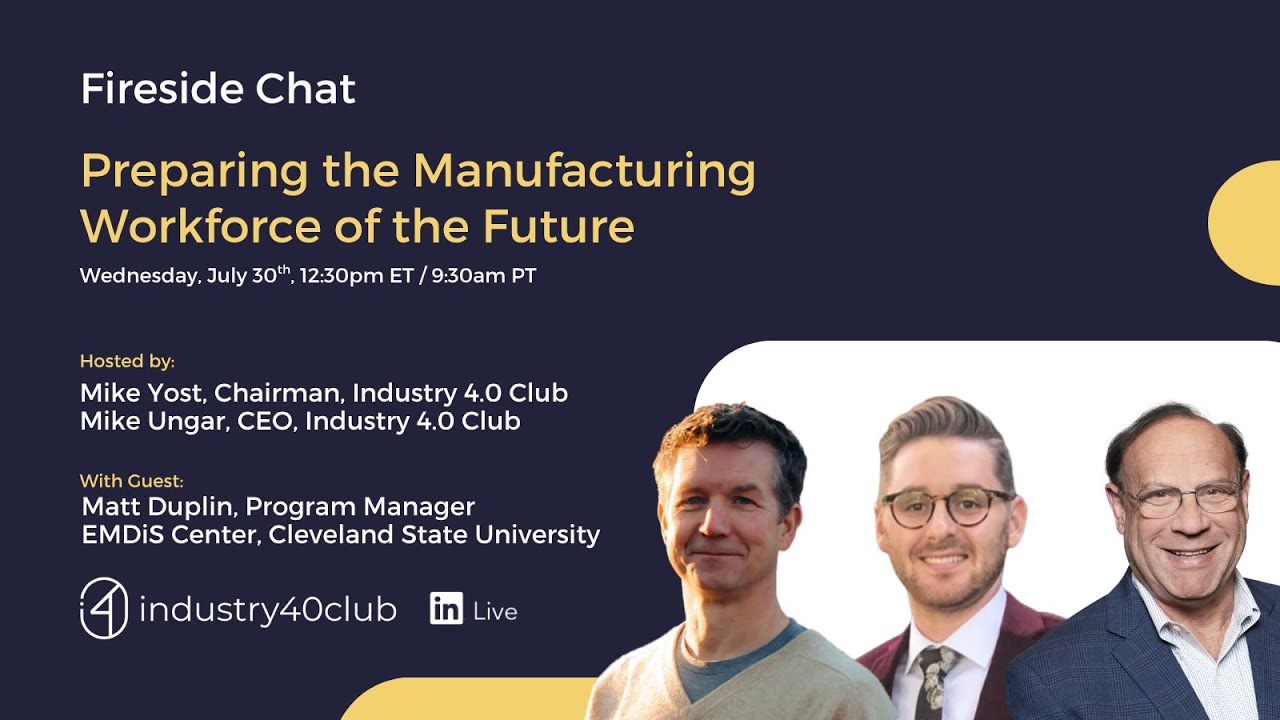
In this Industry 4.0 Club fireside chat (July 31 2025) hosted by Michael Ungar (CEO) and co‑host Mike Yost, Matt Duplin, Program Manager of the TransDigm Advanced Manufacturing Center (AMC) at Cleveland State University (CSU) discusses how the region is preparing the next generation of manufacturing talent. Duplin explains his personal journey from high‑school manufacturing work, through an engineering degree and technical sales at Lincoln Electric, to leading a university‑based workforce development effort. He outlines the evolution of the center from the 2020 Economic Development Administration‑funded Entrepreneurial Manufacturer Digitization Support (EMDIS) Center to the physical TransDigm AMC, describing its mission to bridge industry needs with academic resources. The conversation covers Cleveland State’s role as a local talent pipeline (≈80 % of graduates stay in Northeast Ohio), the importance of reshoring, and the need for hands‑on apprenticeship‑style training in CNC machining, plastic injection molding, cobots, and other advanced processes. Duplin details partnerships with three regional community colleges, major manufacturers (TransDigm, Sherwin‑Williams, Lincoln Electric, Swagelok, Parker‑Hannifin, Rockwell Automation), nonprofit groups (Manufacturing Works, Magnet), and the Smart Manufacturing Cluster (Team NEO). He emphasizes the center’s focus on Industry 4.0 digital connectivity, data‑driven machine monitoring, and cross‑disciplinary involvement of computer‑science students. Operational challenges—grant‑dependent funding, staffing, equipment acquisition, and the need for systematic student feedback—are acknowledged. The hosts close by urging listeners to engage with local institutions, support apprenticeship pathways, and take concrete actions toward smart‑manufacturing adoption.
Chapters
Welcome to the Industry 4.0 Club's fireside chat. The club's purpose is to engage the power of diverse worldwide talent to accelerate the global evolution to Industry 4.0. We accomplish this by hosting and supporting respectful, thoughtful, and interdisciplinary conversations and creating quality content on wide-ranging Industry 4.0 topics to expand the reach of our community. My name is Mike Ungar, and I'm the CEO of the Industry 4.0 Club. I have over 40 years of experience in leadership in manufacturing, with most of that at Michelin. I'm joined today by my co-host Mike Yost. Mike, welcome. Would you mind introducing yourself, please?
Absolutely. Thank you, Mike. As Mike said, my name is Mike Yost. I'm the volunteer chairman of the Industry 4.0 Club. I'm also Mike's co-host on these fireside chats, one of the founders of the club. Been in industry for about 35 years, the last 15 on the industrial nonprofit side. And really enjoy having these types of conversations like the one we're going to have today, where we're going to be talking about preparing the manufacturing workforce of the future. And joining us to do that is Matt Duplin, who's the program manager of the TransDigm Advanced Manufacturing Center at Cleveland State University. Good friend of mine, we work closely together on a number of things. Thanks, Michael. And let me just give a little bit of background on Matt. He started at Cleveland State, or CSU, in 2021 working on a grant from the EDA, which founded the MDIS Center, which I will let Matt explain as it is appropriate. But essentially spent the last few years engaging with local manufacturers and aligning the university resources to the needs to technology and workforce needs of the local manufacturing base. In the summer of 2024, Cleveland State opened the CSU TransDigm Advanced Manufacturing Center, thus absorbing the EMDA Center and taking on its industry support-driven mission. Matt's a graduate of The Ohio State University with a BS in integrated systems engineering and has an MBA from Cleveland State. Prior to his current role, Matt was at Lincoln Electric as a sales engineer for 5 years living in Chicagoland. So before we turn it over to Matt, just want to remind all of you that are joining us on LinkedIn today that if you have questions, please go ahead and throw them into the comment section and we will do our best to get to them through the course of the conversation. So Matt, welcome.
Thank you, Mike and Mike. Appreciate you having me on this chat.
So, of course, Matt, let's get started. And just, you know, we always like to kind of understand a little bit about our guests' backgrounds. And so I noticed you've got an engineering degree, and then you moved in— you moved into technical sales. So what motivated you to move from that into this area of manufacturing education?
Yeah, so, uh, I've been in manufacturing since my first job in high school. So as I progressed through undergrad, I always appreciated my rotational programs that dropped me in a new location, a new place building something. So the variety of manufacturing has always been the pull for me. That's also why I got into sales rather than being more ops role. Sales allowed me to be people-facing and also continue to just go in new shops and learn new things. So, uh, the edge— why I shifted education was more so an opportunity for me to relocate back to Northeast Ohio where I'm from. But it was also I enjoyed and got the sense actually in my sales position that there was a reinforcement of the educational needs in manufacturing, not just at a skilled trades level. Welding is what I sold into. Machining is another big one, but just general manufacturing knowledge and boosting it at the engineering undergraduate level. So it's essentially what my role is now. It's building up those programs for our undergraduate students here at Cleveland State.
So Matt, obviously Cleveland State plays a big role in the region here. My middle son just graduated from CSU in May. But for those who are not familiar with CSU and its standing and its history and stuff, Could you give a little bit of a background on the university and the MDISC program and the shift to the TransDigm Center, sort of ground us here on the university and your work?
So appreciate you shouting out my alma mater. I'm not a big fan of the V, but people still toss it around. So I've been a Viking by work for the last 4 years, and I, as you mentioned, also graduated here from CSU. I grew up only an hour away and I didn't know much about it, but I'm now embedded. CSU is a 60-year-old public research university in downtown Cleveland, Ohio. So it is kind of the primary public university that services the northern, northeastern quadrant of the state, really, amongst a few others. So again, 60 years old, engineering has kind of always been its foundation. I believe it started even longer before that as and college with engineering classes. So it very much seems like a commuter college due to its downtown location. But I say that because there's a very densely populated area around us and students come from the surrounding counties and suburbs, go to school here, and then upon graduation, majority of them stay here. And that's always the fun fact I like to tout is that as a talent pipeline, Cleveland State very much serves the, community and the local business region very well because we're— our graduates are homegrown. And so that's somewhat of a background. We're not just engineering college. There's nursing, sciences, law, business. My focus in our AMC is predominantly engineering and a little bit of the business though.
So I think that's a really important point. And despite the fact I've lived here for 30 years, I didn't really appreciate what the point that you just said, how important Cleveland State is to the local employer base because many of the students are from here and end up staying here and become a pipeline for the workforce. So it sort of anchors us, I think, in the value of your work and the university in the region. Maybe give us a little bit of background on MDIS and TransDigm and sort of how you got going and where you are in your— in your journey?
Yeah, yeah. So, um, currently I'm sitting in the, the CSU TransDigm Advanced Manufacturing Center. I'll talk about TransDigm here a little later. It did start as the EMDIS Center, and thanks for putting on me to say it. I've done it, I can do it in my sleep now, but it stands for the Entrepreneurial Manufacturer Digitization Support Center, and it was less a physical thing, more so just a, a place for innovation and collaboration at the university. It started in 2020 from an Economic Development Administration grant. So EDA, that's Department of Commerce, with the intent of the EMDIS Center would be a place that industry, manufacturing specifically, can engage with the university to support them in predominantly technology adoption needs and more recent, especially since the pandemic, workforce development needs. So I already mentioned the talent pipeline. We are here, we are a workforce development provider of graduated students or degreed students. But for 3 years as the manager of the EMBA Center, I went out and engaged with industry. Their biggest issues were less technology adoption, and at the time in 2021, more so supply chain, getting and retaining people. The technology always came after the fact. Additionally, in working with our faculty, our research faculty in engineering, I learned that their areas of research were very focused and very refined, and it was very hard to bridge that gap between industry needs and the research being done on our campus. So fast forward a couple years, I did something good enough, well enough apparently, that we got renewed from that EDA grant. And the scope expanded for the next 3-year period to, all right, turn this into something physical, build out a lab where you can actually do these projects on campus. That was the missing piece, right? I can bring faculty, I can bring students into this space on campus, and due to our downtown location, I can pretty easily get industry as well down here. And so I came from sales, and what I'm not doing is just selling the university as a resource. And I'm selling the capabilities and the talents of the students here. So it's all a matter of diversifying the knowledge the students have focused on manufacturing. So that is the progression from MDIS Center to now the CSU TransDigm AMC. And I will mention, if there's anyone from Cleveland on this call or graduates, that'd be even cooler, but there was an advanced manufacturing center in at CSU in downtown in the '90s. Uh, it was— its purpose then was to prevent offshoring, and now we've come full circle about 30 years, and its purpose is to train our engineers for the expected reshoring of manufacturing. So it's a cool full circle, and I'm really hopeful for what it can do for our students here.
All right, it's interesting you mentioned reshoring, um, and I don't know how in touch you are, so if it's a question that's beyond you're, you know, beyond what you're aware of in the community, let me know. But are you seeing that reshoring going on in the Cleveland area?
Uh, I believe so. Uh, we definitely are in Ohio. Uh, Mike and I can speak to a lot of the major things that are happening down around Columbus, which sort of gets a trickle effect up here to Northeast Ohio. We work, Mike and I, amongst partners that are very much in the business development side. So there's others that can better answer that as to who's coming into the area. But there's a few partners of ours. One's a digital content creator actually that recently opened a US-based office in Mentor, Ohio. That's about 25 miles east of me. And they're a UK-based company. So they, they're— they operate in the aerospace world creating virtual simulations for them. and they decided to choose Cleveland as a place to, to open up. So that's one example of many. So I do think the reshoring is happening, but as I'm sure we all know and can discuss, just because you bring that back doesn't mean all these new students come out of nowhere or these new workers come out of nowhere, right? We need to spread out who we're training to get back into this manufacturing workforce.
Where, you know, where I live If I could, just to follow up on this, your mission a little bit. Where I live here in the upstate of South Carolina and South Carolina in general, a lot of that workforce development comes from our community colleges. Do you have that similar type thing in your area where you have a community college? Do you compete with the community college if you do? And if not, how are you guys differentiating?
Yeah, so there's a lot of partners involved here and we're all trying to get better at cohesively marketing ourselves as a smart manufacturing hub up here in the region. Cleveland State is the largest 4-year, but there are 3 surrounding 2-year community colleges: Lorain County Community College, Tri-C, which is Cuyahoga Community College, and then Lakeland on the east side. So surrounding us kind of in the outer belt are these schools, and they all do very good things in this— in these areas. And so they are partners, they're not competition. Again, if we go back to— I keep talking about the talent pipeline. I'm probably starting to overuse the, the phrase, but ultimately those students, if they choose to continue on in their education, are— the, the obvious choice is hopefully CSU beyond their associate's degrees. So LCC, for example, has a very good robotics and automation program and lab and partners with industry. I don't need to recreate an automation and robotics lab here behind me because They're 30 minutes away. So we should be sharing resources, we should be sharing curriculums, and we are starting to see that happen at the educational level of replication of curriculum and then sharing of resources.
Yeah, I would just piggyback on that. To your point, Mike, we certainly see manufacturers preparing for reshoring, whether it's hit their docks yet or not. They're certainly gearing up for it. And the understanding of tech, the understanding of, you know, workforce talent, et cetera, supply chain, et cetera, are things certainly top of mind with the manufacturers here. And I'm just wondering, Matt, from your perspective and your work with the center, what are you hearing from the manufacturers themselves about the kind of support that they need? where it fits with, with you and Cleveland State?
Yeah, so, uh, right out the gate it's workforce, workforce, workforce. And so what they really want and what they're looking for from looking at CSU for is just getting more generalized manufacturing knowledge in front of our students. So you might have an all-A's undergraduate engineering student come out, but if they've not stepped foot in a manufacturing floor, if they've not done a co-op or internship rotation in that setting, they're, they're sort of, uh, behind in what it takes to make things, right? They might be able to design them, uh, but the making is the hard part. So just generalized knowledge of that. They want to see more apprenticeship-like exposure for students. Uh, you're seeing a lot of companies want to move undergrad students around to get Experience with CNC machining, for example, experience with plastic injection molding. 3 things I have behind me, right? 3 machines I have behind me. So it's, it's really just that hands-on exposure, uh, in that type of setting. And so I'd like to replicate that in this advanced manufacturing center if enough projects are going on and machines are whirring and cutting fluid is— the smell of cutting fluid is in the air. I mean, that's all just things that they're going to get in the real world when they graduate and get hired out.
So you mentioned— go ahead, Mike.
Nope, nope, go ahead.
Go ahead. Now, earlier you mentioned, Matt, your partnership with the community colleges, and hopefully this will be a place for someone to pursue their education to get a 4-year degree. So talk about for a second what an example of what someone might do if they who spent 2 years at a community college, what would they come to major in and what additional, if you will, exposure do they get at Cleveland State?
Yeah, so our engineering programs, the primary ones are mechanical, electrical, computer science, civil, chemical, and then you have your engineering technologies. What's missing, what my degree is, is industrial. And at least from my experience, that's typically where a lot of engineers get exposure to manufacturing processes, the fundamentals, uh, the, the shop floor tours and all that. So, um, progression into here and what we want to deliver students out of this AMC, uh, is again those common process— that common process exposure. So, uh, we're still in the process of building out our capabilities, but you see behind me there's 2 precision CNC machines. That's very common process for the aerospace sector, right? And aerospace is a very big industry for us in Northeast Ohio. Secondly, to my right here is a plastic injection molding machine, even more complex than the metal cutting, but nonetheless very big. Ohio is the 3rd largest plastics state in terms of plastics production and manufacturing. So there's very limited training on that because of its complexity. And it's not often you see plastics engineering. There's only a few schools in the country that teach that. So again, just generalized knowledge and understanding of that is what they're looking for. And then beyond that, I mean, we are talking cobots, material tending, machine tending with cobots. EDM is another common thing, machinery process for precision manufacturing. But I mean, we all like— engineers like to tinker and use their hands. And so I hope to build out a general fabrication lab where they can the safe and right way, learn how to weld and solder and use a bandsaw and, um, and ultimately just know how to create something from start to finish using real industrial machines. Uh, so again, it's, it's sort of taking on that apprenticeship, manufacturing apprenticeship model where you sprinkle a little bit of everything and, and hope that that really bodes well for them as they move on into their career.
Well, I just want to come alongside what you said there, Matt. All 3 of us are industrial engineers by degree, so I think it really ties well with the Industry 4.0 conversation and some of the points you brought up earlier about how the focus is less on technology and more on people and process. Obviously, you know, industrial engineering outlook is process flow and optimization and costs and quality and the like. So appreciate your inputs there. Just wanted to remind everybody that if you're with us online and you would like to comment or ask questions, I see our friend Valentin asked a question about giving heads-ups and how we try to be here every Wednesday at the same time, but we'll look into that, Valentin, and try to do a better job of that if there's a way to automate that. But if anybody else has any other questions, we're talking with Matt Duplin, who's the program manager at Cleveland State University's TransTime Advanced Manufacturing Center about the future workforce. And Matt, I guess we talked a bit about what you're hearing from the manufacturers out there. I'm wondering what you're hearing either from faculty or from the students themselves as your lab progressed far enough along that you've got students in there, you're creating some coursework and stuff for people already in—
Mm-hmm.
in industry, but I'm wondering what you're hearing from the folks themselves that would be using the lab.
Yeah, so the word is getting out. We haven't really promoted ourselves internally just yet. It's more of a build it and they'll come situation. I need the machinery up and running. I need experts running that machinery. We also need to know how to train the students before they go work on it. We're building out some internal programming. And we're doing that with 2 full-time people. So when you're grant-funded like this, it is difficult. And when you're trying to purchase machinery like this, it's very difficult without the funds. So it's in the early stages. We're finding the partners, we're building the programming. But I expect this academic year, which starts here in the next 3 weeks, that will open the doors to the students. We'll probably have to hand-select the students that are in here. But this is a great place for our senior design capstones, the engineering, uh, the ultimate project they do in their engineering undergrad. This is a place that they can do some of those projects. They can prototype on a piece of machinery behind me. Um, it can be open to faculty research, but again, as we learned, the faculty, uh, the bridge between faculty and industry is pretty difficult, but we're not opposed to research-based projects in here too. And I want to just backtrack once real quick to the last question and your point too, Mike, about Industry 4.0. I'm just mentioning processes and the nitty-gritty, how the things are made, but really we're advanced manufacturing. So advanced is in our name. We want this entire lab to be digitally connected and show how to optimize machinery and optimize processes. So Mm-hmm. An overarching theme of this lab will be the connectivity of it and teaching the students how to do that. A lot of companies I've met with have one engineer tasked with innovation or digital transformation or all the terms you can think of, right? Smart manufacturing. There's one engineer to do that. And so they have to self-teach themselves this, and it really is cumbersome just to get one machine online with data monitoring, right? So we want to teach that here to our students because it pairs well with just understanding the pieces of machinery. What about understanding the data that you can pull off that machinery? And so that is the, the i4.0 is hopefully going to be just within our DNA as we grow this.
Mm-hmm.
And so I did mention too, we have computer science engineers. You don't often see computer science and computer engineers get into manufacturing, but in this world of data analytics, right, they're gonna start to trickle into that more. And so again, that's an area that I'm excited for students to get in here is the whole digital front of it all. So there's a long-winded answer to your question, Mike, but I do know the students are excited. The ones I've had in here say, oh, we wish we had this earlier.
Yeah.
We're going to open our doors to any level of engineer. And I mean, it can be a place for business students to learn things too, right? That can't hurt their resume as well. Yeah.
You know, I was thinking a little bit further about— I think we talked about this offline, but I'd love to highlight it for our listeners. You know, Cleveland State is an interesting— positions itself interesting, and you may have touched on this already, but You know, when I think about Purdue, for example, I think about the students from Purdue graduate and they go all over the country. And, you know, that's fantastic. Purdue has a wonderful reputation as an engineering school. But Cleveland State, you know, if I understand right, most of the graduates stay local. And so there's an interesting thing because you're really serving the local community in that way. Can you elaborate on that a little bit?
Yeah, yeah, absolutely. So I think the stat is 80% of our students across the entire university stay locally here, and they come from here. There's students from the suburbs and whatnot that are commuting in and whatnot. So, but what's interesting and fun for me to see is when I go out and meet with manufacturers, there's oftentimes at management and executive levels graduates. Right? And so there's a pride there, and I'm trying to reconnect with them and, and especially on the manufacturing side, convince them to come, uh, come back to your alumnus, uh, work with these students here, build them up so that they can be in your shoes, right? It's all about the upward mobility of the students, but they understand that that's how Cleveland State is going to serve them, is with good students, good hard-working students, uh, that are really have a knack for the hands-on. I think that's something too that you often see in the big universities that are very research-focused. It's theoretical. We want to be very applied here, uh, and so that's the whole point of explanation of getting the students' hands dirty, is they're, they're going to be applied. They're going to learn the nitty-gritty of manufacturing, but also the, the pretty cool futuristic element of manufacturing too.
That's great. No, I was just— it's interesting to think about that positioning, and it's important because it's a pretty important mission. You know, Cleveland's a large city, and to have that opportunity right there, it's— Mike has shared with me quite often how much manufacturing is in the Northeast Ohio area, and so it sounds like a wonderful opportunity for the community and really for the region as well.
If I could just jump in with that, I mean, even the fact that identifying the work that goes on through Matt and his team and the work that they're doing and the physical space. So we're doing work together on building community and helping expand the Expand the message, expand the understanding, get into conversations about how the technical work ties in with the strategic work, et cetera, et cetera. And just to have a physical space, you know, we hold events at Matt's lab. So people are, you know, recognize the value of coming there. And, you know, it's not always easy for people from the suburbs to want to come downtown into a large city. But we've had a lot of success with people that want to be there, identify with this, want to lean in and help provide input, et cetera. And I'm just wondering, Matt, if maybe, I mean, obviously there are partners involved, but maybe talk a bit about the partnerships that you're building and such to make the space a reality.
Yeah, so first things, TransDigm's in our name. TransDigm's an aerospace conglomerate company. They own several dozen subsidiaries of aerospace supplier headquartered here in Cleveland. They made a large donation to help kind of operationalize us, get the lights on, hire some people, hire students. So they're a primary partner. And I've mentioned the aerospace sector as a whole is one that we want to service because it's very dense here with those types of businesses. Other large manufacturers in the area, your Fortune 500, Fortune 750. Uh, there's, there's Sherwin-Williams, Lincoln Electric, Swagelok, Parker-Hannifin, Rockwell Automation. Those are ones that, uh, also see the mission and see that bigger picture and can support us with resources. Um, but I'd be remiss to not mention all the small manufacturers that are kind of guiding us and helping us, providing input on what programs we should be creating. It doesn't matter if they're only looking for one student a year. Their input matters. So that's on the manufacturing side. It's, it's going to be manufacturing and industry-driven for sure. But on, uh, like the, the nonprofit and, uh, uh, non-industry side is, uh, is Manufacturing Works is a local company that has a very wide network and provides training services to the industry. Magnet is our local MEP in Northeast Ohio. In fact, this was their old building right here that I'm in. So They also have a good network and are very tapped into the, the K-12 students that are getting into these STEM fields. So those are the big ones that I want to shout out. There's Team NEO that does business development. Yeah, I'm sure I'm missing some, Mike.
Yeah, I was gonna say Team NEO, the Smart Manufacturing Cluster, right? It's one of the interesting things about Northeast Ohio is that there are a whole bunch of organizations that have a similar mission and want to help support the manufacturing base. So there's a lot of work independently and a concerted effort inclusive of what Matt is doing to make sure that everybody's on the same page and it's clear of who's doing what and the value that all those—
That was my PI. He's the chair of mechanical engineering too, so he's helping us get things done at a higher— at a high level here. So fantastic.
You didn't want to invite him on stage, huh?
Yeah. No.
Yeah. So hey guys, we've been talking the last 30 minutes with Matt Duplin, who's the program manager of the TransDigm Advanced Manufacturing Center at Cleveland State. As we get ready to wrap up, I guess I want to give Mike and Matt just a chance to give final thoughts for our audience. Mike, you want to start us off?
Yeah, sure. You know, I think really probably a couple of points, but the amount of energy and effort and focus that there is to try to get help to the manufacturing— to the manufacturers. I mean, there are almost 8,000 manufacturers in the Northeast Ohio region. And not enough people, not enough resources, not enough assets to help. So, you know, to see what Matt and his team are doing there with, you know, federal funding support, with the resources of the college, and I think— or with the university, I think the point that you grabbed hold of, Mike, also really sort of shocked me, the percentage of students that stay locally and just what an important factor that is for the local manufacturing base is really, really important. So from a personal perspective, we're doing everything we can. I'm doing everything I can to help Matt and his team succeed. And it's part of the story. You know, we have other parts of the story. We have community, we have, you know, road mapping, we have all sorts of programs and tools and experts and stuff that can come alongside. And support the work that they're doing. So I think it's great that Matt and his team are having the success that they're having, and I really appreciate you sharing everything here today, Matt.
Yeah, great. Thank you for having me. My final thoughts are look to your local institutions, your community colleges, your 4-years. You'd be surprised at how much they're willing and wanting to engage with industry, and their product is the students.
Right?
So if you, if you want to see the talent pipeline grow and be enhanced, tap into it from an industrial standpoint. We are starting to, in Northeast Ohio, I think, align those efforts so that from K-12 through tech centers, through community and 4-year, even in the doctoral research area, there's a pool there that draws students into manufacturing and really grows that talent pool.
Yeah.
So just look into your Perdus, your Cleveland States, your Ohio States, because there's a lot they can offer for resources and talent.
Yeah, I think we— Valentin, to kind of wrap this up, asked a great question, Matt. And maybe it's too early to answer this question, but, you know, are you going to be— do you get feedback from students? So maybe, or how do you plan to get feedback from students as you get into the center? Have you thought through that at this point?
Uh, no, that's— we're kind of still too young to really, uh, be able to track the students' progress. Um, but that's something that we can certainly see as they, as they graduate out of CSU, um, and into their careers, keeping tabs on them and their development and offering them the same resources they had in undergrad, right? We're not closed off to just our students. Uh, we— that's a Great point that we need to kind of keep those tabs and always tweak what we're doing and always make sure that we are giving them the opportunity to stay as competitive in the job hunt as possible.
Yeah, so, so, Valentin, thanks for the question. I think the answer is stay tuned. We've got some exciting things to see how this will evolve, you know, in the very short term, but also I'm imagining, you know, 5, 10 years from now, the impact that the program will have on On the region. Can't wait.
Yeah, there's— we're not the only ones by any means. I'm hearing more and more from other academic institutions as those demographics change for the student body and enrollment, how much they're getting into now the, uh, the skilled trades, the apprenticeships, the manufacturing side of things. Again, going back to the point of the expectation of growth here in the country for that, universities are shifting their focus too.
Fantastic. Well, I want to thank Matt and Mike for joining us, and Matt for sharing your insights into educating the manufacturing workforce of the future. It's been a great conversation, so thank you. The Industry 4.0 Club would like to encourage you to take action to advance the deployment of Industry 4.0. Read an article, attend a workshop, take a class, right?
Yeah.
Develop a smart manufacturing roadmap, for your plant or company or encourage them to do so. We really just want to challenge folks to move forward in the deployment of Industry 4.0, and we'd like to know what you're deciding to do. So drop us a note on our LinkedIn page or our website at www.industry40club.com and let us know what actions you're going to take. Also, to kind of come back to Valentin's question, I'll put it up here on the screen. You know, how do you find out about these broadcasts? We do these weekly. almost weekly at 12:30 PM Eastern Time, US. And then of course they remain resident on our LinkedIn page. We advertise them typically through our LinkedIn page and YouTube channel about between 1 and 2 weeks in advance. So you'll be able to look ahead and see those. So just go to our website or to our LinkedIn page, LinkedIn page, check on page posts. And you'll see the upcoming broadcast. So great question, Valentin, and we hope you folks will continue to join us for these, for these, uh, conversations. So with that, um, Mike, thank you. Matt, thank you. And I wish everybody a great rest of the day and a good rest of the week.
Thank you. Thanks for having me.
Thanks, everybody.
Bye.










