Safety Reinvented: Turning AI & Big Data into Your Competitive Advantage
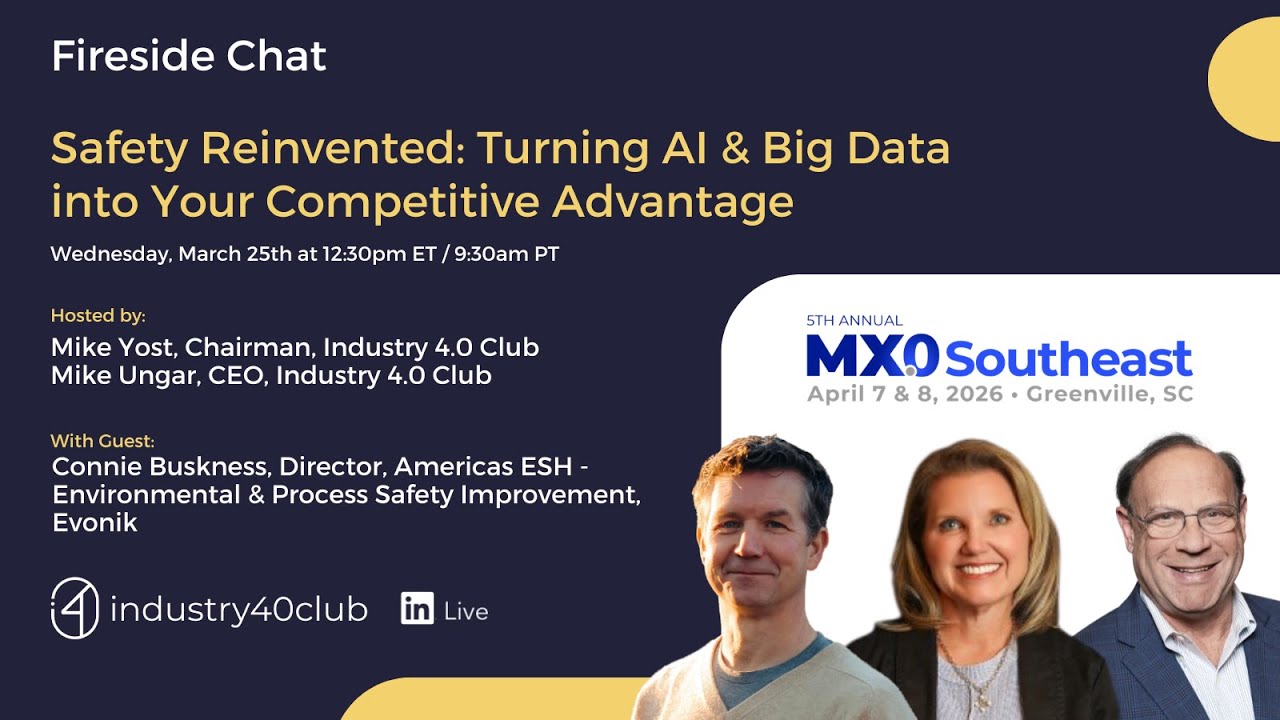
In this Industry 4.0 Club fireside chat, host Mike Yost interviews Connie Buskness, Director of Americas ESH at Evonik, about her upcoming MXDAO Southeast presentation titled “Safety Reinvented: Turning AI and Big Data into Your Competitive Advantage.” The conversation explores how AI and big‑data analytics can shift plant‑floor safety from a reactive, incident‑by‑incident approach to a predictive, learning‑focused system. Connie shares a concrete pilot where 55,000 incident reports from the past two years were fed to large‑language‑model tools (Gemini, Grok, Claude, Microsoft Copilot) to surface key themes, weak safety signals, and hidden patterns, dramatically reducing the time needed for cross‑functional analysis. She emphasizes the cultural shift required—treating AI as a “thinking partner” rather than a simple search engine—and recommends starting with small data sets (20‑50 incidents) to prove value before scaling. The dialogue covers how AI can amplify workforce engagement across generations, help newer talent ask the right questions, and support experienced workers by surfacing data‑driven insights while preserving human judgment. Connie explains how AI helps expose weak signals and break groupthink, citing examples such as electronic Management‑of‑Change (MOC) systems that can unintentionally increase groupthink, and how AI‑augmented MOC reviews can re‑introduce critical questioning. She outlines an eight‑layer framework for safety digital transformation that guides organizations from curiosity to full‑scale deployment. Throughout, she stresses keeping human decision‑making central, tailoring tools to each plant’s maturity, and delivering actionable steps that attendees can implement immediately. The session concludes with a call to action for the upcoming MXDAO Southeast event, encouraging participants to take at least one practical step toward AI‑enabled safety improvement.
Chapters
Well, welcome to the club. This is the Industry 4.0 Club's fireside chat. My name is Mike Yost. I'm the volunteer chairman of the club and the host of the Industry 4.0 Fireside Chat. My co-host, Mike Ungar, is unavailable today, so I will be solo. Excited here today to be talking with Connie Buskness, who is the director of America's ESH, Environmental and Process Safety Improvement, at Evonik. Welcome, Connie.
Thank you. Very excited to be here. Looking forward to this discussion.
Well, excellent. So Connie's going to be talking at the MXDAO Southeast event in Greenville, South Carolina on April 7th, 2026. And the title of her session will be Safety Reinvented: Turning AI and Big Data into Your Competitive Advantage. So before we get into the conversation with Connie, if you're new to the club, our purpose is to engage the power of diverse worldwide talent to accelerate the global evolution to Industry 4.0. And we accomplish this by hosting and supporting respectful, thoughtful, and interdisciplinary open conversations and creating quality content on wide-ranging Industry 4.0 topics to expand the reach of our community. And we'll do that again here with Connie today. If you're new to the MX.DOT.O Southeast event, it's the go-to gathering for manufacturers in the Southeast region to connect, collaborate, and learn from real-world examples of successful digital transformation, talent management, and sustainability shared by those who are making it happen today, such as Connie. So beginning in 2021, the event has empowered local manufacturers to advance their careers and businesses through valuable knowledge exchange and impactful networking opportunities. We'll give information on how to join that event later in the, in the conversation. So by way of introduction, as I mentioned, Connie's a global operation, an EHS executive driving continuous improvement in process safety and environmental strategy. She leads EHS across the Americas, supporting process improvement at over 50 sites, both small and large. Connie's known for bridging the gap between compliance and culture, helping organizations move beyond checklists to build the judgment required for sustained safety. She advocates for using AI and big data to accelerate learning Using technology to expose weak signals and disrupt groupthink while keeping human judgment at the center, all of which are really exciting concepts that I would like to dive into, Connie. So, in Safety Reinvented, Connie challenges leaders to rethink their tools and to create resilient learning organizations. So, if you are joining us today on LinkedIn and you have questions for Connie, you can go ahead and put them into the comments section, and we will do our best to integrate them into the flow. of the conversation. So, Connie, welcome. Thank you for being here with us.
Thank you. Yes, very, very excited.
Oh, excellent. So, you talk about moving safety from being reactive to predictive. Can you talk about what that looks like on the plant floor and if you have real-world examples that have helped drive safety or prevent incidents before they happen?
Yes, absolutely. And that's really my passion is how do we get proactive so we're not just addressing incident by incident. A lot of times in safety, we kind of look in our rearview mirror, we focus on incident one at a time. Where really we need to be looking, where do we want to go? Where should we be in 3 years? But use that experience of our journey. And that's where AI comes in.
Yeah.
Safety data is My background is really operations and production, so over 20 years in that. And safety data can be a little more challenging because it's more discrete. It's not— you don't have as much data set in your datasets. So AI comes in and it can look at our journey over the last 2 years. So we took 55,000 incident reports. This is a lot of qualitative data.
Right.
Ran it through AI for our for our plants for the last 2 years and said, plant by plant, tell us what our key themes are. What are our key areas of focus? So when we set our strategy for the next 3 years, we're on the right topics. Yeah. You know, moving beyond the, I need more capital or I need more people. Like, what are, what is the real crux of it? And the answers were surprising.
And so how have you found the, the, the, the, the receptivity of the findings with the people that you're engaging with? Are they receptive and saying, oh yeah, we see either the ability to do what you're espousing, or we trust the information, we trust this, you know, all this AI kind of stuff?
Right. Really, that part has gone smoother than expected. Before we ran this through AI, we would take a year's worth of data and bring a cross-functional team, 10 people from across the region to go through a snapshot of incidents.
Okay.
And no, nobody enjoyed that team. Like, that was like, please don't make me do— be on that team again. It's 2 to 3 months of like running through questions and doing the analysis and coming up with strategy. So we took that data and used it to whenever we looked at our— what AI was telling us. And so those teams were big proponents. They were like, oh my goodness, do you know how long it took us to do that? And y'all didn't just take a snapshot, you took all of the incidents. So that helped having gone through the trenches first.
Yeah, yeah, yeah. Well, I imagine that's a difficult challenge. So, you know, I'm sure a lot of companies have incident reports, safety data, et cetera, that are sitting in spreadsheets or legacy systems. So do you have a process for, you know, folks to start if they want to use AI to find the kind of insights and And trends and stuff like you're talking about?
Yes, absolutely. So first, probably the biggest step change is everybody on the team that's gonna work on it accepts that, A, it's not a Google search. It's not like I put in and I get an answer. That's kind of the, probably the biggest cultural change is it's gotta be a thinking partner.
Okay.
So you can take, get curious, take 20 of your incidents, 20 to 50 of your incidents in any format. It can be in Excel, it could be a PDF scanned in. And use a tool you have access to. It could be Gemini, Grok, Claude.
Okay.
They all have a little bit different. And just get curious and say, give me the top 3 things you're seeing and start seeing what you can get out of it with no data team, no expenses. You can use Microsoft Copilot too. A lot of companies have that like already employed.
Right.
On our networks.
So does, does that— we talked about in your bio and it was, it was really exciting to me. You talk about, like, building the judgment required to sustain safety. So, does that help you, like, having that accessibility to these types of tools and finding those insights and such? Does that help you as a safety leader sort of find the folks that will, you know, build that judgment? Or I guess, how do you attack that or, you know, enable that?
Right. We find a lot of our No, I don't wanna say less experienced, but newer talents are very interested.
Okay.
And so they actually will do the legwork and even pair up with a more experienced colleague.
Okay.
Learn from them, kind of see what have you looked at, what are your challenges? And then they'll get interested in this AI, in the AI, and they'll start getting curious and just feed it in. And really through those initial of like just feeding in, Really curious questions, really basic data is how we then launched projects, because then once we proved what we could build, then we are ready to go big. We started on the small scale, and that's what I always am telling people. Start small. Start finding where you can have value and start showing where that judgment's improving. So instead of saying, I need capital, saying I need a new hose program, or I need instrument expertise. We're struggling. And now your executives become way more cooperative because now you're speaking their language.
Talking their language.
Yeah.
Well, yeah, excellent. Well, I just want to remind everybody here quickly that we're talking to Connie Buskenes, who's the exec— I'm sorry, the director of America's ESH, Environmental and Process Safety Improvement, for Evonik, ahead of her talk at the MX.O event next month, talking about turning AI and big data into your competitive advantage. And if you have questions about safety, about using AI and big data and such, please go ahead and put them in the comments field, and we'll be happy to ask Connie to comment on that from her perspective. So, you brought up the workforce connection and, you know, how do the digital tools strengthen the safety culture, you know, or is there a risk that it might make it feel like it's impersonal, you know, more automated, that sort of thing?
Right. Very interesting question. That is often the fear, right, that we're going to lose touch with our workforce when we pull in the tools. But really what we've seen is an increase of engagement with our workforce. So tools are giving us knowledge. They can see systematic changes. We may have an operator report an issue, a maintenance technician, and maybe an engineer. And we don't see the common thread. But as we start pulling the data through AI, we start seeing the common thread, and we could build those system improvements rather quickly. And then they're starting to see where their voice is amplified. And so AI is really— I always say it's like our extra person on our team. It's like that intern that's working 24/7, no ego, no time commitments. But we still have to make the judgment call, right? They're like bringing us all this information. And sometimes it's like, whoa, I got to slow down, or—
Yeah.
Oh, hey, That's pretty doable. Let's go.
Yeah, well, it's really interesting because I heard— it's amazing how fast all this AI stuff is accelerating because I heard somebody say that— use the example of AI being an intern and that the potential is that eventually it'll be an executive administrative assistant where it's thinking ahead of you. It's 2 steps ahead and things like that. And so the point on the way people are using it and their receptivity to it, you talk about keeping human judgment at the center. So, can you talk maybe from a leadership perspective how important that is to reinforce the human's role in this and the tools as a supporting feature?
Absolutely. Because at the heart of everything we do, it is that judgment. It is that person. It's that safety manager, that safety director, that plant manager, and that engineer's judgment. At the end of the day, just like we can't say, like, the system made me do it, That's what we say with AI. You can't say the computer made me do it. At the end of the day, you are responsible. You have to make that call. And it's very similar to when the team has an idea and I as a leader can execute on the idea that they've given me. But when I do, it's now I'm responsible or I could not. Same with AI. It's going to bring us feeds, but we do— it's not perfect, right? It's that intern. It's really good, but it's not perfect. We still have to add that. aspect. And I do tell leaders, they do have— you have to know your organization and what your organization can handle, right? Some solutions might work really well at one team and completely be a disaster on another. You've got to know your experience, your ability. Well, we won't be able to train AI to do that, to do that.
Right, right. So that's great insight. So, so do you do a lot of conversations like across, across Evonik, across the organization, and, and also Do you do these types of conversations like you'll be doing publicly at the upcoming event? And if so, sort of how do you frame up, how do you, how do you get people to think about leading and leveraging these tools and balancing the different perspectives that you just talked about?
Right, I do do a lot. It's really at the center of a lot of what we're doing, because it's helping us move and transform. You know, organizations nowadays, they are, they're leaner, than they ever have been. And we need faster results, we need larger results, but without overstrapping our people. So there's, as a leader, our job is to help people do the good job they want to do when they come to work. And so we have tools that can help them get there, but it doesn't take them out of the picture. They're still there. So I do a lot of work on that. Right now, I'm really focused on the safety, process safety side, because I have a passion there.
Mm-hmm.
It's a big untapped area. I truly believe, like, AI can change safety how Six Sigma changed operations in the '90s and 2000s.
Wow.
That was my generation of production engineering, and Six Sigma rocked our world in a very positive way.
Right.
And we've struggled with safety on that platform because the data is not the same. We don't get, you know, data points every 30 seconds.
Right, right. That's great insights. So, so have you developed tools? Do you have a framework? Like, what are you going to be talking about to folks when you're, when you're at the event? True. Yes.
So in Greenville, we'll talk about the safety framework and how the AI aligns and how you move through and how you become that organization, how you transform through an 8-layer framework and go from that very beginning curiosity into, a full digital transformation. So yes, very excited about that.
Oh, excellent. Well, good. I just want to remind folks to go ahead and comment, ask questions of Connie here. I think that's a great— that's very insightful as far as AI to safety and, you know, that connection or the relation back to the transformation of Six Sigma around, you know, productivity and performance all those years ago. So I see we have Sudhakar on here. So hello, good evening, Sudhakar. But others, if you have questions, please go ahead and feel free to jump in here. Again, going back to some of the points from your bio, you talk about exposing weak signals and disrupting groupthink. And I think those are 2 really powerful I could see weak safety signals being a problem and can also see how groupthink— and I'm just wondering how those 2 are together or how you manage those. Maybe talk a little bit more in depth why you highlight those as some of the things you're passionate about.
Absolutely. So those really transpire. So groupthink happens. I've worked at a dozen different plants across the US. From special account to pop, it happens in all facilities, right? You kind of develop these long time, it's always this way, this can't change, this happens because of this theories. And it's just how, it's just how life has been. And then we start running the AI and we start seeing some things challenge us. Like, maybe that's really not what's happening. Maybe we really do have control over these issues. Maybe we really can't. I've seen plants where our data has been flat for 10 years, and it's like we literally, without millions of dollars, this will never get better. We start running it through AI and we're like, well, actually, there's like 3 main culprits, and these are all achievable. And you start getting people scratching their head and like, oh, when— And people have a hard time arguing with data, kind of back to the 6th sense. We're trained on data because we've gone through that generation, so we like that. So now we're giving them that comfort, that blanket of data, and we're starting to see change. Gotcha.
So does groupthink typically apply like to a plant team or to a larger organization? Like how pervasive, I guess, or abundant is the groupthink? Is it just a matter that people sort of take things for granted and dismiss things like you're talking about, say, well, we can't affect change there? Or how does the— how widespread, I guess, is the groupthink?
It can happen not just at a plant level, it can happen at a business level, and it can happen at a company level where this is what we can execute on. It could be, you know, we saw a big change with our plants that do MOCs when we went to electronic MOCs from the paper ones years ago.
We carried our papers You want to define MOC for everybody?
Yes. So your management of change, so your documentation anytime you're going to do that change. So we were in a paper system and we went electronic. It was great for documentation, but it really killed a lot of that development and a lot of that spurring thinking between partners and between engineers and technicians because now everyone's looking at it on screen. They're not taking that time to interact and challenge. So you almost see even more groupthink dominate because you don't have those, those face-to-face, those hallway talks, those challenges of like, are you sure about that? Did you really look at the risk?
Hmm.
Now the engineer can run his MOC through an AI and see what risk he missed before he goes out. And maybe he can go talk to a senior engineer and say, hey, should I really address this? The AI seems to think this is an issue.
All right, let's talk about it.
Right. So it's really kind of disrupting some of our norms and things, processes we thought were just— everything's fine.
Yeah, yeah. And if it's looking at it through the lens of safety, that disruption is a good thing, right? Because oftentimes that's the argument against disruption is that, well, you'll make something unsafe, right? So you have the proper lens on there.
Right. Yeah.
So, so you talked a little bit about multiple generations and, you know, different, different experience levels within facilities and stuff. And are you finding it effective at engaging, you know, across the generations? And any advice for folks on how to manage, you know, more seasoned workers and newer workers and this introduction of technology and AI and such?
Yes, and absolutely, that's a real challenge, right? We kind of are trying to run a hybrid model. So we have to run the best of both worlds with the very technical and the very experienced. But where I've seen it really play out is training programs are much different than our very experienced people went through. We had bigger teams. They spent a lot longer training. They shadowed a lot longer. They're not like an operator or engineer could be making decisions in 2 months. They might have taken a year.
Okay.
So they can sometimes— Our younger team doesn't even know the questions to ask to grow into that experience. And so the AI can even help them help figure out what do they not know that they should be asking.
Yeah.
And so it's helping them come along quicker. And then our experience team is liking that because they're not feeling like, wow, this person just doesn't get it. Like, oh, wow, they came with some good questions. Yeah.
That's really insightful. That's, I mean, that's the primary way that I use AI myself is to think through the steps that I should be thinking through to the right questions to get to some end state. So you're talking about folks using it that way. I think that's really powerful.
Yes. And it really— then the experienced person sees their value. They're like, oh wow, okay, they got here and they came with these great questions. They're learning. And then that relationship starts to grow. Yeah.
So, so this, this sounds like, like your approach is to take the tools and, and use them as they apply in your domain. You're not buying a specific safety application that's AI-enabled to do something or, or other like that. It's really, um, uh, just using sort of core tools available at your exposure or available through the business, uh, to attack, uh, attack these types of challenges. That's the way you're going about it?
Absolutely. And I believe that's really the first step, right? It's like, let's get a hold of it and understand what it can do and what our data is telling us with the tools we have. You know, a lot of times we love to venture into really big solutions that are 5 years and Out and lots of headaches. And maybe in those 5 years, we also could be solving other smaller problems, and we'll get there eventually to need that. But, but we're not there yet.
Yeah, well, it's just really interesting to me because we oftentimes see that big enterprise push or the big solution, you know, technology approach, or since we have so many different functional responsibilities in a manufacturing environment, solution providers that provide, you know, solutions and applications and such in the different functional areas are the ones that are saying, hey, well, you know, we are now AI-enabled. So now there's AI-enabled safety platforms, or there's AI-enabled quality platforms, or laboratory systems, or whatever, whatever. And so it sounds like you're really just sort of getting after it from the ground up. in a way that's actionable and bringing results for you.
Absolutely. Yes. And I think it's really analogous for the production operations people to how process control developed, right? We went from manual process controllers to DCS, then we added advanced process control, then we added simulation. But you really can't go from manual to simulation.
Right.
What you— I thought you could. That, that'd be a mighty jump for that poor group of people.
Yeah. Yeah, because I think a lot of times you're missing so many points of the human and the experience and all the things that you're learning and you're dealing with. So does your framework apply like plant to plant to plant? Or, I mean, is it— sounds like you've got an approach that enables people to follow, you know, guidelines and such, but it's not a— you know, you're not— you mentioned a couple of different AI tools that people can use and things like that. So you're not mandating them into a particular system. You're just, you're, you're letting them use tools they're comfortable with to follow the framework, I guess.
Correct. That is very accurate. And really it's designed where each plant can figure out where they are on the continuum or each business and go from there. Because everyone's not, everyone's not at the same goal line.
Yeah. Yeah, that's for sure. Yeah, that's for sure.
Yes.
Well, I want to remind everybody that we're, we'll be wrapping up here shortly. If you have any questions or comments, For Connie, please go ahead and throw them in the comments here. You know, again, just as a reminder, Connie will be speaking at the MX.O Southeast event on April 7th. And so I'm wondering, Connie, people that are thinking about coming or maybe watching right now and thinking about whether they should attend, what would you expect them to take or hope that they take away from coming to your session? listen to you speak on this topic?
My goal is that they take away at least one step that they can go do tomorrow and start making a difference in their organization. And that's, that's what people depend on us for as leaders is make their job better. They come to work to do a good job. And so I, I wanna deliver that.
Well, that's, that's valuable, right? That's, that's, that's what we're hoping that people will get, or that's why you go to a conference and things like that. Excellent, Connie. If you have any final thoughts, again, from my perspective, I think your approach is fantastic. It seems very well-grounded. It seems structured enough to give people a path in the right direction, but also open enough to meet them where they are on so many different levels. I'm really excited. I would encourage everybody to come and and meet you and interact with you and learn more directly. Do you have any final closing thoughts that you'd want to leave everybody with here, either on the topic or specifically about the upcoming session?
I'm excited about this session. It was 2 years ago that I was at a conference and heard about AI and got triggered by it and jumped in. And so I believe everyone can learn it. You don't have to be a computer science expert. So I'm very excited. I hope everyone can make it to Greenville.
Well, excellent. Well, thank you for that. So I would like to thank you, Connie, for being here today and everybody who's joined us and giving us a preview of what you'll be talking about at the MX.O event. I'm going to put a banner up here for those of you that are interested. Again, Connie will be speaking at the MX.O Southeast event, April 7th, 2026, at the Hyatt Hotel in Greenville, South Carolina. And I hope that you will join Connie there and the Industry 4.0 Club as well. So for the club itself, you know, we would always like to encourage folks to take action to advance the deployment of Industry 4.0. So that's reading an article, attending a workshop, going to the MX.O event, maybe even creating a smart manufacturing roadmap for your plant or your company. Challenge your organization to engage and take a step forward in moving forward. So we would like to know what actions you're taking to move forward on this journey. We routinely host these sessions, so if you are interested in participating, being a part of the club, being a part of these discussions, invite you to go to our website at www.industry40club.com or follow us on our LinkedIn page. And so with that, we will let you go. Connie, again, thank you very much and good luck in Greenville. Appreciate you sharing with us and sharing with the MX.io crowd.
And thank you, Mike.
Excellent. All right. Take care, everybody. Bye-bye.
Bye.










