The 2024 Sustainability World Cup
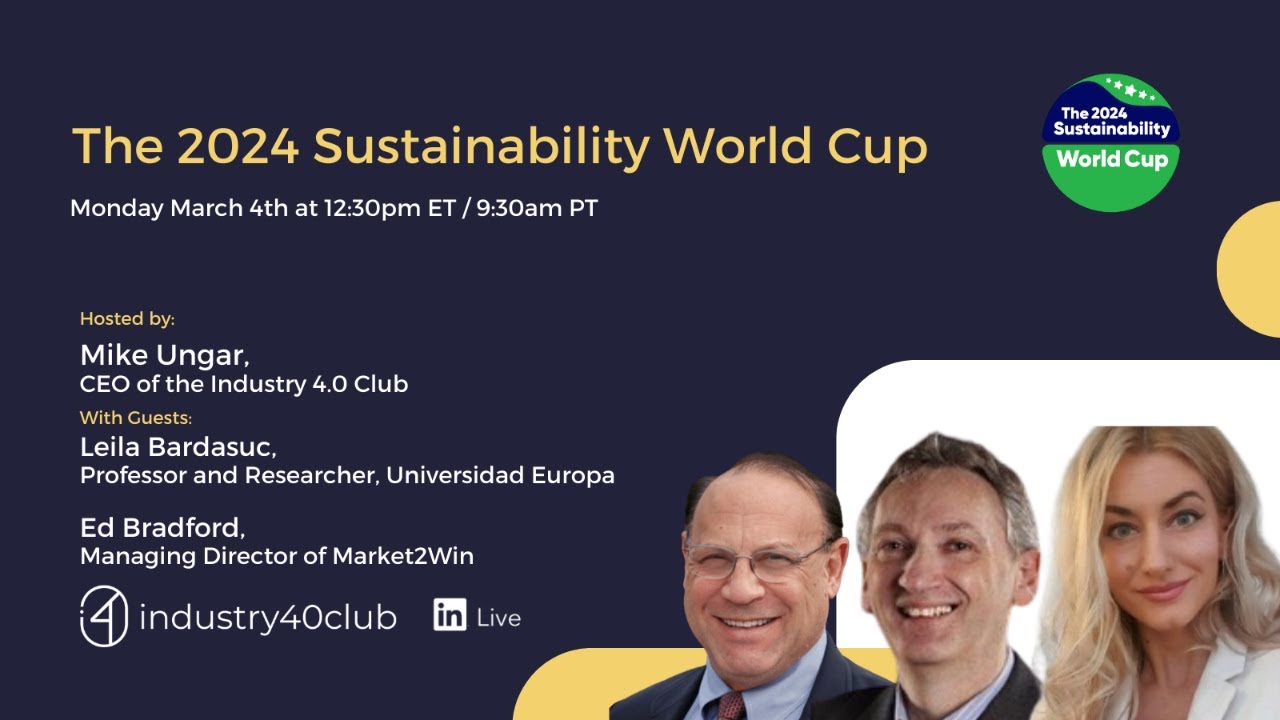
Ed Bradford and Leda Bardasuk created the 2024 Sustainability World Cup, a seven-week online competition where teams of five make strategic decisions scored on an ESG index. Judges from AI, cybersecurity, and marketing evaluate both game outcomes and teamwork. Registration opens at sus-world-cup.com.
Chapters
Hi everybody, my name is Mike Ungar and I'm one of the co-founders of the Industry 4.0 Club. The club's purpose is to advance the deployment of Industry 4.0 for manufacturers really around the world. It's an important element that manufacturers need to be aware of and engage in in order to drive their competitiveness. This is our weekly fireside chat, and I'm excited today to be speaking with Leda Bardasuk and Ed Bradford. A little bit about both of them. Ed is an educator and an entrepreneur in sustainable growth strategy. He has over 30 years of experience in designing and implementing strategic growth initiatives around the world. His corporate experience includes working with leading brands in many industry sectors. He's written extensively about strategic marketing, strategic account management, and sustainable growth. Ed is also a teaching associate at Warwick Business School. He's a former teacher at Swansea University and an experienced judge at various UK and international Business Awards. Leila. Leila is a professor and researcher at the Universitat Europa. She has experience expertise, excuse me, in the transformation of business models, marketing, communication, and digital transformation, teaching these topics to master's level students in several disciplines. Like Ed, Leila designs innovative learning experiences, activities, and courses to stimulate creativity. Sustainable approach, collaboration, and strategic thinking. In addition to her work at the University of Daegu Europa, Leila is a team coach for Team Labs, coaching and mentoring future entrepreneurs and business leaders. She's also a strategist helping companies transform their companies through her company Strategy of Kindness. Both Ed and Leila are involved in a company called Market to Win, who produces simulation games to teach students and executives about sustainable growth. And that's really what we're here to talk about today. These games are now used in many universities around the world for MBA, master's, and undergraduate students. Through Market to Win, Ed and Leila are leading the 2024 Sustainable World Cup and are here today to share a lot more about this exciting opportunity. So thanks, both of you, for joining today.
My pleasure.
It's really great to have you.
Thank you for the invitation and hello everyone.
Yeah, so let's start by talking about the 2024 Sustainable World Cup. So what is that? Can you just talk about what it is a little bit and sort of set the stage for our listeners?
Yeah, sure, sure, sure. I mean, it's a new, brand new international competition and we've created that competition to try and find the best sustainable leaders of tomorrow, and we're doing that through game-based learning. So at the heart of the competition, there's a game, it's a simulate— a little simulation, and teams of players compete in the game. So it's a genuine competition, and they compete against each other to win, to try and win that game. It's online, so they can play it wherever they they are in the world. And it's going to run for about 7 weeks from early April to late May. And I'll just say straight away, Mike, that no knowledge, no experience is necessary if you want to sign up to play the game. Yeah, we're keen to find these leaders wherever they are out there, because they could be in any function, in any walk of life, and they could be the change agents of tomorrow. So if I put it in a nutshell, it's kind of like sustainability training while gaming.
That's cool. So what motivated you guys to launch this program?
For me, because I have been working in innovation and in education for the past decade, I really saw the need to integrate sustainability and collaborative leadership as well in programs, because apart from sustainability, the Sustainability World Cup is also about leadership, right? With Universidade Europeia, I'm doing this together with them, like forming leaders of tomorrow and integrating know-how not only on what ESG is and how to be sustainable, sustainable, but also developing the skills, right, to achieve a sustainable digital transformation, for instance, or how to develop sustainable marketing strategies, how to build collaboration based on trust. And in Masters of Engineering and Industry 4.0, sustainability is indeed for everyone. And the feedback that I am constantly getting from companies I work with is that they need people with this set of skills. And it's also, that's something that I try to focus on with my work as a team coach with Team Labs in Spain so that our young entrepreneurs have the tools to become sustainable and convert it into their competitive advantage. And my main question was how to start, how can we bring all these people together? And I am a big fan of gamification and innovation. Yeah. When, when I first saw the sustainability simulation, I immediately saw it as the perfect way to get universities, companies, entrepreneurs, get them all together and create this ecosystem of value building in business through sustainable practices. And why not make it even more fun? So let's have a competition. We can all share know-how there. We can interact. We can learn from one another. And just start on this journey. Basically, this is how the idea of the Sustainability World Cup came to life together with that.
That's really neat. I think about my own background in manufacturing, I spent a lot of time in continuous improvement and operational excellence. We used to think about lean as our primary driver for continuous improvement and operational excellence. Then along comes Industry 4.0 and we integrate those 2 together now. Then when you start adding then sustainability to it as well, this idea that really all of that together is really important. Leila, you used the term ESG. That stands for what? ESG stands for what?
Environmental, social, governance. It's not only about being green, And it's also about the social aspect, the governance aspect. So this type of collaboration of building something of value, something that lasts. And I would really like to ask you, Mike, because you mentioned your expertise in Industry 4.0, and how did you see this integration of sustainability and the data, right, within the process? of manufacturing that can help in ESG reporting and basically sustainable digital transformation for within our factories?
Well, you know, today, going back to a responsible business is, you know, I'm a— I didn't mention my background, but I spent 35 years with Michelin, the tire manufacturer. And I really appreciate today the way they framed up, and a lot of companies frame this the same way. It's really the 3 Ps. It's people, profit, and planet. Okay. And really, it's integrating those together. So you've got to take care of your people as you move forward in the business. Otherwise, you don't retain— you don't— I mean, people run a business, they make a business go. Profit, obviously, you have to make some money, but obviously, you have to do that while taking care of the planet. And so really bringing these things together. So when I think about at a lower level, Industry 4.0 and sustainability, they really go hand in hand and lean together because lean is very much focused on engaging people to help drive continuous improvement. Continuous improvement, operational excellence drives profit. Ultimately, then we add sustainability, which is the planet piece. It really goes together at more of a tactical level almost when you think about this strategy of people, profit, and planet.
Yeah, I mean, I totally agree with that. And I spent some time in manufacturing as well, by the way. So I'm a great 100% believer in everything you're doing with Industry 4.0. I spent many years as well working on continuous improvement projects, task forces in shop floors, offices, etc. So I'm a believer in it. And I think for me, I mean, I'm fairly new to the sustainability game really. I mean, we've been doing simulations for, you know, 18 years or so.
Yes.
But it was when one of our university customers came to us about 5 years ago and said, can you build us a sustainability simulation? That's when I personally first got involved with it. And I think for me, what I found fascinating is just that point about how much it will change life for whatever function you're in, the implications in terms of processes, implications in terms of relationships, culture, measurement that we just talked about, how companies can be measured, it all gets impacted. And one thing, we did a lot of reading in our team as to what you wanted to include in the simulation, and the triple bottom line, the 3 Ps you mentioned, are in there, and they need to be in there because they're kind of core. But we found 3 other Ps that we think should include. You've got those principles of governance, which is the G bit.
Yes.
It's not profit. Profit definitely needs to be understood and it's central to the simulation. But we've got another one in there which is prosperity, which is how you generate broader prosperity in the community which you operate. And the final one, by the way, which I'm sure everybody agrees with, but it's often overlooked, is purpose and having this leadership of purpose. And you can't have the triple bottom line if you've got a leadership that's only focused on, let's say, becoming a profitable but dirty company.
Absolutely.
So yeah, there's actually, as I've learned, by the way, there's a huge amount of interesting material in sustainability. It has massive implications for all of us.
Yeah, that's, uh, no, those points are really, are absolutely correct. Uh, the purpose, I, I didn't, you know, we, we, um, I usually use this example with, uh, with Michelin, for example. You know, some people think Michelin makes tires, but when I was an employee of Michelin, my purpose was freedom, was to provide people with freedom, freedom to travel, freedom to, uh, pursue economic, uh, improvements for their lives. Freedom to pursue their hobbies. So it's more than making tires, it's providing for freedom for— to be able to travel. So I think you're right about purpose is really important, and prosperity without question. You know, we, we, uh, we create communities with where we, where we work and where we manufacture, um, and we want to sustain those communities. It's very, very important. So though I appreciate you sharing those other points, they're very important, and it's great to hear they're part of the simulation. You guys have put together quite an interesting— I was looking at the website about the Sustainability World Cup and I noticed you have some really interesting judges. What are you judging and who are these judges? Maybe you can talk about that for a moment.
Well, we wanted— because when we started, we know that sustainability is for everyone in every sector. We are quite fortunate to have an amazing panel of judges with amazing expertise, but each of them comes from a different sector with different background. So not only in sustainability and ESG, but also in digital, in cybersecurity, in AI ethics, and marketing and sustainable growth. In marketing management, so in the industry. So I think that this is what will help also the participants because they seek leaders that can showcase innovative and creative approaches to addressing systemic sustainability challenges. And the simulation, it's— so it's, it's a game that I described earlier, but it also gives you the chance to develop and include some novel strategies and to form you or give you a nudge in that sense, right, to develop new, new strategies or a new purpose for your company. Just the basic for you to have the tools to start in that sense and methodologies that can contribute to sustainability goals. But also one other important thing that the judges mentioned, for instance, during our introduction event is collaboration and that building of trust, of teamwork, communication skills, because you're going to work together with a team, right? And participate in this in this competition. And how can you work with that team across diverse backgrounds?
Yes.
And the value is there, right? Because you also learn from the simulation, but you also learn from every team member that come with diverse backgrounds and expertise. And this is essential for driving impactful sustainability initiatives. And I think that's the best, the best way to learn what our judges do, how are they going to evaluate and why are they involved in this is to join us on our next introduction event to the Sustainability World Cup, which is going to be on the 5th of March. So if you search on LinkedIn, an introduction to the 2024 Sustainability World Cup, you'll see the event, the link and how you can join and speak with the judges directly and hear, hear from them what, uh, what they have to, to say on this.
Will you be recording that event, that, um, event with them on the 5th?
Yes.
Super.
We are sending the recording to everyone who registers via, uh, via the LinkedIn page.
Good. And that'll be something that they could also reach out. We can also be a conduit for that if someone's got a question through the club. So that's great. That's super. Well, that's really neat. So the judge— go ahead, I'm sorry.
Reach out to us if you need to watch the recording if you cannot attend. Happy to share that.
Fantastic. Well, that's really neat. So the judges are going to be looking at the various strategies and the really, I guess you're saying, the creativity and the— well, not only, I guess, meeting the criteria that you've established, but also the creativity and innovation behind those strategies, if I understand correctly.
Yeah, there's, I think the way the simulation works is that a lot of that should be done in the simulation. So we'll have teams competing against each other, they'll be making decisions, we'll be doing the calculations based on their decisions, and there's an ESG index in the game. And quite simply, the team that has the best ESG index at the end of the game is going to be, you know, declared the winner of the actual game. So some of that, you know, analysis we've done within the actual game itself, but we're also asking the teams to present a video, to do a video reflecting on what they've learned, talking about their teamwork, talking about their team leader, and that will also be reviewed by the judges as well. So we'll have a combination of the actual gameplay as well as the videos that teams submit to produce the actual overall awards.
Well, that's really neat. So what do you guys— what do you hope that the participants take away from their participation in this Sustainability Cup?
Well, we want them— I think primarily we want people to learn about the fundamentals of sustainability. The actual, you know, I mentioned a minute ago about the 6 Ps, that there's a— we've worked very, very hard to get really good content into that simulation. And it's important, I think, people understand that the fundamental sustainability and the key terms around sustainability, because sometimes it has a language of its own. And I found it myself when I was looking into it, you get lost in all the acronyms or the 3-letter acronyms and you go down rabbit holes trying to understand what some of these things are, ESG being just one of them. So I think it's a structured way that people can learn the subject. From my point of view, I want them to be confident in their next conversation about sustainability. So whether that's with a work colleague, at home, could be a customer, could be supplier, partner, but they've got this confidence to talk about the subject because they've been through this this program that we're doing, had a bit of fun as well, you know, learned some key terms, um, and, and learned about the challenges and opportunities of it as well, you know, how we balance, how we balance profitability with the other things. And who—
so talk about the ideal part. Who's the ideal participant? Um, is it someone who's a fresh graduate right out of school, or someone experienced, or maybe both? Can you— what do you guys— do you have a particular target? Audience for this activity?
Leila, do you want to respond to that?
It's for both, because that's the main idea, to also learn about sustainability, but to also create this kind of networks, right? And sharing of know-how while you are learning yourself. And the best way to do it is to be able to learn from people that come from different backgrounds with different expertise. And it's also an opportunity to build bridges between universities, between startups, entrepreneurs, companies. And basically anyone can join in. You can join as a full team from a company or from university. You can join as an individual, as an entrepreneur. You can join maybe 2 or 3 colleagues from a startup joining in. And we have a system, a questionnaire where we can pair, pair you up with people from similar time zones.
Right.
If you do not have a team. So this is also an opportunity to not only learn from everything that we prepared and that is inserted in the But also learn together with peers.
And so what is the ideal team size if someone wanted to put a team together?
I would say about 5 people. 5 people is a good team size. We can cope with bigger teams, we can cope with smaller teams. But the nice thing about 5 people is if, let's say, for example, one person, you know, he's got a work commitment for one particular week or is on holiday for one particular week, We've still got 4 people left and—
To do the work.
Yeah, to do the work. And the real value from all this is not, you know, just bashing decisions into a bit of software. The real value from this is the discussion and the debate you have within your team about the different options that we have. There's almost an infinite variety of different options to look at, and it's narrowing them down to the best few choices and having that discussion. That's where you learn. That's where you you kind of test out your ideas, and that's where you build confidence in the actual subject.
Will the teams be able to interact with each other as well at some point during the, the, the cup or not?
Well, that's an interesting question. That's an interesting— yes, they can, because we have, we have generally, normally we keep them apart, I would say. In universities, of course, they interact because they're in classes. If we're doing an online game, we quite often keep them, keep them apart because we don't want them sharing any competitive information. But for this particular competition, we've got 2 events where they can interact with our judges, which is going to be hugely valuable to them.
Yes.
Of course, whoever is on that event, they'll be able to see the questions and answers as they go, and of course, they'll be recorded for people who can't attend it. There's going to be 2 opportunities to interact. Join the competition, and of course, at the end, when we're doing the online awards ceremony, there's an opportunity to interact as well.
That's great. Well, I think that's a, you know, it sounds like a wonderful opportunity. I think, as you mentioned earlier, Leila, too, about folks being able to, you know, interact with different folks with different level expertise. You know, the team from one company might really benefit from interacting and at least meeting a team from another company, or one university in one part of the world to another university. Certainly, there's some competition here. And so I appreciate this.
Yeah.
the separate side a little bit, but there's also a real opportunity for collaboration, as you know.
One of the things—
yeah, go ahead.
No, I was gonna say, and then the— when we do the feedback, we do, you know, participant feedback, you know, as a matter of course. And one of the important things we get from that is how important networking is. They really do value the networking and meeting kind of like-minded people that have similar issues, similar challenges. And of course, if it's from a different industry, that's even better because you can talk to them more openly about the challenges you've got within your company, within your industry. So that's really, really useful. I know that from the feedback.
If you wish, this is the award that every participant is getting out of the competition, no matter the results at the end, because as I mentioned in the beginning, I see this as just a start. Because you can form this kind of collaboration and relationship with people who are genuinely interested in sustainability.
Yeah, that's fantastic. Is there a limit on the number of participants? In other words, you cap it at 40 people or 8 teams, or is it really— can you take as many as can sign up?
We can take as many as we sign up. Effectively, what we'll have is that if we have more than enough people for, let's say, one particular game, then we just run a parallel game with it with another bunch of people. Yeah, so that's quite interesting because the games actually evolve in different ways, and that also means, by the way, there's more winners as well. So yeah, we can technically, and as part of the process, handle, you know, as many people that really want to sign up.
Yeah, I really like the idea. I mean, it's a— I think you said it best, Leila— there's everybody wins, and then there's a winner. And it's kind of like, well, you know, no, because it really— what you learn, you learn knowledge, you learn some new skills, um, you learn— you get a chance to network with people that you didn't know before the, the cup. And then of course there's a winner of the event, but there's a lot of takeaways it sounds like from this opportunity. Um, so where do people go to sign up? I think that's something we should leave our folks with here before we We get close to wrapping up. Where— how do I sign up if I wanted to, if I was interested with a team or, uh, as an individual?
Yeah, the best thing to do, Mike, is just head over to our webpage, uh, which is www.sus-world-cup.com.
Spell that out for me.
Yeah, it's www.sus-world-cup.com. Yeah, dash cup dash dot com dot com. Yeah, so it's SUS World Cup with 2 dashes in the middle there.
Very good.
Head over there, you'll find lots of information there on that landing page, or head over to the Market to Win website and you'll find that particular page under our simulations header as well. So yeah, just fine, just head over there, that's the best place to go. The other thing to do is what we talked about earlier, isn't it, Leila, which is sign up for the next event that we're running, which is, I think, did you say 5th of March? I don't see my calendar. 5th of March, yeah. And the best place to find that, Leila, LinkedIn?
It's on LinkedIn, yeah. So if you search for the event on LinkedIn, an introduction to the Sustainability World Cup, an event for the 5th of March will pop up. You have all the details there, link, tags to all the judges if you want to connect with them on LinkedIn. So that's another opportunity to connect even before starting the competition.
Well, that's fantastic. So we've had a really— what else would you guys like to leave with our audience before we wrap up today? Maybe I'll start with you, Leila, and then Ed, go from there. So Leila, first, any final thoughts on What do you hope people take away from what they've heard today, or as they get ready to maybe participate in the World Cup?
I am looking forward to meeting everyone. I am also quite new to the sustainability space. I've been searching on my own to learn more about sustainability, so this is, for me, is a tremendous opportunity to do so, and I cannot sustainability without collaboration and without trust. And I really want for this cup competition course, however you want to call it, to be the beginning of us creating this ecosystem for people who are interested in sustainability and building value to have a place to meet and then develop it. So we have the competition, but I would really like that after the competition with everyone involved to continue this conversation together until next year when we'll have hopefully another World Cup.
Thank you. Ed, how about yourself? Any final thoughts for the audience?
Yeah, I mean, just, I think a big one, which is, you know, like I've been through, is just realize that sustainability isn't going to go away. It's not a fad. It's not some kind of fad that's here today and not here in the future. It's here to stay. Legislation's happening all the time to make life tougher for everybody. And you've got a choice. You either be ahead of the curve and understand what's happening and let that— and see the opportunities and improve your own skills, shape yourself Yeah, so you can be part of that world, or I'm afraid, you know, get a little bit left behind. And we know how many jobs are going to be affected by sustainability, for good and for bad. So it's a real opportunity, I think, to try and get yourself ahead of the game, literally ahead of the game, and maybe find some new opportunities and new career opportunities for yourself.
Yeah, thank you. Thanks, both of you. So just want to reiterate then, we've been talking with Leila and Ed for the last half an hour or so about the 2024 Sustainability World Cup, and Eric shared the website that you can go to to register for that. And, you know, if you're ever wondering why Industry 4.0 Club is talking about sustainability, I think Leila asked the question earlier. We know that Industry 4.0 technologies can be very impactful for reducing the use of energy and eliminating, eliminating Really waste, improving quality, limiting waste in the manufacturing environment. So very tactically or operationally, there's a real significant connection in addition to just it's the right thing to do, as we know. So I really appreciate the time both of you have spent with us today. If you like this sort of conversation, please join us on our website. At, um, www.industry4allclub.com. We, as well as on our LinkedIn page, we host broadcasts every, uh, week on Tuesdays and Wednesdays on various topics: women in manufacturing, the future of manufacturing, which is a technical topic about Industry 4.0, fireside chat like this conversation we've had today with Leila and Ed, and people, process, and culture. So again, thanks, and we look forward to seeing everybody on a future broadcast. And certainly, uh, please sign up for the World Cup. We hope that you'll take advantage of this great opportunity.
Thank you, guys. Thank you.
Thank you.










