The Awareness Gap: Pursuing the Skills Needed for the Future of Manufacturing
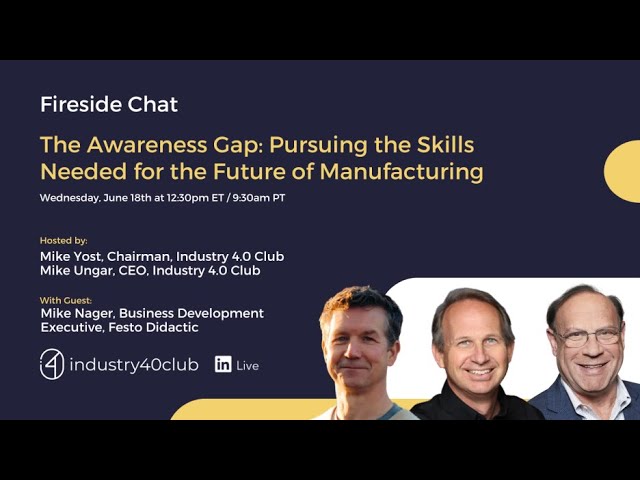
In this Industry 4.0 Club fireside chat, host Michael Ungar (CEO) interviews Mike Neger, Business Development Executive at Festo Didactic. The conversation begins with Neger’s personal journey from electrical engineering to manufacturing education, highlighting his experience visiting over 500 production facilities and creating learning factories. They define the "awareness gap" – the precursor to the well‑known skills gap – as the lack of knowledge among students, parents, and even employers about manufacturing career paths. Historical factors such as offshoring, the COVID‑19 pandemic, and shifting demographic trends are identified as drivers that have reduced the visibility and attractiveness of manufacturing jobs. The dialogue outlines the specific hard skills manufacturers now demand (PLC programming, robotics, AI, basic mechanics) and the increasingly important soft skills (leadership, growth mindset, adaptability). Neger stresses the value of experiential, hands‑on learning, arguing that early exposure through labs, learning factories, and project‑based competitions bridges the gap between theory and practice. He describes outreach tools he created – a guide for high‑school students and a rhyming picture book for younger children – as "virtual windows" into factories. Competitions such as SkillsUSA and FIRST Robotics are highlighted as powerful motivators that provide real‑world challenges and attract talent. Neger also points out an "employer awareness gap": many manufacturers underestimate the upcoming talent war and need to actively market manufacturing careers to young people. Practical recommendations include industry sponsorship of competitions, financial and moral support for student teams, and collaborative outreach with schools, guidance counselors, and parents. The conversation closes with a call to action for listeners to engage with Industry 4.0 Club resources, support smart manufacturing initiatives, and share their own efforts.
Chapters
Welcome to the Industry 4.0 Club's fireside chat. The club's purpose is to engage the power of diverse worldwide talent to accelerate the global evolution to Industry 4.0. We accomplish this by hosting and supporting respectful, thoughtful, and interdisciplinary open conversations and creating quality content on wide-ranging Industry 4.0 topics to expand the reach of our community. My name is Mike Ungar, and I'm the CEO of the Industry 4.0 Club. I have over 40 years of leadership and experience, with most of that being in manufacturing at Michelin. Today's topic is The Awareness Gap: Pursuing the Skills Needed for the Future of Manufacturing. We're joined today by Mike Neger. Mike is the Business Development Executive at Festo Didactic. He's worked for world-class manufacturers of industrial controls and has visited over more than 500 production facilities throughout his career. At Festo Didactic, he creates learning factories for industrial and mechanical engineering programs. He has authored books to popularize manufacturing among kids, students, and teachers. Mike, we're glad to have you today on Fireside Chat. How are you?
I'm doing well, Mike. Thank you so much for this invitation. I've been looking forward to this for several weeks now.
Yeah, super. So Mike, you know, I look back at your background and I noticed that you Studied electrical engineering, and now you're focusing on educating people about manufacturing, manufacturing skills. Talk a moment about your journey from engineering to now, if you will, education.
Yeah, so I started off in electrical engineering and immediately after college got involved in companies that were involved in some sort of automation control or instrumentation of manufacturing processes. So this was, this was a while ago now, so it was before Industry 4.0 terminology was invented. But, you know, looking back, what we were doing is we were trying to automate or somehow take the human element out of a lot of the processes by using technology. So things like transmitters and controllers and sensors and things of that nature. And I enjoyed that quite a bit. That's where the 500 manufacturing facility visits came up. I tended to always have customer-facing positions, so that afforded me the opportunity to travel around the country and in Europe to see operations. And that was kind of the genesis of what later became my journey into the education market because I joined Festo Didactic about 10 years ago with the mission of bringing those same technologies that I use to help manufacturers increase their productivity, but bring that technology into the classroom so that students and that first-level employee would have a little bit more of a, of a a stand-up in the skill set, right? So, you know, something that I look back on is, you know, I wish I had a little bit more of that hands-on experience with those exact technologies, and that would have done me a world of good.
Yeah, it's interesting when you talk about that. I mean, I retired from Michelin 5 years ago, and so, you know, I think about the things I was involved with when I actually was involved in working with the plants. And of course now I've been further away from it too. And you, you know, it's, you understand the principles and the issues around that, but yeah, you miss sort of the, let me see how this works and feels a little bit. You know, I do understand that.
Yeah, yeah, exactly. And, you know, so many positions, so many jobs benefit from that hands-on experience. It's not theoretical. You learn by doing.
Yeah.
You know, I heard someone say on another podcast, you know, like, imagine trying to learn how to swim or to ride a bike, but you never actually got on a bike or got in the pool. You just tried to, you know, listen to people that, you know, were great swimmers and tutorials. But at the end of the day, you got to get into the pool, you got to jump on that bike. And part of what I've been doing with Besto Didactic is trying to get some of that early experience of jumping in the pool or riding on the bike inside the educational experience instead of the first year on the job. So taking that on-the-job experience in the very first 6 months, let's say, of a position and shifting that over into the educational experience.
Well, that's, that's quite interesting because I know when you, when you talk about that, you know, even today we know adult learners especially are more experiential, you know, versus the lecture in a lecture hall. So I think that, and even I guess younger too, this idea of experiential learning, that seems to be the different way. Not everybody learns through a lecture. A lot of people do learn through Experience, huh?
Yeah, yeah, yeah, most definitely. And the people that are specialists in education, and I do not include myself in that group of people, but there's a complex and nuanced way that people learn. And what we're saying, hands-on experiences encompassing a whole bucket of different types of things that experts in the field can dice and and slice. But, but at the end of the day, you know, a lot of those senior projects, those capstone projects, those competitions that students do are the things that really stick with them going forward. And yeah, what I'm trying to do working with Fresco Didactic is provide more of those experiences, more of those opportunities. So when that student becomes a job seeker and maybe gets in front of someone like you, you know, you had the position in HR for many years, I believe, um, that now they can start talking about things that are very, uh, critical and germane and timely to your business, right?
Yes.
And now you as a potential hire or employer doesn't have to make that stretch over on their side. Okay, this person really seems to know what's going on.
Yeah, that's so true. I appreciate that a lot. Well, let's jump a little bit more into today's topic. So we want to talk about the awareness gap. So first of all, what is it? And can we talk for a moment? So I want you to define what it is. How did we get here? I mean, that's really the question.
Yeah, so the idea of the awareness gap terminology came to me, and I think it was me, but it was a play on the skills gap. You know, for the last 20 years at least, and Mike, I'm sure you'd agree with this, you know, you've heard manufacturers saying there's a skills gap, referring to the fact that you have open jobs in some sort of position in some sort of company that needs a very specific skill set. And when you go out to the open market and say, I need a welder, or I need a robot programmer, or I need a PLC programmer, you cannot find people in the area or even outside the area to come in and fill those positions. So that, that was coined the skills gap.
Mm-hmm.
So, you know, when I got involved in this gig of education and working, you know, I tried to apply some principles of root cause analysis. It's like, okay, well, why is there a skills gap? I know that I'm working with great teachers, instructors, community colleges, technical schools, universities every day of my working life here at Festo Didactic. They're putting in great labs, they have great professors, great credentials. Um, but when I go back a year later and I see that gleaming lab that I helped design and install There's only 7 students out of a classroom that can hold 25. Like, what the heck is going on here? And that's where the awareness gap came up. I was like, you know what, the students that are deciding to go into these programs aren't even aware that these programs exist. And, and we're leaving a lot of, a lot of potential students and potential employees by the wayside because they're just not aware of the manufacturing industries like they might have been 30 or 40 or 50 years ago. So, so I go into the awareness gap to describe not from the employer's perspective, but from a perspective employee, a student. What is going to be my profession? What industry am I going to go into? And, and other industries are very good at distinguishing their ROI, their return on investment. Like, if you're going to spend a lot of time going to school and studying, well, you know, medicine has a pretty good reputation for making it worthwhile. Finance has a pretty good reputation for making it worthwhile.
Yeah.
Manufacturing? Nah, we're falling down a little bit.
So, well, so how did we get here? Because I know, like, when— I mean, I'm going to go back now. So I'm, you know, 40 years ago when I was leaving the military, I was— manufacturing was quite interesting to me. How did we get here?
Well, you know, I think it's part of the broader economic cycles, political cycles, you know, that have happened over those last 40 years, you know. So for for, you know, quite a long time, you know, the offshoring trend of—
Yes.
You know, saying, you know what, you know, we're going to take a look at the industry as a whole. The actual manufacturing of putting stuff together is kind of far down on the value chain. So why don't we, you know, we made a decision in the world, kind of, you know, that we were going to offshore that. And when you did that, that meant declining numbers in the industry of people working. And whenever you have that dynamic, it's kind of like an uphill battle that you have to struggle with, you know, making people excited about going into an industry that year over year employs less people.
Yeah. Did you think Do you think the— so, I mean, if we get to more recent history with COVID during the COVID era there, the fact that people were, you know, a lot of plants paused or, you know, were concerned about keeping their folks safe, more opportunities to work from home or the gig economy. Do you think these things sort of accelerated this problem for us?
Yeah, I think so. I think so. People are looking at a lot more than just careers and and pay, which manufacturing, you know, in a lot of cases can offer very attractive packages, if you will. But they're also looking at lifestyle balance and, and, you know, positions that you can work at home from, you know, have a certain appeal to a large percentage, you know, of the population. So that, that definitely contributed to it, I would think.
Yeah, I was, um, Just trying to think of some more trends. I guess the thing is, given the current focus on maybe reshoring and the supply chain issues and the job opportunities that are available, are you seeing any shifts kind of back towards interest, or is this something that's going to take a long time to solve, do you think?
Well, I think both. I think both. So, you know, even before COVID I think there was signs that something was going to happen in this regard. You know, when in the 1990s, it's when, you know, the globalization of the supply chain really, really took off. And, you know, the hunt for low-cost labor around the world really, really started. But, you know, it's well documented that manufacturing raises the standard of living wherever it occurs. So in our own country, in the US, manufacturing is the backbone of the industrial progress, and manufacturing is one of the few industries that actually creates wealth where wealth didn't exist before, right? So there's only a couple, couple industries that can make that claim.
Yeah.
And what you find is if you go to a place, you know, let's just pick China, you know, because it's a big one. You go to a place like China and it doesn't have manufacturing, and then all of a sudden the industry's booming. That raises wages, that raises standards of living, that raises all sorts of, of good things, and, and it also raises the price of labor. So, you know, even before COVID we were seeing that labor cost differential in 1990 was like 25, 30 to 1 between China and the US. And by 2020, let's say, or 2015, it was 6 to 1. So it was a huge—
Yeah, it changes over time. Yeah. Well, that's really interesting. So if we think about the— you talk about this awareness gap, which obviously leads to the skills gap. So what skills are manufacturers looking for? What are you hearing today that aren't being pursued by students?
Yeah, so there's some very specific ones. So manufacturers will have a list of different hard skills, if you will. A lot of them seem to be, you know, accelerating towards software and AI and things of that nature, but there's still going to be the fundamental skills that are required to learn, and that And that's things like programmable logic, controller programming, and basic mechanics, things of that nature. In addition, you know, there's a lot of talk now, much more than before, about what are the soft skills that students need, you know, because if you look at the big picture of automation, you know, automation meaning either robotics taking over physical tasks that people used to do, or artificial intelligence, machine learning taking over mental tasks, for lack of a better word.
Yeah.
You know, that people used to do. Well, what are the jobs that are left for people to do? And increasingly, that is, you know, being able to show leadership at every level in the position. not just the CEO of the company, but if you're a supervisor or even an individual contributor, you're expected to have leadership capabilities.
Influence others. Absolutely. Yeah. Well, that's neat. It's funny, your background as an electrical engineer. I know when I was involved with recruiting, we would meet a lot of students who started as a EE, mechanical, electrical engineering school. I'm not talking about professionals now for a moment. Mechanical engineers. And for many of them, it was a little bit more challenging than they had anticipated, right? So they would move themselves into a manufacturing engineering technology major, if you will, that required a little less of the hard engineering. Can you Are you aware of that kind of trend? And, you know, is there a big— is it a big gap, you think, when someone pursues a technology degree or manufacturing engineering technology degree versus the actual hard engineering degree? What are your thoughts there?
Yeah, yeah, it's really come full circle, you know. So, you know, at one point, you know, I think you kind of alluded to it in the way that you phrase, you know, your, your statement there is that like engineering technology was looked at as maybe like a slightly lower level than, yeah, engineering engineering degree, right?
Right.
Maybe you don't have to take that class on Fourier analysis or linear algebra in that program. But I think recently things have really shifted around. And I would say, As far as I can tell, that both of those programs are on equal footing at this stage, right? So I'm not going to say one is better than another. I'm going to say that a lot of companies are looking for people that can demonstrate that they, you know, for the lack of better words, can, you know, work with their hands a little bit more. A lot of interviews now become like a little bit of a scenario, like, oh, okay, you said that you studied robot programming at university or in college. Here's a robot. Why don't you move it around a little bit here and show us what you could do? And that's where those hands-on experiences in the engineering technology really you know, come to the forefront. So I would, I would think, I think it's kind of on equal footing now. It's like, what type of job do you really— are you really looking for as an employer?
Yeah, I mean, it's a really great point. I think there— I'll share a couple different scenarios. Sometimes there's a— you're looking for a very specific skill set for a very specific need in manufacturing, okay, where you need the engineering degree because of what you need the person to do. But beyond that, or in addition to that, I mean, we used to really target— and I know this is going to sound a little bit biased— but people with a 3.0. And occasionally that 3.0 in school, I mean, it's certainly different if you work your way through school and yet you had other challenges. It wasn't always only that bar. But that bar was an important bar really for an important reason, whether you were at a top-tier school or an average school, it didn't matter. But what we were interested in is, did you learn how to learn? And I sort of drew a magic line and said, hey, if you have a 3.0, I mean, it isn't always the, you know, from a resume look, it isn't always the— for entry-level students and just several roles, it isn't necessarily the only thing to decide this, but it's an important one, I think. is if you got a 3.0, you were a serious student.
Yeah.
And you demonstrated that you learned how to learn. And the reality is in today's workforce, what you're gonna do in your first job will not be what you do in your last job. It's gonna change dramatically, right? And you're gonna have to learn a lot of different things over your career in order to, advance and support the companies that you're going to work for. And so I think this idea of learning how to learn is really key. So it's not only— I guess, I don't know, Mitch, in your thoughts— and not only is it important to attract people to manufacturing, but to understand that it's really just the beginning of their education, not the end, that you're hiring someone for that ability to continue to grow and learn through their career.
Yeah, yeah. And that, that's one of those soft skills that we talked about a little bit earlier. You know, sometimes it's referred to as a growth mindset. So being able to think, you know, beyond the box, beyond the situation that you're in today, and be able to think about what it is to take to grow. So you can interpret that as, you know, growing the business, growing your own skill set, own knowledge, but that's very much part of that soft skill set that's, that's being talked about quite a bit.
Yeah, it's always interesting. I love telling the story about when I started in manufacturing, we had one computer in the plant, and, and, you know, my phone has more power than it today. And all of our equipment was controlled by solenoid, right? Pneumatic controls, not not PLCs or more advanced, you know. So a very different time. But can you imagine? I mean, what we— I'll never forget as an industrial engineer trying to make progress and improve a piece of equipment and realized we had no more capacity in the syllabog to be able to make changes.
Yeah.
And that limited our ability to become more productive. It's like, wait a minute. And then we started installing PLCs. And anyway, but you know, that, that you think about that, you go like, what, what's syllabog, right? And so, no, but my point is that things change dramatically over, over the decades and will continue to. We see that today with, uh, with how fast technology is changing.
So yeah, yeah, I got started at a company called Moore Products, which, uh, later was, was purchased by Siemens. Yeah, but, but their claim to fame was pneumatic controls. So, you know, it was a 3 to 15 PSI control loops. They were doing PID control with pneumatics, and it's completely forgotten today.
Yes, absolutely. So when we circle back around to this awareness gap, what do you think needs to be done to address that, to help us move forward in terms of, one, closing that awareness gap, and then two, getting people to then get to the labs like you described earlier and engage in these important classes?
Yeah, so I think there's a missing piece in the awareness gap, or at least another little bit of a wrinkle. So what we had talked about a few moments ago was from the student's perspective, from the high school or the middle school student's perspective, not being aware that manufacturing is a viable, you know, career choice and something that should at least be considered before being decided upon. But we could also use that terminology on the employer side, the manufacturer side, because I think employers aren't aware for the most part, and there are some folks don't meet this stereotype, but I don't think manufacturers are quite aware of how competitive the talent war is going to get to find new employees. And it's up to the industry and it's up to individual manufacturers to reach out and to make these younger people in our society aware of the, of the career opportunities. We've got a demographic shift happening right now where there's Fewer young people. There's one college a week that is closing their doors in the US.
Yeah.
And that's gonna continue for the next 10 years at least. You're gonna see consolidations and closings because there's just not enough young people coming in. Syracuse University just got themselves in the news for going back to students that said, uh, rejected their offer and sweeten the pot by $200,000 to have them reconsider and go to Syracuse University. Those students are 4 years away from being in the, in the workforce. Universities are seeing this tremendous challenge in attracting students into their programs, and I think it's coming from manufacturers a lot sooner than they're aware of. So I encourage any manufacturers out there to have a real heart-to-heart with all your senior leadership, your HR teams, and really reevaluate how you're going to market, not for customers but for talent.
It's a great thought to share with others. I know also, you know, we talked about— you talked about manufacturers getting involved, but I know you've written a couple of books Targeted at young people. Can you talk about that as well to help get them more aware of manufacturing?
Yeah, so I created a couple content pieces. You know, it happened during COVID You know, I was not traveling around. I had some downtime, and I was like, oh, what can I do? I know, maybe I can take my LinkedIn articles that I sporadically wrote and compile them into a book. So that's what I did. The first one was called The Smart Student's Guide to Smart Manufacturing. And it introduced high school students to the idea of manufacturing, kind of like, you know, in the construction industry when you'd walk by a construction site, you know, sometimes they cut a little hole out in the plywood wall and you could look in, you could see all the bulldozers going by.
Yeah.
The trouble with manufacturing is it's, it's off, it's off the common path of where people take typically walk. And even if you could, you'll probably take a dim view and cutting a hole into the side of the building so passersby can look in. So, so I made the books as kind of a virtual window going in, you know. So, so that building you see off the highway that has no windows and you always wondered what it did, I tried to make the books as a virtual window, you know, inside that facility. And then And then I got the idea that, okay, that's for high school students, but really 8, 9, 10-year-olds is where the decision-making is starting to happen. Mike Rowe on a podcast just mentioned this, that they're very aware— Mike Rowe of Dirty Jobs fame was up talking to the submarine manufacturers in New England and And he told them that, okay, you need to hire 100,000 employees in the next 10 years. Well, they're in middle school right now. They're 8 years old. That's who you have to target. And that was the same philosophy. So the best-selling book that I have on Amazon is called All About Smart Manufacturing. And it's a rhyming picture book that talks about manufacturing in a way, and some of the illustrations are pretty Younger kids like to see the robots in there and things like that.
Well, that's wonderful. So, you know, if I'm a parent listening and I've got someone who's 8 or 9 and I'd like them to consider manufacturing, by the way, they should consider it. It sounds like a great resource. So thanks for putting that together.
Yeah, yeah. You know, and, you know, I don't even expect, you know, people to read it cover to cover, but what What I hope it does is it sparks that conversation. So, you know, with teachers, guidance counselors, with parents, let's talk about how things are made and at least get that thought process rolling. And that's fine with me.
That's fantastic. Well, so I know you do a fair amount of traveling today around the country. Have you seen other— so we talked about books as one example, but have you seen other programs that you'd like to— that you would highlight as really what you consider to be kind of local success stories in different parts of the country?
Yeah, I mean, all over the country there's a lot of great colleges and technical schools and universities, you know, that are doing their job and providing first-class instruction and first-class facilities. But, you know, the competitions are what really, you know, gets people motivated. So So this week actually is starting SkillsUSA. So if your listeners aren't familiar with it, you know, do a quick Google and you'll see SkillsUSA, where the vocational trades have a yearly competition. And that is also involving mechatronics and robotics. And it's something that Festo Didactic actually supports, you know, so we're a supporter of that. And, and that allows students from all around the country to compete and to show off, you know, what they know on it. FIRST Robotics is another great program, right? So my sister company Festo Automation sponsors that one. And, you know, students get to compete, you know, on a national level. state level with that. And that gets a lot of excitement in the engineering disciplines and manufacturing.
So yeah, so competitions seem to be— when you can find a competition to get young people excited about, you know, quote unquote winning something in the area of manufacturing, these are the things that seem to be making a big difference, if I understand you correctly.
Yeah, yeah, yeah, most definitely. So, you know, the skills organization, every state has a competition.
Uh-huh.
Uh, you know, you can become the state champion, then you get invited to nationals, you go nationals, and then every other year there's global somewhere in the world.
Wow.
Um, and, and this is where manufacturers have to step up. If there's a team in your state that's competing, um, they need some financial support and moral support, uh, to be able to go to that global competition. And, you know, it's money. It's not a small amount of money, but if you were to look at it compared to an advertising budget, it's a drop in the bucket, right?
Yeah. No, thank you for that. That's a great idea. So we've been talking to Mike Nagier for the last 30 minutes or so about the awareness gap pursuing the skills needed for the future of manufacturing. And Mike, To wrap up our conversation today, do you have any final thoughts for our audience that you'd like to share?
Yeah, I would say if you're involved in the manufacturing industry, you know, get involved in looking at this next generation of talent coming up. It's really going to separate those companies that thrive and the ones that are going to try to muddle along and And try the old, old methods of gaining talent. And, um, you know, there's a lot of good ideas out there and how you can be involved. It just requires some time, you know, effort and money. But, you know, what doesn't in, in the business?
Yeah, so great. Well, thank you, Mike. I appreciate it a lot. I want to thank you for taking time out of your busy schedule to join us and share your insights. into the awareness gap, first of all, and then secondly, what we need to do to try to close it and really to engage students around the country. So thank you for that.
My pleasure, Mike.
Yeah, so as we wrap up, the Industry 4.0 Club would like to encourage you to take action to advance the deployment of Industry 4.0. Read an article, attend a workshop, or maybe even encourage your company to put together a smart manufacturing roadmap. We'd like to know what you decide to do. It's important that we share that with each other, so please let us know on our website at www.industry4oclub.com or on our LinkedIn page what you're doing to advance the deployment of Industry 4.0. We also would love to have you on a broadcast, so if you're listening and have something you'd like to share, again, drop us your name and what your thoughts are. Either to our website or our LinkedIn profile. So with that, again, hope everybody has a wonderful rest of the day. Mike, thanks again, and we look forward to seeing you all on a future broadcast.
Thank you, Mike. Take care.
Thanks, Mike.










