The Configuration Lifecycle Management (CLM) Summit: Mastering Complexity and Customization at Scale
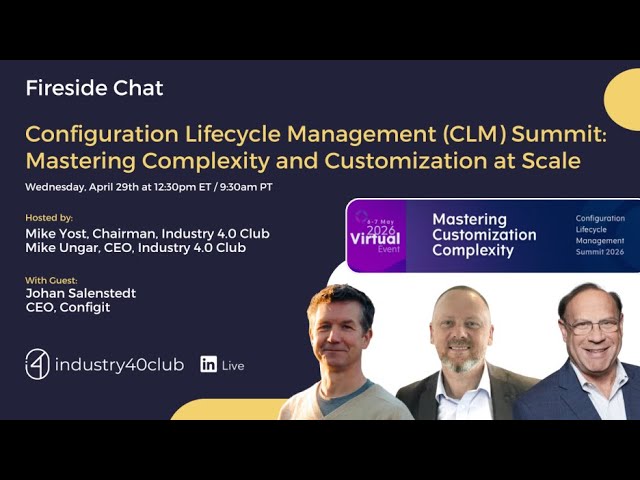
Johan Sällenstedt, CEO of Configit, discusses why manufacturers need Configuration Lifecycle Management to handle mass customization at scale. Modern products demand configurable solutions across engineering, sales, and service over 30-50 year lifecycles. The upcoming CLM Summit (May 6-7, 2026) brings 400+ participants to tackle AI integration and cross-enterprise data challenges.
Chapters
Welcome to the Industry for Bueno Post Fireside Chat. Club's purpose is to engage with the power of diverse worldwide talent to accelerate the global evolution to Industry 4.0. We accomplish this by hosting and supporting respectful, thoughtful, and interdisciplinary open conversations and creating quality content on wide-ranging Industry 4.0 topics to expand the reach of our community. My name is Mike Unger, and I'm the CEO of the Industry 4.0 Club. I have over 40 years of leadership and management experience, most of that in manufacturing at Michelin. I'm joined today by my co-host, Mike Yost, who's chairman of the club. Mike, would you please introduce yourself further?
Absolutely. Thank you, Mike. Welcome, everybody. As Mike said, my name is Mike Yost. Mike's co-host here on the fireside chats, also the volunteer chairman of the organization. I've been in industry almost 40 years myself, largely on the solution provider side and the nonprofit side. So I really enjoy bringing people together, talking about the role, the value, and the fit of modern technologies for a manufacturing business. So super excited that today we're going to be talking with Johan Sällenstedt, the CEO of Configit. We're going to be talking about configuration lifecycle management— excuse me— CLM, and a summit that they have coming up on the topic, and focusing in on mastering complexity and customization at scale.
scale.
So just a little bit about Johan. He brings more than 30 years of experience leading organizations and multifunctional teams across Europe, the Middle East, and Africa. His career has taken him from small service organizations to some of the world's most recognized brands, including Lotus, IBM, and Adobe. Johan is passionate about building successful organizations by implementing integrated, effective processes that align every part of the business from marketing to pre-sales to sales and consulting services. At Configit, they talk about a one-team culture, which we definitely want to dig into. And they talk about collaborating closely across functions, geographies, and with partners to create real impact for their customers and make a difference. So, Johan, we welcome you here to the show.
Thanks. Thanks for having me. It's a pleasure to be with you guys.
Before we get into our questions, I just want to share a little bit about the CLM Summit. So Configit is going to be hosting their 11th Configuration Lifecycle Management, or otherwise known as CLM Summit, on May 6th and 7th. This virtual event will focus on how manufacturers can master customization complexity by establishing a strong data foundation for future growth. It's virtually held over 2 half days, and the summit brings together B2B manufacturing leaders to explore how connecting systems, data, and logic enables organizations to manage complexity more effectively. So we hope you decided to join the conference. We'll talk more about it at the end, but really the opportunity will be to discover how the CLM approach links systems and configuration logic across enterprise, turning product complexity into confident decisions throughout the product lifecycle. Johan, in your introduction, and Mike's talked to you about your biography, you've established this, what you call a one-team culture at Configit. Could you talk more about the importance of culture and really what you're trying to create inside the company?
Yeah, sure, Mike. For me, culture is basically, it starts with the culture you have in your company. And I think we're all experienced having working for different companies, some, some good cultures, but, you know, some not so good cultures as well. And, and we've all seen the effects of what that, you know, what that impact, uh, is. Um, so for us, it's— and for me, it's, it's just a natural thing to build a really strong corporate culture, um, a culture that is not just you know, testifies by artifacts on the walls where you said all these good cultures and values, but actually something that you bring to everyday work, you know, where you, where you sit in a meeting room and you actually have people understanding how do we treat each other, how do we talk to each other, how do we, um, you know, what pace do we do business with, how do we support customers, because You say one team, and everyone alludes to that in this company. It's basically, guys, let's come together. We know we're one team, right? We win together and we lose together. And when we say we, it also includes our customers. It's not just us as a company. We want our customers to excel, and we want them to feel that they are part of the Configit culture and Configit family. So we do everything. And one of the other things we talk about is move fast. Move fast doesn't mean that we do things just because of doing things fast. It actually means acting fast. So whenever there is a customer having a customer problem, it's— they should understand that we come together as one team together with them and we move fast to sort out the problem if it's a problem or if it's a business opportunity for that sake. So I mean, I just think it's super important and it is also important considering we have 27 different nationalities within Configit. So people come from different countries, different way, you know, different cultures in the world, different genders, what have you. Just having a strong culture also is, you know, is a good basis for making it fun to come to work as well.
Yeah.
Your passion—
Oh, I'm sorry, Mike, go ahead.
Yeah, no, I was just gonna say your passion for that really shows through in how you talk about it. So thank you for sharing.
Yeah, I was just gonna say the same thing in that you talk about your customers being part of that culture that you've created. So can you talk to us a little bit about, you know, you have the summit that's coming up and you're engaging manufacturing leaders. They're dealing with increased product complexities. What do you see as the biggest shift in how they're managing configuration and lifecycle complexity today?
Yeah, I mean, if we look what's happened recently, the past 10 years, we basically, we've gone from a kind of a mass production into a mass customization need, right? Customers are demanding much more customized product, configurable products, and they want it to fit their purpose, right? It's no longer, you know, one size fits all. And it's really changed radically in the last 5 or 6 years, especially with software being so much a part of our products, manufacturing products today.
Sure.
So basically, if a manufacturer in the industry today, if they want to meet the customer demands, they really need to be smart on how they configure and how they can manage that need. And the old way of doing that was, of course, build-to-order or engineer-to-order, right? So the customer came to you and they asked for help and they said, we want this elevator or we want this wind turbine or we want this, whatever that is, to look like this because we're going to apply that in this building or at this wind farm. It just doesn't You can't do that anymore because it's just— you're losing time, it's costful, and you also have other things. As I said, software comes into play, but also compliance and regulations.
For sure.
So you need to be able to meet them, and you need to meet them over time. So you need to find a smarter way of doing things.
So it seems to me, to that point, I mean, one of the core promises of Industry 4.0 that we talk about all the time is how you know, using the evolving technologies allows manufacturers to be more customer-centric, to be more customer-focused. So as they innovate and make a more, you know, differentiated elevator like you just talked about, or if people are now embedding software chips into tennis rackets, right?
Yeah.
Like the products themselves are becoming more complex and that spans, you know, different parts parts of their entire business, and so it adds to the complexity. And that's where your team fits to help manage the complexity of delivering on those products?
Yeah, because if you think what has happened, I mean, if you look on the digital transformation as such, I would argue that some of the manufacturers has been a little bit slow in terms of looking across the portfolio. across functional. So they've done a lot on improving engineering as one discipline. They've been doing— looked down on the manufacturing side and lean manufacturing, and they kind of made that effective. And then they said, okay, so how do we sell this? And they implemented the CRM system, right?
Right.
They never looked across. How do you make sure that all the data that you have in your PLM system, for instance, or in your ERP system when it comes to manufacturing, or in your CRM system. How do you make sure that that becomes one shared source of truth that can live over the span and the lifetime of a product? And that's really what CLM is all about, making sure that you basically engineer what can be sold and you only sell what can be manufactured and you can maintain that over time. to allow you to do more service rotation and being able to source that service for the customer across, you know, until you decommission the product, which could be, you know, for some products, 30, 40, 50 years.
For sure. Well, you know, that's great. So I want to kind of shift gears just for a second. You know, we— it seems like today that every time we do a we have a conversation, AI has to be in part of that conversation somewhere. So we don't want to disappoint here. So I've got to ask you about that. So there's so much excitement today about GenAI and AI, but also concern around accuracy. So how is Configit approaching the balance between AI-driven speed and the need for deterministic, repeatable outcomes?
Yeah, a great question. And, you know, I— when I meet CEOs of, you know, large companies, they basically, it's kind of, we first get introduced to each other and we speak how business is doing and then we get into AI, right? That's the kind of narrative today. And many of the questions are, why are we, why do we need a configuration tool, right? AI will, you know, can do that already for us. And I'm trying to explain that there are parts where, you know, the large language models are great, right? They are very creative. They are super— they are probabilistic in its nature, so they actually can do a lot of things for us. They can improve how we do, how we build product models. But it's a little bit, as you say, it's how do you make that deterministic? How do you make sure that you are 100% correct? And they don't allow for that, and that's what we do. So we kind of complement— I mean, we use AI today in our tools just to make sure that the process of implementing a CLM system is much faster, but also that it contains the 100% accuracy. It's pretty funny because I met a CIO, this is about a month ago, and we had the conversation about the accuracy or how to use AI. And he basically, he said, To me, they said, well, Johan, you need to understand that if it's not 100% accurate, it's 100% wrong. And it actually is, because even if it's 99%, you cannot manufacture complex configurable products with 99% accuracy. It's like you come to the end, you build a car, and it's got 3 wheels. It just is not good, right?
No.
So it improves accuracy.
So that's one end of the spectrum, and I think AI is certainly driving conversations with everybody to the table to challenge these kinds of questions, which is fantastic. But reality is most folks are probably on the other end of the spectrum where they're not using AI, they're using spreadsheets, et cetera, et cetera. So I think you touched on some of the risk, and I've heard your team talk a bit about the need for deterministic, repeatable outcomes that your team ensures. Can you talk a little bit about the risk What are the risks for not having that? I know you just touched on the 3-wheeled car, which is a good example, but what are the other risks for somebody that's on either end of that spectrum?
I mean, we meet customers pretty much every day who some still don't have a PLM system. They do configuration, product configuration for pretty large organizations, very costful products, uh, both from selling into and to manufacture, that still relies on, on spreadsheets. So you're absolutely right. The biggest risk is probably not the accuracy. You, you, you can manage the accuracy with resources, but here comes the problem— it's time. So, so you're going to be, you're going to be very hard— it's going to be very hard for you to actually even enter into some kind of digital transformation, right? And you're going to be short in terms of of, of how competitive you're gonna be. Um, I even meet— I actually, I, I met a reseller to, to one of, of our potential customers that one of the issues we have, we, we need a better partner, you know, a reseller portal. So we kind of build up, build our own. And, and the next leg is then, okay, what do we do in terms of, are we gonna go to another vendor which actually has a better you know, reseller portal. So it's all about time and being competitive, um, and, and, and the resources you can throw at it. Yes, it's fine, but how, how sure can you be about, um, you know, delivery times? What happens if you have a geopolitical situation where you cannot source it, right? So you have a supply chain issue. How are you going to deal with that? If you don't have a, you know, proper system and processes to manage it.
Yeah, and I, you know, certainly the theme of business nowadays is speed, right? And so nobody wants to slow down and everybody's looking to grow and post quarterly earnings and things like that. So as you're moving, as a manufacturer is moving to run faster, you take on these kind of risks that you're talking about if you don't have This kind of structure.
Yeah, yeah, no, that's, that's great. So maybe we can, um, I wanted to turn our attention to the summit. Um, so the CLM Summit, May 6th and 7th, it's a, you know, this virtual summit. So what makes it different from other manufacturing digital transformation events, and what should attendees expect to walk away with when they participate in it? Maybe you could talk about some a little bit.
So it's the 11th year we do it, um, and it's remote. We will, uh, we usually have plus 400 people joining. Um, we hope we break the 500, uh, people attending mark this year. I think first we need to understand what it is. It's really a thought leader event, so it's not us trying to push a product or a new release or anything such as that. It's basically the thought leader event for Configuration Lifecycle Manage, where experts, our partners, our customers, our internal resources as well, of course, are coming together and speak about the challenges, um, the possibilities. But this year, of course, AI is going to be playing a big part, uh, of it. So, so it's kind of the content is informed with the help of our customers and the market itself. So it's basically we listen to what are the challenges and, and what's happening in the market and what is the latest and greatest that our customers and partners have seen, and we bring that up and we may build that into the agenda. So it's, it's, we, we both show the possibilities, uh, with, with CLM, but we're super practical, especially on the second day. We basically go down very much in, you know, practical terms. How do you do it? How do you make it happen? What is the first step? What is the pitfalls? What do you need to think about? Um, so it, it really, when you— my wish and my, you know, my, my ambition is that when you leave this event you're basically going to go home and say, okay, either you say this is for us, this is something that where we feel that we will benefit from this. And now we have built a network where we can go back and speak either to some of our customers, but also to us or some of our partners, but also understanding where do we start? What is the first thing we need to do to make sure that we can that we can embark on this journey.
Well, you're certainly singing our song when you talk about thought leadership and education and sharing the word, right? That we know how critical that is and how important it is. And when I think about the amount of education that needs to go on with this topic, it's immense. So I would certainly encourage people to attend and learn. Because, you know, I'm assuming you're talking about leaders across many different disciplines, engineering and sales and manufacturing. You talked about PLM systems or ERP systems or MES systems. Like, every one of the vendors that's selling products that, you know, has specific domain expertise in those areas is enhancing their product portfolio. They're talking to their audience about the effects of AI, etc., etc. So there's plenty of opportunity for confusion and, you know, muddled messages and such. And I think that this kind of a forum, my guess would be— and I believe if I'm not mistaken, you're not talking about replacing those systems.
No.
It's about stitching them together, right?
Absolutely. No, I mean, we're not trying to say that we're a PLM vendor. We're not trying to say that we're an ERP vendor for sure. We're just trying to— what we're trying to say is that all that— there's configuration data that sits in all these different sources, right? Even if it's a CRM system or CPQ system, you know, what do you sell to which customers to which terms?
Yeah.
And that data needs to come together, together with the PLM data and the manufacturing data. And now Nowadays also, of course, service citation systems, because services and aftermarket is a big portion of how, you know, how you, how you make your money today. So yeah, that's what we do.
Yeah.
And I think, I think it's a great— I think this is, you know, together with this event, and you talked about training, we do a lot of webinars. I mean, we do monthly webinars where we bring it, bring up this subject. We bring in experts, whether that is from other vendors or whether that is from you know, from, uh, from customers or just from our experts just to discuss those trends. So we do run quite a, I would say, an intellectual exchange in terms of discussing CLM as well. Um, and we are a, you know, we're a company founded by 2 professors to start with 25 years ago. So the level of knowledge, the level of skills, and the level of trying to form and shape the market is high, super high. And I think that we really want to share that. One of the— coming back to the culture thing, by the way, we have— one of the words, one of the values we have is knowledge. And one of the things we said, it's forbidden not to share knowledge. It's forbidden to sit on your knowledge, just make yourself more powerful. We really want to share it internally. We really want to share it with the rest of the world and with the partners and the customers to make sure that they are up to date as well.
Well, appreciate that. I just want to remind everybody that we are talking today with Johan Sällenstedt, the CEO of Configit, ahead of their Configuration Lifecycle Management Summit and that event and the value of being there. So Thank you for joining us here, Mike.
Yeah, so the— it's great. I really appreciate you sharing the importance of sharing knowledge.
For sure.
You know, it's, it's so important. The— if you believe that you do something well, I mean, we— a lot of companies, they're the— I appreciate you kind of sharing your values. The— you focused on that and you focus on serving your clients and sharing. You know, it, it's, uh, it really brings— it really comes back to you, I think, in terms of results. And people want to work with companies like yours that, that have those sense of values and that sense of approach, I think. So I wanted to kind of segue, uh, to kind of ask you to think about the future. I know this is something that you're— you think about a lot. Um, so thinking about this, this topic of configuration lifecycle management, I know you're going to talk a lot about AI at the summit, but If you think even beyond the next 3 to 5 years, where do you see this topic going and how do leaders stay ahead of this, the curve, so to speak, in terms of handling the complexity they've got to deal with?
I think it's interesting because for me, it's going to move into being basically, I would say, CDM is going to be in— it might actually, it's interesting, but it might actually not be named CLM in the future. Because what's going to happen is this is going to move into become a kind of a backbone, industry backbone enterprise system, right? I'm, you know, we've had some success so far, but we basically only serve the early adopters, right? This market is going to now move into the more of a mass market enterprise standard type of style. Um, and, and I, I think what, what's going to be, what's going to be done, people are going to communicate with your CLM system in a very different way. AI is going to cater for that, but still the kind of making sure that integration works, making sure that it's accurate, making sure that you get this kind of deterministic and, and, and, and, um, and accurate outcomes, um, time and over and over again, that's still going to sit in that system, but it probably will be more of industry backbone in the future rather than a tool or a discipline itself.
Yeah, I think it's really— that's an astute look. Like, you almost take it for granted, like it should be like that already, right? But it doesn't behave that way, right? It's not, it's not that backbone. So you end up with these different, different silos. And so yeah, I think that's a great outlook.
You know, we're kind of reaching the end of our discussion today. And of course, people can join the summit to talk about this topic further. But I wanted to kind of get maybe a last thought for our audience, maybe starting with you, Mike, and then Johan giving you that last thought to share with our audience. Mike, would you start us off?
Absolutely. First of all, very excited to encourage everybody to attend the summit and learn more. As I mentioned before, I think that The promise of Industry 4.0 of allowing manufacturers to be more customer-centric and move faster, be more responsive, plays right into this topic of how do you manage, you know, the configuration of your products across all aspects of the business. And probably my big takeaway is we still have so many silos, organizational silos and technology silos, and you know, product owners and sales owners and manufacturing owners with their individual systems. And so I guess the big takeaway I would have is it still just comes back to me that Industry 4.0 is a leadership opportunity, right? You're going to need senior leaders to work across those silos and those boundaries and get people to meet up with folks like Johan and his teams. So again, I would just encourage everybody to come to this event and learn all you can. And there's a lot of great value there.
Thank you, Mike. Johan, how about your last thoughts for our audience, if you don't mind?
I just hope that everyone that has the possibility to sign up, and as I said, it's a 2.5-day event, the first day being more on the business side, looking at the challenge and seeing some of the Seeing some of the outcomes and seeing some of the customer stories and where they have transformed from and now to, and also what's the next insight for them. Then the second day being a bit more practical. How do I start? How do I make this happen? Because as you say, Mike, sometimes it looks overwhelming, but it's really not. It's just the first steps in understanding where do you address and where do you start? And I think, you know, both from a technology standpoint but also from an organizational standpoint.
For sure.
I mean, so who will lead such a transformation and who will in the organization will, you know, will say, okay, now we set sail, now we embark on this journey. And I think this event will actually, you know, you will be learning how to make that happen, how to do it super practical. and also leaves you with people to talk to and get some guidance.
I'm a big fan. I'm sorry, Mike, one more point that Johan just sparked in my thinking. This is the 11th summit. This is a new thing, and ConfigIt or CLM may be a new concept for people. I always talk about the work people do behind the scenes over the years to become an overnight success. And I think when you get into this topic, if it is going to be an industry technology backbone or a functional backbone, you're gonna wanna be talking with people that have been invested in this and training models specifically into this problem space. And so I do think I, I think it's really important that you're focused in this space and so much domain experience and practical experience. So I hope people don't overlook that.
Thank you.
Thanks. So just thank you, Johan, again for taking time out of your busy schedule to join us today to talk about the upcoming CLM Summit. We want to remind everybody that if you'd like to register, that's— there's There's still time to do that. Here is the, uh, here's the website to go to to register for the summit and really to participate in what Johan just described as, uh, one, to learn not only about how people have themselves progressed on day one and things that they've learned, but two, some practical ways on how to start. So I think you'll enjoy that. Please join, uh, go to this and sign up for the summit. which will be taking place on May 6th and 7th, just around the corner. So the Industry 4.0 Club would like to encourage you to take action. Attend the summit, you know, listen to a webinar, read an article, or start a smart manufacturing roadmap for your facility, and/or encourage others to do so. We'd love to hear what you're doing. So if you, if you can, if you have something you'd like to share, please drop us a note on our website. at www.industry4oclub.com or on our LinkedIn page. We also host conversations like, like these weekly. So if you'd like to be on one of our shows, let us know again at our website or our LinkedIn page. And with that, Johan, thank you again. Mike, thank you for your time. And we look forward to seeing everybody at the summit. Wonderful.
Thanks, everybody.










