The Future Isn't Just Coded - It's Built
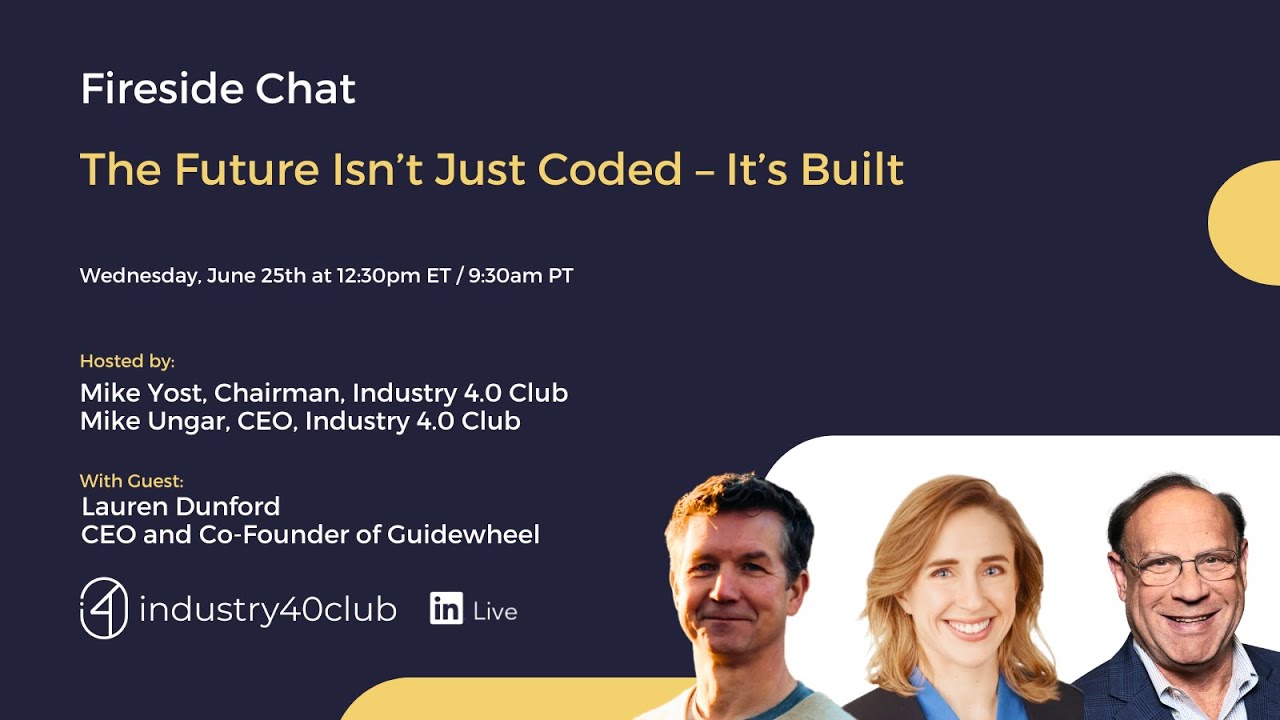
Lauren Dunford, CEO of GuideWheel, discusses how AI-powered sensors on factory equipment can cut energy use by 45% and boost productivity by 1.4×. She argues manufacturing is critical to climate action and the economy, but faces a talent crisis: 57% of Gen Z want to work in the sector, yet the industry struggles with a "dull, dirty, dangerous" reputation.
Chapters
Welcome to the Industry 4.0 Club's fireside chat. The club's purpose is to engage the power of diverse worldwide talent to accelerate the global evolution to Industry 4.0. We accomplish this by hosting and supporting respectful, thoughtful, and interdisciplinary open conversations and creating quality content on wide-ranging Industry 4.0 topics to expand the reach of our community. My name is Mike Ungar, and I am the CEO of the Industry 4.0 Club. I have over 40 years of leadership experience, with most of that being in manufacturing from Michelin. I'm really excited today. We're really lucky to have with us Lauren Dunford. Lauren's been on our show before, so we're happy to have her again. She's the CEO and co-founder of Guidewell. She recently gave a TED Talk entitled The Future Isn't Just Coded, It's Built, and we're going to get a chance to hear that later today. We're looking forward to talking to Lauren about her passion for manufacturing and what motivated her to do this talk. Just a quick introduction about Lauren. She's the CEO and co-founder of Guidewheel, empowering the world's 10 million factories to achieve sustainable peak performance. Described as Fitbit for factories by the World Economic Forum, Guidewheel's all AI-powered factory ops— we seem to have some difficulty, bear with me, but we're going to keep introducing her and hopefully we'll get her back. Their factory ops platform supports manufacturing, driving productivity and decarbonation at scale. A Stanford BA and MBA graduate, Lauren serves on the executive committee for the U.S. Center for Advanced Manufacturing. She's a regular speaker at Stanford and Davos and delivered an official TED Talk in April 2025, measuring success in approving nods from her wonderful husband and enthusiastic dance moves. From her 2-year-old daughter. So, um, it's great, Lauren, to have you on the show again. Welcome.
Oh, thanks so much, Mike. We had so much fun last time. I was really excited to join again.
I apologize, my internet, uh, from before was perfect and now seems to be funky, and probably the 2-year-old has something to do with that. So just apologize right away, and I'm hotspotting now.
I don't know what happened.
Okay, well, thank you for following up, and that's great. So, um, we're really glad to have you on again. Um, Last time we spoke, you shared a little bit about your background. I think it would be interesting this time to, to, to hear what— we've lost her again. Hopefully we get her back here in a minute and then ask her the question.
Hi, Michael. Oh my gosh, Mike, I am so sorry.
That's okay. We're gonna, we're gonna give one more try. Ask a quick question, maybe you get the answer in before you jump off here. Um, so we were talking about what really, what motivated you to transition from a leadership role at Revolution Foods to start a technology company like Ideal?
Yeah, I mean, if anyone has ever, uh, if you're listening, you probably worked in a production environment.
And, um, you know, we were making fresh food.
It was a really amazing All right, so we're having trouble with Lauren. So why don't I? We're going to move forward, and we'll talk about this with her a second. But I'd like to air the TED Talk that Lauren gave at TED Talk in Vancouver, and then we'll get back and talk with her more in a few minutes.
So here's as we get started. I wanted to first ask everyone to set aside any thoughts on current events for the moment. And let's take 5 seconds to look around this big room we're all in right now to try to find even one thing that was not manufactured. Other humans don't count. Ready?
Go.
Make eye contact when you're done. One thing that's not manufactured. Not actually that easy, is it? Manufacturing is a sixth of our global economy, One-third of all greenhouse gas emissions, about. And for context, that's huge. That is 3 times all the emissions of the United States. Somehow, though, it starts to actually feel even bigger than that when you try to think of what in our daily lives isn't manufactured. The trees, the ocean, fluffy clouds, of course, but everything we humans make, which is more and more every single day, is manufactured. So how that manufacturing happens is so important. I want to share how we can all think differently about manufacturing, why the greatest opportunity of our generation is manufacturing, and why the heroes of our time with the coolest, most absolutely cutting-edge careers are going to be in manufacturing. And here's the great news: 57% of Gen Z wants to go into manufacturing.
Just kidding.
57% of Gen Z wants to be social media influencers. And that's the problem. Manufacturing has an outdated reputation as 3D: dull, dirty and dangerous. So I grew up in the San Francisco Bay Area. Friends went into tech, saying code was the future, but I was a wide-eyed 23-year-old on the hunt for purpose. I joined a company on a mission to bring millions of students fresh and healthy food, and I showed up my first day ready and inspired. First thing my new boss handed me? A hairnet. Let me tell you, nothing brings you down to earth faster than realizing your actual first job is not to get hair in someone's food. But then I stepped onto the production floor. Conveyors moving, machines sealing meals. And I realized I had always thought of food as cooking. But everything at scale becomes manufacturing. I spent 5 years there, and I can never see the world the same way. Manufacturing is everything. Not just food, but cardboard boxes, pipes bringing clean water, asphalt roads our trucks drove on. Manufacturing is everything, but we don't give it a second thought. Or in most cases, even a first. We should. Where and how we manufacture has never been as important as it is today. We got a tiny taste of it in COVID. Trapped at home. At first, it was kind of a joke. Stores are sold out of toilet paper. But then it cuts deeper. Groceries, baby formula, N95 masks, when it actually felt terrifying not to have one. And then I realized, if someone I love has to go to the hospital, they may not have gloves or masks either. Because we don't have the factories. For critical things, if we can't make, we break. Even AI. We all talk about the cloud like it's some magic fluff in the sky. Nope. Every conversation I have with AI leaders, they're trying to figure out how the heck to build and power massive data centers stacked full of metal servers, wrapped in steel and cement with fans and cooling towers, all using more power than this entire city. That's all made in factories. The future isn't just coded. It's built. If we can't build, we can't lead. If we can't build, we are handing the keys to our future To those who can. We're at a turning point. And as humans, we've actually had a moment like this before. In World War II, people rolled up their sleeves— Rosie the Riveters— powering manufacturing that saved the world. The choice we humans face today is actually even bigger than that. It's not just about which countries are going to run our planet. It's about whether we humans are going to have a planet that we can live on at all. I'm seeing people everywhere stepping up. Jacob Malawa, efficient solar-powered manufacturing of HIV meds locally in East Africa. Olivia Weatherly, optimizing massive spinning machines making water tanks in Indiana. Lisa transforming bottling across Latin America. Paul Boudreau making coffee pods compostable. César Bermúdez making igloo coolers. Beth Espinette, 3D weaving jeans. Medicine, water tanks, jeans, satellites, sutures, speedboats, underwater drones, animal crackers. This can be fun, it can be entrepreneurial, it can be sexy. And it can be sustainable. From food manufacturing, I headed to Stanford for my MBA, and I saw incredible technology to decarbonize manufacturing. Win-win-win: lower cost, lower emissions and a sales advantage. First, it felt like we got this, and I thought, I don't know if they even need me. But since then, I've spent time in more factories than I can count, everywhere from Minneapolis to Mexico City to Mombasa, and I've seen the same thing everywhere. Energy is a big cost, and 99% of the world's factories don't even have the foundation yet for those awesome Stanford solutions. The light bulb went off, and I started a company called GuideWheel to close that gap. At first, we got started with energy efficiency. Clipped sensors like little smartwatches on the power going into each machine and launched, excited to see those energy savings start rolling in. And nothing happened. Oh my gosh, I remember staring so sadly at those usage stats. Energy was a big cost, the team seemed to care, but they were not using it. Except for 2 guys, Willie and Parav. They were logging in all day, every day, like energy superfans. So we went out to their factory, and their production team showed us what all the energy teams had missed, which is that the power going into their machines wasn't just power. It was the heartbeat of their machines, which was the heartbeat of their production, which was the heartbeat of their entire business. Energy was a big cost, But production was the priority. It's all about production. And production had been a nightmare to measure and track across patchworks of different ages, makes and models of equipment across the factories. But every machine uses power. And just like you don't have to tell your smartwatch if you're running or resting, from that electrical heartbeat of the machine— that's a real machine, actually looks like a heartbeat—
Wildly cool.
We can know exactly how much it's producing, how fast, and predict problems before they happen. It's the first-ever universal translator for any machine anywhere on the planet— energy to production— and the foundation for real-time intelligence, so any factory team on Earth can reach peak productivity and decarbonize. For a very simple example, if you have a big machine idling in between production runs, it's wasting energy and it's wasting production time. That's just one tiny part of why the hundreds of manufacturers using this technology are already seeing energy efficiency improve up to 45% and productivity up 1.4x. That is a huge impact, and the impact just grows with more scale and as the power of AI improves. These are not dull, dirty and dangerous jobs anymore. These are clean, cutting-edge and really dang cool careers. But unless we bring manufacturing from devalued to uplifted, millions of jobs in manufacturing are currently on track to go unfilled by 2030. That's innovation that's not going to happen, critical infrastructure that won't be built. Edison said, opportunity is missed by most people because it's dressed in overalls and looks like work. These awesome teams need talent excited for hard work to join them. If they come, we can build it. Imagine if 57% of the next generation actually was excited to make real things instead of Instagram Reels. Each of us, whether we care about our countries or our climate, can help make manufacturing the biggest comeback story of our time. So here's my ask. If you're a parent, talk about this with your kids. If you're a kid or a kid at heart, Talk about it with your friends. And everyone, let's thank the makers, because our future isn't just coded, it's built. Let's roll up our sleeves and build it. Thank you.
All right, well, that was exciting. So Lauren, so thanks for— that's a great TED Talk. I wanted to ask you just what motivated you to do that talk?
Yeah, so I spend most of my time actually out on plant floors with our customers, and one of the things that everyone brings up on every plant floor is talent and how we get great people coming into this incredible industry. I'm also lucky to serve on the executive committee for the U.S. Center for Advanced Manufacturing. And every meeting that we have, every gathering of executives and leaders who care about manufacturing, it's all the same thing. It's talent. And so working backwards from, okay, what would it take for manufacturing to be the best possible industry when parents think about what their kids could go into, when this next generation thinks about careers. The goal was, let's think about how we can make a small dent in that big problem through this, this opportunity of getting to be on the TED stage.
Yeah, that's fantastic. I really enjoyed it a lot. Just a comment for our listeners who might be listening live on LinkedIn Live. If you have a question for Lauren during the remainder of our talk together, please drop it in the comment section and we'll be sure to get it to Lauren to to address it if we can. So there are a couple of key messages, I think, in the TED Talk that I picked up on anyway. The first I'd like to kind of dig into with you is AI, all right? Every week there seems to be something new being discussed about AI, and it's almost as if it's going to save the world, right? And most certainly manufacturing. So what's your perspective? Is it going to save manufacturing?
Yeah, I mean, I think a lot of the stuff on AI depends on humans to adopt it. So the models are getting really, really, really good. Will they save the world? Definitely not tomorrow. And I think it always depends on adoption and how we as humans use those tools. So I think what I'm seeing right now in AI is there is a real competitive advantage for folks who use it and leverage it in smart ways. For software companies like us, we're thinking every single day about what's happening today that is better than it was tomorrow and how do we make the most of it for our customers and team. And then also in manufacturing, I think there are a lot more barriers to high-quality data on the plant floor because you've got to have good data for AI to work well. I heard the saying the other day, garbage in, poison out. So instead of just garbage in, garbage out, garbage in, poison out is the danger. You might actually make the wrong decisions if that AI is using the wrong data. So I definitely am not a believer that AI is going to save the world or dramatically transform manufacturing tomorrow, but I am a big believer in the power of these tools increasing exponentially and that there's a massive opportunity out there.
Well, let's add to it the layer of generative AI.
Yeah.
So, you know, AI, we know from for a few years now that when it comes to predictive maintenance, predictive quality, that's been quite— it's added tremendous value if done well. And as you mentioned, with the right data. My question would be, what about GenAI? Does that change the picture a bit more, or tell me what you're seeing there?
Yeah, I think it does change the picture. I think traditional AI is still incredibly useful. Predicting problems before they happen, very valuable. Where GenAI comes in is around going from predictive to prescriptive. How do we get information and context out of people's heads where it's often locked and then get it into a system where the operator who just had a machine go down can get the recommendation about a simple fix that they can do, or, hey, please escalate this right away to the maintenance technician, or here's how you run this differently next time to avoid that problem. And that's where The GenAI ability to take rich forms of context— videos, photos, voice memos— it's starting to get really exciting, especially when combined with things like the regular AI/ML applied to time series data. Those 2 things in combination, super powerful and interesting.
Yeah, it's great that you share that. You know, when As I mentioned at the top, I've got 40 years of experience, and I remember in my career I've been through at least 3 attempts at knowledge sharing prior to AI, where we would try to document everything because we worried about the retirement of our key people, right?
Yes.
And that person who knew how to fix something quickly, or, you know, when we knew who to call. And so how do we borrow— how we would try to write that down. Or first of all, get them to write it down and then bottle it up and then have it be available. And we never quite succeeded because it was cumbersome. And I think your point is now that we have maybe these new tools, GenAI, where the potential is there, it's huge to capture that in much easier format.
Yes.
And make it available, as you alluded to, for new folks coming into the shop floor.
Yeah, exactly. Simplifying what used to be cumbersome. Fun, just example in case, in case it's of interest is I last week heard about a person I respect respect to kind of helps build companies like ours. I was like, oh, okay, he, you know, he's pretty great. And I was looking up his profile and he had built himself a custom AI, a clone of him that learned from every podcast, every interview, every blog post he'd ever written. And that's now available to ask him questions. So I started asking him questions. I was like, oh, this is actually kind of useful. Let me see if I can do this for us, for Factorial. And so in, I think it was like 45 minutes, I created a clone that could learn from every podcast, every interview, everything I had ever done or written. And I started asking it questions. And at first I was asking it simple questions like, you know, what is factory ops, that type of thing. And then I started realizing, you know, my team could use this to get me to critique things that they do before I have to critique it. And so now my team might go back and forth 5 to 10 times with this AI, having it critique things. Before it gets to me, and the quality is just exponentially better. So I never would have thought of that use case, but it's a really interesting one that's pretty relevant as well within manufacturing.
Yeah, now I have to scare you for a moment, okay? Don't give that to your 2-year-old. Your 2-year-old will probably trick it and get it to tell that— to tell your 2-year-old something to do that they shouldn't do, okay?
Oh, definitely. Or to get me to give her some goldfish.
Or something like that.
Yeah.
So be careful, you know, in the wrong hands, that could be quite dangerous. But I know it's funny to think about that. But, um, it's, uh, it's really interesting that you say that. That's a, that's a very useful tool for that, for routine things especially. Um, that's really neat. You know, the— and like you said, it didn't take long. To create. That's really cool.
And it's getting better and better because we're training it as we release new features and new things. So we'll see. Yeah.
I had a— you know, that's another part of this. You know, I was aware of somebody who was working on this idea of, you know, because I do coaching also, of creating a coach, someone that can, you know, a CEO can call upon an agent, if you will, with all this knowledge that you can ask for feedback. You know, how would you handle this? What are some ideas you've seen? And rather than having to hire a real person, you've got an AI agent that you respond to and ask questions of. It's pretty cool, actually.
Yeah.
That's neat. So I wanted to kind of— in your talk, I know in Guidewell, you started Guidewell thinking a lot about sustainability, energy efficiency, for example. And in your talk, you talked about sustainability and that the two kind of go— have to go hand in hand. Can you kind of elaborate on how that— how they fit together in your eyes today?
Yeah, definitely. So we tend to just think about do more with less as, you know, the mandate of manufacturers globally and continuous improvement as a really wonderful principle. Part of the reason I think manufacturing careers are so great is it's all about improvement. never just staying static, always getting better. And so when I think about what manufacturing is, what's exciting to me is not just how do we continue to manufacture the things we need, which is exciting. I think infrastructure is important. I appreciate living in a great home. I appreciate having good food. All of those things are manufactured. I think it's also, though, even more exciting to think about not just how to maintain the status quo, but how to get it to be better and more sustainable is part of that.
Yes.
More productive is part of that. So when I think about the, the next generation of talent we want to attract, we want to attract people who are coming in not just to maintain what's great, but to bring their own take on it and make it even better. And that's why I think talking about sustainability as part of what is exciting about manufacturing is important to me personally and also exciting.
Yeah, that's a really good point. And I think the other part that when done well, it is also profitable. Okay. And so it also, you know, I think that's the other part is we, you know, when you challenge yourself to think about it in terms of how do I do this and do it profitably? I mean, it's a question of setting those expectations and boundaries for yourself.
Completely.
And then you figure it out. And that's part, again, that's what you started with GuideWorld really, I think as well.
Yeah, and I think it's also about seeing the creative new ways people find to be more productive, do more with less, more sustainable. I had a fun experience the other day where I was prepping for a panel. Walmart had pulled in me and then a couple of customers of ours to be on their global supplier panel and speak about what we were doing together. And the customer— we had been on a prep call, so we were just, hey, what are you going to talk about, etc. And we got done with the prep. And he said, oh, Lauren, just quick before you go, I wanted to tell you something about how we've been using GuideReel. And I was like, okay, I'm always excited to hear that. What is it? And he said, you know, we've been using GuideReel not just to reduce downtime, that's what we mostly use it for, but did you know it was possible to track and reduce energy costs with this system? I was like, yes. He said, I think some of your other customers might wanna know too. And that was so perfect. He had discovered at the right moment for him The use case that, of course, in the TED Talk we talk about launching with that.
Right.
But he had rediscovered that piece for him. And it wouldn't have been a company where we would have been able to work with them with just that as the use case. It was from him using the technology to reduce controllable downtime, engage his team, be more productive, and then discovering, oh my gosh, there's this additional thing that I can do. And in this case, he was sharing something we did know and love about, about the platform.
But yes.
There are cases when customers share things we would have never thought of in terms of ways it can be used. And sustainability is one of those things that people on the plant floor will have more and more creative ideas that we would never think of.
That's really neat. No, I appreciate the story. I think that's the fun part about innovation, right? When you launch something and you bring other people into it, as long as you have open— the word kind of open innovation now. They find new things and new ways to use it, and then you're able to build back on what you've started, and it's exponential. It's really cool.
Yeah.
So I wanted to kind of segue to one more thing that you talked about in the TED Talk that I thought would be interesting to talk about with our audience, and that's that you mentioned the 3 Ds: dark, dull, and dangerous. And you also mentioned that this is one of the reasons why maybe we don't see more Gen Z individuals in manufacturing because of that perception. of manufacturing. Can you talk for a few minutes about what you've seen being done in your travels to maybe change this perception?
Yeah, I mean, I will say this, you talking about the cool stuff happening in manufacturing, one of the things that I think is exciting, you look and there are all these groups popping up of people applying technology in different ways. Part of what's happening is the ability for someone to go into manufacturing and show up and not be handed a pencil on their first day, but be handed great technology that's exciting to use and kind of gamifies it and makes it fun. I think that's huge too. I, you know, having a 2-year-old, we're just gonna think about her for a moment, and she plays with trucks and, you know, is doing a bunch of building with Legos and things that are manufacturing like that. The industry is such an incredible opportunity because you get to play with these awesome machines and trucks and build things from scratch. And I think as much as we can continue to equip folks on the plant floor with great tools that make it feel like you can bring your very best self and realize your full potential and actually make that true within manufacturing, that's fantastic. The other thing is the role of parents as well as kids. So as much as, you know, Gen Z, it's wonderful if they start to think about manufacturing as options. We can also think about the next generation and what an important role the respect of parents, respect of teachers. What do we talk about? When I was in high school, no one talked about manufacturing as a career. And that's a miss because it is a huge opportunity full of careers that are not going to get automated away right away. The engineers and leaders, it's just such an incredible opportunity. So I think parents, we have a— with my 2-year-old, we read Rosie Revere Engineer. There are lots of—
Yes.
Coming out, those types of things. And then spreading the word with friends about what an opportunity this is. So we just get that misconception eliminated as much as possible.
Yeah, and there's still work to do. It's interesting. When I remember first starting in manufacturing myself, most of the folks that worked on the factory floor made a good living, but they were encouraging their children in many ways to not follow their footsteps, but to go become professionals.
Okay.
Yeah. Lawyers, doctors, and quite successful. A lot of them did that. And part of that reason was because we had ergonomic challenges on the floor. We rotated shifts and then we didn't have the best shift rotations and stuff. And so as we have to continue to work on those things that people find, sort of less than optimal for their lifestyle.
Yes.
So that— and there's ways to do that today. I mean, we— there's AI tools now, or there's interactive tools where if I want to— if I need to shift off, I'm, you know, I've got— I can, through software, I can— my colleagues can— we can swap shifts very easily versus before I had to pick up the phone. And so there's ways we begin to work on that stuff, but it's I think factories that find that they're having trouble, it's because they're not really moving forward and addressing some of these basic issues like you alluded to.
Yeah, there's so much opportunity to make everything better in the industry and then also to remind people that it's here and that it's an incredible place to have an impact.
Well, you bring that up because it's a— we— I'm thinking about one more war story that's interesting. You mentioned that. Our— we had a factory that was having trouble attracting women.
Yes.
To the shop floor. And so what they did is they advertised in all the laundromats that they were having an open house for women. And they brought folks in to show them the factory.
Yeah.
Targeting women, though, having a women's day in the factory. And of course, at that point, word got out in the community that this wasn't a bad place. It was a good place. And so I think you have to really think about and meet those folks where they are as well and bring them in and show them what you have to offer as a manufacturer. And I think, as you alluded to, it's a wonderful opportunity and a phenomenal, if you will, career for those that are interested in that.
Absolutely. And one of the careers that AI will have a harder time automating. We look at the doctors and lawyers and I don't know, that's easier for AI to automate. Manufacturing, yeah, doing things with real equipment, making real things. We are still going to want to live in houses and have roads and pipes and all sorts of different things. And that's— it's doable. AI comes in and improves it, but it requires a lot more of the human talent to make that happen. Yeah.
Well, for our audience, we've been talking for about 30 minutes with Lauren Dunford. Lauren, as we wrap up our talk today, I just want to ask you, do you have any final thoughts for the audience before we part ways?
I'll just say thank you to everyone listening. Probably you're in manufacturing or considering it, and Mike for hosting, and just thank you all for the incredible work you're doing every day. I appreciate it tremendously. Pull more people in.
Yeah, thanks for joining us, and really, what a wonderful TED Talk. I think it touches on a lot of key points about manufacturing, about the future of manufacturing. And I really want to thank you for— I know it's not a simple thing to take that, put that together, and then get up on stage. So appreciate that tremendously, and thank you for doing that for all of us who are in manufacturing. So just to kind of close this off, I wanted to mention that the club, the Industry 4.0 Club, would like to encourage you to take action to advance the deployment of Industry 4.0. Read an article, attend a workshop, Maybe do a smart manufacturing roadmap for your plant or company, or challenge your company to take those actions. We'd like to know what you're doing. We'd like to know what you're doing to advance manufacturing. So drop us a note on our website at www.industry40.club— sorry, club.com— or on our LinkedIn page. And if you'd like to be on one of our future broadcasts, we'd love to host you there as well. So again, drop us a note either to our LinkedIn page Or our website. Lauren, thank you again and wish everybody a great rest of the day and rest of the week.
Such an honor. Thank you.










