The Future of AI in Manufacturing
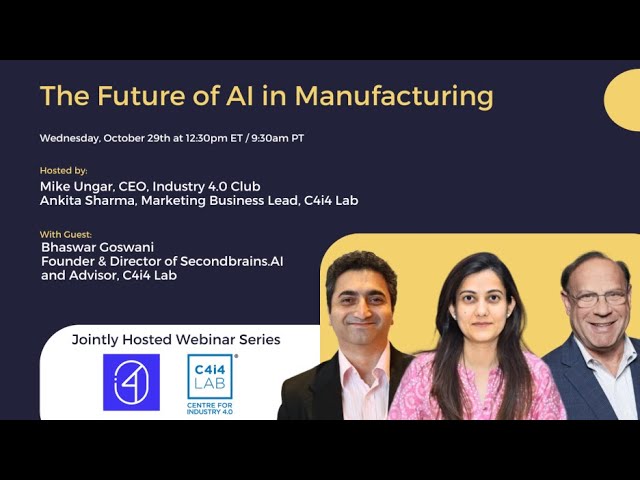
In this Industry 4.0 Club fireside chat, hosted by CEO Michael Ungar and co‑host Ankita Sharma of India’s C4I4 Lab, AI entrepreneur Bhaskar Goswami (founder of secondbrains.ai, former IBM strategist) discusses the practical state of AI adoption in manufacturing. The conversation begins with anecdotes of AI‑driven recruitment POCs in traditional Indian firms, illustrating the current buzz and early experimentation. Goswami highlights the fundamental data problem: many SMEs rely only on ERP, with MES, sensor data, and quality systems either missing or nascent, creating a chicken‑and‑egg barrier for AI value. He stresses realistic ROI expectations—12‑month payback demands are unrealistic; a 3‑5‑year strategic horizon is needed. Concrete AI use cases are explored, including work‑order execution automation, low‑cost MES alternatives, supply‑chain supplier discovery, predictive maintenance, and traceability via LLM‑driven extraction into graph databases. Legacy equipment integration is addressed through cheap IoT sensors, gateways, and an abstracted integration/API layer that separates data extraction, cleansing, and storage, enabling scalable connectivity. The impact on roles is examined: plant heads become “wartime generals” relieved by actionable insights; operators gain decision support but must upskill to work alongside AI. The panel stresses aligning AI roadmaps with manufacturing KPIs, selecting appropriate metrics, and moving beyond isolated POCs to scalable execution plans. Finally, Goswami warns of rising complexity and geopolitical volatility, urging immediate, pragmatic investment in AI with a 3‑5‑year view, clear execution plans, and the ability to scale solutions.
Chapters
Welcome to the Industry 4.0 Club's fireside chat. The club's purpose is to engage the power of diverse worldwide talent to accelerate the global evolution to Industry 4.0. We accomplish this by hosting and supporting respectful, thoughtful, and interdisciplinary open conversations and creating quality content on wide-ranging Industry 4.0 topics to expand the reach of our community. My name is Mike Ungar, and I am the CEO of the Industry 4.0 Club. I have over 40 years of leadership and management experience, most of that in manufacturing at Michelin. Our broadcast today is a joint broadcast with the C4I4 Lab, Center for Industry 4.0, based in Pune, India. My co-host today is Ankita Sharma, the marketing business lead for the lab. Ankita, welcome. Would you please introduce yourself a bit more and tell us a bit about the lab and our guests?
Yeah. Thank you, Mike. Hi everyone, I'm Ankita Sharma. I'm a marketing business lead for C4i4Lab. Uh, C4i4Lab is a premier hub for Industry 4.0 which is developed by Ministry of Heavy Industries, Government of India. It acts as an Industry 4.0 ecosystem which provides training, awareness, upskilling and reskilling programs, and the i4.0 solutions to the entire industrial landscape in India. And it's a go-to institute for digital transformation. So we handhold both MSMEs as well as OEMs and provide the solutions to make the manual manufacturing to a digital manufacturing. So we actually enable our manufacturing ecosystem to go paperless, automated, and intelligent. And today I would like to introduce you a topic which is going to be a very interesting topic today, which is a future of AI in manufacturing. And we have a wonderful guest today, Mr. Bhaskar Goswami. Bhaskar Goswami is an AI entrepreneur who has spent a decade shaping the digital transformation across industries. As a founder and director of secondbrains.ai, he's driving the innovation to make AI accessible, actionable, and transformative for businesses. With prior leadership roles at IBM spanning the strategy, supply chain, and Industry 4.0 initiatives, he now leads the AI training sessions at C4I4Lab and on an AI-driven second brain for CXOs pushing the boundaries of intelligent decision-making. Uh, welcome, Vaswar. Welcome to the fireside chat.
Thank you, Ankita. Thank you, Mike.
So, uh, before we go, uh, deep dive into the topic today, I would like to ask you, Vaswar, like what— this is the current topic, it's a buzzword and everybody is discussing, and especially it's being discussed around the roundtables of CXOs. So what is, uh, you know, what is the thing that is keeping that CXOs roundtable discussion up and fiery? And what are your customers telling you about AI?
So, uh, thank you for that, uh, loaded question. I think it's a— it's quite a lot to unpack. So let me, uh, give you a couple of anecdotes in terms of how, uh, we see, uh, AI actually, uh, you know, opening up in very different, uh, businesses from where we were a couple of years back. As you said, I've been in this area for about 10 years, but the amount of interest and sometimes paranoia that I'm seeing around AI is something that I have not seen earlier, right? So just recently, you know, we were talking to a company in East India and, you know, it's a very, very traditional business. Right, as traditional as it can get, which is into core manufacturing. And even there, you know, people are doing POC experiments in terms of the recruitment. So which I found very interesting that they were looking at how they could automate the entire recruitment process. So currently, you know, when they hire for anything below a level of a manager or below, the process is the first and second level of interviews are actually conducted by AI, right? And it's only when they pass those first 2 levels that they get into a face-to-face discussion. So it kind of opens up that, you know, AI and the interest in AI and the application of AI, I think, is percolating very fast, especially in a market like India. And I think everyone is trying out something, right? And therefore it is definitely a discussion topic in the board. Obviously there is a, you know, when the sword unfortunately cuts both ways. So it's kind of a, you know, everyone understands that this is something that they need to do and therefore it's being tried out in silos, you know, as you would expect. However, where I think we are really not seeing the kind of success stories that we should, which I hope will happen in the next few years. But from a manufacturing perspective, I think we're seeing some very early shoots, at least from an interest across the board. Like the example that I gave you, a company which wouldn't in a million years think about doing any investments in AI even 5 years back. So I think it's a buzzword and it's, you know, people are trying to implement it. But there are definitely some challenges along the way which I hope we will discuss in, uh, you know, more detail. But that's the, that's the reality today.
Well, thank you, thank you for that. Your example of interviewing is quite interesting, um, as well. When I think about though, if we flip over to maybe the core operations of manufacturing, because I think that's really what folks are trying to figure out, that's where, you know, there are some benefits in the support functions, but when we think about things like planning, production, and quality control, maintenance, how's AI impacting that today?
I can tell you from an India perspective, and I think India is a very different example and maybe compared to a more advanced economy like the US. Traditionally in India, when you see there are 2 different industries, obviously enterprises, and I'm going to separate those out. I'm talking more in terms of the small to medium businesses. Typically these were running on a single IT system, which is their ERP. That was the only backbone. Everything else was manual, right? So, and obviously straight off the bat you can see that there is an issue when we talk about AI, right? Because, you know, there is obviously a dependence on data which comes in when you talk about, you know, operations and how you can benefit, and that can be impacted. So I think the first point that I would say is before we get to the impact, the challenge, key challenge that I've seen from an India perspective, and maybe it is in other economies as well, that where you have, you know, the top floor kind of function, the system which is there, ERP, which is kind of there, but below that, the MES, you know, the control systems, these sensors, those are something which are still in a very nascent stage. People are doing— people were, you know, still doing POC, etc. And I think if we have to really succeed in AI, you know, as you're aware, that this problem has to be first solved. And I think we are getting into a kind of a chicken and egg situation where the operations are concerned, that, you know, how do we get the benefit out of it? Right, so the benefit can only come in once you put that— I mean, I was just last week, I was having a very interesting conversation with a CEO. So he, you know, we were going through the different functions in operations, quality. He said, yeah, okay, all this, all that you're talking about AI and all the benefits, it's great, but I want to see an ROI and a payback period, and the payback has to be within 12 months. So as you can see, it's a fairly unrealistic goal, right, because the basic backbone of data was missing. are still missing. So it becomes a question of, you know, it's, you know, that's what I told him. See, think about AI, which will give you— it's, it's a, it's an investment which will pay you over a period of time.
Sure.
Right? But unless the initial investments are made in the core operations, in putting in place the workflow execution system, in QMS, maintenance systems, your uh, you know, logistics systems. And unless these— those get integrated into your operations, till that time, you know, the benefits of AI is going to get difficult to realize.
Yes.
So that's where I see a lot of challenges coming up, that companies are definitely eager, they understand also some of the values, but where they're a little hesitant is in terms of how do I generate value from AI when these systems of robots are missing.
You said something that's interesting to me when you talked about the leader who said I needed 12-month payback. It makes me wonder, are they integrating— do you see leaders integrating smart manufacturing and AI into their strategies? Most companies need a 3 to 5 year strategy, right, in order to think about where they're going in the midterm. So this needs to be— are you seeing that folks are making it a chapter in that strategy where they— or a subject in the strategy where they actually understand that they can put the foundation in place and see the longer-term benefits? Does that— that seems to be lacking in the conversation about 1 year, you know.
Right, and that's such an interesting point that you brought up, you know, and the analogy I gave him was, see, think of it like a, you know, capital investment, you know, and a capital— when you put your machine in, when you put your, you know, automation in, it doesn't mean that it's going to pay you back the next, you know, next 6 months or 3 months or, you know, 12 months. It is a 3 to 5 year period. Similar to that, your strategy for AI also needs to be in line with that, right? And the expectations therefore has to be realistic. I think the challenge really is coming up because especially with the manufacturing, there is a kind of sense, and that is something which I think there is a hype around AI which is there, that, you know, it's a system which is up and ready, you know, plug and play with that. The fact that there is this huge invest— they're not, but relatively speaking, there is an investment which is there in putting in place the foundational layers. Beyond that, there is a period in terms of the system to learn, right? And then it becomes operational. So as you said, I think that the— and you hit on a very key point that it needs to be part of an overall strategy, not just, you know, a 6 to 12 months. And going back to some of it is the hype and the buzzword that we are hearing around here. like that, right? So I think that's realistic expectations that people have to set. People have to select the right use cases. I think that's also something that, you know, as you could understand the example I gave you previously, right, where a manufacturing company is focusing on AI where? In the recruitment process. Why? Maybe that's simple to do, right? So I think the difficult job is in terms of integrating it with AI into the overall business strategy and then having it embedded into the processes. I think those are going to be the long-term wins, right? Like examples of it would be, for example, you know, in one of the companies that we are currently working with, we are seeing how you would be able to build up and, you know, working through this automation process that, you know, workflow execution, how you would be able to simplify your traceability in the process. Today there is a huge amount of documentation and manual processes which are involved. How do you automate that, which would have an impact from your quality perspective, from the savings, from your risk mitigation perspective. So these are, I think, other levers that you also need to look at from an AI perspective, which I see is something we are still not there.
So, uh, when we talk about, when, uh, you know, about the end results, okay, maybe it's a long-term plan, it's a 3 to 5 year strategy where your overall business strategy has to be aligned with your AI vision. So when we talk about the end results, we are talking about the KPIs, right? And when we talk about the core manufacturing functions, as Mike said, that it's planning, it's supply chain, it's operations. So can you just give us a few, uh, simple examples of AI integration into the legacy manufacturing systems? And what KPIs are the main KPIs that we are looking at? Like, what is the end goal that we are looking at? So if you can just give us a few examples of the same.
Right. And Ankita, I think you brought out a very— and I'll answer your question, but I think there's one point which you brought out which I feel is very important. See, I think operations is one of the areas where obviously there is, you know, an AI impact which we can see from the various use cases that— and I'll come to that in a bit. The other area where I see, especially for us, where huge impact which would come in is in areas which are beyond door-to-door. So 2-3 areas which I feel are very underutilized from an AI perspective today, which needs to be more in focus. One would be product development, right, for sure, from a manufacturing perspective. I think the point is a lot of the costs that we start incurring in manufacturing comes because of the poor design process that we follow. And that is an area where I feel AI hasn't really— we haven't really focused much on that. So that's one. The second I think is beyond, you know, operations, as you said, planning, supply chain, right? I think this is a massively important area, especially in today's volatile geopolitical situation, right? I mean, you never know whether your next shipment is going to arrive and at what price it is going to arrive at. So given those situations, I think those are 2 areas where AI can be massively impactful. So I'll give you a couple of examples that we're working on. So from a supply chain area, so one of the areas where we are trying to help a customer is in, I mean, it's a power electronics company which has a very global supply chain, right? And a lot of their supply is coming from China today. And they are really not having any visibility into that, right? So how do you— and the other part is, so their main challenge is, you know, they are limited by the visibility of who are the suppliers. The suppliers are very limited. So how can AI help to expand the alternate suppliers? What are the alternate parts which can be searched for, right? That's a very, very manual process today. And that'll be true in a lot of the core manufacturing processes which have— where, you know, finding parts and, you know, you ask any purchase manager, that's what keeps him alive, awake at night. So that's an area I think where there is a lot of impact that AI can make beyond, you know, just operational savings. It's basically a risk mitigation. Now coming to pure operations perspective, as I said, there is obviously, you know, in terms of cost, Benefits which can come in from productivity benefits. That's one area that we are—
Yeah, I think his internet froze for a second.
We'll have—
hopefully he'll come back here in a minute. That's, that's quite interesting to, to, um, hear him describe, uh, these different challenges. At least that's from, from our perspective. And it's interesting that to do a little compare contrast between our 2 regions in the world, you know?
Sure.
Because there's a lot of focus in the United States. The cost of sensors have come down. And really the focus on using AI for reliability and quality has been a big part of a lot of companies' early successes with AI. And it seems as he's talking about— maybe we'll get him to come back here in a second, I'm sure. But as he's talking, it seems that there's a lot of emphasis on the application around the core process of manufacturing. Is that what you're aware of as well, Ankita?
Yes, I think more importantly, as Bhaskar was saying, that it was about the— when we talk about the core operations, it's about, you know, the station-to-station assembly and the production where automated alerts are being generated, and there the AI intervention is, uh, you know, uh, much required.
Welcome back, Baswarath. We always are victims of the internet sometimes.
Sorry, I was sharing at the wrong moment.
That's okay. So please continue with what you were sharing.
Yeah, so I think from a productivity benefit, I think, uh, you know, from an operations, pure operations benefit, as I said, said, some of the work that we are really helping people to do is in terms of the work order execution, for example, those, like I've mentioned earlier, how do you actually make that process more streamlined? The other thing where I see AI really helping a lot is in solving, for example, a lot of these companies don't have the budget to invest in very high-end MES systems. Systems, for example. So we are kind of building, you know, AI allows a much cheaper option into building some of those, you know, solutions. The third area where I see we are helping companies is in terms of integrating a lot of these disparate system data like IoT data, you know, images that you're getting, document, you know, work order documents, quality documents. So AI is also helping to create that data backbone and it's making it much cheaper. to do, you know, with the— especially with the advent of LLM. For example, one of the work that we are currently doing is sourcing data from these multiple systems and using, you know, an LLM for extracting all the information, understanding it, and then storing it in a graph database so that it's very, very easy to kind of query. And we are doing it at a fraction of a cost than possibly, you know, we would require— we would be doing it the standard way of doing it. So I think in terms of, you know, AI, yeah, obviously there are those front-end use cases which are there. But the other thing from a long-term perspective also, what we are trying to do is use AI from a data engineering perspective to kind of solve for the initial problem which we discussed, which is the data problem, right, the data layer, how do you make your data layer cheap and effective. So that's another area where, you know, we are trying to work on. And I think that's an area which will pay off for the companies.
Are you seeing, you know, you mentioned this, this, um, the, the data layer, if you will. Um, you know, a lot of, a lot of manufacturers have equipment that's not connected. Um, and in fact, that's the main, the main problem, right? And a lot of it is older equipment, but it runs really well and it produces a good product, right? So how are folks in— how are manufacturers that you're seeing overcoming this challenge of integrating AI into what we call, you know, older equipment? How is that being handled from what you've seen?
Yeah, so that— right, so that's an interesting question. Again, I think that's the way that a lot of companies are being able to do. Like, as you said, I mean, any shop floor that you go to will be a mix of legacy and new systems. So I think in terms of how companies are working is in terms of the older equipment, you know, we are using, putting in, for example, there are certain parameters which a machine is not able to give, right, which we probably require for analysis. So then in those, with the, you know, we are able to put forth fairly cheap sensors, IoT sensors, and then obviously have gateways to capture that data. So I think that's from the older system. And then we have from the newer system, obviously the connectivity is much better. I think the more fundamental problem which needs to be solved is in terms of, as I said, that you need to abstract a few layers, which I think is missing in a lot of the manufacturing companies today. What I want to unpack in that is when you're talking about any of the AI transformation or from a data perspective, you know, there's this connectivity layer, then you have the data cleansing layer, and then you have a data storage, right? So this, a lot of the companies are not really, uh, you know, are doing a point-to-point integration, so machine to, you know, cloud directly.
Correct.
And that I think is a problem, you know, is a recipe for disaster because you're not able to scale up. And you see, you connect 3 or 4 machines, but as soon as the 5th machine comes, which is probably not interoperable, and you run into a problem. So I think we need to think of the data problem in this, you know, architecturally we need to solve it by abstracting the data extraction layer, the integration layer, and the data cleansing layer, and the data storage layer. So I think this, you know, will allow it to become more scalable. scalable. Like when you said that integration, well, you have legacy system and you have new systems, how do you kind of pull in the data? The way that we are trying to solve it is to have an integration layer in the middle. So it doesn't really matter, you're not really connecting your data system, you know, your data layer directly to your machine.
Yeah.
You're connecting it to an integration layer, and that integration layer is completely abstracted, and it doesn't really matter what machine, what— so you are completely flexible in being able to pull out the data from there in whatever form and shape that you want to. All right, so that I think is very, very important.
Yes. Are you referring to edge computing when you speak about that?
No, I'm not referring to edge computing. Um, I'm referring to the, uh, the API layer, right? The integration layer. What I mean by that is you have, let's say, a 20-year-old machine, you know, and you don't have any sensors on that. And let's say you have another machine which is Modbus UA, you know, it's completely new and you're able to pull out the data automatically. And you need data, let's say, from both these machines. One way of doing it would be to, you know, have your data layer and connect both of them by point-to-point to your database, right? So you take out the sensors, you put the sensors on the old machine, connect it to the edge gateway, and from gateway you directly connect it to the layer, to the data layer. And then you have the new machine which you can connect also. Now the problem with that architecture immediately, as you can see, is if for example you want to add a 3rd machine, you again need to build that same, you know, integration again separately again, which is a problem. So rather than doing it, we— what we are doing is we are putting an integration layer in between.
Okay.
So you're connecting it not directly to your data layer, but you're connecting it to an integration layer. so that you are completely isolating the problem of integration to the problem of data availability.
Okay, thank you. That makes sense.
So, Baswar, when we are unfolding all these layers and we are adding an integration layer, so do you think it will— there will be a lot of change in the roles? So like for plant heads, you know, or there might be a different role that requires that data extraction part, the storage part, the analytics part. So how do you think the job roles are changing with AI intervention and adding, you know, all these layers to it and having the data-driven shop floor?
Right.
You know, I always liken a plant head to a wartime general, right? What I mean by that is they are always in a firefighting mode, right? And that's what gets there. And Mike would probably realize that more better than me, that, you know, that's what gets them going, right? There has to be a crisis every day. I think the biggest change that AI can bring in is make their life simple, right? So how do you make— like, at the end of the day, if you think, what is the— where is the plant head spending his time? You know, most of the time firefighting, material is not available, resources are having some issues, uh, you know, machine is down, etc., etc., etc. With the advent of AI, I think we are in a position to actually in a very affordable way— and I, I, I kind of underline that word— in a very affordable way, you are able to get those actionable insights. For example, you would be able to build a model which can predict when a machine would fail. You would be able to predict your resource availability. You are able to get better visibility into your supply chain. Now, these need to be— when these insights are taken and you're able to provide those as actionable insights to a plant head, his life becomes much simpler. He doesn't need to be firefighting all the time because he knows these are exactly the 1, 2, 3 things that I need to take care, which if I do, you know, my operations are going to run smoothly. I know this is something which has been promised over the last 30 or 35 years, but in my 20 years 25 years that I've been in this field, I think we are closer to that utopian view than we have been ever in the past. I think AI allows us to firstly do that. That's from a plant head, from a manufacturing perspective, right? So, and then we're doing that. It's something that, you know, we are currently, as I said, it might be something which was possible for very large enterprises. It was very, very difficult for the small to medium businesses. to invest in. But I think that's something which has become much simpler with AI. From an operator perspective, I think his or her life is also changing in more ways than one, right? I think the jobs are going to get a lot simpler. At the same time, it's going to get more What I mean by that is AI is now going to be able to give a lot more recommendations to an operator on how to, you know, work with exceptions. Like today, for example, any exceptions, you know, he has the andon switch and he can just directly press that and, you know, get the thing. But I think as we move on, AI is going to take over a lot of those exception handling. And the operator will need to now work alongside AI in solving some of those problems. So I think you're going to see, and we are already seeing that, you know, the principles of Lean, Six Sigma getting integrated with AI. And I think that's going to make the life of the worker, as I said, simple in one way because a lot of the exception handling is going to be done through technology. But at the same time, there is a steep learning curve which is going to make it a little more difficult also for them.
Well, it's interesting you speak about that. I will, you know, where our experience in the US— I maybe I mentioned to see if it's the same in India— is that we're seeing a shortage of frontline workers. And in fact, the expectation to attract workers to the shop floor is that technology is being used. You know, if you— where do you want to work? You want to work in a factory that and it doesn't have the technology or does have the technology, we are going to choose to work on the one that does. Are you seeing the same thing, uh, the same challenges in India and the same results?
It's a very interesting point that you brought out. In fact, uh, you know, we have a— we have also the very, uh, similar problem that we keep hearing, that people don't want to work in the shop floor, right? They would rather spend their office— their time, their work, uh, in the office. And that's just— that's causing, uh, you know, some— definitely causing issues. And I do see that this is a problem where companies are trying to integrate and that is definitely making it more attractive that, you know, you are no longer really a workman as you said very nicely but you're really a technology-enabled agent of change almost if you like.
Yeah.
I think that empowerment is something that workers are definitely taking to you know, in India, especially given our very young demographic, you know, profile aspect.
For sure. No, very good. Thank you. So we're reaching— we've been talking for the last 30 minutes or so with Basavar Goswami about the future of AI manufacturing. It's been really interesting. As we begin to wrap up our discussion, maybe I'll start with Ankita. Could you share maybe your thoughts on what you've heard during our time together, and then we'll, we'll ask Baswar for some final comments.
Yeah, Mike. So as far as discussion goes, what I could understand is that AI is going to be a long-term game. Uh, you know, it's a strategy that AI strategy has to be aligned with your manufacturing vision and manufacturing goals. Then only you will— you'll be able to reach out the KPIs or the end goal that you're actually, you know, wanting, uh, through your enhanced technology upgraded manufacturing shop floors. There's obviously going to be a learning curve. It's not easy. It's not going to change overnight, but it's definitely going to make life very much simpler for the operators and for plant heads. And it's going to be more of a technology-enabled shop floor rather than just, you know, those traditional workman spaces where it used to be considered as scary and difficult a place to work with. But now it's going to be very simple, you know, it's it's going to be as, uh, you know, easy as the office space. So it's not going to be called as a shop floor as such. So yeah, I think it's going to be very, uh, interesting to see how things unfold with AI interventions in the core manufacturing operations. It's going to be a very different and, uh, you know, exciting scenarios to be in the manufacturing sector. So look forward to it. And we had a very good discussion, uh, I think.
Thank you.
We should also hear the last words from Bhaskar also, like how he thinks, you know, the things are unfolding, especially in Indian manufacturing sector, and what is the global context, and what are going to be the challenges for next 5 to 10 years.
So I think a very interesting discussion as well for me. I think the most important parts which are going to be there is like, I think in the next 4 to 5 years at least, I see things getting more complex. And I think the complexity handling will become even more difficult in the manufacturing scenario, you know, given the geopolitical climate and all sorts of other extraneous, you know, problems that we are currently seeing. So I think AI is definitely, you know, is something that companies need to invest in for them to stay relevant in the manufacturing space in the next in the coming, at least the coming few years as well. They can't really— I think the most important thing is the time to act is now, right? The second thing I think is the— you need to be— I think the optimism needs to be tempered with some sort of pragmatism as far as AI is concerned. I think the expectation of, as I said, 12 months, 6 months, 12 months of ROI from an initial investment perspective, That needs to kind of get tempered. People, you know, especially manufacturing companies need to have a longer-term view of 3 to 5 years at least to feel, you know, to see a transformative impact of AI. Third thing, I think people need to have a very clear execution plan from an AI perspective. I think it's not sufficient, as I said, I think a few examples also, it's not sufficient just to showcase some, uh, you know, POCs, which I think is, uh, really good, but that it needs to go beyond that. And I'm— and I think we saw even in the IoT, uh, you know, area a few years back, there are a lot of investment into, uh, into doing some POCs, but they're not scaling up. So I think scale-up and execution is going to be equally important. So we need to gear up our systems, we need to gear up our people. to be able to scale up and deliver. So yeah, well, that's all. Yeah, that I thought I had.
Yeah, thank you, Balswaran. That's excellent. So we would like to thank you for joining us to share your insights into the practical application of AI in manufacturing. It's been great to hear your perspective and your thoughts on that topic. The C4i4 Lab and the Industry 4.0 Club would like to encourage you to take action. to advance the deployment of Industry 4.0? Read an article, attend a workshop, or develop a smart manufacturing roadmap or strategy, or encourage your company or your plant to do the same? We'd like to know what you're doing, and if you need support, please, you know, let us know. This is the Industry 4.0 Club website. Please drop us a note on our website. We'd be happy to hear from you. There's also some resources there. And as well, here's the website for the C4I4 lab. There, there are plenty of great resources, and they're also interested in hearing about what you're doing and, and, and what support you might need. And you can also drop that on both of our LinkedIn pages. The Industry 4.0 Club also hosts conversations like this on a regular basis. So if you'd like to join us on a future broadcast, We'd be happy to hear from you as well, either at our website or LinkedIn page. And with that, Ankita and Vaswar, thank you so much for your time today. It's been great, a great conversation.
Thank you, Mike.
Thank you, Mike. Thank you, Ankita.
Yeah, yeah, have a great day.










