The Push Towards Net Zero through Factory Automation
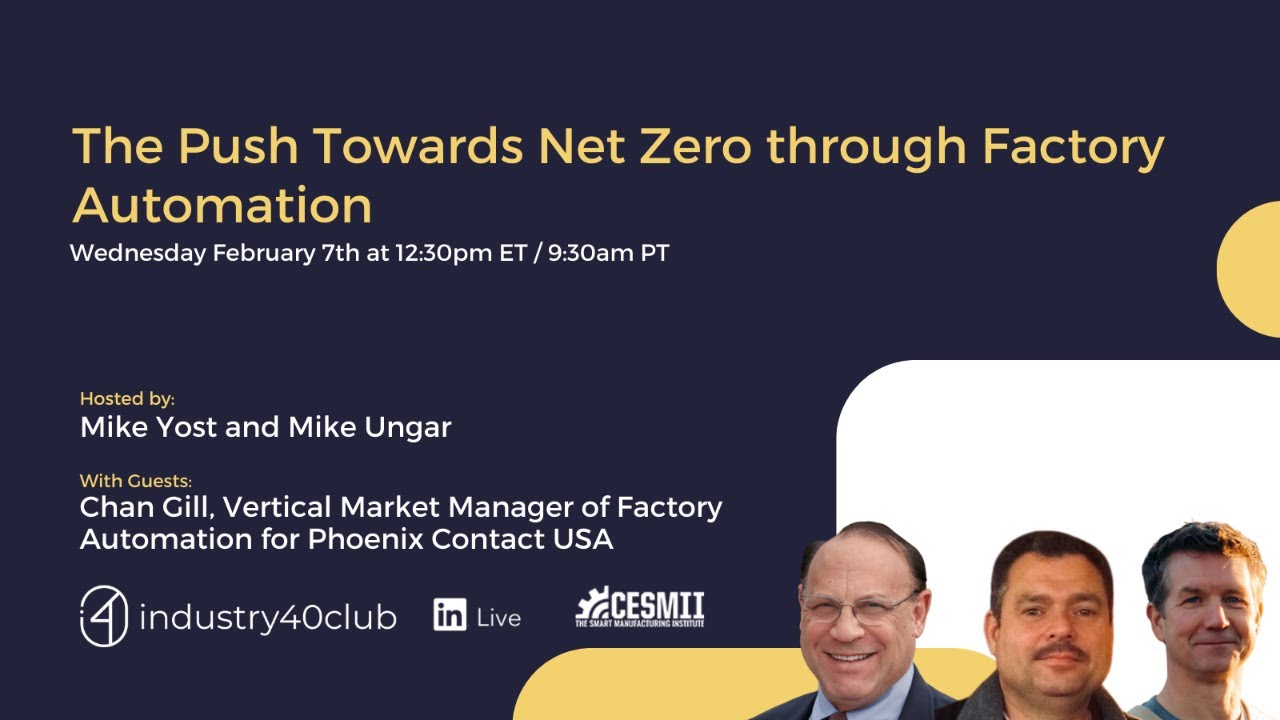
Chan Gill from Phoenix Contact explains how factory automation drives net-zero goals. Manufacturers use utility metering to track carbon footprint, while AI-powered condition monitoring detects equipment problems early. Phoenix Contact targets 2030 for net-zero emissions and works with plants to balance automation projects against sustainability priorities.
Chapters
Welcome.
My name is Mike Ungar, and I'm one of our Industry 4.0 Club co-founders. Our club's purpose is to advance the deployment of Industry 4.0 across manufacturers in the U.S. and abroad. My background includes 35 years at Michelin North America, in a variety of continuous improvement, operations, finance, and HR roles. Today I'm a focal point business coach helping business leaders achieve their full potential. I'm joined today by my co-host Mike Yost. Mike, would you introduce yourself please?
Sure. Hello, I'm Mike Yost. I'm one of the co-founders of the Industry 4.0 Club and about 35 years of industrial automation, industrial software experience. Spent the last 15 years on the nonprofit side Doing a lot of this type of interaction, helping drive awareness and understanding around the value of modern technologies in business operations. So glad to be here today.
Thanks, Mike. So we have the privilege today, we're having these conversations from the SESAME broadcast booth in the Smart Manufacturing Zone at SME's South Tech Conference. And we're really fortunate for this conversation to be joined by Chan Gill. But just a little bit about Chan before we hear from him. Chan is the vertical market manager of factory automation for Phoenix Contact USA. Prior to this role, he was a strategic account manager for the food and beverage packaging and material handling markets, also at Phoenix Contact. Earlier in his career, he served as the market— he served the market as a regional sales manager focused on industrial automation. Chan has a Bachelor of Science in degree and resides in Pontiac, Illinois, and loves, as he says, all things automation and helping customers on their sustainability journey to a net-zero future. So I look forward to hearing more about that. So welcome, Chan.
Thank you. Thank you for having me. I appreciate that.
So could you talk for a minute? I know we maybe just to set the stage, what's the relationship between Phoenix Contact and SESAME?
So the relationship between Phoenix Contact and SESAME, is really what I would say is like a partnership, a partnership that helps us partner with other manufacturers to bring IIoT and digital solutions to the marketplace. So helping small, medium, large customers on their IIoT journey, on their net zero journey, You name it from a digital perspective and we help them on that journey.
Thank you for that. So when you mentioned that you're the vertical market— or when you mentioned that you're the vertical market manager for factory automation, what does factory automation include?
So factory automation in its purest form, the implementation and the integration of PLCs, programmable logic controllers, human-machine interface, sensors, safety products into a manual process in a manufacturing environment, or to take those products to improve what is a current automated process and make it better. And then if you look at it from a company perspective, which is, it's gonna vary from one company to another, but at Phoenix Contact, factory automation is discrete, Or hybrid manufacturing. So discrete would be the manufacturing of end products. It could be cars, it could be trucks, it could be toys, it could be shoes, sporting equipment. And then hybrid manufacturing is a little different in that it involves process, but it also involves discrete manufacturing. So the best example of that is food and beverage. So in food and beverage, You're taking a recipe, you're blending, you're mixing, you're frying, cooking, baking. That's your process.
Right.
And then you have to convey those products and take them to packaging machinery. That's your discrete piece of that. So, you know, and other companies may look at it differently. There are going to be some companies that are going to probably include process as a part of factory automation. That part of it varies company by company.
And so you two talked about the relationship between Phoenix Contact and SESAME. Obviously, Phoenix Contact and the Industry 4.0 Club are connected as well, working toward similar goals to share in this discussion and stuff. So I'm wondering if just from your perspective, the trends that you're seeing in your domain, in the factory automation, what are the The trends that you're seeing?
It's interesting because there are so many trends. You have everything from condition-based monitoring of equipment, machinery and such. You've got, you know, IIoT, digitalization. You've got the journey to net zero, sustainability. There are just so many different topics out there. that are a part of the trends in automation. I mean, believe it or not, automation itself is one of the trends of automation. So.
Yeah. Oh, especially nowadays with the, at least what I'm seeing is we, you have a connection between automation and the labor shortage.
Yes.
Right? So people are now saying, let me take the workers that I have, make them more productive by giving them tools, giving them automation, giving them solutions.
Yes, I mean, the data out there, the data clearly states between the amount of jobs we have open now and the amount of jobs we're going to create between now and 2030, we're going to have a 25% shortage in labor if every able-bodied person took a job just in manufacturing.
That's incredible.
So you have to fill that void. You have to fill that gap. So when manufacturers look at it, And they start to think about how am I going to do that? Automation is probably the simplest avenue to get there.
Yeah, yeah, definitely. And so as you see these trends and there's dozens of them, like you just touched on a couple of them, how do you prioritize or do you prioritize? Because you can't be all things to all people, right? And so like you've talked about sustainability, I think in your bio talked about the journey to net zero. That's a phenomenal, relatable initiative that you can then correlate back to what you need to do in your plants and data you need to collect and things like that. So do you focus on that or do you say that's one of the things that we do in addition to this, this, this?
So that's a plant-by-plant thing. You have to know your customer. You have to find out what they're interested in and what's important to them and what road they want to travel. Are they interested in low-hanging fruit and picking off automation? Or is the executive team more interested in sustainability and being able to bring a sustainability message to the marketplace, a commitment to net zero? And if you're gonna make a commitment to net zero, you better be able to back that up with a plan. It varies a lot from one plant to another. Same thing with utility metering and monitoring.
So can you make, so, You've mentioned sustainability and net zero a couple times, and I'm kind of like an older school manufacturing guy, and so I think about automation, I think about a PLC.
Yes.
Now connect the dots for me. How do I— why would I talk about net zero and factory automation in the same breath?
So the craze across all industries that we're seeing today, whether it's automotive, Or their tier suppliers, or material handling, food and bev process, is utility metering to a great extent.
Okay.
And the utility metering is frequently tied back to that net-zero commitment and sustainability. That's where a lot of companies start. If you're doing a lot of packaging, they normally will start with what they're using for packaging. So that You know, that doesn't so much involve automation. But when you start talking about, you know, how much am I consuming from electrical, water, various types of gas, so on and so forth, that's where it comes into play.
So energy and a lot of— I know there are a lot of industries that are very heavily energy dependent.
Yes.
I bet that you're— you have some pretty interesting clients in that area, I would guess.
Yes.
So the utility monitoring.
Yes.
What are some of the other things that factory automation is being used for besides that today?
So you've got the metering, the monitoring, efficiency, just trying to get better at what you do. You have a lot of things tied to factory automation that also tie back to quality. No matter how much we want to admit it, you put the human element into anything, no matter what it is, and you increase the opportunity for issues, quality issues, failures, scrapping products, so on and so forth. So if you can automate it and duplicate that process over and over and over, you can typically get faster at that process. And in the end, you're creating, you know, a safer work environment. You're creating greater efficiencies, and you should be able to take that and turn it into additional profits for your organization.
That comes back to sort of the manufacturer's philosophy of how they're empowering their people, right? Like, are you trying to automate people out or are you trying to use automation to empower the people, right, and make the systems as capable and work for them and give them information, give them dashboards, you know, that's what's—
every manufacturer will tell you they can't afford to automate anybody out. Anybody that may be replaced with automation, they're not going to lose their job. They're going to move to a different job inside the facility.
We used to have that— one of the things you used to talk to folks about, about their career, is you can retire from a factory, if in most cases, if you have really 2 traits, adaptability in your ability to learn and adaptability physically in terms of where you work in the plant. If those sort of traits exist, as you hit it on the head, your longevity in a company is normally quite good, environment aside for a moment.
Yes. Yes.
Economic environment, I mean.
Yep.
Yeah.
Yes, sir.
So do you tend to find particular industries? You talked about discrete and hybrid industries. Are there particular markets or size companies that are more receptive to your message than others?
Food and beverage.
Food and beverage?
Hands down right now, food and beverage is king. And a lot of that is driven twofold. The consumer, because consumers now more than ever are voting with their dollars and cents by how they spend their money on companies they want to do business with. And when you start looking at folks that are, you know, much younger than I am, you know, the younger generations, they will openly tell you, and they have openly stated in surveys, they will pay a little more to to do business with companies that have a net-zero commitment or a good, strong sustainability plan. And, you know, even when they buy products like shoes, Brooks makes a complete net-zero carbon footprint. So they're buying those. You know, there are different breweries, especially microbreweries, that produce products With a net-zero footprint. Some of the Panera Bread locations are now putting the net-zero footprint or the greenhouse gas footprint on their menus. You know, there's a company called Just Salad, and on their board, their menu board, when you walk in, it tells you what the greenhouse gas footprint of each meal is on their menu. It's, it's crazy.
Yeah.
Well, it's a good representation though of, I think, showing people that we can do, we can solve for the engineering problem, right? If the goal is we're going to understand and know whether we treat energy as an ingredient on the bill of material or we're able to document the greenhouse gas per product output, like whatever the business driver is that we want to meet, the goal that we want to meet, well, we can engineer the solution, right? It ends up being, oh, I'm buying sensors or I'm buying PLCs from Chen or whatever, right? But let's start with what the business case is, what we're trying to get from an outcomes perspective, and we'll go ahead and we'll rise to the challenge with the technologies that we have and the talent, the people that we have to solve those kind of problems. So that's the right place to be, I think.
Yeah, that's real interesting. So one of the things that we— I wanted to kind of get into a minute is condition-based monitoring.
Yes.
So what role does Phoenix Contact play in helping companies with that?
So condition-based monitoring, think of preventative maintenance versus predictive maintenance. And if you can do condition-based monitoring, so you could be monitoring anything from vibration on a particular motor, a particular production cell, a machine, or entire line. You can monitor things like, you know, voltage and current. It could be flow of various types of liquids or gases. By monitoring these things, it can tell you a lot about what's going on with your production lines. And we make a number of And there are products that play in that arena that can take a 4 to 20 milliamp signal or a 0 to 10 volt signal and take that and monitor it, set a baseline, and look for anomalies that take place, variations that take place in the manufacturing process. And then what you do is you decide from the baseline how much of a variation— it can be a percentage or it can be a hard set number. Companies do it different ways. You know, maybe when you— if you set it by a percentage, when you're 15% off the baseline, somebody gets an alarm, gets a warning. And then when it reaches 25%, 30% off the baseline, they get a warning. When it reaches 45%, 50%, they get an alarm. And, you know, at that point they make a decision as a manufacturer, am I going to have my system Just automatically shut everything down? Most companies don't do that. Or do I shut down certain portions of the line so that we can evaluate what's taking place? And typically, you know, that first variation to get from 0 to 15% off the baseline takes a while. And it's a lot shorter time to get to 25% off the baseline. And then the further you get off the baseline, the further south it goes. They can also use readings like that on their machinery to get a better understanding about quality, because as those things start to shift and change, the quality of the products being manufactured can shift and change as well.
So you're— what you're describing, I think, is kind of an AI, or not?
AI is definitely involved. There's no doubt about it. It's really, you know, call it AI, call it machine learning, call it what you want to call it.
Right.
But essentially, yes, it is machine learning. That's essentially what it is. And there are a lot of folks that play in that arena out there. You know, there's a number of different software companies, there are hardware and software companies. Some people's packages are very neutral and they can cross a number of manufacturers and a number of protocols and platforms to collect the data. And then there are some that are very manufacturer-specific. And their products will only work with products they produce. So it's a lot of different ways to do that.
Interesting. I know you've talked a lot about sustainability and net zero. I guess, as we said earlier, can you talk about this race to net zero a little bit more about, you know, why, what you're seeing? I mean, I guess it's a request you're getting from a lot of companies now.
So in 2015, there was a collection of nations. I think it was a United Nations event that where they all came together to address sustainability, climate change, all these different things. And what they walked away from, from that meeting was called the Paris Agreement.
Yes.
And the Paris Agreement was to encourage manufacturers, And countries as a whole to reduce their net zero footprint to the point where they were at net zero. The goal was by 2050. So we are seeing a lot of companies make that announcement. Even a lot of your fossil fuel companies are making that announcement. And if you follow them closely, you'll see they're making investments in a lot of alternative energies. Food and beverage leads that charge in a landslide. There are over 250 companies across the world that have made a net zero by 2050 commitment. And then Phoenix Contact, our commitment is by 2030. And believe it or not, we are a long way down that path into achieving that goal. It is incredible what we've done along that way.
You're talking about on the menu, on the manufacture of your parts?
So yes, not only in the manufacture of our parts, but we're beginning to travel the path of the net-zero footprint of the people that provide us either raw materials, could be plastic beads that go into our product, that has to be considered as a part of that process as well.
Okay, very interesting.
I'm curious whether it's net-zero, it's condition-based monitoring, it's general productivity, etc. How do you guys engage with manufacturers? So do you, do you go directly with them? If somebody is listening to this and says, hey, we just signed, we signed that pledge too, right? We're looking for people that can help us. Do they call you? Do you guys provide those types of services to engage or do you work through partners? How do you guys—
It's kind of a mix. Sometimes we hear from them if we have established relationships with them. Typically, as it comes down and works down in their organization, it will eventually get to a point where somebody calls us and says, hey, we have this sustainability initiative going on. You guys, do you do anything with that? What do you do? But in most cases, quite honestly, we learn about somebody making a net zero statement, a net zero commitment. You know, maybe it's Subaru stating their net zero commitment on TV. Maybe we're reading about it in a trade publication. You know, maybe you go to pick up a 12-pack of beer and the 12-pack of beer says carbon neutral. You know, so at that point, we typically try to get involved with them. You normally will try to start with a sustainability person. Or if you're lucky enough to know a manager, especially someone in the C-suite, you can travel that avenue. But even maintenance managers, engineering managers, they're gonna play a role in that as well. So they can also be a good place to start.
Very good. So we've been talking for a while now and I guess we're getting close to wrapping up. I wanted to ask you for some final thoughts. What do we need to know about what you're doing at Phoenix Contact that we haven't talked about already?
You know, we're very fortunate at Phoenix Contact that we're a very innovative company. 100 years, we turned 100 years old this year. And, you know, the real big statement is for 100 years our customers have trusted us. You know, when we first started making our first terminal block all the way up to recent years where, you know, we're making one of the most open platform PLCs on the market, we have you know, human-machine interface, HMIs, industrial PCs. We're just a very innovative company. We have a lot of things that we can bring to the party to help you with automation, sustainability, whatever journey you're on. And then we also offer, you know, the one really hidden thing about our company, we have a network services team. We can come in, we can do a network services assessment at your plant. If it's greenfield, we can help you design and lay out an entire system for a plant. We have an engineering group that works with OEMs, that works with systems integrators, that works with end users, you know, on, you know, typically the most difficult problems that they have to help them solve those problems.
You have, and you have that factory automation piece then of the overall company on In North America?
Yeah. So in North America, I am the vertical market manager of factory automation. So all things discrete and hybrid manufacturing. And I have an incredible team. My team will not like that I just said I have because I always promise them that I won't do that because it's not my team. I don't own it. Yeah, we have, we have an incredible team.
Thank you for that. That's great. Do you have any final thoughts, Mike, as we begin to wrap up?
Yeah, I mean, probably just the one statement I'd go back to that Chan brought up, right? Nobody's automating jobs out, right? That where we are today with the job market and where we project the job market, especially in the US, with bringing manufacturing back, these conversations need to be happening now, need to be happening with folks that you trust. Maybe they've been around for 100 years and can go to for these types of solutions and services. So I think it's a good learning.
We can't afford to wait any longer. We just, we can't. And, you know, with an organization like SESAME that brings a large collection of manufacturers together to try to create solutions that can help all manufacturers across the country come to market faster at less expense, that's incredible. The idea of creating standards that can be used by all industry is phenomenal. You know, they have a marketplace as well where you can go and look for products and software and code. And it's just the whole collaborative effort of SESAME and the entire manufacturing community that's involved with SESAME is just phenomenal.
And I really appreciate the discussion today as well. Honestly, I told you, I'm kind of— I think about factory automation, I think about a PLC, And, you know, the role that a company like yours plays in things like sustainability, net zero, condition-based monitoring, all of that utility monitoring really makes a lot of sense. And you can be a real partner with companies on that. So, yes, I appreciate getting to know that and understanding that better about what Phoenix Contact does.
Thank you for allowing us the time. We greatly appreciate it.
Thanks for the chance. And thank you, Mike, just this conversation. Please look for additional Industry 4.0 Club conversations on women in manufacturing, the future of manufacturing, fireside chat, or people, process, and culture. We advertise these broadcasts on our LinkedIn page and also on our website at www.industry4oclub.com. Also, we'll be at live events. Our next live event will be in February of 2024. At IME West in Anaheim, California. So thank you guys again, and, uh, everybody have a good day. Thank you.
Thank you.










