The ROI Reality: How Manufacturing Leaders Turn Tech Investments Into Bottom-Line Results
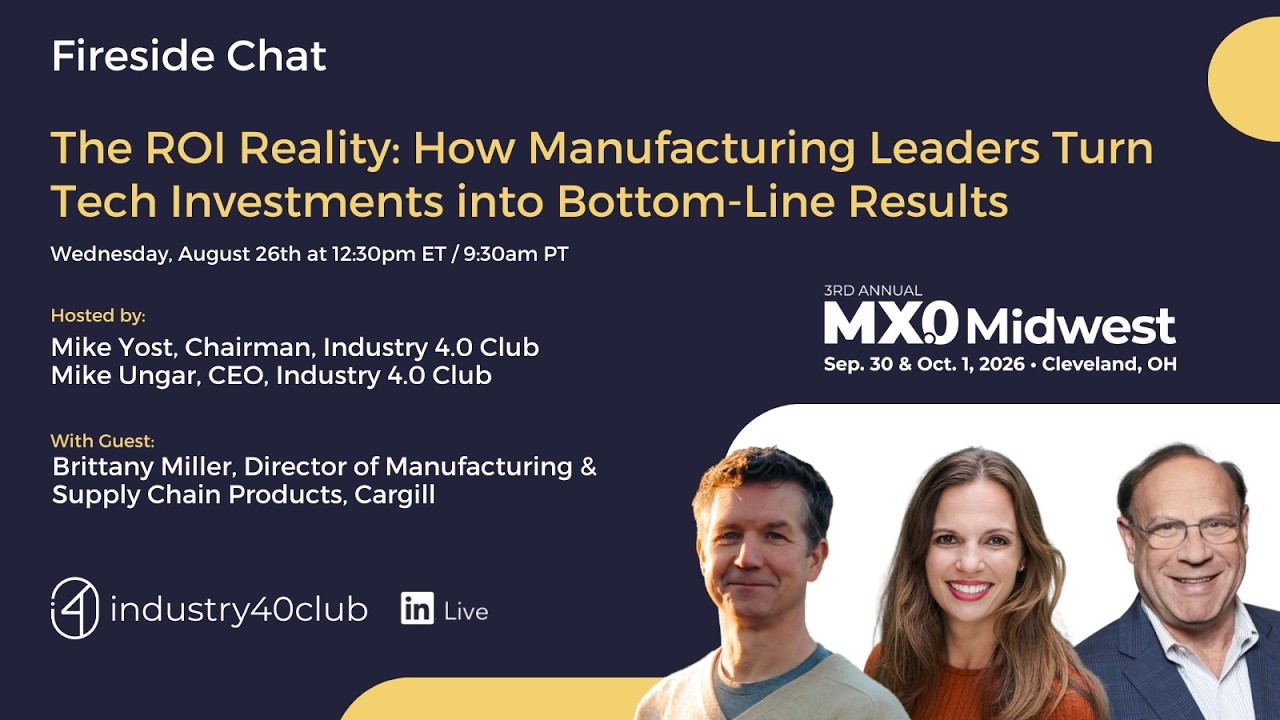
In this Industry 4.0 Club fireside chat, host Michael Ungar and co‑host Mike Yost interview Brittany Miller, Director of Manufacturing & Supply Chain Products at Cargill, about how manufacturers can translate AI, analytics, automation and digital platform investments into measurable ROI. Miller stresses that successful digital initiatives start with a clear business problem rather than a technology‑first mindset, and that defining concrete success metrics—such as increased line throughput, waste reduction, improved service levels, and on‑time performance—is essential before any spend. She discusses the need to balance exploratory technology pilots with problem‑driven goals, and recommends vetting vendors by asking for references to similar solved problems. Scaling across many plants requires disciplined customization: only customize when it adds clear value, otherwise rely on configurable settings to avoid a fragmented solution landscape. The conversation highlights that technology alone does not deliver value; a solid data foundation, well‑designed processes, and especially people who trust and adopt the tools are critical. Effective change management involves communicating the problem, involving frontline staff in design and testing, and preparing the workforce for new processes. Miller offers three key executive questions to ask before approving a digital project: (1) what operational decision or improvement are we targeting?, (2) how will we measure success?, and (3) are we ready to change people and processes to support the technology? The discussion closes with a forward‑looking view on AI’s transformative potential in manufacturing, reiterating the importance of staying problem‑focused, data‑driven, and people‑centric to achieve ROI.
Chapters
Welcome to the Industry 4.0 Club's fireside chat. The club's purpose is to engage the power of diverse worldwide talent to accelerate the global evolution to Industry 4.0. We accomplish this by hosting and supporting respectful, thoughtful, and interdisciplinary open conversations and creating quality content on wide-ranging Industry 4.0 topics to expand the reach of our community. My name is Mike Ungar, and I am the CEO of the Industry 4.0 Club. I have over 40 years of leadership and management experience, most of that in manufacturing at Michelin. I'm joined today by my co-host Mike Yost, who's chairman of the club. Mike, would you mind introducing yourself a bit, please?
Not at all, Mike. Thank you. Uh, thanks everybody. Uh, as Mike said, my name is Mike Yost. I'm the volunteer chairman of the organization, one of the co-founders of the club, and Mike's co-host here on these regular, uh, podcasts. Uh, been in industry for almost 40 years, most of that on the industrial solution provider side. In the past 16 15 years on the industrial nonprofit side, and I love engaging with people and learning about their experiences. And so that's why we're really excited that today we have the opportunity to speak with Brittany Miller, who is the Director of Manufacturing and Supply Chain Products at Cargill. She's going to be on a panel discussion at the MX.O Midwest event here in Cleveland on September 30th and October 1st. So Brittany's going to be— the panel is going to be focused on ROI, the ROI reality, how manufacturing leaders turn tech investments into bottom-line results. So we look forward to that.
Thanks, Mike. The MXO Midwest event is the go-to gathering for manufacturers in the region to connect, collaborate, and learn from the real-world examples of successful digital transformation and workforce solutions shared by those who are making it happen today. Beginning in 2024, this event has empowered local manufacturers to advance their careers and business through valuable knowledge exchange and impactful networking opportunities.
Yeah, and so getting back to Brittany, she is, as I mentioned, the Director of Manufacturing Supply Chain Products at Cargill. She leads digital product strategy for manufacturing and supply chain operations. She has more than 17 years of experience driving digital transformation through AI, advanced analytics, and product management, helping manufacturers improve scheduling, operational efficiency, and decision-making at scale. So we look forward to both the conversation today and her time on the panel. And any of you have questions for Brittany, want to contribute, please go ahead, put them into the comments section on LinkedIn, and we will get them as quickly as we can. So with that, welcome Brittany.
Thank you.
We're glad that you could take time out of your schedule to join us. So let's jump right in. I guess just start with, uh, thinking about this topic a little bit. You know, manufacturers have invested billions in AI, analytics, automation, and digital platforms, yet many executives still struggle to demonstrate meaningful ROI, which is, I think, really what— at the heart of what we want to talk about today. So from your perspective, what separates organizations that consistently generate business value from those investments and those that simply accumulate technology?
Yeah, I think that's a great question, and I think I've really found the biggest differentiator is organizations who start with a business problem instead of the technology opportunity. Organizations see strong— see the strongest returns when they look to solve a problem instead of ask the question of, where can I use AI? Where can AI help me? More looking at Where am I losing money? Where do I want to improve customer satisfaction? Where do I need to increase capacity and throughput with my manufacturing locations? So digital investments should really operationalize decision-making for the real world. So like I work in the— a lot of work that I do is in the supply chain planning space. So any digital technology should help our schedulers and planners make supply chain decisions quicker. make a better supply chain decision, and they should also help increase, you know, value and revenue and on-time metrics for our manufacturing facilities to increase our success for our customers.
Yeah, I think those are great insights. And, you know, I think for many years, to Mike's point about previous investments and such, you know, digital initiatives have been popping up all over the place, not necessarily structured top-down or solution-focused, but we have dashboards and we have data lakes and we have all sorts of different systems that are getting put into place. So how should manufacturers, the leaders, define success from the outset? How do they work together and ensure that they're going to have continued executive support when these types of initiatives get dropped in?
Yeah, I mean, I think the most important thing is before you start any technology investment, you need to have clear metrics on how you're going to measure that technology investment. So a lot of times with those dashboards, they might be user uptime, you know, like how much is the application online and available to our users? How often are our users using the application? And while those are important metrics, they're not the metrics that are going to generate ROI. They're not the metrics that are going to show the value that this technology can enable for your business. So again, in my space, I think the biggest things that I look for with my product is throughput. Like, you know, are we scheduling products on our manufacturing lines that allow us to increase our throughput, right? And be as optimal as possible. We're not scheduling one product that then has a heavy changeover in order to go to the next product, right? We're sequencing all of those materials and those products that we run on our manufacturing lines in an order that's most optimal. We're also increasing service levels with our customers right now that we can supply plan better. We have the ability to demand it, also understand what our customers' demand is, and then also make sure we're increasing their demand and creating production plans and supply plans that increase their service levels as well. Also around waste reduction, I think it's super important. How can we manage waste? Obviously in manufacturing facilities you can have a lot of waste. I do work in our meat manufacturing facilities and when we have waste, it's very expensive. So like, how do we minimize the amount of waste we have in our manufacturing plants? Are, are we scheduling products again for changeovers that are most accurate? Are we also not overproducing, right? Overproducing. We have products that have 5-day shelf lives. That's a really short shelf life, right? You want that meat that you buy in the grocery store at our suppliers to be as fresh as possible, not something that's 14 days old. So how do we make sure we're making the product in enough time to have good service metrics for our customers, but at the same time not have it be produced ahead of time where it's going to expire?
Yeah, I certainly think meat right now is a very Relevant topic. Just a quick note for you, Brittany, we've lost your camera. So we can hear you loud and clear, but we can't see you. So I don't know if it's flipped over to your computer or exactly.
Yeah, give me one second.
This is why we love being live.
Right, because it shows that my video is on. Now it shows that it's off. And now it shows that it's on.
Yeah, it's on.
Okay, well, let's keep— we'll continue. And so, um, while you're trying to figure that out, the, um, just talking about that a little bit, the, you know, you mentioned this idea going back here that you got to start with solving a problem. And, um, I think that makes a lot of sense. A lot of folks though need to learn about the technology before they even know What problems it can solve. So how do we balance that? Because obviously sometimes you introduce technology. I'll use the word for technology's sake. Realizing that you're just learning, really, that it's a way to experiment and explore. So how do you balance that? Because ultimately you still want to be able to, like you said, solve the problem, but you've got to get some experience with the technology. How have you handled that?
I don't know. Sorry, are you guys still able to hear me?
Yes, we are. Mike, you're on mute. Yes, we are.
Yeah, we can hear you. All right.
All right.
So she's gonna come off and come back on for a second there, which would be a great time for anybody that has any questions to go ahead and populate them in the comments, and we will have them ready for Brittany when she comes back. Yeah.
No, Mike, have you seen— so what have you heard from other companies relative to this question about, you know, how do you bring technology in? I mean, I think Brittany's comment about solving problems makes a lot of sense.
Yep.
But you got to be knowledgeable on how— what tools— what problems the tools can solve.
Right. Yeah. Yeah. And I think a lot of folks are learning that, like, digital capabilities, building digital capabilities, has to become— oh, there we are. Welcome back.
Apologize. My audio cut out too. And I was like, I can't do this without audio.
Oh, we have— let's keep going.
Brittany, let's just keep going. So don't worry. So did you get that last question, Brittany, about how do you introduce technology into the Workplace?
I did not. If you could repeat it, that would be fabulous.
All right, super. So you mentioned problem solving is really the place you got to start so you don't become technology sort of enamored. At the same time, though, if you don't know what problems the technology can solve, you're also a bit lost. So a lot of companies will try to bring technology in In order to learn about it and learn what problems that it can solve. What's been your experience at Argo? Have you seen that sort of approach? And if so, what are some of the best practices there? Yeah.
I have seen that approach, and I still think the most successful products really focus on what the business problem is and what problem we need to solve. So I think we always start, or we always want to start when we do a digital technology investment on what problems are we trying to solve in our business? What problems are our end users having? And then it's great to like work with technology vendors and start pulling technology vendors in to say, can you solve this problem? Have you worked with other customers and solved this problem? I think one of the best ways that we evaluate technology to be able to solve the specific business problem that we're looking for when we bring in other technology vendors to tell us whether they can do it or not is have them allow us to talk to other customers that they've solved this problem for. A lot of technology companies in my experience come in and say they can solve every problem and solve, you know, solve the world, right? And don't think about the process and the data and things like that that are required in order to accomplish or solve that problem. So I like to start by, again, clearly understanding the business problem and the value that it's going to give. When we start bringing in our technology vendors and evaluating our technology, then it's best to ask them, hey, have you solved this problem for another customer? Can I talk to that other customer and have them demo, display, set up, you know, a fireside chat or a coffee chat with them of how this technology has enabled value for their business? And if they come back and can give you great examples of what they've done and, you know, learning points and how this has been successful, you can feel really confident in the company that— or in the technology that you're selecting and that it's going to solve your business problem and generate value for you.
Well, it's funny you say that because just as Mike was asking the question, I wrote down, circled, and starred that technology can solve everything. So I think it is a real challenge to manage that balance between having this potential toolset and potentially people that use it to solve problems, come in and say, oh yeah, we can do that, we can do that, we can do that, we can do that. So I think it's really good grounding for folks, the perspective that you're sharing, Brittany. And I want to take just one second and remind everybody that we're speaking with Brittany Miller, who's the Director of Manufacturing and Supply Chain Products at Cargill. We're having a little bit of technical difficulty, but she's still coming through loud and clear and can take your questions if you have any. She will be in Cleveland for the MX.O event at the end of September. And so we'll be talking on this subject about ROI from technology investments. And I guess one of the questions that I would be interested in, Brittany, is to the point that typically speaking, that by the time a technology vendor gets to your door, they've proven value, proven that they can do things. And we do see impressive pilot projects and, you know, things like that.
Sure.
But when you're talking about scaling something out, especially an organization like a global organization like Cargill, you know, what are the biggest obstacles that you see as far as being able to scale, you know, point solutions or pilots across your entire organization? And how have you seen organizations overcome those obstacles?
Yeah, so I think scaling is really important, right? That's where you can generate a lot of value when you can scale a product throughout your organization. I will say one area that I've seen a lot of organizations have a pitfall with this is customization for the sake of customization. So we've got a solution deployed to 21 plants and all 21 of those plants are different, right? Like they are different equipment, produce different products, service different customers. So they're all different, but how we customize our product is very important. We shouldn't be customizing for the sake of customizing. We really need to customize for things that are going to generate value, because if you have a product that's super customized, then you essentially have— instead of one product, you have 21 products, right? And it gets harder to support those products, harder to sustain. They get more expensive to manage. And then when you look to scale those outside your current landscape, that gets even more difficult. So I think making sure If you're going to do a customization in your product, one, that customization needs to generate value and you need to clearly articulate what that value is. And then I think it's most important that you're not customizing for one location, one person, one business. How do you make sure you're customizing something that can generate value over your entire deployment landscape? Also, I think something that's been beneficial for us is how do we build in configurations as well that allow us to like have the ability to configure configure our product for different businesses that may need it, where it's not necessarily a customization, but we build it as a configuration, whether you can turn that off or you can turn it back on.
It almost sounds like, you know, a kind of a phrase I hear used quite often is start with the end in mind. Know where you want to go, and then you're building your pilot around with that, that final You know, goal in mind. Is that sort of the— you do the same thing at Cargill the same way?
Yes, I mean, we definitely relatable to that. Like when we started our product, we had the intent that we would scale this out of the business that's currently in, that we wanted to scale it to other Cargill locations and not specifically to the one subset that we have. So we started with that being our roadmap, even though we knew at this point in time our only customers were going to be our specific business holders that we have.
Yeah, perfect. You know, it's— I know we're talking about technology and, you know, starting with the problem, but one other challenge we see quite often is that technology itself rarely delivers the return. You know, you've seen— you probably, and even yourself, have been involved in leading these projects, engaging the frontline teams and really involved in some redesign of the processes to help drive success or failure. Have you seen the same thing where success is driven really by other things and in fact where the people really make a big difference? Can you talk about that?
Yes, 100%. The people are essential. We always like to say technology is driven normally by the technology you pick, the data that supports that technology, and then the process. And people play heavily in the process. Process with that. So specifically, I would say in supply chain planning and detailed scheduling, which is the product that I do a lot of support in, you have to have accurate data, right? So your data is laying your foundation. AI is not going to fix your data. AI is not going to magically solve all of your problems if you don't have a good foundation. Honestly, it's just going to create results that you think are accurate and maybe pretty, but that aren't going to contribute value to your business. So having a data foundation is a must. And then you need your technology. And then on top of your technology, you have your processes. So the people that support that technology are going to have specific processes that they need to follow so that the technology can be successful. We've also had times where there's people that don't trust the technology. I think we've all lived in that world. And therefore, if they don't trust the technology, then And following the process in order to support the technology doesn't occur. So I think something that I've learned throughout my journey is how do you make sure you bring the people that are going to be using your product along the way? How do you make sure that they're a part in the discovery? How do you make sure they understand what problems this technology is going to solve? How do you make sure they help design the product? They help QA, you know, new features, do quality testing for you on new features. How do you make sure you train them appropriately? Because you can have the best technology in the world, and if the people that are supposed to use the technology don't trust it, don't believe it, the technology is going to add no value to your business.
Yeah, I've seen that quite a bit. And speaking of the people and speaking— you mentioned a moment ago about 21 different plants, and the plants are all different, right? Can you speak maybe to the people side of that? Because when you get into like a production operation, right, the fact that it is different, you know, the people there know the processes, right? And the people there are the ones that they can't afford to put something in that's going to slow them down or impact their quality or, you know, be a burden to what they're doing. So I just wonder from a people side of things, maybe not the plant-level workers or the line-level workers, but maybe the plant managers and the ops leaders and folks like that, how have you seen those conversations go? You know, I'm corporate, I'm here to help, you have differences in your plants, like how do you work those sorts of things out with folks?
Yeah, I think the biggest thing that I've seen is people want to do the right thing, people want to add value, they want to contribute. And the thing that I've seen that has worked the best is you make sure people understand the problem we're trying to solve. So whether that's on the manufacturing floor and maybe for the day we're not running products in the most optimal way from a manufacturing standpoint, but when you clearly articulate and communicate to our manufacturing employees, hey, we're running this on your manufacturing line today so we can meet our customer If you run it as optimal as you would like to run it, we're going to miss these sales orders. We're going to have trucks sitting at your dock waiting for materials because you're, you're not, um, you're not ready and not running them at the beginning of the day when you should be, um, you want— when we asked you to run them, and you're running them at the end of the day. Um, so I think the biggest area that I've seen is making sure when you're talking about things, it's, it's communicated clearly why people need to do that and they understand the value that it's delivering.
That's excellent. No, I think it's this whole idea we've seen time and time again and heard from others that, you know, people really at the end of the day make the difference in the success of the project. So really appreciate you sharing your perspective on that. We think about, you know, the next project or the next project that's coming or next year's investment. What questions should manufacturing executives be asking before they go and approve the next major digital initiative with the idea of maximizing results at the end of the day? What have you seen?
Yeah, so again, go back to the Not having technology for the sake of technology. So I think the first question is just what operational decision are we trying to make, or what operational improvement are we trying to make? Clearly understanding that, clearly understanding like what value or what measure of success is this going to— how are we going to measure success of this? Like, what does success look like? What is achieving our goals? look like? And then the third thing, which ties really well to the first question before that you asked, was just how are we preparing our people and are we willing to change our processes to support the technology that we implement?
Yeah, great, great, great insight. I mean, it rings out to me that, you know, we're all learning to be digital. I say that a lot in that, you know, in our personal lives and our professional lives. And I've heard some people talk about how, you know, culturally, you know, digital capabilities need to get ingrained into a manufacturing operation as a pillar the way that, you know, safety and quality have been for decades. And I think some of the things that we can learn from Cargill and what you're talking about in aligning the organization, people thinking this way, Collaborating, focusing on the challenge really opens the door for us to sort of operate with those basic premises underneath us all the time. So thank you for sharing that.
So we're reaching— we've been talking for about the last 25 minutes with Brittany Miller from Cargill. And as we begin to wrap up the conversation today, maybe, Mike, I can ask you for a final thought based on what you've learned and I heard from Brittany as well as Brittany, uh, looking for a final thought that you might share with our audience. So Mike, would you start us off please?
Yeah, probably 2 things. One that's, um, I think kind of a no-brainer. Um, I'm glad to hear Brittany say it though. And then the second one that's probably more nuanced. And the first one is, um, talking with other people who have gone down the path with a particular solution provider you're working with. I think that's Great insights. And then also the idea of customization and avoiding that as much as possible, I think it's really, really critical because instead of having one system across 21 plants, you end up with 21 different systems you have to support. So I think those are great insights. Thank you for sharing that.
Brittany, how about you? Do you have a final thought for our audience today?
Yeah, all I would say is I think with AI and all the advancements in technology we have right now, we're really entering a very exciting period in manufacturing and in supply chain and the rapid growth and development and how this line of work is going to change over the next few years is just more than I can probably comprehend, I think, at this point, or anybody really can, or more than what we can predict. But making sure you still think about the data and the people and making sure the underlying architecture is important, making sure with technology you're always asking, what problem am I trying to solve? What value am I trying to generate? Is what's going to really make your technology investments successful.
Fantastic. Well, thank you for that. Well, again, Brittany, thank you so much for taking time out of your busy schedule to join us to give us a preview of your participation and the topic you'll be talking about as part of the panel at MXO Midwest. This will be happening September 30th and October 1st in Cleveland, Ohio. We hope that you decide to join us and really participate in order to see— I mean that, no pun intended— see Brittany and part of the panel and join her and the Industry 4.0 Club at the event. So to register for the event, here's where you need to go. Here's the website. Go there, register for the event, and join Brittany and the Industry 4.0 Club at MXO Midwest. The club would like to encourage you to take action with regards to the deployment of Industry 4.0. Read an article, attend a workshop, start a smart manufacturing roadmap, but take some action. And we'd like to know what you're doing, so please share with us the action you're taking either at our website at www.industry4oclub.com or at our LinkedIn page. We also host conversations like this weekly, so if you'd like to be a future guest on one of our broadcasts, we'd love to hear from you as well. Drop us a note at our website or our LinkedIn page. And with that, many thanks, Brittany, Mike, for your time today.
Of course.
Excellent.
Thank you, everybody.
We look forward to seeing you all at MS Summit West. Thanks, Brittany.
Thank you.
Thanks.










