The "Should Have, Would Have, Could Have": How to Roll Out a New ERP Across Multiple Sites
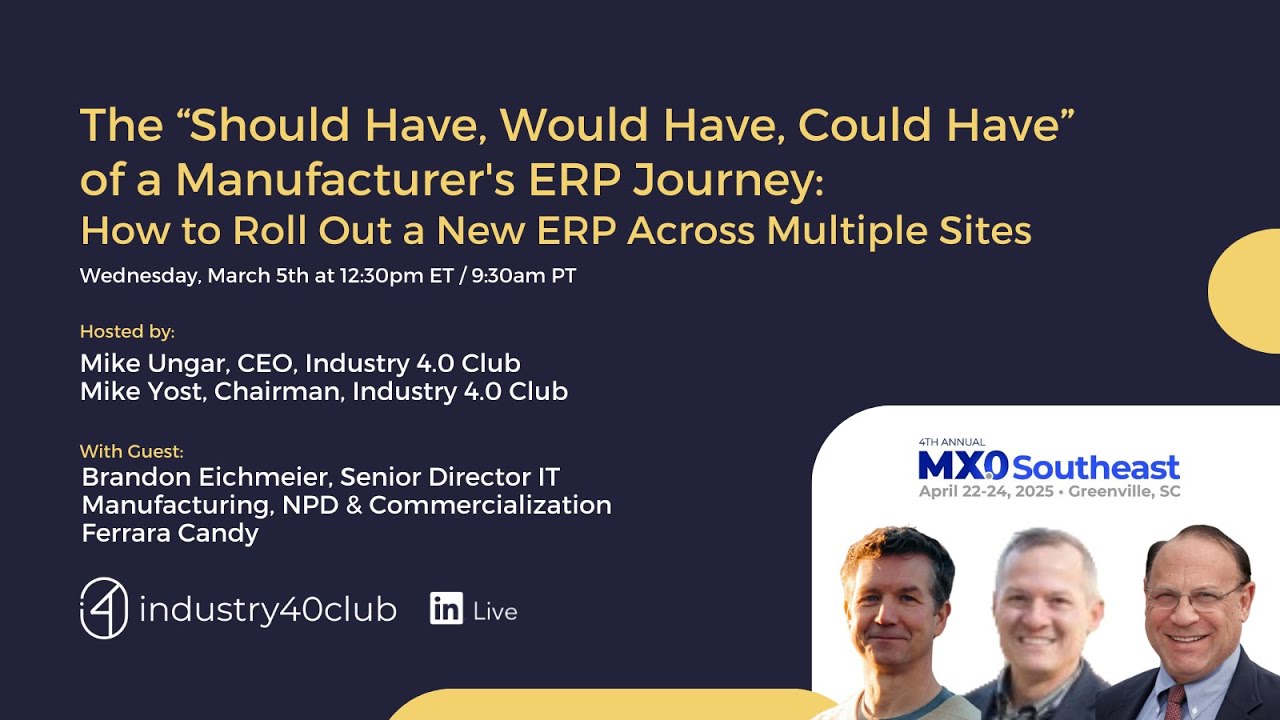
In this Industry 40 Club fireside chat, host Michael Ungar (CEO) and co‑host Mike Yost interview Brandon Eichmeyer, Senior IT Director for Manufacturing, NPD and Commercialization at Ferrara Candy. Brandon shares how his early hands‑on operations background informs his IT leadership, emphasizing a bottom‑up, plant‑floor‑first approach to building trust and understanding real‑world challenges before designing technology solutions. The conversation explores practical criteria for evaluating and selecting ERP systems—understanding the current footprint, standardization needs, growth strategy, and the cost of customizations. He links ERP strategy to new‑product development and PLM, stressing the need to map end‑to‑end product‑to‑market processes and harmonize master data. Technical debt signals such as custom tables, site‑specific transactions, and lengthy month‑end close times are presented as red flags that an ERP may be outgrown. Data cleansing and master‑data governance are described as the foundational work for any ERP, PLM, or emerging AI/GenAI initiative. People‑centric change management, change‑fatigue awareness, continuous planning, and governance structures are highlighted as critical success factors. Brandon offers lessons learned from two global ERP transformations, advises early involvement of business teams in evaluating new technologies (including GenAI), and promotes the upcoming MX.O Southeast event where he will expand on these themes. The session closes with a call‑to‑action for the community to engage with Industry 40 Club content and attend the event.
Chapters
Welcome to the Industry 4.0 Club's fireside chat. The club's purpose is to engage the power of diverse worldwide talent to accelerate the global evolution to Industry 4.0. We accomplish this by hosting and supporting respectful, thoughtful, and interdisciplinary open conversations and creating quality content on wide-ranging Industry 4.0 topics to expand the reach of our community. My name is Mike Ungar, and I'm the CEO of the Industry 4.0 Club. I have 40 years of experience in leadership, and most of that being in manufacturing at Michelin. I'm joined today by my co-host, Mike Yost. Mike, would you mind introducing yourself, please? Sure.
Thank you, Mike. Welcome, everybody. My name is Mike Yost. I'm the volunteer chairman of the Industry 4.0 Club, Mike's co-host, and one of the co-founders of the club. Been in industry for about 35 years, with the last 15 years on the industrial nonprofit side, trying to support conversations like this. So look forward to the conversations we're going to have here today with Brandon.
Thanks, Mike. So we are joined today by Brandon Eichmeyer. Brian— Brandon is the Senior Director for IT Manufacturing, NPD, and Commercialization for Ferrara Candy. He's going to be at the 4th MX.O Southeast event in Greenville, South Carolina on April 22nd, and he's going to be speaking about the should have, would have, could have of a manufacturer's ERP journey How to roll out a new ERP across multiple sites. So just to get us thinking about the event, the MX.O Southeast event has become the go-to gathering for manufacturers in the region to connect, collaborate, and learn from real-world examples of successful digital transformation shared straight from the horse's— or if you will, the manufacturer's mouth. Since 2022, the event has empowered local manufacturers to advance their careers and businesses through valuable knowledge exchange and impactful networking opportunities.
So a little background on Brandon here before we get started. As Mike mentioned, he's the Senior IT Director at Ferrara Candy, leading the information technologies strategic and operational aspects for both the engineering— I'm sorry, manufacturing and engineering functions. Brandon has over 8 years of experience in the consumer packaged goods industry. With a proven track record of delivering innovative, cost-effective solutions that enhance business performance and customer satisfaction. Brandon's recent experience has included 2 global ERP transformations. Somehow he survived that and is here to talk with us about that today. He has an MBA from the Quinlan School of Business at Loyola University Chicago and holds PMP and Lean Six Sigma Green Welcome, Brandon.
Awesome. Thank you both for having me on here. Very excited to participate in the conversation as well as the NX Studio Media Southwest, the conference coming up in April. Really looking forward to it. Excellent.
So just to mention, for those that are joining us on LinkedIn Live, if, if you have a question for Brandon during our broadcast today, we'd be happy to share it with him and get his feedback So place your questions or comments in the comment box, again on LinkedIn, and we'll be happy to try to present that to Brandon and engage in that conversation with you. So Brandon, early in your career, you worked in operations. Can you talk a minute about how that's influenced your work today in IT?
Yeah, absolutely.
And I'll take a step back or a higher level view at first. You know, I found IT by accident. It was never an intended approach. You know, back even in the high school days, I'd worked in computers at a computer company in my hometown. And so, you know, everybody thought, oh, computer, computer logistics, or technology, that was the trajectory. And maybe it's because of that high school experience, I don't know, it scarred me from it. But I took that in a small town. So everything was very hands-on and operational. And I think that's really where my mind had always been.
in, right?
Seeing the nuts and bolts of an operation moving and how those repetitive processes connect. So coming out of college and getting into more operational roles, you know, moving into a healthcare logistics company right here in Chicago is when it really started to click on the operations side. Being in the, we'll say, the underbelly of the healthcare systems and how all the components move around, all the supplies, pharmaceuticals, how everything connects that whole healthcare system to ultimately help patients, right, and keep everybody healthy was very eye-opening. And it had a technical component to it. We had a custom RF handheld solution, had a custom internal program solution that we managed all of our, you know, all of our customers, our healthcare offices, and a bunch of other intricate components to it. And we had a logistics, a routing software, literally designing our couriers were taking throughout each city they're operating in. And so I moved up in the company to a project management and implementation role. And that's when things just started to take off, traveling around the country, working internally cross-functionally amongst your own teams, cross-functionally across different areas of the healthcare supply chain. And then that got me to the CPG role. I came in as an IT project manager because I had that technical background but had that strong operational understanding and started working in CPG in that manufacturing space. But what I think the big components of having the operation— operational knowledge first, it's really the understanding in managing, leading people. There's so much every industry does and every operation does, like people are at core of all of that and understanding the different levels and layers. And this person's in this particular function and role, this group's in this function and role. How do you work with them but know how to bring them together at the right moments? And just understanding, yeah, the basics of how each cog in the machine connects to drive that next step really adds to your learning capabilities, understanding the technical aptitude of the appetite of the team and just the overall dynamics. So it was like this bottoms-up approach. if you will, as opposed to stepping in IT first and getting too technical and trying to push that down. So I found more foundational pieces in there to allow me to understand the technology and layer on top.
Yeah, I'm sure we'll get to the technical or solutions-focused conversation here. Before we go there, can you talk maybe a little bit about that? Because manufacturing operations, IT, there's certainly different technology stacks and such, but there's also the organizational pieces that you already mentioned, cross-functional teams, So how do you manage working across the different organizations and how is that, you know, as a technology service provider to the different businesses, or how does your— what has your experience been as far as the best way to approach blending the technical capabilities along with operational and organizational needs?
Yeah, no, it's multifaceted and some of it is around, I love getting to the plant floor itself. I love— I want to go see the operation, even if I've seen a million times something be cooked down in the kitchen, go through any kind of processing, packaging, etc. Everybody does it a little different, even if it is a beverage, a food, or confectionery like I'm in now. So getting down there and having that level of humility a little bit, right, to build that trust with that operator on the plant floor and learn the actual business and know that when I am able to talk to my IT leadership, whether, you know, who I report directly to, CIO, or cross-functionally, like, I know the actual business challenges and needs because I've been there, I understood, I heard it firsthand. So there is this level of you have to get down there. You can't, in my opinion, you cannot drive the technology advancements from, you know, the corporate office. See those challenges, see, understand everyone, the the common vernacular, if you will, right, in your factories, and then how you can take the technology and work with them to implement it.
That's, you know, the example you shared about getting to the shop floor is quite interesting. And it kind of leads me to ask a question maybe a little bit differently about implementing IT systems. So you— yeah, we also, we talk a lot about do they come in top-down or bottom-up? Right. How do you— what you just described going to the floor, and how do you blend that together in your own experience?
Yeah, and I'm actually— I'm doing a lot of it right now, which is great, more so right now than ever, 'cause our business here has a big appetite for the advancements in technology and wanna get to, you know, as we— you know, the name of the club, the Industry 4.0 smart factory, and what does that mean? But so one layer of it is, back to building the trust, but bringing the right kind of knowledge, actually listening and bringing the right kind of thought leadership into the conversations with the manufacturing leadership and the subfunctions under it, quality, environmental health and safety, engineering, et cetera, and making sure tying them all together. It's easy, the operation, and it's nothing unintended or they do intentionally, right?
Right.
They want to drive in one area and focus on, hey, I need to make sure I'm hitting my volumes. Boom, boom, boom. Okay, well, what does that do from a quality perspective, right? When you have more product rolling off the line, we got to get, you know, better and faster inspections. We got to see the results quicker so we're sending a good product out to the customer, right? So you get to be that umbrella, if you will, looking over everything. And that you have to pay attention. You have to pay attention. You have to make sure your teams are positioned and know to kind of live through curiosity and ask the right kind of questions. And oh, have we thought about that? You don't need to be directive and say, hey, did you talk to so-and-so? It's more about, I know that this is happening over on this side. I didn't hear a mention of this. And you just casually, oh yeah, you know, I see over here. What about over here on the supply chain side? How do we know that's gonna impact from a warehousing perspective?
Right.
Oh, good point. Let's get that conversation going. Great, I'll set it up. Right? So it's asking a lot of the right questions too, but, and also just inserting yourself. Wherever it needs to be.
Well, and talk about asking the right questions. Like, so what are some of the right questions to ask when you're evaluating the ERP systems, right? Because I mean, like, there's lots of options, right? And you may be living with an existing solution, you may be living with multiple existing solutions. You know, like, what are some of the considerations that people should be looking at when it comes to either selecting a new one or sort of evaluating what the ERP capabilities they have today and Versus what they need long-term.
Yep. It almost feels like everybody has an ERP to offer you now, right? You know, from the Dynamics and Microsoft, obviously, all the way up to the bigs in SAP, Oracle, etc. So I think a lot of times people will be— I don't want to say backed into a corner, but because I'm on this solution, it's becoming end of life, I now— it makes sense to naturally move to whatever cloud or modern solution they have. Which is totally fine, right? You know, you always have, you should consider your current solution 'cause inherently there should be a lot of, you know, synergies and a lot of, we'll say, easier paths to getting a solution live. Now, before you even, to me, what can matter, what should matter most is, do you really know your current footprint? Do you have a good understanding of, you don't wanna be down in the day-to-day tactical delivery of everything, but how each one of your facilities truly operates? Hey, as an example, we produce candy, we produce sugar confections at X amount of sites across the country. Okay, do we do it the same? Well, why wouldn't we? There are a million reasons why you wouldn't, right? As we just said, maybe you built over M&A activities, maybe you just, you know, you purchased something from somebody else and what have you. So do you have a good understanding of what those— that variance may be? Can you flush that out quickly? You need to spend the— that time to do a little legwork.
Up front?
Because that can tell you what size of ERP should I go with. Maybe the one I have is too big for my company. Maybe I need to be something more flexible and a Dynamics would work. We're not that big. So are you positioning yourself as a— to do something specific, right? Do you want to grow naturally? Are you maintaining? You want to grow through natural growth? Do you want to grow through expansion, M&A? Are you positioning yourselves to be bought?
Right.
Do you have the appetite to standardize your operation and simplify as well? Because if you do that, now you can really think about maybe I don't need something as robust, or I can go for core ERP functionality and look at additional modules down the line and build that technical roadmap. It shouldn't just be like a whole dollars and cents. I know they kind of throw out there like if you're a small, mid-sized, large, of this kind of value of company, you should be looking at, you know, these solutions, this solution or that solution. I mean, you gotta have the funding, of course, right? And the appetite there. But if you build up, you take that good kind of independent guidance, put the proper legwork in, find a partner to come in and think objectively with you, not necessarily your SI to implement, but to think objectively about helping you drive that decision, build the right business case around it, you can find your right solution.
Well, and you talk about standardization of your operations and such to make it easier, but I think Mike mentioned that part of your responsibility is new product development and commercialization, right? So if you're innovating by bringing new products to the marketplace, right, then that has an impact on, hey, new business opportunity. Now we have to make new stuff, which means new processes, new lines, what have you. So what's the role of that, you know, sort of strategic thing the company's driving toward and how that impacts, you know, the ERP and the connection to the other systems.
Yeah, good, right? I mean, great, great points there because from a new product development, right, for the listeners, PLM, right, your product lifecycle management solution, your commercialization, hopefully you have a, some sort of PPM project portfolio, portfolio project management solution, right, that can help move your innovations through its lifecycle to get the idea to actual to market, whatever that solution may be, paper or actual physical system in this case. But process engineering, that's the tie-in there. And you really kind of start with the piece that manages it, the commercialization piece, and that team that should be lifting a new product from an idea, from your R&D and innovation centers. And how do we get it to our pilot center to start testing out some samples and market? And using, making, standardizing their processes, right? When you standardize, when you look to standardize, it shouldn't just be the operation itself, right? You can look across your entire organization and every business function and see what opportunities there are to streamline. And if you don't have a process documented, a process flow end-to-end, say getting a new product to launch to market, that's some time you have to spend to do, right? You need to understand where you're at currently. And how you can— where you can identify opportunities to change in the future. Companies, obviously SIs will be out there to tell you to do that stuff for you, but your people know your processes just as, as best as anybody. So find the time to kind of line out that strategy of how do you look at a process and map it out, and then realize, hey, we're launching these products, why do we have 12, 15 different variations of this one product when we should only be 3 or 4? So there is the harmonization aspect of it you have to kind of monitor and look at.
Yeah, that's not a simple— not a one-dimensional decision, is it? Lots of things go into making that. So, you know, I was— we were talking before we got on the line here about a company that they've had their ERP system for 10 years now or 12 years. And of course, the ERP system they're using, and there's regular updates and that kind of thing. But when do you know, when does it come a time when you think you've outgrown your ERP system? How do you know?
You know, from an IT lens, it's easy to say when the technical debt has become too deep. But how do you identify that? You know, from an SAP perspective, it's how many custom transactions do you really have and are used on a regular basis? How many custom tables are out there? How many times are you having to modify a report because there is a new product and it's going to, you know, a different, you know, business unit now? And well, why? We launch new products all the time, but why am I modifying a report for this one particular process? And you look at, you know, per site in that case too, how many different custom— we have this one T-code that's for Site A only. Well, what do they do different? We're making candy everywhere, right? And I'm just using You know, for our, as an example, but it's when you have to have the people with that kind of foresight now, which can be a combination of IT as well as your business SMEs.
Yes.
'Cause they're the ones that are using the outputs there and they know when these things fail or they know when these things are, you need to modify them because something new is happening across your organization. IT needs to be more than just that run and operate, like keep the lights on, if you will. type group. So once you can bring those 2 together and do that assessment, that's a real key indicator. Then if I think about, hey, we want to grow, we want to continue to grow our business. We, you know, you've bought a company, let's say, and wow, it took forever to onboard them. They had so much legacy data, so much technical data, etc., etc. But we want to keep growing. Do you want to do that every time? And you want to have to go through that challenge of trying to force-feed them or force them into your ERP or just bring on their ERP. No, because somebody at some point is gonna have— we wanna harmonize and look at all your financial data in one nice clean way. If everyone's talking in a different language, somebody's manually doing all these reports. Look at your month-end close process. How long does it take you? How accurate is that?
Right.
So there's some, like, I think some simple key indicators that people just get used to the process. And they just, this is how it is. But if you stop and take a step back and look and go, whoa, this is not how it should be.
So I'd just like to remind everybody that we are talking here with Brandon Eichmeyer, Senior IT Director at Ferrara Candy, and he will be speaking at the Manufacturing X.0 Southeast event next month. So we're having this conversation so that you can sign up now and, and, uh, go meet Brandon in person. Uh, in the meantime, if you want to ask any questions, uh, chime in here, go ahead, um, uh, enter your questions or comments into the comments section here, and we, uh, we can discuss them with Brandon. Um, and I guess speaking about the, the event itself, Brandon, and not to give away the, uh, your, your entire presentation or anything like that, but, um, are there any, like, lessons learned, um, from your experience? You know, when I read you've done 2 global ERP transformations, I was like, wow, yeah, how did you survive those things? But, um, so any lessons learned that you could just give a little teaser to folks here that they might hear about in, in the event?
Yeah, one of the foundational pieces of, of your ERP, and if you think about any of the more advanced technologies we're continuing to roll out across the board, is data. Never underestimate your data. Never underestimate the approach of cleansing, cleansing that data or harmonizing that data. It will take so much time. You're not going to just do a simple export and, you know, your SI and maybe your IT leads or a business lead are going to look at everything and go, yep, we know what all these components are. Yep, these are all used, and be able to go through that. But the data is the absolute foundational piece. Talk about your master data, and especially if you have ERP, then you think about your PLM system. That data has to be obviously 100% in sync as well, and most of that master data comes into your ERP, then flows into your PLM, or vice versa, depending how you set it up. But to harmonize that, to clean that, to have the right quality of that data there is incredibly time-consuming. And if that's something you can start right now, even before you decide you wanna go on an ERP journey.
Right, right.
Do some assessments, 'cause that will be one of the biggest hurdles that you'll have. And I've, 2 for 2, and I've talked to others who are going on the S/4 journey, same thing. You know, it's like we wish we had more time to try to harmonize and clean up data. And because it is, will be your technical foundation for your ERP, but even moving forward when you think about that catalyst of any AI, ML, GenAI and, and, and etc. from that space. Um, and one other thing everyone wants to focus on, like this clean core, a non-customized ERP, which I totally agree with. You know, think of all of us with an on-prem ERP today. We just got done talking about the technical debt, and that's one of the biggest indicators of, hey, when is it time to move? When you— if you can keep a clean core, is mostly clean, great. Um, don't customize ERP. Have it be this North Star. But don't let it be that dominating force of every conversation. Don't let it take away from understanding, oh, this could be an enhancement, but it doesn't need to be a clean core enhancement. It could be done at this layer. Or maybe we have to look at our WMS solution and doing an enhancement over there. Maybe it doesn't impact that solution as much. You get— you can get blinders on and then you go ahead and you make at the very beginning of your ERP rollout when you're doing your conceptual design or design phase, you make some big decisions. that once you get to build months and months and months later, now you're talking about doing whole-scale massive change to your, to your whole ERP template if something you made months ago or a year ago did not align with what the actual business is going to need. And now that adds a huge ripple amongst your whole program. And I, I think one of the other things, um, you know, thinking about like, know your people, really understand where they're at, maybe from a change fatigue. Whether it's your leadership across the— how you want to structure yourself, is it from a PMO and director perspective, but down to the plant floor, understand them a bit of how you think this rollout can probably go. Do some game theory sort of on that, right? And different scenario planning.
That's great. So I know you're going to be at MX.com. Oh, event on April 22nd. For those that do come to your presentation, I know you've shared some, some really great nuggets so far. Um, what do you hope people leave, leave with? What do you hope people leave, uh, prepared to do or thinking about?
Yeah, we talked about this a little bit before we started, but it's that validation bit of, of those in the audience thinking about, of either have gone on an ERP journey, going on, or you're just even thinking about it, is are my thoughts right? Am I having the right conversations with my team? And like everything we hear at the event is not all-encompassing, of course, but it can help affirm with individuals like, all right, I did have an idea here. No, I wasn't even thinking about this, right? So maybe I should give an eye into this area. But it's perhaps ways to avoid the things you should not do. I always believe like there's Always multiple ways to get to a certain destination. Obviously some more efficient than others, but there's for sure wrong ways to do things. So one thing I can truly highlight is don't do this, or at the very least, don't forget about this area. Don't underestimate this area so that way it doesn't come back to bite you later on in that path. And really, because we all hear about the bad stories, right, of an ERP rollout and how it can impact the business. Business wants to get going on go-live, they want to get 100%, and it is not 100% on day 1. Um, the more you can vet out, obviously, up front, the more you can figure out ways, uh, to work around to not do the thing— the wrong things up front— the quicker you can get your business back up to 100%, and thus getting all your product out the door, and obviously in turn the financials back to where they need to be. Um, so I want it to be guidance. as well as hopefully thought-provoking. I hope I can bring up some good conversations there, or at the very least afterwards, or at some other points during the event itself.
Excellent.
I'm wondering, Brandon, obviously we're the Industry 4.0 Club, so we have a lot of people, you know, talking about new technologies and different solutions in the different areas of the business. And I'm just curious, do you want your team to come to you when they're— 'cause I'm sure all of your teams in your business are getting hammered relentlessly with all sorts of new technologies. Every single vendor out there has a GenAI solution now, right? And it doesn't matter if it's a quality solution or if it's PLM-centric, if it's ERP, it doesn't matter where it is within the business. There's just innovation and tech coming everywhere. Do you want your teams to bring those kind of opportunities or things that they're thinking about to you as sort of a voice, or do you let those teams do whatever they want to do and you only get into the touchpoints between the corporate IT systems and their local systems?
No, it's the former. I want them to bring stuff up to myself or members of the team. We want to be a part of the conversation in the very, very beginning, again, to kind of avoid some of the dos and the don'ts, of course, or at least to understand the dos and the don'ts. But more importantly, when we talk to IT cross-functional teams, networking impacts, cybersecurity impacts.
Right.
Because it's easy to have, oh, we're going to turn on GenAI for this solution we already have implemented. Okay, well, how is that really using our data and where does that data go? What's the large language model sitting on top of it? What's the exposure we're now increasing to our company? So I want to understand very beginning, even if it's, you know, an automated PPE vending machine, you know, something like that. What are you hooking into the network? Let's talk about that. Or as advanced as a GenAI solution. We want to be there to be thought leaders and to educate each other. It's learning for both.
Sure.
Excellent.
Well, we've been talking for the last almost 30 minutes now with Brandon Eichmeyer from Four Eyed Candy. We're getting close to wrapping up, so maybe, Mike, I'll start with you. Any last thoughts for our audience? And then we'll go to Brandon.
Yeah, a couple. First, I'm wondering if Brandon's gonna bring any Jelly Bellies or Sprees or Nerds or anything to the event. If so, I'll be there. But really, I mean, from a takeaways perspective, I think he's got a lot of experience and this is what this is all about, both what we do here and what the MX.io event is all about. And I think the points Brandon talked about, know your current footprint from a solutions perspective, but also know your people. And I think that's a really valuable insight for people to glean and manage this transformation together, because I think we're all learning how to be digital. So that would be my big takeaway so far.
Thanks, Mike. Brandon, how about you? Any final thoughts for our audience today?
Yeah, absolutely. I will have some candy there. Don't worry. We do get these little— little, it's a big box, right? A sampling of everything. So I'll make sure to have one with me at the time. No Jordan Rollins, unfortunately. Boston Bacon, though, probably. All right. So, you know, Mike, Joost, you just mentioned it from the people perspective. Always consider the people. I think in many other conversations I've been around the GenAI and how it can enhance the manufacturing floor, it's have to take that people-centric approach first. And then once you understand your people and you go on this journey, plan, plan, and plan some more and realize that a plan is a living, breathing thing. It's never set it and forget it. You have to always have a team and structure appropriately to watch your plan, monitor your plan, and be able to pivot more importantly when things start to derail, we'll say, or veer one way or the other. Take your time in decision-making. There's no rush. I mean, look at how many times SAP has moved out the goal line, right, of when you have to be off the on-prem ECC version. But just take your time, don't rush into it, and get your buy-in with your senior leadership, your exec leadership, whatever layer you call them, but the very top, and build that business case as to why. Not just, hey, we should do this because it's fun and modern, but where will the business have the most value brought to them by implementing, by spending the time and the effort and the money, you know, the capital to implement an ERP. Here's the type of return in each one of your strategic pillars you will be able to see.
Yeah, that's great. That's a great way to end, to make sure that we're doing this to improve business results.
So excellent.
Thank you so much. So we've been, we've been talking with Brandon. Thank you for your time today. Who's giving us a preview of his participation at MXO.Southeast. That's gonna be happening in Greenville on April 22nd. Just in just a few short weeks. We hope that you decide to join us, and here's the website to go to to register for the event. We're only a few weeks away, so please go there and register, and we hope that you decide to join Brandon and the Industry 4.0 Club at this event in Greenville, South Carolina. The Industry 4.0 Club would like to also encourage you to take action to advance the deployment of Industry 4.0. That could be by reading an article, attending a workshop, or developing smart manufacturing roadmap for your plant or company, or challenging your organization to move forward in the deployment of Industry 4.0. We'd like to know what you're doing, so please drop us a note on our LinkedIn page or go to our website at www.industry40.com and give us some insights there as well. We routinely host conversations like these on LinkedIn and YouTube. If you'd like to join us on a future broadcast, we'd also love to hear from you. So with that, I would like to thank Brandon, thank Mike for a wonderful conversation, and wish everybody a wonderful and good rest of the day and week.
Fantastic.
Thanks, everybody.
Thanks, guys.










