The State of Agentic AI and Prospects for Industrial Automation
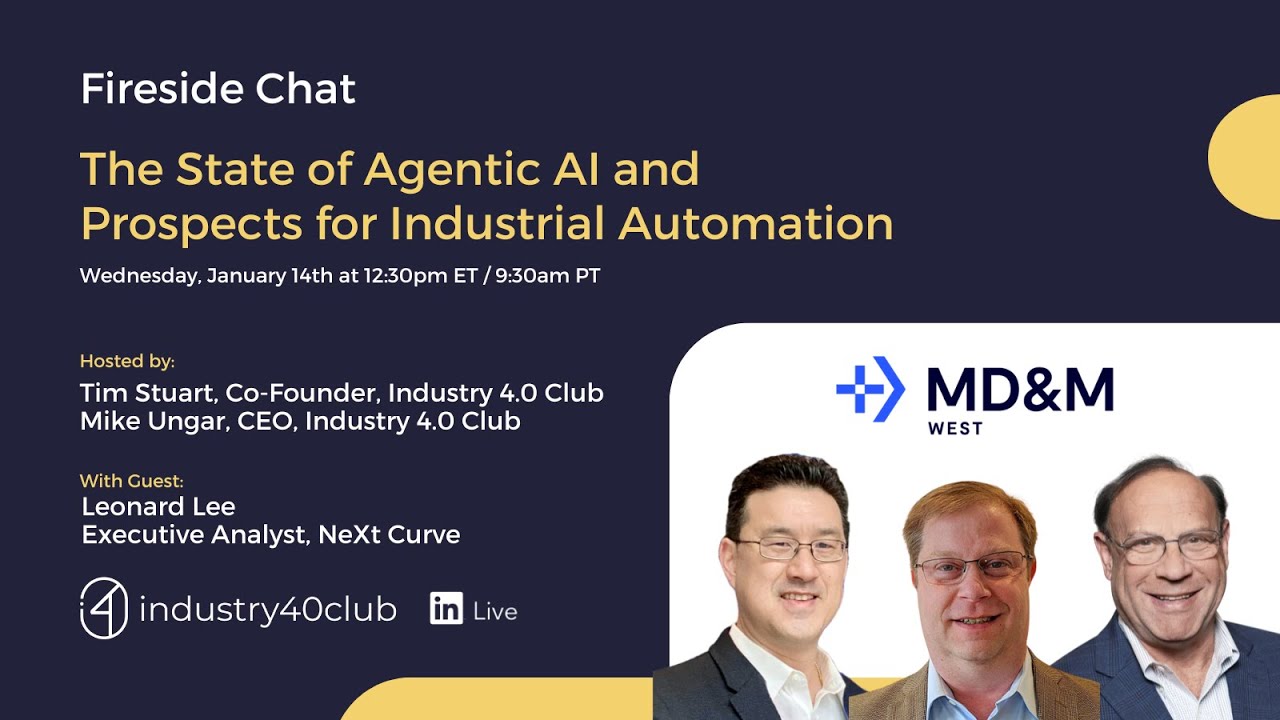
In this Industry 4.0 Club fireside chat, host Michael Ungar (CEO) and co‑host Tim Stewart introduce guest Leonard Li, Executive Analyst and founder of the research firm Next Curve. Leonard recounts his career path—from early consulting and database work to senior roles at IBM, PwC, EY, Gartner, and finally launching Next Curve—explaining how his diverse background shapes his view of AI in industry. The conversation then pivots to defining “agentic AI,” tracing its genealogy from large language models through multimodal and reasoning models, the emergence of “chain‑of‑thought” and “chain‑of‑action” concepts, and the integration of these capabilities with traditional process‑automation tools (RPA, workflow management). Leonard stresses that successful deployment hinges on robust knowledge bases rather than raw data alone, arguing that AI must act on curated knowledge to make reliable decisions. He outlines practical manufacturing use cases such as back‑office code remediation, legacy system modernization, and digital twins, while warning against superficial IoT “Fitbit‑style” data collection that lacks actionable insight. The discussion highlights major risks: hallucinations, the probabilistic nature of AI versus the deterministic expectations of industrial quality, and the current “POC hell” where pilots fail due to hype‑driven expectations. Leonard predicts that within three to five years, generative AI will move to the industrial edge, delivering low‑latency contextual computing that augments perception (vision, small language models) and enables more responsive automation. The chat concludes with a call to attend Leonard’s MD&M West presentation on February 3 2026 in Anaheim, urging listeners to engage with the Industry 4.0 Club and apply grounded, knowledge‑centric AI strategies to avoid another AI winter.
Chapters
Welcome to the Industry 4.0 Club's fireside chat. The club's purpose is to engage the power of diverse worldwide talent to accelerate the global evolution to Industry 4.0. We accomplish this by hosting and supporting respectful, thoughtful, and interdisciplinary open conversations and creating quality content on wide-ranging Industry 4.0 topics to expand the reach of our community. My name is Mike Unger, and I'm the CEO of the Industry 4.0 Club. I have over 40 years of leadership and experience with most of that Being at Michelin in manufacturing. I'm joined today by my co-host Tim Stewart, who's co-founder of the Industry 4.0 Club as well. Tim, would you mind introducing yourself further?
Sure. Tim Stewart. I'm also the president of Visual Decisions. I founded that company 24 years ago, and we seek to help manufacturers utilize information from the shop floor to improve their operations. Today we have the pleasure of speaking with Leonard Li, Executive Analyst with Next Curve. Leonard will be presenting at MD&M West in Anaheim, California on February 3rd, 2026. The title of his presentation is The State of Agentic AI and Prospects for Industrial Automation. Leonard is the founder and managing director on of Next Curve, an independent research advisory firm based in San Diego with the mission of helping technology, media, and telecommunication— telecommunications industry pioneers explore and pursue opportunities forming at the intersection of transformative technology and industry trends. Leonard's cross-domain research covers mobile computing and wireless infrastructure, Enterprise computing and networking, AI infrastructure and data center, media and broadcast technologies, enterprise software and analytics, consumer and industrial IoT, cybersecurity and trust, and semiconductor technology. Leonard, that is a lot.
That is a lot.
Welcome.
Did you get that off of ChatGPT? Wow, that's really impressive. I'm really impressed by myself.
Yeah, who is that guy, right?
Yeah, who is that guy? Yeah, really.
Before we dive in—
Oh, hey, it's awesome to be on here again. And sorry, it looks like we're having a little bit of collision here.
Yeah. Hey, before we dive in, just want to mention for those listening in on LinkedIn, um, if you have a question for Leonard during our conversation today, please drop it in the comment box and we'll be glad to get to it and share it with Leonard. So he can actually respond to your thoughts and questions as well.
So thanks. Yeah.
Well, Leonard, let's, let's jump in. So before we get started, you've been involved as an analyst and consultant for over 30 years.
Yeah.
You know, when you think back on your career, can you talk about one or two pivotal moments that shaped what you do today?
Oh, yeah. I'd have to say it was a moment with one of my managers very early on in my consulting career who told me that, hey, you want to be a partner, you need to focus on one thing and be really good at it. And I took that coaching session and completely disregarded it and went on a path to pursue my interests, which were really diverse. And so at the time, I was doing database application development work, which was the hot thing at the time, and decided, hey, look, you know, I want to expand beyond this. I want to get— I want to understand businesses. I want to understand processes. I want to understand how businesses work. I want to understand how industries work. I want to understand how technology, this thing at the time called information technology, can revolutionize, um, businesses and, um, economies. And so, and, you know, prior to that, I actually was going to get into iBanking. Um, And I bumped into this thing called consulting. And so that's where I started to focus and eventually just kicked off, you know, a long career in consulting where I became a partner principal at IBM PwC and then EY. And I did a 3-year stint at Gartner and started my own firm, Next Curve, to really pursue my diverse interests, leveraging my diverse background. So when you went through the description, Tim, and I was going, who is this guy? Sort of that pivotal moment that brought me to where I am today and the kind of research and advisory that I do at Next Curve.
Excellent. So for your presentation, I know that you're going to be talking about agentic AI and Uh, industrial automation and so forth. Uh, can you tell us a little bit more about what you're going to be speaking about at MD&M?
Yeah, I mean, quite honestly, what I really want to do with this presentation is ground a conversation around agentic AI. Uh, agentic AI is, it's one of those pivots in this long stream of generative AI pivots that have occurred since the introduction of ChatGPT and LLMs to the public. And I want to help whoever is attending, whoever is listening, to have a better understanding of how we arrived at agentic AI and what we're really looking at here. And then as we look toward leveraging this paradigm, if you will, or this next generative AI pivot, how does that apply to industry and what is it that Next Curve is seeing, having researched and followed this continuum of pivots for the better part of 5 years? And a lot of this is rooted in the work that I do in the semiconductor industry because you probably hear Jensen Huang talk a lot about AlexNet. I mean, these, you know, I've been engaged in this conversation for a really long time also, uh, with my background in IBM, uh, working in pre-commercialization work with IBM Research in AI and in particular natural language processing. Um, you know, I have this background in this stuff to understand what it takes to actually you know, realize solutions leveraging these technologies in its different forms.
So, you know, jumping off what Tim had alluded to, agentic AI is really a relatively new term. I mean, I think only a couple of years from now, so, or at least maybe I'm not up to speed yet, but, you know, I'm thinking about a couple of years, it's changed a lot even in the last 2 years. Can you talk about just That evolution?
Yeah, and that's one of the things that I'm going to be addressing in the talk, um, in a couple of weeks, is really the genealogy of, uh, agentic AI and how it really is a representation of a confluence of a number of things. Number one, the evolution of models themselves, right? So going from large language models, right, to multimodal, to reasoning, to Uh, you know, now, um, so, you know, there's a term long thinking, um, and then there's this concept of, um, you know, uh, chain of action, okay? You might have heard of a chain of thought. There's chain of action, and then you have agentic and, uh, AI, okay? And that is also being fed in with a thread of what we've seen in process automation, whether it's RPA or workflow management, stuff that we've been doing for years. That being the scaffolding to allow agents, these AI agents to actually do something in terms of a set of actions. That's really what's being different versus AI being more of a query tool or something that provides you with a conversational interface, you know, moving towards something where there's actuation in what one might think is, you know, a closed-loop control paradigm, right? You know, autonomous or, you know, paradigm of intelligent automation, if you will.
Yes. Good. Go ahead, Tim.
In terms of manufacturing use cases, where do you see kind of the easy places to apply something like this within manufacturing?
Oh, man, you're going to make me disclose all of the nuggets from my presentation. Is that the thing?
At a high level.
Oh, at a high level. Let me see if I can start with like the high-level thing, and then we'll figure out whether or not I'll disclose any of the nuggets in my presentation, because we do want people to come, right? Fly to Anaheim.
Much more detail if they go to the presentation.
Yeah, exactly. A lot more detail. Um, you know, where people really need to focus is foundationally on not just data, everyone talks about data, their knowledge graph and their knowledge base. This is more important than data itself. You know, one of the— and I had a recent conversation actually with a telco client of mine. There is this trope that data is the gold. No, knowledge is the gold. And if you have a really horrible knowledge base and you don't have the systems and the capability to manage knowledge, you are not going to do well with any of this stuff. What AI does is it, especially in the context of manufacturing, is it reacts to data like telemetry, right? Like the structured stuff, or I mean, you know, some people call it unstructured, but usually you have a—
Right.
Right? I mean, you have a schema, you're contextualizing data at a very low level, but you know what kind of data is coming in. Even though, you know, there is this talking point that, oh, well, it's unstructured and we need to make sense of it. Well, the thing is, is that the AI reacts to data, but it needs to be based on knowledge because what we expect the AI to do is make decisions. decisions on its own, right? It doesn't make decisions based on data, it reacts to data. And this is what we see in ML as well. But this is that mindset that you have to have in order to properly think about, um, you know, intelligent automation in manufacturing environments. And, you know, all those, those technical guys out there, they know this stuff. They're just being impressed that, you know, Somehow there's this magic out there that LLMs, you know, bring to the table, and that's not the case.
Well, let me probe a little bit further and see if I steal some of your thunder from the actual presentation. For a long time, you know, I've been working with IoT systems and so forth and doing that data collection from the shop floor. And one of the things that I caution my customers about is that, you know, an IoT system is a lot like a Fitbit where just collecting the information, putting it in pretty charts and graphs and so forth doesn't actually make anything better. You still have to do the hard work.
Right.
And, you know, if you still run the same process in the same way tomorrow that you run it today, you're not making any improvements and you're just spending money Um, on something that's not going to help.
Yeah.
Um, correct me if I'm wrong, but part of the promise of the agentic AI is that, um, you can actually have it now take action on that data that's coming in because it's doing that intelligent interpretation and has the capability of tying back into actually doing things with that data and knowledge that you're building out. Is that a correct assessment?
It is an assessment and it all entirely depends. Is that, you know, it's more complicated than that. I think, you know, I think we're hearing more about the challenges of determinism versus probabilistic or probability, right? And intrinsically, and this is something that we saw in previous hype cycles with AI, AI is probabilistic. It has issues. It's not accurate. It doesn't give you X number of nines that are required to meet many of the industrial requirements where the processes actually have been designed in some way to be reliable and of high quality, right? I mean, there's been, Now, it's funny, I recently had a conversation with a client about Kenichiro Ohmae's book and that era of like business management where there was a huge focus on quality, right? And so there's this legacy of quality that's already been put in place, and now we're introducing the Silicon Valley mentality of break things fast and run away, right? And I don't know, you ask anybody who runs a manufacturing operation, is that the right kind of mindset to bring into an environment? Now, that's not to say that AI doesn't have a role in manufacturing. The thing is, is that you have— you really do have to have that or let's say grounded perspective on how to leverage its capabilities completely cognizant of its limitations, right? And so the same— this is the same thing we saw at IoT as well, um, and because there was a hype cycle there and, um, we're, we're barely coming out of the trough of disillusionment which I think is a good thing because people are a little bit more sober. We're not hype drunk and there's opportunity. But again, you know, the purpose of my, my presentation is going to be to help the audience ground themselves and get to that better place that you're describing.
Okay. Well, I have to admit, I'm a little bit You know, when I, when I use something as simple as ChatGPT, since we're talking about— it seems simple when you talk about agentic AI to talk about ChatGPT, right? But, you know, it doesn't always tell me the truth.
Yeah.
You know, and you mentioned the knowledge base. Is that, is that because the knowledge base isn't sufficient? Or is it because I haven't— tell me, why do I need to worry about that with agentic AI as well?
Yes, no, and yes. You guys want to kick me off yet?
No, it's interesting, but that's what we want to talk— you know, it's an interesting question because I think, I think ultimately, you know, you know, Tim's question about letting it make decisions, um, you know, you— what kind of decisions you want to have them make needs to be very— yeah, yeah, defined, doesn't it?
Which is why you see a lot of ISVs in particular, actually a lot of tech companies early on tried to train these domain-specific models. Then we saw RAG architectures where the whole thesis was, hey, if you plug it into your corporate information and your knowledge bases, then you can RAG this stuff, which is retrieval augmented generation, to ground the responses more. Well, that didn't quite work out the way people thought because people didn't think through how reliable are vector databases. How do you secure these things? How do you really architect trust into these applications? People didn't think about this stuff. There's a lot of unlearning happening. It's happening through these POCs where people are realizing, hey, this is not what we were sold at the beginning of this project by this fast-talking sales guy or evangelist. There's some real ground truths that you have to deal with, otherwise you are definitely not going to get anywhere close to what that strategy PowerPoint suggested. You're absolutely right, the hallucinations have not been solved. I remember seeing some companies claim that they solve the hallucination problem, it's like, okay, really? If the AI researchers haven't figured it out, what makes you think any ISV out there has figured it out? They haven't. And so, um, there again, I'm going to emphasize there is a lot of unlearning happening and a lot more that has to happen. And the problem and the challenge for manufacturing companies in the industry overall as they're dealing this hype cycle is figuring out what's real and what's not. And there's a lot of disconnected narratives out there at the moment that need to be dispelled.
Well, with all those caveats, with all those caveats, are there any well-established use cases where this has been applied successfully within manufacturing?
Yeah, I think, um, in the, in the treatment of data, um, there's some— there are these weird back office type of, um, uh, applications, whether, you know, some of the stuff that's really interesting is a code remediation or, you know, like remediating, uh, uh, an older system or modernizing an older system. Maybe it's based on like, um, COBOL or another proprietary language that nobody knows how to code in anymore. There are these really interesting use cases in the backend that can support the modernization of a manufacturing environment. One of the problems that has— Tim, you're going to know about this. One of the important things about AI is that whatever it is that you're trying to do XYZ in, it needs to be software-defined. This is why you had this big excitement like 3, 4 years ago about digital twins. Well, digital twins are not trivial, they're very important as manufacturers look at how do we modernize in an AI automation era, how do we ride that curve? That is often missing or is in a low level of maturity within many manufacturing environments, and it's also expensive. It's very, very difficult to do, especially at these, you know, advanced levels, right? Maybe at a lower level, it's— but you're going to be prioritizing what you create a digital twin of, right? There's this cost, you know, let's say a cost-benefit curve that you have to ride. Right. Anyway, I'm going to try to keep my responses short.
Yeah, I haven't seen too many true digital twins out there. It's more like digital caricatures.
Ooh, that's mean, Tim. Come on, you must have gotten bit by the metaverse, industrial metaverse. No, no, you know what? But you see, here's the thing. If we look at this stuff in a more grounded fashion, then we can actually start to ride that maturity curve, identify what are those value opportunities that manufacturers can actually leverage to modernize, and then translate that into operational benefit. You know what I'm saying?
Mm-hmm.
We don't do that. You know, when you listen to how people are talking about this stuff, they don't talk like this. And this is the— that shift that has to happen. Otherwise, you're going to be wallowing in like, um, POC hell, which is one of the objectives that I'm trying to, uh, help. Uh, one of the objectives of what I— when I get up on stage is to help companies, um, end users avoid dropping into POC hell.
Yeah.
Right. But these are the mindset shifts that have to happen. And a lot of the problems that I hear a lot of practitioners suffer is board pressure. These board members and executives who don't really know the technology putting out agendas that are, you know, hype-driven and unrealistic. We have to reverse that. And then the companies that do that are gonna find, they're gonna get outta the POC hell much faster than everyone else. And guess what? You will win. The other way, you lose. You're stuck in hell losing money, right? We see this all the time. This is not new, right? Yeah, the same mistake that everyone just seems to make over and over and over and over again.
So yeah, I just want to mention to our audience while, uh, that we've been talking with, uh, Leonard Lee for the last 20 minutes or so, but if you've got a question for Leonard before we get towards the end of this conversation, please drop it in the comment box and we'll try to get to Leonard to have him share his perspective on that. So yeah, anyway, as we think about the future, what's one thing that if you close your eyes and think 3 to 5 years from now, what would be one thing that you think might be the case with respect to GenAI and manufacturing that might Just sort of challenge our folks on the thinking that— to our listeners.
I'm sorry, I don't think I perfectly understand.
Give us a prediction of the future. Give us one thing that Agentic AI will be doing to help manufacturers 3 to 5 years from now.
Yeah, yeah. I think there's going to be some really great contextual computing happening at the edge of the industrial edge, right? At the moment, you know, as we see this transition in the AI conversation from all this model training and these uber neo-clouds to, you know, this diffusion of generative AI and specifically generative AI to the industrial edge. I'm seeing some really interesting work being done by silicon players in providing these landing sites for robust generative AI, you know, so whether it's a vision model, whether it's a small language model, these emerging architectures are going to allow industrial players to augment their perception capabilities, right? So going back to IoT, it's a step— there will be, let's say, a step change where you can get better contextual intelligence, hopefully at a lower latency than what we're— because latency is a big problem right now with any kind of generative AI stuff. And it will create a lot of possibilities, you know, but there's going to be a lot of, you know, sort of boring technical work that should yield a lot of benefit for the manufacturing industry. So it's one of the things that I'm keeping an eye out on in my research.
Fantastic. Well, for those that attend your presentation, you shared a little bit of what you hope they should learn there. Anything else you would share that, hey, come and hear me, here's what I've got to tell you that you'll find interesting? What would you say?
Everything. I think I already— you're, you know, I would encourage everyone to buy a ticket. How's that?
That's good. Well, I think, I think it's, you know, what's clear to me from listening to you that you, you really enjoy the topic. You like to have fun with it as well. And so I think that, I think folks will really enjoy coming to interact with you. So I appreciate that a lot.
Yeah. And I look forward to meeting anyone who's interested in this topic. I think it's an important one. And especially any end user or organizations that want grounding, because I think it's important. And then also I want to give a lot of attention to, you know, I want them to focus, ask better questions, number one, and number two, to be able to engage with companies at the moment who don't get attention because of the hype. who should get attention because they're the ones that can, um, they can help, uh, organizations, uh, move forward, uh, with AI versus, you know, wallowing in expensive experimentation, right? I mean, this is what we really need to do at this point. Otherwise, AI is, is not going to mean anything and we will see another winter.
So thank you. Thank you. for that. We're getting ready to wrap up. It's been a great conversation so far. Maybe Tim, a final thought, Leonard, a final thought, and then we'll wrap up. Tim?
I'm anxious to hear the rest of the presentation so I can hear all the details. I think that there's tremendous opportunity. I do think, as you mentioned, we have to be cautious of getting, you know, too far out ahead, um, you know, based on the hype and so forth.
Mm-hmm.
And, uh, think through some of that, you know, probabilistic versus deterministic, uh, decision-making. Uh, you know, where do you have humans involved, uh, in the decision-making? Because, you know, in those cases you already have some probabilistic, uh, things in there. And so those may be better targets for utilizing the agentic AI and so forth. But yeah, I'm excited to hear the presentation and learn a lot more.
Awesome. You want, you want to be on stage? That was pretty good.
We'll see you there.
Yeah.
Another thought from you, final thought for the audience before we wrap up?
Buy a ticket to Anaheim, head out to MD&M West 2026. It's gonna be cool. You're gonna learn a lot, especially if you're in the manufacturing sector. And I'm excited. This is my first time, and I'm expecting to learn a lot from everyone who attends as well as just, you know, wandering around the shelf, the exhibition floor, bumping into something really cool. So look forward to seeing everyone there. Everyone.
Yes.
So just to follow what Leonard shared, here's the website for the event. If you'll go there, you can register for the event. We're just 2 or 3 weeks away. Gosh, in first week in February. So join us. Tim will be there. I'll be there. We'll be there to listen to Leonard. We look forward to hearing you, Leonard. Leonard's going to be presenting on February 3rd. It's at the Anaheim Convention Center, and we hope that you decide to join us, and we hope to see you at the event. As we wrap up, just wanted to remind folks that the Industry 4.0 Club would like to encourage you to take action and attend an event like this, a talk from Leonard. or someone also to share something very interesting about Industry 4.0. Read an article and encourage your company to take action, whether that's to educate its workforce or develop a smart manufacturing roadmap. There's a lot of opportunity, but we need to move forward. We need to take advantage of the technology that will help us be more competitive as we move into the future. We'd like to know what actions you decide to take. Please drop us a note on our website at www.industry4oclub.com or on our LinkedIn page. We routinely host conversations like these. If you'd like to be on one of our fireside chats and share your own insights, we'd be happy to do that as well. Drop us a note if you're interested. With that, I want to thank Leonard, Tim, it's been a great conversation. We look forward to seeing you in Anaheim, Leonard.
Same here. Safe travels.
Yes, have a great week, everybody.
Stay warm.
Thanks.










